



How to Size Low-Pressure Industrial Steam Systems for Stable Heat Demand




How to Size Low-Pressure Industrial Steam Systems for Stable Heat Demand
Sizing industrial steam systems low pressure applications correctly is less about choosing a boiler with a comfortable safety margin and more about understanding how heat is actually consumed over time. In many plants, low-pressure steam serves a mix of steady and intermittent loads: tank heating, process jackets, humidification, washdown support, low-temperature dryers, or HVAC-related heat exchange. When the system is oversized, it tends to cycle, waste fuel, and struggle with condensate behavior during part-load operation. When it is undersized, pressure drops show up exactly when the process needs stability most.
For technical evaluators, the real task is not just capacity selection. It is matching steam generation, distribution, control response, and condensate return to a demand profile that may look stable on paper but still contains short spikes, startup peaks, and parallel users competing for the same header pressure.
That is why low-pressure steam sizing sits at the intersection of thermodynamics, plant layout, and operating discipline. It is also why intelligence-led evaluation matters. Platforms such as GTC-Matrix, with their focus on industrial cooling, compression, vacuum, and heat exchange technologies, are useful not because they sell a single answer, but because they help evaluators connect energy pricing, boiler technology trends, and process-side heat requirements into one decision frame.
Start with the heat demand, not the nameplate
A common sizing mistake is to total the rated steam consumption of every end user and treat that number as design load. In practice, rated consumption often reflects maximum equipment capability, not real operating coincidence. A jacketed vessel may only pull peak steam for warm-up; a coil may throttle far below design once the product reaches temperature; a sterilization or cleaning sequence may be batch-driven rather than continuous.
A better approach is to divide demand into at least three layers:
- Base load: steam consumed for long periods with limited variation.
- Cyclic or batch load: predictable but not constant.
- Transient peaks: startup, sanitation, simultaneous valve opening, or process upset recovery.
This separation matters because stable heat demand does not necessarily mean constant steam flow. A plant can have a steady thermal objective while the steam side still sees oscillation caused by controls, condensate backup, or poor sequencing. If you size only for arithmetic peak demand, you may buy excess generation capacity without solving the real stability issue.
Why low pressure changes the sizing logic
Low-pressure systems are often chosen for gentler heat transfer, lower equipment stress, safer distribution, and process compatibility. But they also offer less pressure head to absorb losses across piping, control valves, separators, strainers, and heat exchangers. In other words, a pressure drop that looks minor in a medium-pressure network can become a serious stability problem in a low-pressure one.
Steam at lower pressure also carries a different balance of latent heat, specific volume, and velocity implications. As pressure decreases, specific volume rises, which means pipe sizing and steam velocity become more sensitive. Headers that are acceptable at higher pressure may create excessive velocity, noise, or wet steam behavior when the same duty is delivered at lower pressure.
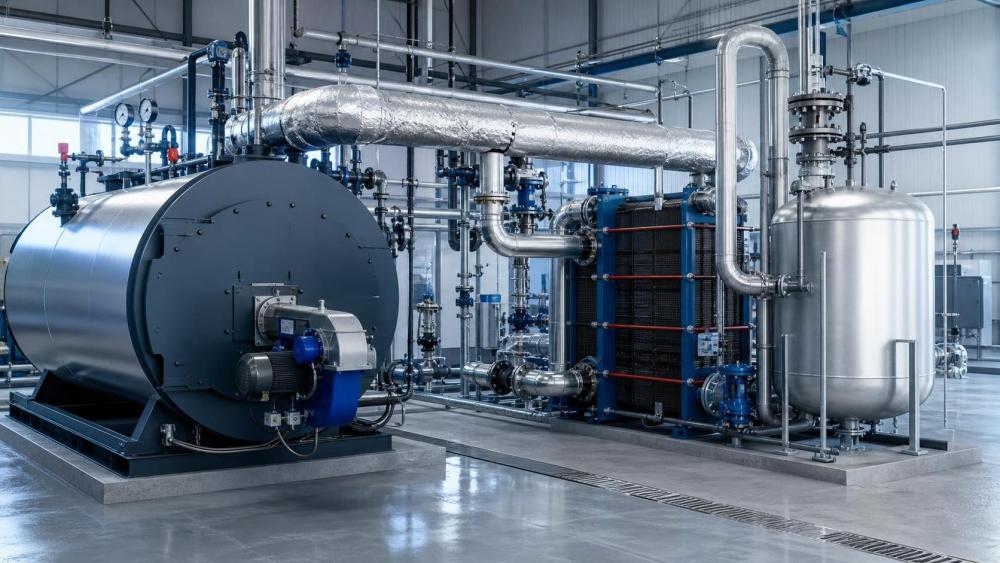
That is one reason experienced evaluators rarely size boilers in isolation. They review the whole chain: generation pressure, expected pressure at the user, control valve authority, line losses, condensate removal, and return temperature.
The minimum data set worth collecting before any decision
If project information is incomplete, it is usually better to pause and structure the inputs than to force an early equipment shortlist. For most industrial steam systems low pressure studies, these parameters are the minimum starting point:
Without these basics, system sizing becomes a guess disguised as engineering.
Boiler capacity should follow the load shape, not just the total load
Once demand is mapped, the next question is whether one boiler, multiple boilers, or a hybrid arrangement best matches the load. In stable heat applications, a flatter demand curve often supports high-efficiency continuous operation. Even then, evaluators should still test part-load behavior. Many plants spend far more time below design load than at full load.
An oversized unit may reach setpoint quickly and then short-cycle. That creates thermal stress, lower combustion efficiency, and unstable header pressure. A modular arrangement can sometimes control better, especially where batch users come in and out. But modular systems also add controls complexity, sequencing logic, and maintenance interfaces. There is no universal rule; the right answer depends on how often the plant operates near base load, how quickly demand ramps, and how critical pressure stability is at the user end.
For low-pressure service, turn-down capability deserves more attention than it often gets. If a boiler cannot run cleanly and stably across the operating range, the system will compensate with cycling, venting, or pressure hunting elsewhere.
Distribution losses are often the hidden cause of bad sizing decisions
A plant may conclude that it needs more steam generation when the actual problem is that the steam is not arriving in usable condition. Long lines, poor insulation, inadequate drip legs, failed traps, and oversized control valves can all distort apparent demand. In low-pressure networks, wet steam and condensate accumulation are especially damaging because they reduce available heat transfer surface and trigger local pressure instability.
This is where technical evaluation needs field reality. A calculated load may be accurate, but if the distribution network was not designed for the same operating philosophy, the installed system will behave differently. Many steam upgrades underperform not because the boiler is wrong, but because the header and return system were treated as secondary.
If there is one practical warning worth repeating, it is this: do not use boiler oversizing to mask piping deficiencies. It raises cost and fuel use without fixing unstable delivery.
Condensate recovery is part of sizing, not a downstream add-on
Stable heat demand depends on stable heat release at the user, and that means condensate must leave heat exchangers predictably. Poor condensate removal reduces effective temperature difference, causes waterlogging, and can make operators request more steam pressure than the process really needs.
From a system perspective, condensate return also affects feedwater temperature, deaeration strategy, blowdown economics, and net fuel consumption. High return rates often improve efficiency, but only if the return quality is acceptable and flash steam is managed correctly. In some plants, contamination risk or backpressure constraints limit how much condensate can realistically be recovered. That should be established early, not assumed.
Evaluators looking at low-pressure systems for food, pharma, or precision thermal processes should be especially careful here. The heat source may be low pressure, but the cleanliness, control, and condensate management requirements are often not low complexity.
Leave room for flexibility, but be precise about where you leave it
Future-proofing is sensible. Oversizing everything is not. The better method is selective flexibility: reserve physical space for an additional module, choose headers that can accommodate later branches, verify control architecture can accept expansion, and confirm utility interfaces will not become bottlenecks.
If process growth is probable but unconfirmed, that uncertainty should be documented as a design assumption. Technical evaluation works best when unknowns are visible. GTC-Matrix regularly frames industrial thermal decisions this way through its Strategic Intelligence Center: not by pretending the future is certain, but by connecting technology evolution, energy cost shifts, and sector-specific demand patterns to the practical choices engineers make today.
What a solid sizing review should answer before specification
Before moving toward vendor comparison or internal approval, a competent sizing review should be able to answer a few uncomfortable questions clearly:
- What is the verified continuous steam load, and what part of the peak is truly coincident?
- How much pressure can be lost between boiler outlet and the most sensitive user?
- What happens during startup, cleaning cycles, or simultaneous valve opening?
- Is the apparent need for extra capacity actually a condensate or control problem?
- Can the system operate efficiently during the many hours it is not at design load?
If those answers are weak, the specification is probably premature.
Sizing low-pressure steam is ultimately an exercise in balance: enough capacity to carry real process demand, enough control to avoid hunting, enough distribution quality to preserve steam condition, and enough recovery discipline to keep the thermal loop efficient. Get that balance right, and stable heat demand becomes much easier to maintain. Get it wrong, and the plant will spend years compensating for a system that looked adequate only in a spreadsheet.
For teams still narrowing options, the next sensible step is not a rushed equipment shortlist. It is a structured review of load profile, pressure tolerance, condensate strategy, and likely expansion path, ideally checked against current boiler and heat exchange technology trends rather than old rules of thumb.
Related News
- How to Size Low-Pressure Industrial Steam Systems for Stable Heat DemandAuthor :Thermal Energy Strategist

- Low Emissions Boilers: What to Compare Before You ChooseAuthor :Thermal Energy Strategist

- Low-NOx Boilers Cost Breakdown: Upfront Price, Fuel Savings, and PaybackAuthor :Thermal Energy Strategist

- Boiler Combustion Systems: Common Causes of Unstable Fuel PerformanceAuthor :Thermal Energy Strategist

- Hot Water Industrial Boilers: When Efficiency Gains Justify ReplacementAuthor :Thermal Energy Strategist

- What Boiler Efficiency Really Means in Daily Operation and Energy BillsAuthor :Thermal Energy Strategist

- Boiler Efficiency Testing Methods That Expose Heat Loss and Fuel WasteAuthor :Thermal Energy Strategist

- Industrial Burner Systems: Key Factors for Safe Heat OutputAuthor :Thermal Energy Strategist

- Gas-Fired Boiler Combustion Technology: Key Efficiency and Emissions Trade-OffsAuthor :Thermal Energy Strategist

- Unfired Heat Recovery Steam Generators: When Do They Pay Off?Author :Thermal Energy Strategist

- How to Evaluate Steam Generation Systems Electric for Process Heat ProjectsAuthor :Thermal Energy Strategist

- Thermal Power Systems for Industrial Heating: Common Sizing Mistakes to AvoidAuthor :Thermal Energy Strategist

- Low-NOx Condensing Boilers: How to Compare Efficiency and EmissionsAuthor :Thermal Energy Strategist
![]()
- Low Emissions Boilers for Food Processing: Key Compliance and Fuel Cost FactorsAuthor :Thermal Energy Strategist

- Steam System Efficiency Calculation: Key Inputs That Change the ResultAuthor :Thermal Energy Strategist

- How to Evaluate a Steam Boiler Components Exporter Before OrderingAuthor :Thermal Energy Strategist

- Burner Systems Troubleshooting: Common Efficiency Loss CausesAuthor :Thermal Energy Strategist

- EU PED Q2 Rules Require Digital Compliance TagsAuthor :Thermal Energy Strategist

- Thermal Power Systems: Key Efficiency Risks in Daily OperationAuthor :Thermal Energy Strategist

- Low-NOx Combustion Boilers: Key Efficiency and Compliance ChecksAuthor :Thermal Energy Strategist

- Low-NOx Combustion Boilers: Key Specs That Affect Emissions and Fuel UseAuthor :Thermal Energy Strategist

- Low-NOx Combustion Boilers: Key Compliance RisksAuthor :Thermal Energy Strategist

- Thermodynamics Analysis for Boiler Heat-Loss ReductionAuthor :Thermal Energy Strategist

- Industrial Thermal Systems: Common Operating RisksAuthor :Thermal Energy Strategist

- Low-NOx Combustion Boilers: Key Spec Checks Before PurchaseAuthor :Thermal Energy Strategist

- How Industrial Heat Recovery Cuts Boiler Fuel Costs in 2026Author :Thermal Energy Strategist

- Thermodynamics Analysis: 5 Heat Loss Clues in Steam BoilersAuthor :Thermal Energy Strategist

- Low-NOx Combustion Boilers: What Affects Real Emissions PerformanceAuthor :Thermal Energy Strategist

- Thermodynamics Analysis: Finding Heat Loss in Steam BoilersAuthor :Thermal Energy Strategist

- 2026 Steam Boiler Upgrades for Lower NOx and Fuel CostsAuthor :Thermal Energy Strategist

- EU to Expand CBAM to Steam Boilers; Exporters Must Prepare Carbon DataAuthor :Thermal Energy Strategist

- Industrial Heat Recovery: When Payback Beats New Boiler CapacityAuthor :Thermal Energy Strategist

- Carbon Neutrality Targets and the New Boiler Retrofit PaybackAuthor :Thermal Energy Strategist

- Low-NOx Combustion Boilers: Fuel Savings vs Emission LimitsAuthor :Thermal Energy Strategist

- Industrial Energy Efficiency Benchmarks for Steam Boiler Upgrades in 2026Author :Thermal Energy Strategist

- Low-NOx Combustion Boilers: Efficiency vs Emissions in 2026Author :Thermal Energy Strategist