Pure Power Sources and Vacuum System Stability




In vacuum-critical operations, system stability depends not only on equipment design but also on pure power sources that reduce contamination risk and performance fluctuation. For quality control and safety management teams, understanding this connection is essential to maintaining process integrity, regulatory compliance, and reliable production in industries where precision cannot be compromised.
Across pharmaceutical filling lines, semiconductor fabrication, analytical laboratories, and food packaging systems, vacuum performance is often judged by pressure setpoints alone. In practice, however, vacuum stability is also shaped by the cleanliness, dryness, and consistency of the upstream energy and media feeding the process.
That is why pure power sources have become a practical decision factor rather than a technical preference. For quality control managers and safety leaders, they directly affect contamination control, alarm frequency, preventive maintenance intervals, and audit readiness across 24/7 production environments.
Within the industrial intelligence landscape followed by GTC-Matrix, this topic sits at the intersection of compression technology, thermodynamic efficiency, and risk-managed operations. The value is clear: when power quality and media purity improve together, vacuum systems tend to deliver lower variability, fewer excursions, and stronger compliance outcomes.
Why Pure Power Sources Matter in Vacuum-Critical Production
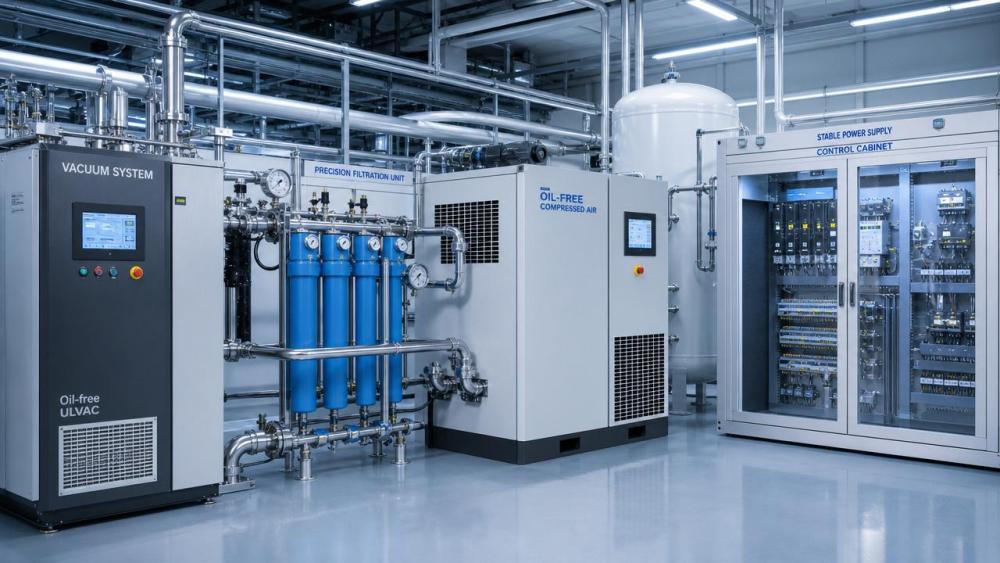
In industrial settings, the term pure power sources usually covers more than electricity. It includes clean compressed air, oil-free drive media, dry utility streams, stable voltage supply, and contamination-controlled interfaces that support vacuum pumps, valves, actuators, and measurement devices.
A vacuum system may operate at 10 mbar, 1 mbar, or below, but a small variation in input conditions can still create measurable instability. Pressure drift, pump overheating, seal wear, and sensor deviation often begin upstream, long before the vacuum chamber shows an obvious failure.
The hidden link between purity and stability
When compressed air contains oil aerosol, water vapor, or particles above the application limit, these contaminants can migrate into actuated valves, vacuum ejectors, and instrument loops. Even a particle size range of 0.01–1 micron can influence precision components over repeated duty cycles.
Similarly, unstable electrical supply can cause variable motor speed, delayed starts, and control noise in vacuum pump systems. A voltage fluctuation of just 5%–10% may not shut equipment down, but it can increase temperature rise, reduce repeatability, and shorten service life.
What quality teams usually observe first
- More frequent deviations during validation or batch release checks
- Inconsistent vacuum pull-down times, such as 12 seconds on one cycle and 18 seconds on the next
- Unexpected residue, moisture, or odor near process contact zones
- Higher alarm counts from pressure switches, temperature probes, or leak detection routines
For safety managers, these signals also point to wider operational risks. Unstable vacuum can compromise containment, increase exposure during transfer steps, or weaken the reliability of interlocks in enclosed process systems. In regulated production, that creates both product risk and procedural risk.
Common contamination pathways in mixed utility systems
Many facilities still treat utilities as separate assets rather than as an interconnected performance chain. Yet vacuum pumps, heat exchangers, compressed air dryers, filters, and process controls often influence one another across 3 to 5 shared interfaces.
The table below shows how common utility conditions affect vacuum system stability and what quality or safety teams should monitor during routine inspections.
The pattern is consistent: vacuum instability often begins with utility inconsistency. A cleaner, more stable source reduces failure propagation, especially in plants where one compressor room or one electrical feeder supports multiple critical lines.
How to Evaluate Pure Power Sources for Quality and Safety Performance
For procurement, engineering, and compliance teams, choosing pure power sources should not be reduced to a single equipment specification. A sound evaluation should cover four dimensions: purity level, supply stability, compatibility with process risk, and maintainability over a 12–36 month operating horizon.
Key selection criteria
First, define the cleanliness threshold required by the process. Semiconductor and pharmaceutical environments may require stricter oil-free and particle-control conditions than general packaging or utility applications. The target should be tied to the process, not just to the compressor brochure.
Second, review stability under load swings. If a facility runs 2 shifts on weekdays and full 24-hour operation during peak demand, the utility source must maintain reliable output across variable duty. Intermittent purity is not enough for critical vacuum performance.
Third, evaluate monitoring capability. Systems with logged dew point, pressure trend, temperature rise, and alarm history are easier to validate and defend during audits. For many quality teams, data visibility is as important as the equipment itself.
A practical 5-point review list
- Confirm acceptable oil, water, and particle thresholds for the application.
- Check pressure and voltage stability across peak and low-load conditions.
- Verify filter, dryer, and separation stages match the contamination risk level.
- Review maintenance access, spare part cycle, and downtime exposure.
- Ensure trend data can be captured at least weekly, and preferably continuously.
The next table compares common utility approaches used to support vacuum operations. It can help decision-makers align technical design with risk class, maintenance expectations, and compliance needs.
For most quality and safety teams, the strongest option is not automatically the most complex one. The right solution is the one that matches contamination sensitivity, uptime target, and maintenance capability without creating unnecessary operational burden.
Implementation Steps That Reduce Compliance and Production Risk
Once the need for pure power sources is established, implementation should follow a controlled sequence. Facilities that move too quickly into equipment replacement without mapping interfaces often solve one problem while creating two more in validation, training, or maintenance planning.
Step 1: Map critical vacuum points
Identify where vacuum failure can affect product quality, operator safety, or regulatory documentation. In many plants, 20% of vacuum nodes create 80% of the practical risk. These points usually include filling chambers, transport grippers, sealed reactors, and test stations.
Step 2: Audit upstream utilities
Run a 2–4 week baseline review of pressure stability, dew point, motor current, filter differential pressure, alarm count, and maintenance history. This period is often enough to reveal whether vacuum instability is episodic or structurally tied to the utility backbone.
Step 3: Define acceptance criteria
Create measurable limits before upgrades begin. Examples include allowable vacuum pull-down variation, maximum moisture exposure, acceptable restart time, and monthly alarm thresholds. A target such as less than 3% cycle variation is easier to validate than a vague goal of improved performance.
Step 4: Align maintenance and quality documentation
Update PM schedules, SOPs, calibration routines, and deviation workflows. If pure power sources are introduced but documentation remains unchanged, audit teams may still view the system as weakly controlled. Operational reliability and documentation reliability must improve together.
Common implementation mistakes
- Replacing pumps without checking air treatment or electrical conditioning
- Adding filters but not tracking pressure drop after 30, 60, and 90 days
- Assuming one utility standard fits all lines, despite different product risks
- Ignoring operator training on alarm interpretation and early warning signs
A disciplined rollout can reduce unplanned interventions and improve batch consistency, but only when engineering, quality, and safety work from the same risk map. This is where market intelligence and system-level insight become especially valuable for cross-functional teams.
Maintenance, Monitoring, and Long-Term Procurement Value
The long-term value of pure power sources is often realized after commissioning, not at installation. Cleaner utility inputs usually extend filter life predictability, lower contamination events, and reduce emergency troubleshooting hours, particularly in facilities with high audit pressure and narrow production windows.
What should be monitored routinely
At minimum, teams should monitor 6 indicators: vacuum level stability, pull-down time, compressed air dew point, oil carryover risk, motor temperature trend, and alarm frequency. In more demanding sectors, particle control and energy consumption per cycle should also be trended monthly.
A practical inspection cadence may include operator checks every shift, engineering review every week, and quality trending every month. This staggered model helps detect both immediate abnormalities and slow degradation patterns that a single inspection layer may miss.
How procurement should frame the business case
The purchase decision should be based on total operational effect, not only on capital cost. A lower-priced utility setup may lead to more filter changes, more line stoppages, and more deviation investigations over 12 months. For quality and safety teams, those hidden costs can outweigh the initial savings.
Decision-makers should compare at least 4 factors: contamination risk, stability under load, maintenance labor, and data visibility. When these factors are reviewed together, pure power sources become easier to justify as a risk-reduction investment rather than a premium add-on.
Where GTC-Matrix adds practical value
For teams managing industrial cooling, compressed air, vacuum processes, and heat exchange technologies, GTC-Matrix provides a decision-oriented view of how utility purity, energy efficiency, and equipment evolution interact. This is especially useful when selecting between oil-free compression pathways, thermal optimization strategies, and risk-sensitive vacuum support systems.
Because industrial performance is increasingly shaped by decarbonization targets, refrigerant policy changes, and high-precision manufacturing demand, quality and safety professionals need more than product brochures. They need structured intelligence that links thermodynamic behavior to operational control.
Pure power sources are not an abstract engineering concept. They are a measurable control factor for vacuum system stability, contamination prevention, audit readiness, and safer production in precision-driven industries. For quality control and safety management teams, the most effective strategy is to evaluate vacuum performance as part of a wider utility ecosystem, then match purity, stability, and monitoring capability to real process risk.
If your facility is reviewing vacuum reliability, compressed air cleanliness, or system-wide utility performance, now is the right time to turn technical data into a clearer operating decision. Contact GTC-Matrix to get tailored insights, discuss application-specific risk points, and explore more solutions for stable, efficient, and compliance-ready industrial systems.
Ready when you are. Send us a message to get started.
Related News
- How does base pressure affect film purity in vacuum deposition?Author :Vacuum Process Fellow

- How to size vacuum process equipment for the required pump-down timeAuthor :Vacuum Process Fellow

- Which vacuum specification best protects semiconductor process yield?Author :Vacuum Process Fellow

- How Can Contamination Be Prevented in a Semiconductor Vacuum Chamber?Author :Vacuum Process Fellow

- Which Vacuum Pump Specifications Matter Most for Semiconductor Processes?Author :Vacuum Process Fellow

- How to find leaks in vacuum pump systems before pump performance dropsAuthor :Vacuum Process Fellow

- How to size a Roots blower for vacuum process equipmentAuthor :Vacuum Process Fellow

- How vacuum level affects vacuum process efficiencyAuthor :Vacuum Process Fellow

- China Imposes Temporary Helium Export BanAuthor :Vacuum Process Fellow

- Semiconductor Vacuum Systems Factory Checklist for Process Stability and Cleanroom UseAuthor :Vacuum Process Fellow

- Vacuum Process Optimization Services: Signs Your Line Needs a Performance ReviewAuthor :Vacuum Process Fellow

- Vacuum Chambers for Cleanroom Use: Key Design Points That Prevent ContaminationAuthor :Vacuum Process Fellow

- Vacuum Distillation Systems: Key Performance Metrics That Affect Product PurityAuthor :Vacuum Process Fellow

- Vietnam Halts High Vacuum Pump Import Licenses for 30 DaysAuthor :Vacuum Process Fellow

- Vacuum Technology Database: What to Check Before Using Technical DataAuthor :Vacuum Process Fellow

- Dry Pump Vacuum System Design Mistakes That Raise DowntimeAuthor :Vacuum Process Fellow

- When Vacuum Systems Lose Performance: Common Causes and FixesAuthor :Vacuum Process Fellow
![]()
- EU Tightens EN 13445-3 Weld Testing for Vacuum VesselsAuthor :Vacuum Process Fellow
![]()
- EPA Cuts R-1234ze(E) Quota 35%, Tightening Vacuum Cooling SupplyAuthor :Vacuum Process Fellow
 Quota 35%, Tightening Vacuum Cooling Supply")
- ICA Warns of Tight Copper Alloy Supply for Vacuum PumpsAuthor :Vacuum Process Fellow

- Vacuum System Leak Detection: Signs, Tests, and FixesAuthor :Vacuum Process Fellow

- How to Compare Vacuum Systems Factory Capabilities for Stable Process UptimeAuthor :Vacuum Process Fellow

- Vacuum Pump Lead Times Extend to 26 WeeksAuthor :Vacuum Process Fellow

- Semiconductor Vacuum Systems Explained for Stable Process YieldAuthor :Vacuum Process Fellow

- Vacuum Process Efficiency: 7 Hidden Causes of Energy LossAuthor :Vacuum Process Fellow

- Vacuum Technology Solutions for Stable Low-Pressure ProductionAuthor :Vacuum Process Fellow

- Vacuum Processes: Common Efficiency Losses and FixesAuthor :Vacuum Process Fellow

- Common Vacuum Processes Problems and How to Prevent DowntimeAuthor :Vacuum Process Fellow

- Tantalum Spike Extends Vacuum Crucible Lead TimesAuthor :Vacuum Process Fellow

- Vacuum Process Efficiency: 5 Hidden Losses to Check FirstAuthor :Vacuum Process Fellow

- How Heat Transfer Design Impacts Vacuum Process EfficiencyAuthor :Vacuum Process Fellow

- EN 13445-4:2026 Takes Effect for High-Vacuum ComponentsAuthor :Vacuum Process Fellow

- EU Vacuum Components Face New EN 13445-4:2026 Leak Test RuleAuthor :Vacuum Process Fellow

- UBS: Fed Cut View May Ease Vacuum Pump Lead TimesAuthor :Vacuum Process Fellow

- Vacuum Processes: Common Causes of Unstable PerformanceAuthor :Vacuum Process Fellow
![]()
- SiC Certification Signals New Entry Path for Vacuum and Compressor DrivesAuthor :Vacuum Process Fellow
![]()