Dry Pump Vacuum System Design Mistakes That Raise Downtime




Where dry pump downtime usually starts
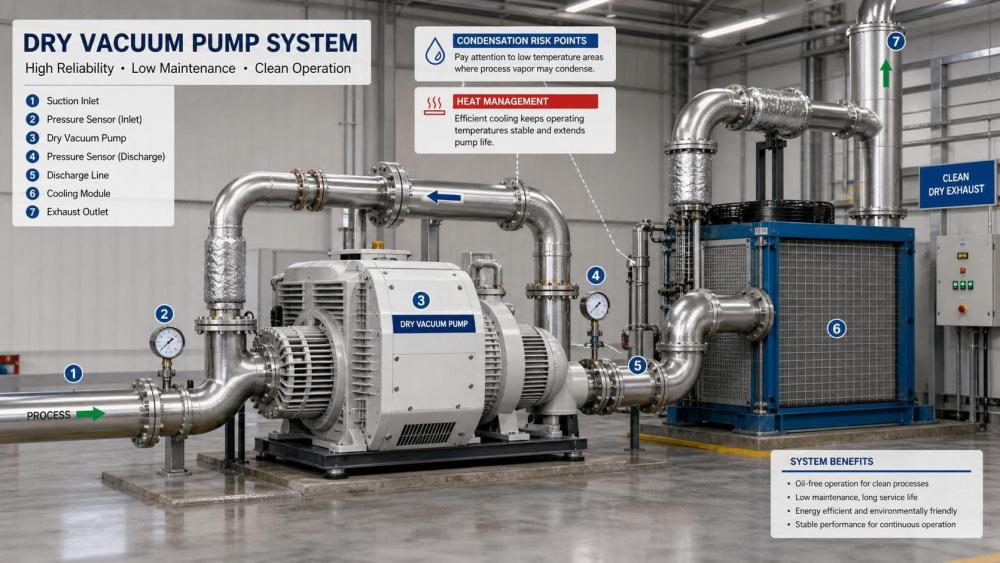
Dry pump failures rarely begin with the pump alone. They usually begin with a vacuum layout that looks acceptable on paper but behaves poorly in production.
That is why vacuum system design dry pump decisions deserve more than nameplate matching. Real operating conditions shift with product mix, maintenance habits, utility stability, and thermal load.
In broad industrial use, the same dry pump can perform well in one line and struggle in another. The difference often comes from piping resistance, gas composition, duty cycle, and control logic.
Across the sectors tracked by GTC-Matrix, a repeating pattern appears. Uptime improves when vacuum design is treated as part of the full thermal and compression system, not as an isolated machine purchase.
A poor vacuum system design dry pump layout can create unstable pressure bands, condensate accumulation, overheating, and frequent intervention. Those issues raise downtime even when the pump itself is high quality.
The same pump behaves differently across process settings
Different applications ask different things from a dry vacuum system. A packaging line, a coating process, and a chemical transfer step may all require vacuum, but not in the same way.
Some lines need fast pull-down and frequent cycling. Others need a stable base pressure over long runs. Some tolerate minor pressure fluctuation, while others lose yield immediately.
This is where many vacuum system design dry pump mistakes begin. Teams assume similar pressure targets mean similar design requirements, then overlook vapor load, particulate risk, or thermal sensitivity.
In practical terms, application differences shape everything: pipe diameter, trap design, purge arrangement, cooling strategy, and even where sensors should be installed.
Batch processes and intermittent duty
Batch environments often stress response speed more than steady-state efficiency. The system must recover quickly after chamber opening, recipe change, or material loading.
A common mistake is selecting a dry pump only by ultimate pressure. In batch service, pull-down time and conductance losses may matter more than the lowest achievable vacuum level.
Another issue is oversized equipment with poor control tuning. That can cause excessive cycling, unstable temperature, and wasted energy during short production intervals.
Continuous processes with long operating windows
Continuous lines usually expose thermal weaknesses faster. A dry pump running near its limit for hours will reveal insufficient cooling, restricted exhaust routing, or inadequate purge management.
Here, vacuum system design dry pump reliability depends on heat balance as much as pumping speed. Small thermal penalties can turn into varnish, deposit buildup, and shortened maintenance intervals.
Sizing errors are often hidden behind acceptable startup results
Many systems pass commissioning but fail later because sizing was based on nominal conditions. Startup tests are often cleaner, cooler, and less variable than actual production.
In vacuum system design dry pump projects, the real load includes leakage, vapor release, backstream resistance, future throughput changes, and upset conditions. Ignoring those margins invites downtime.
Undersized pumps show obvious symptoms: slow pump-down, unstable pressure, and high operating temperature. Oversized pumps are not harmless either. They can trigger poor control behavior and unnecessary energy use.
A more reliable sizing approach starts with the process profile. Map pressure range, gas composition, temperature swings, and peak events before choosing pump capacity.
This kind of comparison matters because vacuum system design dry pump performance is rarely defined by one number. It is defined by how the system behaves across changing states.
Piping and layout mistakes create avoidable instability
In many facilities, layout decisions are treated as secondary. Yet poor routing can erase the expected benefit of an otherwise strong dry pump selection.
Long pipe runs, unnecessary elbows, undersized manifolds, and low-point condensate traps all reduce effective pumping performance. The pressure measured at the pump may not reflect the process reality.
This becomes more serious when multiple tools share one header. A line that appears balanced during one shift may become unstable when parallel demand rises.
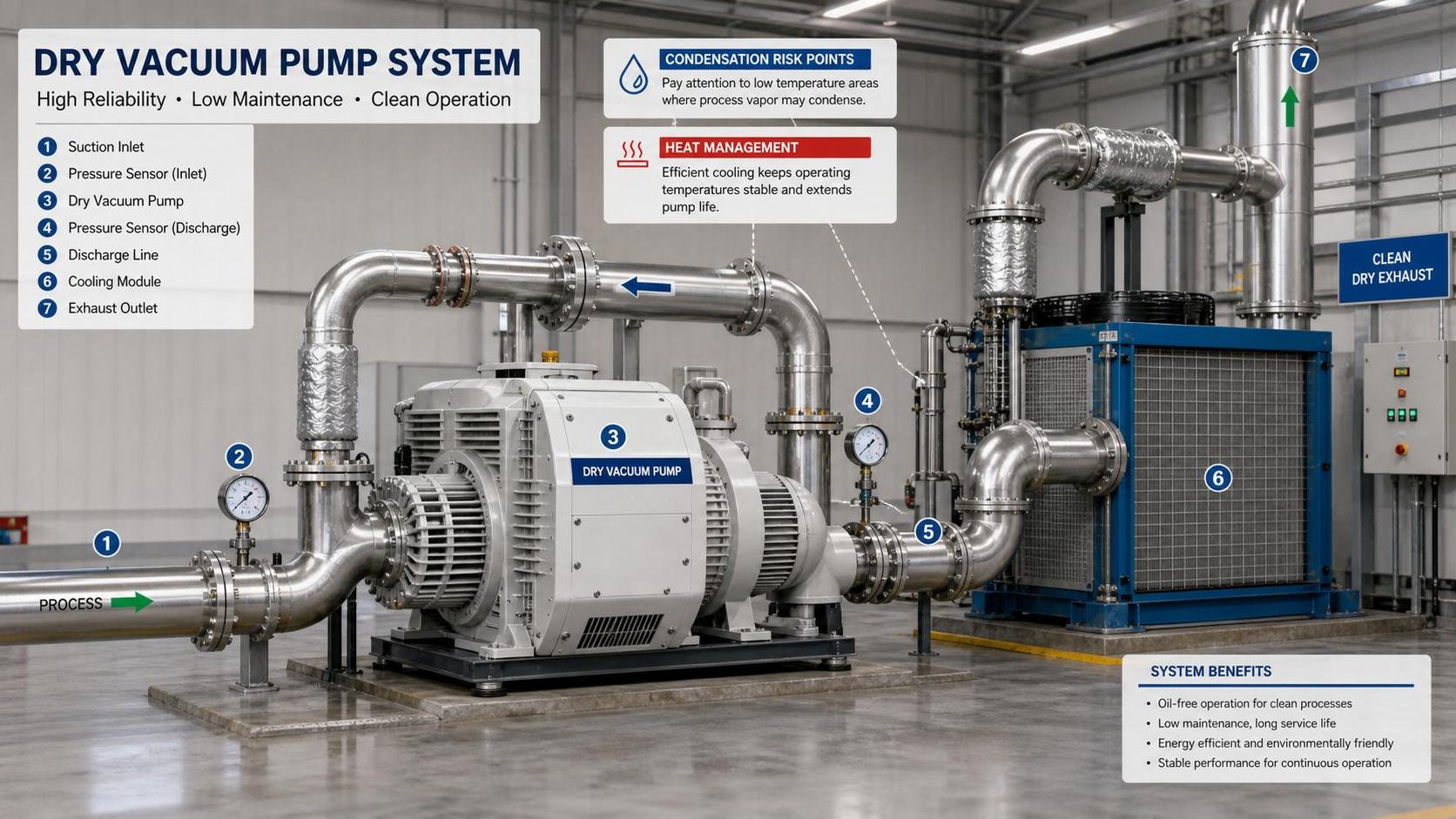
A recurring vacuum system design dry pump error is placing sensors only near the package skid. For control and diagnosis, process-side pressure readings are often more valuable.
- Keep suction paths short where rapid response matters.
- Separate wet and dry streams when process variability is high.
- Check exhaust routing for hidden backpressure during peak operation.
- Place drains, traps, and isolation points where maintenance can be performed without disrupting the full line.
Thermal management is where many dry pump designs quietly fail
Dry pumps are often chosen to avoid oil contamination, but that does not remove thermal complexity. It changes where the risk appears.
Compression heat, ambient temperature, vapor condensation windows, and utility fluctuations can all affect uptime. This is especially true in facilities where cooling and compressed air systems already operate near design limits.
The broader industrial view from GTC-Matrix shows why this matters. Vacuum reliability increasingly depends on the same energy and heat management discipline shaping compressors, chillers, and heat exchangers.
In practical terms, a vacuum system design dry pump package should be checked against room heat load, cooling medium quality, and expected summer operating conditions, not just normal-day assumptions.
An overlooked point is transient temperature behavior. Shutdown, standby, and restart can be more damaging than stable operation if vapor condenses inside the pump during cool-down.
Where the thermal risk is highest
Processes with solvent traces, water vapor, reactive gases, or hot off-gas deserve closer review. These conditions alter the safe operating envelope and maintenance strategy.
Ignoring thermal interactions can turn a good vacuum system design dry pump concept into an unstable asset with frequent service interruptions.
Controls and monitoring need to match the real production rhythm
Another common mistake is using simple control logic for a process that is not simple. Dry vacuum systems often face changing loads, recipe shifts, and maintenance windows that require adaptive control.
A fixed setpoint may work in one operating band but create oscillation in another. Delayed valve response, poor interlock sequencing, or missing alarm hierarchy can drive nuisance trips.
In shared systems, controls should distinguish between genuine pump distress and normal line variation. Otherwise operators end up compensating manually, which hides design defects instead of correcting them.
Useful monitoring usually includes suction pressure trends, motor load, casing temperature, purge status, and maintenance indicators tied to operating context rather than fixed calendar intervals.
What gets misjudged when teams compare similar applications
Two processes may appear comparable because both require clean vacuum. Yet one may release condensable vapor while the other mainly handles dry gas.
That difference changes material selection, purge demand, and service interval expectations. It also changes whether a centralized or point-of-use arrangement makes more sense.
Another frequent misjudgment is focusing only on purchase price. In vacuum system design dry pump planning, downtime exposure, cleaning frequency, spare strategy, and utility cost often outweigh the initial equipment delta.
The more useful comparison is total operating fit. That includes maintenance access, tolerance for contamination, energy profile, and how the system behaves during non-ideal conditions.
A practical way to improve vacuum system design dry pump decisions
Before making layout changes or specifying a new package, build a short decision sheet around the real application. This helps expose hidden mismatch early.
- Define the actual pressure window, not only the target endpoint.
- Record gas composition, vapor fraction, solids risk, and upset events.
- Map piping length, valve losses, low points, and header sharing.
- Check cooling, exhaust, and ambient conditions across seasonal peaks.
- Review control response during startup, standby, and restart.
- Estimate downtime cost alongside capital and energy cost.
That approach supports better vacuum system design dry pump choices because it reflects operating reality. It also aligns with a broader industrial trend toward data-led reliability decisions.
The strongest next step is not a generic equipment comparison. It is a structured review of site conditions, load variation, and maintenance constraints before the next downtime event defines the design for you.
Ready when you are. Send us a message to get started.
Related News
- How does base pressure affect film purity in vacuum deposition?Author :Vacuum Process Fellow

- How to size vacuum process equipment for the required pump-down timeAuthor :Vacuum Process Fellow

- Which vacuum specification best protects semiconductor process yield?Author :Vacuum Process Fellow

- How Can Contamination Be Prevented in a Semiconductor Vacuum Chamber?Author :Vacuum Process Fellow

- Which Vacuum Pump Specifications Matter Most for Semiconductor Processes?Author :Vacuum Process Fellow

- How to find leaks in vacuum pump systems before pump performance dropsAuthor :Vacuum Process Fellow

- How to size a Roots blower for vacuum process equipmentAuthor :Vacuum Process Fellow

- How vacuum level affects vacuum process efficiencyAuthor :Vacuum Process Fellow

- China Imposes Temporary Helium Export BanAuthor :Vacuum Process Fellow

- Semiconductor Vacuum Systems Factory Checklist for Process Stability and Cleanroom UseAuthor :Vacuum Process Fellow

- Vacuum Process Optimization Services: Signs Your Line Needs a Performance ReviewAuthor :Vacuum Process Fellow

- Vacuum Chambers for Cleanroom Use: Key Design Points That Prevent ContaminationAuthor :Vacuum Process Fellow

- Vacuum Distillation Systems: Key Performance Metrics That Affect Product PurityAuthor :Vacuum Process Fellow

- Vietnam Halts High Vacuum Pump Import Licenses for 30 DaysAuthor :Vacuum Process Fellow

- Vacuum Technology Database: What to Check Before Using Technical DataAuthor :Vacuum Process Fellow

- Dry Pump Vacuum System Design Mistakes That Raise DowntimeAuthor :Vacuum Process Fellow

- When Vacuum Systems Lose Performance: Common Causes and FixesAuthor :Vacuum Process Fellow
![]()
- EU Tightens EN 13445-3 Weld Testing for Vacuum VesselsAuthor :Vacuum Process Fellow
![]()
- EPA Cuts R-1234ze(E) Quota 35%, Tightening Vacuum Cooling SupplyAuthor :Vacuum Process Fellow
 Quota 35%, Tightening Vacuum Cooling Supply")
- ICA Warns of Tight Copper Alloy Supply for Vacuum PumpsAuthor :Vacuum Process Fellow

- Vacuum System Leak Detection: Signs, Tests, and FixesAuthor :Vacuum Process Fellow

- How to Compare Vacuum Systems Factory Capabilities for Stable Process UptimeAuthor :Vacuum Process Fellow

- Vacuum Pump Lead Times Extend to 26 WeeksAuthor :Vacuum Process Fellow

- Semiconductor Vacuum Systems Explained for Stable Process YieldAuthor :Vacuum Process Fellow

- Vacuum Process Efficiency: 7 Hidden Causes of Energy LossAuthor :Vacuum Process Fellow

- Vacuum Technology Solutions for Stable Low-Pressure ProductionAuthor :Vacuum Process Fellow

- Vacuum Processes: Common Efficiency Losses and FixesAuthor :Vacuum Process Fellow

- Common Vacuum Processes Problems and How to Prevent DowntimeAuthor :Vacuum Process Fellow

- Tantalum Spike Extends Vacuum Crucible Lead TimesAuthor :Vacuum Process Fellow

- Vacuum Process Efficiency: 5 Hidden Losses to Check FirstAuthor :Vacuum Process Fellow

- How Heat Transfer Design Impacts Vacuum Process EfficiencyAuthor :Vacuum Process Fellow

- EN 13445-4:2026 Takes Effect for High-Vacuum ComponentsAuthor :Vacuum Process Fellow

- EU Vacuum Components Face New EN 13445-4:2026 Leak Test RuleAuthor :Vacuum Process Fellow

- UBS: Fed Cut View May Ease Vacuum Pump Lead TimesAuthor :Vacuum Process Fellow

- Vacuum Processes: Common Causes of Unstable PerformanceAuthor :Vacuum Process Fellow
![]()
- SiC Certification Signals New Entry Path for Vacuum and Compressor DrivesAuthor :Vacuum Process Fellow
![]()