When Vacuum Systems Lose Performance: Common Causes and Fixes




When vacuum systems start slipping, the first task is not replacing parts

When vacuum systems lose performance, the effect is rarely limited to one pressure reading.
Cycle times drift, product quality becomes inconsistent, and energy use climbs before anyone notices a hard failure.
In practical operations, the real challenge is diagnosis speed.
A weak vacuum level may come from leakage, contamination, worn internals, unstable utilities, or a control sequence that no longer matches production reality.
That is why vacuum systems should be judged in context, not only by nameplate performance.
Across processing, packaging, electronics, medical production, and thermal applications, the same symptom can mean very different fixes.
Within the wider industrial view tracked by GTC-Matrix, vacuum processes sit close to compressed air, cooling, and heat exchange.
Performance loss often reflects that broader system relationship.
A pump may be healthy, while condenser fouling, cooling water instability, or upstream contamination is the real driver.
Different operating scenes create different failure patterns
Vacuum systems do not fail in one universal way because their duty is not universal.
Some lines need deep vacuum for product integrity.
Others need fast pump-down, stable holding pressure, or clean gas handling with minimal backstreaming.
In food packaging, a small leak may mostly reduce shelf-life margin.
In semiconductor or laboratory environments, the same leak can disturb process repeatability immediately.
In heavy industry, dust loading and vapor carryover are often more damaging than absolute pressure error.
A useful starting point is to separate vacuum systems by operating condition.
- Clean and dry service: control stability and seal integrity matter most.
- Wet or vapor-heavy service: condensate handling and temperature control become decisive.
- Dusty service: filtration, rotor wear, and clogged paths drive most performance loss.
- Intermittent cycling: controls, valves, and start-stop logic often fail before the pump core does.
This kind of sorting prevents a common mistake.
Teams often treat all vacuum systems as pump problems, even when the site condition has changed around them.
On packaging and handling lines, leaks usually hide in routine wear
On high-cycle lines, vacuum systems lose performance gradually.
Suction cups harden, fittings loosen, hoses age, and valve response slows.
Operators may only notice more dropped picks, slower evacuation, or inconsistent sealing results.
Here, the key judgment is not maximum vacuum alone.
More often, the issue is evacuation speed under repeated motion.
If the target pressure arrives too late, throughput suffers even when the pump can still reach specification during idle testing.
A practical fix starts with leak isolation by section.
Check end effectors, branch manifolds, quick couplings, and non-return valves before opening the pump.
On many lines, replacing low-cost sealing parts restores vacuum systems faster than major service work.
What deserves attention in frequent-cycle duty
- Compare loaded pump-down time against earlier baseline records.
- Inspect flexible hoses near moving axes for micro-cracks.
- Check valve timing against the machine sequence, not only static pressure.
- Review filter pressure drop if product dust is present.
In wet processes, contamination and temperature often explain the loss
Vacuum systems working with vapor, solvents, or moisture tell a different story.
Performance decline may appear as higher operating temperature, unstable ultimate pressure, oil discoloration, or frequent corrosion-related service.
In these applications, contamination is rarely accidental.
It is often built into the process load.
That changes the fix.
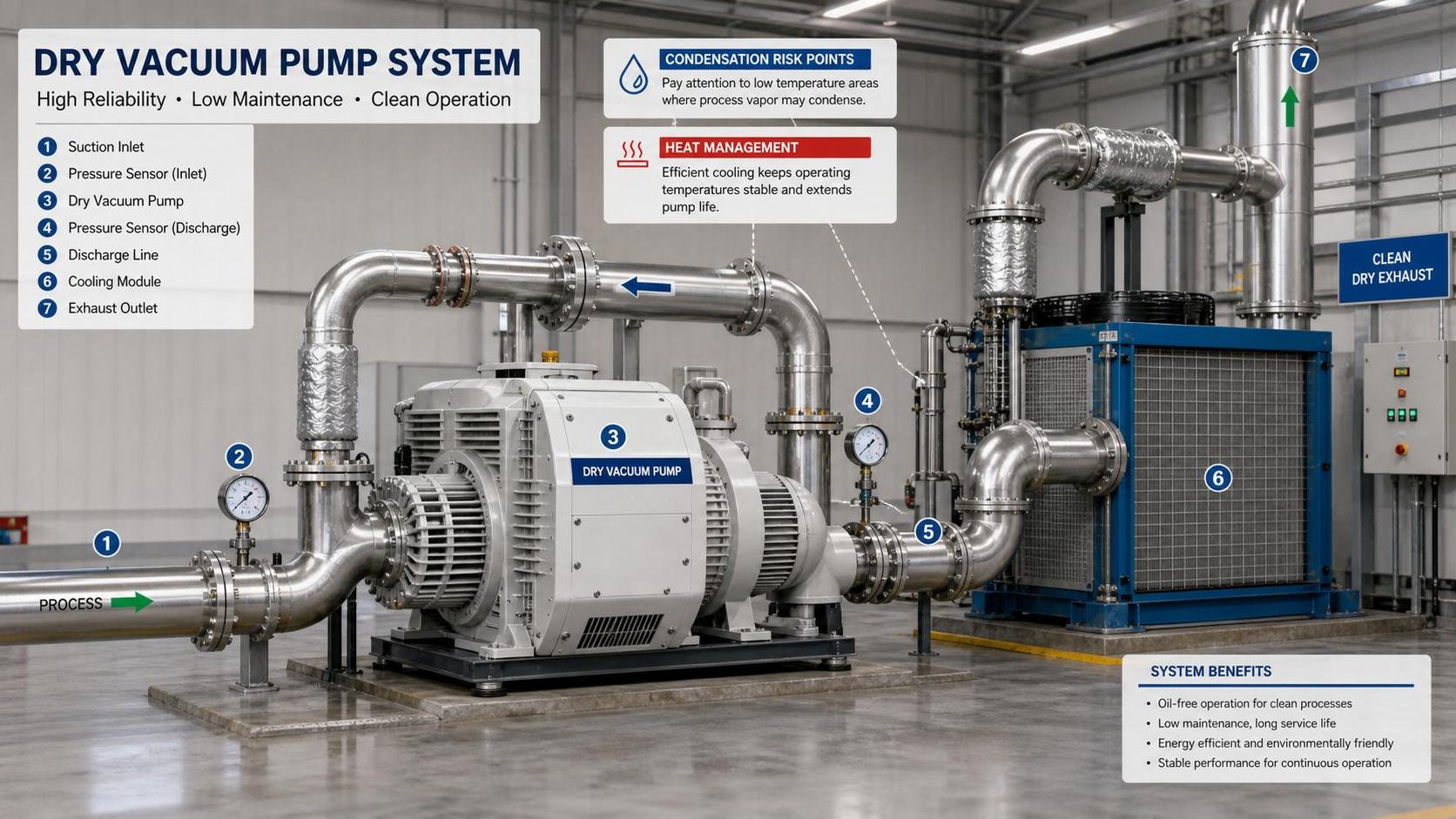
Instead of simply cleaning the pump, it is better to ask whether gas ballast settings, knock-out capacity, separator efficiency, or cooling conditions still match the duty.
In thermal operations, even moderate cooling drift can push more vapor into the pump than expected.
That is where the wider GTC-Matrix perspective becomes useful.
Vacuum systems often depend on stable thermal management as much as mechanical integrity.
If heat exchangers foul or cooling media vary seasonally, the vacuum side may underperform without any pump defect.
Clean-process applications punish small control errors
In electronics, medical, coating, and laboratory work, vacuum systems are judged less by brute capacity and more by repeatability.
A process can look mechanically normal while still drifting outside acceptable limits.
Typical causes include sensor offset, valve leakage, unstable variable-speed control, and poor coordination between roughing and holding stages.
These are easy to misread as pump wear.
A more reliable judgment method is trend comparison.
Look at pressure decay, pump-down profile, motor load, and temperature together.
If vacuum systems lose stability without matching mechanical noise or heat rise, the control layer deserves attention first.
This matters even more as sites push for energy optimization.
Aggressive energy-saving settings can unintentionally create hunting, delayed response, or poor low-load behavior.
The most common misjudgments happen between system boundaries
Many maintenance delays come from looking too narrowly.
Vacuum systems are often diagnosed as isolated assets, yet their performance depends on connected piping, separators, controls, utilities, and process changes.
Several misjudgments appear repeatedly in the field.
- Using no-load vacuum readings as proof that production performance is acceptable.
- Replacing pumps before checking leak growth in downstream tools.
- Ignoring cooling, ambient temperature, or seasonal humidity shifts.
- Comparing similar applications without checking contamination profile differences.
- Focusing on purchase cost while neglecting fluid, filter, and shutdown costs.
In real facilities, similar vacuum systems can age very differently because process discipline differs.
A line with better pre-filtration and stable thermal control may keep performance longer than a larger system with nominally stronger hardware.
A practical route to restore vacuum systems without wasted service work
The fastest recoveries usually follow a short sequence.
First, confirm whether the loss is vacuum level, evacuation speed, holding stability, or energy efficiency.
Those are related, but they point to different causes.
Next, compare current data against a known healthy baseline.
Then split the system into sections and test from the load side back toward the pump.
That approach reduces guesswork.
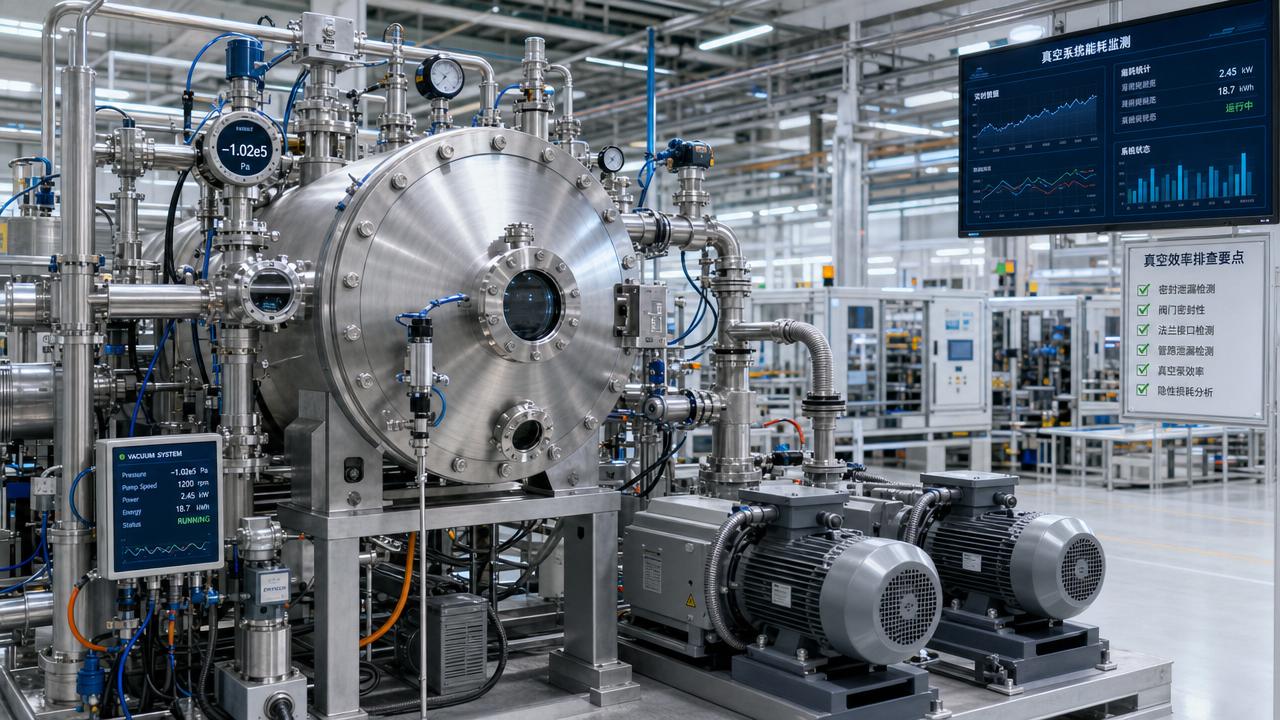
For most vacuum systems, the following checks offer the best return.
- Verify instruments before trusting the reading.
- Measure leak rate under real operating load.
- Inspect filters, separators, and drains for restriction or bypass.
- Review oil, seal, vane, rotor, or claw condition based on pump type.
- Check cooling and control parameters against current process conditions.
Where process demands are changing, it is also worth reviewing whether the original vacuum systems sizing still fits.
A line expanded for speed, cleanliness, or moisture load may now need different filtration, staged pumping, or revised control logic rather than another like-for-like repair.
What to review next before the same problem returns
Reliable vacuum systems depend on matching the fix to the operating scene.
Leak repair works in one setting, while contamination control, thermal stabilization, or control retuning matters more in another.
The strongest results usually come from treating vacuum performance as part of a wider energy and process system.
Before the next intervention, map the actual duty, the contamination profile, the thermal conditions, and the maintenance history together.
Then compare those findings with current throughput goals, quality limits, and utility stability.
That creates a clearer standard for judging vacuum systems, choosing corrective action, and preventing repeated loss from being treated as a single recurring fault.
Ready when you are. Send us a message to get started.
Related News
- How does base pressure affect film purity in vacuum deposition?Author :Vacuum Process Fellow

- How to size vacuum process equipment for the required pump-down timeAuthor :Vacuum Process Fellow

- Which vacuum specification best protects semiconductor process yield?Author :Vacuum Process Fellow

- How Can Contamination Be Prevented in a Semiconductor Vacuum Chamber?Author :Vacuum Process Fellow

- Which Vacuum Pump Specifications Matter Most for Semiconductor Processes?Author :Vacuum Process Fellow

- How to find leaks in vacuum pump systems before pump performance dropsAuthor :Vacuum Process Fellow

- How to size a Roots blower for vacuum process equipmentAuthor :Vacuum Process Fellow

- How vacuum level affects vacuum process efficiencyAuthor :Vacuum Process Fellow

- China Imposes Temporary Helium Export BanAuthor :Vacuum Process Fellow

- Semiconductor Vacuum Systems Factory Checklist for Process Stability and Cleanroom UseAuthor :Vacuum Process Fellow

- Vacuum Process Optimization Services: Signs Your Line Needs a Performance ReviewAuthor :Vacuum Process Fellow

- Vacuum Chambers for Cleanroom Use: Key Design Points That Prevent ContaminationAuthor :Vacuum Process Fellow

- Vacuum Distillation Systems: Key Performance Metrics That Affect Product PurityAuthor :Vacuum Process Fellow

- Vietnam Halts High Vacuum Pump Import Licenses for 30 DaysAuthor :Vacuum Process Fellow

- Vacuum Technology Database: What to Check Before Using Technical DataAuthor :Vacuum Process Fellow

- Dry Pump Vacuum System Design Mistakes That Raise DowntimeAuthor :Vacuum Process Fellow

- When Vacuum Systems Lose Performance: Common Causes and FixesAuthor :Vacuum Process Fellow
![]()
- EU Tightens EN 13445-3 Weld Testing for Vacuum VesselsAuthor :Vacuum Process Fellow
![]()
- EPA Cuts R-1234ze(E) Quota 35%, Tightening Vacuum Cooling SupplyAuthor :Vacuum Process Fellow
 Quota 35%, Tightening Vacuum Cooling Supply")
- ICA Warns of Tight Copper Alloy Supply for Vacuum PumpsAuthor :Vacuum Process Fellow

- Vacuum System Leak Detection: Signs, Tests, and FixesAuthor :Vacuum Process Fellow

- How to Compare Vacuum Systems Factory Capabilities for Stable Process UptimeAuthor :Vacuum Process Fellow

- Vacuum Pump Lead Times Extend to 26 WeeksAuthor :Vacuum Process Fellow

- Semiconductor Vacuum Systems Explained for Stable Process YieldAuthor :Vacuum Process Fellow

- Vacuum Process Efficiency: 7 Hidden Causes of Energy LossAuthor :Vacuum Process Fellow

- Vacuum Technology Solutions for Stable Low-Pressure ProductionAuthor :Vacuum Process Fellow

- Vacuum Processes: Common Efficiency Losses and FixesAuthor :Vacuum Process Fellow

- Common Vacuum Processes Problems and How to Prevent DowntimeAuthor :Vacuum Process Fellow

- Tantalum Spike Extends Vacuum Crucible Lead TimesAuthor :Vacuum Process Fellow

- Vacuum Process Efficiency: 5 Hidden Losses to Check FirstAuthor :Vacuum Process Fellow

- How Heat Transfer Design Impacts Vacuum Process EfficiencyAuthor :Vacuum Process Fellow

- EN 13445-4:2026 Takes Effect for High-Vacuum ComponentsAuthor :Vacuum Process Fellow

- EU Vacuum Components Face New EN 13445-4:2026 Leak Test RuleAuthor :Vacuum Process Fellow

- UBS: Fed Cut View May Ease Vacuum Pump Lead TimesAuthor :Vacuum Process Fellow

- Vacuum Processes: Common Causes of Unstable PerformanceAuthor :Vacuum Process Fellow
![]()
- SiC Certification Signals New Entry Path for Vacuum and Compressor DrivesAuthor :Vacuum Process Fellow
![]()