



When does a procurement specification planning process reduce bid risk?




When a Procurement Specification Planning Process Actually Reduces Bid Risk
A procurement specification planning process does not reduce bid risk just because it exists on paper. It works when it forces alignment before the tender goes out: what the asset must do, under which operating conditions, how suppliers are expected to prove compliance, and how the buying team will compare offers that are not identical.
That matters in almost any capital purchase, but especially in industrial cooling, compressed air, vacuum, and heat exchange systems. These are categories where a bid can look commercially attractive and still be wrong for the site. A chiller sized on nameplate capacity rather than actual ambient conditions, an oil-free compressor specified without air quality verification, or a heat exchanger package quoted without fouling assumptions can all pass a weak tender stage and become expensive later.
In practice, bid risk drops when the specification planning stage converts ambiguity into decision criteria. If that does not happen, the tender simply spreads confusion across more suppliers.
The process is most valuable when the purchase is hard to compare
For straightforward commodities, over-engineering the specification phase can waste time. But when procurement is sourcing performance-driven equipment, the specification planning process often becomes the cheapest risk control available.
The clearest examples are purchases where lifecycle cost is more important than unit price, where process uptime has real operational consequences, or where energy performance is tied to utility budgets and internal decarbonization targets. Industrial buyers know this instinctively: two technically compliant bids can carry very different maintenance burdens, control philosophies, spare parts exposure, and operating efficiencies.
That is why experienced procurement teams spend more time planning specifications when they are buying systems rather than parts. A system bid is where supplier assumptions hide.
In thermal and compression equipment markets, this is also where external changes can distort bid quality. Refrigerant policy shifts, regional energy price volatility, lead-time swings, and evolving preferences for oil-free or low-emission equipment all affect what suppliers are willing to offer and how they frame performance claims. Platforms such as GTC-Matrix are useful in this stage not because they “sell certainty,” but because they help buyers see where technology and market conditions are moving before those movements show up as variation in bid submissions.
What usually goes wrong before tendering
Most bad bids are not caused by bad suppliers. They are caused by incomplete instructions.
A procurement team may ask for a compressed air package at a target flow and pressure, but omit pressure dew point, air purity class, altitude, duty cycle, redundancy philosophy, noise limits, controls integration, or required turn-down performance. Vendors then fill the gaps differently. One prices a basic package. Another includes dryer upgrades. A third assumes standby capacity. On the comparison sheet, it looks like pricing inconsistency. In reality, the buying document invited non-comparable bids.
Something similar happens with cooling and heat exchange systems. If process load profiles, inlet water quality, seasonal ambient conditions, or cleaning access are poorly defined, suppliers will make design assumptions that may be technically reasonable yet commercially misaligned with the site. Procurement only discovers the mismatch after award, during technical clarification, change orders, or commissioning delay.
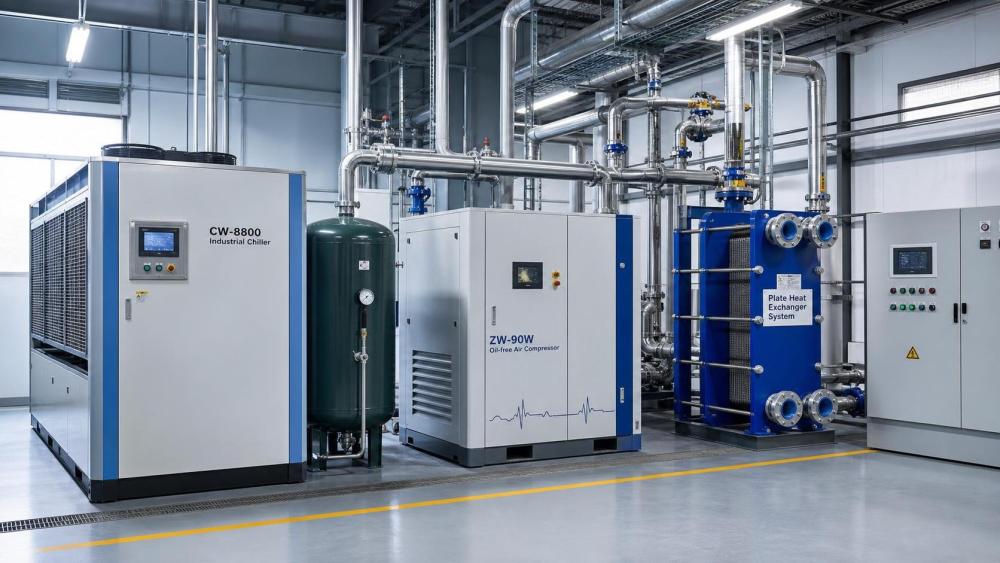
This is the point where a procurement specification planning process reduces risk: before the RFQ, when assumptions can still be challenged at low cost.
The signs that specification planning will materially lower bid risk
It tends to have the strongest effect under a few recognizable conditions.
- The equipment must meet a process outcome, not just a dimensional or catalog requirement.
- There are multiple viable technical routes, each with different CAPEX and OPEX implications.
- Failure cost is high because downtime, contamination, rejected product, or energy waste is expensive.
- Internal stakeholders are not naturally aligned; operations, engineering, maintenance, EHS, and procurement want different things.
- The supplier market spans premium OEMs, integrators, and lower-cost fabricators who interpret requirements very differently.
If several of those conditions are present, a weak planning process usually produces one of two bad outcomes. Either the tender is so loose that bids cannot be evaluated fairly, or it becomes so overprescriptive that procurement eliminates practical alternatives and pays for unnecessary features.
A good specification does not try to design the supplier’s solution
This is where many sourcing documents drift off course. Procurement wants clarity, engineering wants control, and the result is a specification that locks the vendor into one design pathway without clearly stating the business objective behind it.
That approach can reduce competition rather than risk. It may also block newer technologies that deserve consideration. In categories tracked closely by industrial intelligence teams, such as oil-free compression, microchannel heat exchangers, or low-NOx thermal systems, technical evolution does not always fit old template specifications. If the document only copies the last project, it may freeze outdated assumptions into the bid package.
A stronger planning process separates three layers:
That last layer is often underestimated. A bid becomes safer when suppliers are forced to expose their assumptions in a consistent format.
Where procurement can save money without inviting trouble
Cost control during specification planning is not about squeezing the document until every supplier quotes the cheapest possible package. It is about deciding where standardization is sensible and where flexibility is dangerous.
For example, standardizing documentation format, testing expectations, training scope, warranty language, and spare parts breakdown improves evaluation efficiency with little technical downside. Trying to standardize every component brand, every fabrication detail, or every internal design choice may reduce supplier creativity and narrow the field unnecessarily.
In energy-intensive systems, cost discipline also means specifying how performance is to be stated. At full load? At part load? At a stated ambient condition? Against which utility assumptions? Without that, one supplier may price a higher-efficiency package and another may optimize for low first cost. Both will claim competitiveness, and procurement will have no clean basis for comparison.
This is where market intelligence becomes practical rather than academic. If energy prices are unstable, refrigerant choices are under policy pressure, or demand is rising in industries such as pharmaceuticals, semiconductors, or food processing, procurement should expect supplier positioning to shift accordingly. GTC-Matrix’s coverage of sector news and technology evolution is relevant here because these shifts often affect specification choices before they affect internal purchasing templates.
What to resolve before asking suppliers to bid
Not every issue needs a final answer before tender, but some do. If they are left open, bid risk stays high no matter how many pages the RFQ contains.
- Actual operating envelope, not just design-point demand.
- Critical interfaces with utilities, controls, civil works, and upstream/downstream processes.
- Minimum acceptable reliability or redundancy philosophy.
- How deviations will be declared and scored.
- Whether total cost of ownership will influence award, and if so, how.
- Responsibility split between equipment supply, installation support, commissioning, and performance verification.
If these are unresolved internally, suppliers will answer different questions, not the same one.
A common mistake: confusing specification detail with procurement maturity
Longer specifications are not necessarily safer. Some of the riskiest tenders are packed with copied clauses, inherited standards, and generic technical appendices that nobody has reconciled with the current site. Suppliers then respond selectively, commercial teams quote against summaries, and engineering reservations appear after nomination.
A mature procurement specification planning process is usually shorter where it can be and sharper where it must be. It states the duty clearly. It defines the conditions. It distinguishes mandatory from preferred. It gives suppliers a structure for technical deviation. And it sets an evaluation logic that the internal team will actually use.
That last point sounds obvious, but many organizations still issue bid documents that emphasize technical detail while leaving commercial comparison criteria vague. When award pressure increases, price takes over by default because the team did not agree in advance how to value efficiency, maintainability, delivery certainty, or service support.
So when does it reduce bid risk?
It reduces bid risk when the planning process changes supplier behavior and internal behavior at the same time. Suppliers submit cleaner, more comparable offers because the requirement is explicit and deviations must be visible. Internally, procurement, engineering, and operations stop arguing about basics after the bids arrive because they already settled the evaluation rules before the market responded.
That is the real test. Not whether the specification looks complete, but whether it prevents avoidable reinterpretation.
For buyers working in thermal systems, compressed air, vacuum, and related utility infrastructure, this is rarely a one-time documentation exercise. Technologies shift, site constraints change, and policy or energy-market signals can alter what “best value” means from one procurement cycle to the next. A disciplined planning process, supported by current industrial intelligence rather than old templates, is usually where lower bid risk starts showing up as lower project friction and fewer expensive surprises later.
Related News
- What drives sustainable thermal systems cost over their operating life?Author :

- Which industrial solution comparison criteria prevent project delays?Author :

- How Ambient Temperature and Load Profile Affect Industrial Compressor SizingAuthor :

- What to evaluate before choosing a thermal process engineering supplierAuthor :

- How industrial utility systems affect energy costs in process plantsAuthor :

- What Data Is Needed to Assess Heat Recovery Decarbonization?Author :

- Can Waste Heat Recovery Support Carbon Neutrality Targets?Author :

- Is Compressor Heat Recovery Worth the Installation Cost?Author :

- What to verify before choosing a process separation technology supplierAuthor :

- When does process utilities engineering reduce project rework?Author :

- Where thermal efficiency optimization delivers the fastest savings in EuropeAuthor :

- What should you verify before selecting a heat transfer supplier?Author :

- What drives compressed air systems price for industrial projects?Author :

- How an industrial product knowledge comparison guide reduces sourcing riskAuthor :

- When does a procurement specification planning process reduce bid risk?Author :

- When does thermal system optimization for electronics reduce failure risk?Author :

- When high temperature process heating systems justify the higher energy costAuthor :

- How to compare sludge dewatering equipment by cake drynessAuthor :

- What to Check Before Sourcing a Gas Turbine for Distributed Power ProjectsAuthor :

- What drives industrial thermal systems price in large facility projectsAuthor :

- How to build an industrial product comparison chart that speeds up vendor selectionAuthor :

- Vacuum Technology Application Guide for Selecting the Right SystemAuthor :

- What Drives Vacuum Drying Cost in Industrial Procurement?Author :

- What Drives Compressed Air Pricing in Industrial Systems?Author :

- How Procurement Specification Planning Shapes Total Project CostAuthor :

- Compression Technology Guide: How to Compare Efficiency, Pressure Range, and Maintenance NeedsAuthor :

- How to Compare Industrial Separators by Throughput, Purity, and Maintenance LoadAuthor :

- How to Size a Compressed Air Equipment Receiver Tank for Stable PressureAuthor :

- Industrial Equipment Selection Guide: How to Compare Capacity, Duty Cycle, and Operating CostAuthor :

- How to Evaluate an Intellectualization Supplier for Industrial UpgradesAuthor :

- High-Efficiency Manufacturing: Cost Savings vs. Upgrade RiskAuthor :

- Thermal System Optimization Cost: What Drives ROI?Author :

- How to Plan Process Utilities for a Cleanroom Without Costly ReworkAuthor :

- How to Compare Process Heating Suppliers in MexicoAuthor :

- Food Processing Utilities: Common Sizing Mistakes That Raise Energy and Water UseAuthor :

- How to Build Procurement Specification Planning for Industrial EquipmentAuthor :