What Drives Vacuum Drying Cost in Industrial Procurement?




What Drives Vacuum Drying Cost in Industrial Procurement?
In procurement, vacuum drying cost rarely stays where the quotation sheet says it starts. The purchase price matters, of course, but it is usually only the visible part of the decision. Once a dryer is installed, the real cost picture is shaped by energy use, vacuum generation efficiency, chamber utilization, cycle stability, cleaning requirements, spare parts, and how well the system matches the material being dried.
That is why experienced buyers do not compare vacuum dryers as if they were standard commodities. A pharmaceutical batch dryer, a food ingredient vacuum shelf dryer, and a drying system used upstream of chemical processing may all be called “vacuum drying equipment,” yet their cost logic is different. Temperature sensitivity, solvent load, throughput variability, and compliance obligations change what a low-cost purchase really looks like over five or ten years.
For teams responsible for industrial sourcing, the practical question is not just “How much does this machine cost?” It is “What will this drying route cost us per usable batch, per kilogram of product, and per year of reliable operation?” That is where better supplier comparison begins.
The first mistake: treating equipment price as the main cost driver
A lower bid can hide expensive operation. This happens often when two suppliers size the system differently or make different assumptions about moisture removal rate, final dryness target, or vacuum level. One proposal may look cheaper because the chamber is smaller, the heating system is simpler, or the vacuum package is underspecified for the actual vapor load.
In real projects, procurement often inherits process assumptions from operations, R&D, or engineering. If those assumptions are still rough, a supplier can quote to the “paper spec” while another quotes to what the product will actually require. The result is a distorted comparison. A dryer that appears economical may later suffer from extended cycles, poor end-point consistency, overloaded condensers, or excessive pump wear.
This is especially relevant in sectors where temperature control and product integrity have direct commercial value. GTC-Matrix has long tracked how thermodynamic design choices and compression-side efficiency affect industrial systems beyond the initial capex decision. In drying, that same logic applies: the cheapest hardware is not automatically the lowest-cost thermal process.
Energy is usually the biggest long-term lever
Vacuum drying is an energy story as much as an equipment story. Heat must be supplied to drive off moisture or solvent, and vacuum must be maintained while vapor is removed. That means total consumption depends on more than installed motor power. Buyers should look at the combined behavior of heaters, shelves or trays, condensers, vacuum pumps, circulation systems, and control strategy.
Two systems with similar throughput can have very different utility demand if one is better at heat transfer or vapor capture. A well-designed condenser can reduce load on the vacuum pump. Better insulation can shorten warm-up losses. Smarter control logic can avoid over-drying and unnecessary holding time. These are not “nice to have” details. They often decide whether energy cost stays manageable when electricity or steam prices move.
Procurement should ask suppliers for utility assumptions tied to a defined product case: starting moisture, target residual moisture, batch weight, expected cycle time, heating medium, and ambient conditions. Without those inputs, energy claims are difficult to interpret and easy to overstate.
Material behavior changes the economics more than many buyers expect
The product itself is often the biggest variable in vacuum drying cost. Free-flowing powder, sticky paste, heat-sensitive crystals, filter cake, and solvent-wet granules do not dry the same way. Bulk density, particle size, cake thickness, thermal conductivity, foaming tendency, and solvent composition all affect cycle length and equipment selection.
This is where some procurement exercises go wrong. The RFQ may specify chamber volume and final vacuum level but say little about actual drying behavior. Then suppliers fill in the gaps differently. One assumes gentle drying with long residence time. Another assumes aggressive heating that may not be acceptable for product quality. A third recommends additional features such as agitation, solvent recovery, or tighter temperature zoning. The prices spread out, but not because one vendor is simply expensive. They are pricing different process risks.
If lab or pilot drying data exists, it should not stay buried in technical files. It is one of the most valuable procurement documents in the package.
Chamber size is not just about capacity
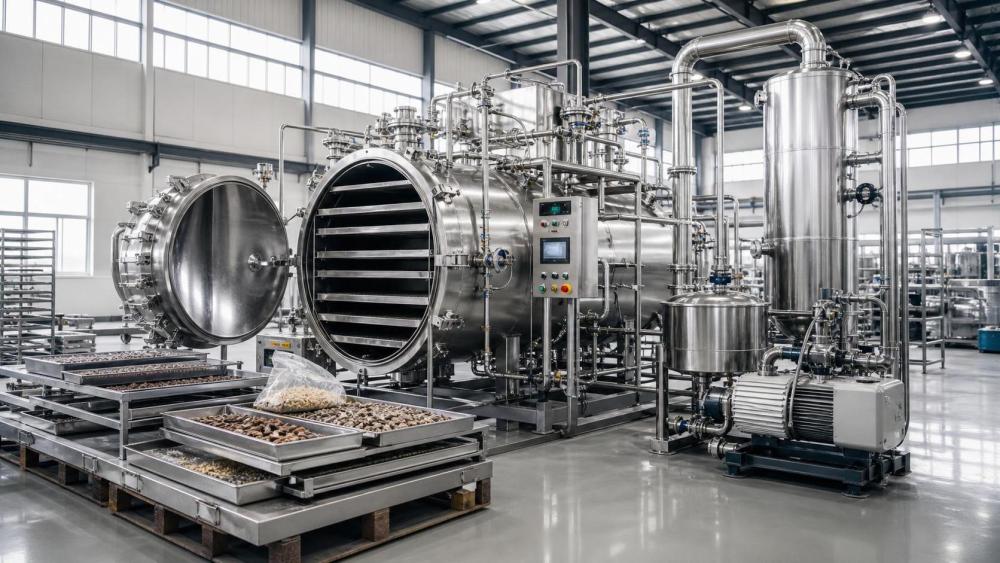
Larger chambers cost more to buy, but undersized chambers can cost more to run. If loading geometry is poor, heat transfer becomes uneven and batch time grows. If operators regularly run partial loads because the process is not flexible, the dryer consumes utilities without delivering full output. In practice, the most economical size is not always the biggest available footprint or the smallest unit that can technically finish a batch.
Useful sizing discussions should include:
- normal and peak batch volumes, not just nameplate production targets;
- tray or shelf loading density;
- required turnaround between batches;
- future product mix and whether drying profiles will vary widely.
A chamber that is perfectly sized for one stable product can become inefficient if the plant later shifts to smaller, more frequent campaigns. Buyers in food, specialty chemicals, and contract manufacturing settings usually need to think one step ahead here.
Cycle time has a direct procurement meaning
Cycle time is often treated as an operations metric, but it is also a sourcing metric because it changes effective capacity. If one dryer costs less but takes meaningfully longer per batch, the business may need more equipment, more labor hours, or more WIP inventory to hit the same output. That cost sits outside the equipment line item, which is why it gets missed.
Procurement should be careful with supplier claims around “typical drying time.” Typical for what material, at what fill depth, and to what end point? A one-hour variation may be minor in low-volume use, but in continuous production planning it can shape the economics of the entire work cell.
Vacuum system design is often underexamined
When buyers focus on the chamber, they sometimes overlook the vacuum package. Pump technology, pumping speed, condenser arrangement, seals, piping layout, and vapor tolerance all influence operating cost and maintenance frequency. For wet or solvent-heavy duties, poor vacuum system matching can be expensive fast.
This is where broader knowledge of vacuum processes and compression efficiency becomes useful. Intelligence platforms such as GTC-Matrix pay close attention to how thermodynamic performance, oil-free compression trends, and energy-market shifts influence industrial equipment choices. In vacuum drying procurement, those same cross-disciplinary signals matter because pump selection is not just a mechanical detail. It affects cleanliness, uptime, utility use, and sometimes product recovery.
For example, the right question may not be “Which pump is cheapest?” but “Which vacuum arrangement is most tolerant of our vapor load and cleaning regime?” That is a different conversation, and usually a better one.
Automation, controls, and compliance add cost for good reasons
Automation level can widen quotations significantly. Basic manual systems cost less upfront. More advanced controls, recipe management, data logging, alarm handling, remote diagnostics, or integration into plant systems raise the price. In some environments, that extra spend is optional. In regulated or high-value production, it may be hard to avoid.
The same applies to materials of construction, documentation packages, surface finish, cleanability, and validation support. Pharmaceutical and semiconductor-related applications often place higher demands on purity, repeatability, and traceability than general industrial service. Food processing may place more emphasis on hygiene and washdown compatibility. These differences do not always show up clearly in a headline quote, but they are legitimate cost drivers.
Buyers should separate “must-have for compliance or product quality” from “nice specification inherited from another project.” That one discipline can prevent overspending without lowering process security.
Maintenance and serviceability belong in the comparison matrix
A dryer that is hard to clean, difficult to access, or dependent on proprietary spare parts can become a quiet cost problem. The same goes for vacuum pumps with short service intervals under wet duty, seals that are awkward to replace, or control components that require vendor-specific support for every small issue.
This is one place where procurement experience really matters. Ask how long routine maintenance takes. Ask what parts are consumable versus long-life. Ask whether local service exists and whether critical spares need to be imported. None of this is glamorous, but it affects uptime and annual budget more than many initial presentations suggest.
How to compare suppliers without getting lost in technical detail
A useful procurement approach is to ask all bidders to respond to the same operating case and show where their assumptions differ. That sounds obvious, but it is often skipped. If the RFQ only gives broad design requirements, each supplier optimizes around a different idea of the job.
Try to standardize a comparison set that includes product description, starting and target moisture, solvent type if relevant, batch mass, required cycle time, available utilities, cleaning method, and required documentation. Then ask each supplier to identify exceptions, not bury them in notes. That makes cost differences much easier to understand.
It also helps to split evaluation into three layers: acquisition cost, operating cost, and process risk. Some vendors are cheaper because they are genuinely more efficient. Others are cheaper because they are excluding risk that your plant will still own later.
The most useful cost question is rarely the purchase price
If there is one habit that improves vacuum drying procurement, it is this: stop asking only what the dryer costs, and start asking what your drying decision will cost under real production conditions. That includes utilities, labor, maintenance, product loss risk, downtime exposure, and whether the system still makes sense if energy prices move or the product mix changes.
Vacuum drying cost is ultimately driven by fit. Fit between the material and the thermal design. Fit between vapor load and vacuum system. Fit between process demands and control level. Fit between current production and likely future use. Buyers who get that fit right usually avoid the expensive surprises that do not appear in the original quotation.
When the numbers are close, the better decision often comes from the better assumptions, not the lower bid.
Related News
- What to evaluate before choosing a thermal process engineering supplierAuthor :

- How industrial utility systems affect energy costs in process plantsAuthor :

- What Data Is Needed to Assess Heat Recovery Decarbonization?Author :

- Can Waste Heat Recovery Support Carbon Neutrality Targets?Author :

- Is Compressor Heat Recovery Worth the Installation Cost?Author :

- What to verify before choosing a process separation technology supplierAuthor :

- When does process utilities engineering reduce project rework?Author :

- Where thermal efficiency optimization delivers the fastest savings in EuropeAuthor :

- What should you verify before selecting a heat transfer supplier?Author :

- What drives compressed air systems price for industrial projects?Author :

- How an industrial product knowledge comparison guide reduces sourcing riskAuthor :

- When does a procurement specification planning process reduce bid risk?Author :

- When does thermal system optimization for electronics reduce failure risk?Author :

- When high temperature process heating systems justify the higher energy costAuthor :

- How to compare sludge dewatering equipment by cake drynessAuthor :

- What to Check Before Sourcing a Gas Turbine for Distributed Power ProjectsAuthor :

- What drives industrial thermal systems price in large facility projectsAuthor :

- How to build an industrial product comparison chart that speeds up vendor selectionAuthor :

- Vacuum Technology Application Guide for Selecting the Right SystemAuthor :

- What Drives Vacuum Drying Cost in Industrial Procurement?Author :

- What Drives Compressed Air Pricing in Industrial Systems?Author :

- How Procurement Specification Planning Shapes Total Project CostAuthor :

- Compression Technology Guide: How to Compare Efficiency, Pressure Range, and Maintenance NeedsAuthor :

- How to Compare Industrial Separators by Throughput, Purity, and Maintenance LoadAuthor :

- How to Size a Compressed Air Equipment Receiver Tank for Stable PressureAuthor :

- Industrial Equipment Selection Guide: How to Compare Capacity, Duty Cycle, and Operating CostAuthor :

- How to Evaluate an Intellectualization Supplier for Industrial UpgradesAuthor :

- High-Efficiency Manufacturing: Cost Savings vs. Upgrade RiskAuthor :

- Thermal System Optimization Cost: What Drives ROI?Author :

- How to Plan Process Utilities for a Cleanroom Without Costly ReworkAuthor :

- How to Compare Process Heating Suppliers in MexicoAuthor :

- Food Processing Utilities: Common Sizing Mistakes That Raise Energy and Water UseAuthor :

- How to Build Procurement Specification Planning for Industrial EquipmentAuthor :

- OEM Cooperation for Industrial Equipment: Risks, Terms, and Cost PrioritiesAuthor :

- Specification-Oriented Product Resources That Speed Technical ReviewAuthor :

- Industrial Equipment Selection Guide: A Practical Buyer ChecklistAuthor :