



What drives sustainable thermal systems cost over their operating life?




A thermal-system proposal can look inexpensive at the approval stage and become expensive once it enters daily operation. A chiller, compressor package, heat recovery loop, boiler, vacuum system, or heat exchanger may run for many years, often under changing loads, energy tariffs, production schedules, and environmental requirements. The purchase order captures only the visible starting cost. The larger financial question is whether the system will keep converting energy into useful cooling, heat, pressure, or vacuum without creating avoidable operating exposure.
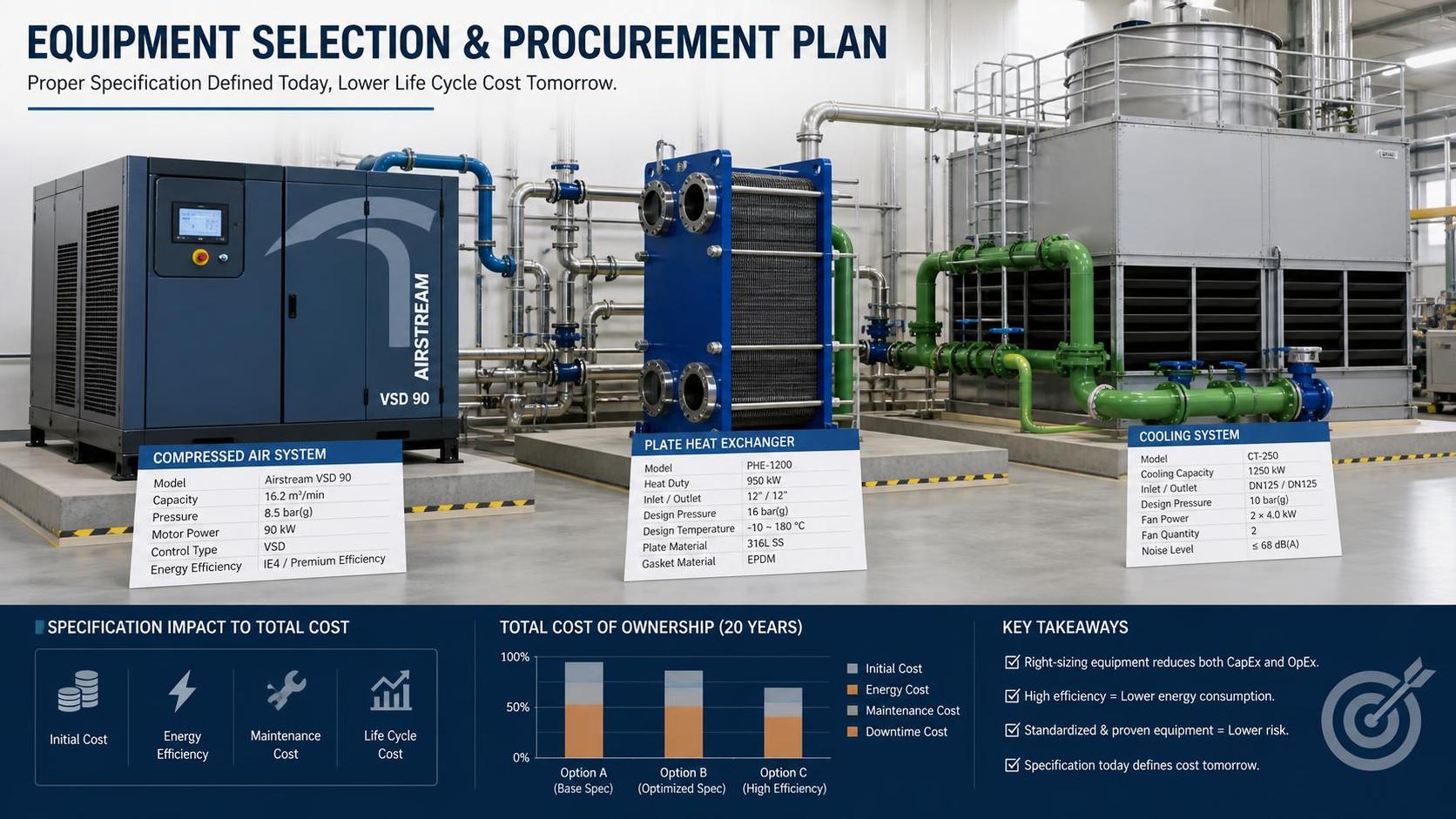
The main drivers of sustainable thermal systems cost over operating life are energy use at real load conditions, maintenance intensity, uptime and production risk, refrigerant or emissions compliance, replacement-part availability, system controls, and the practical service life of the equipment. A sound approval decision compares alternatives as whole operating systems rather than treating equipment price, installation scope, and utility expense as unrelated line items.
The purchase price is rarely the largest cost
Capital price matters because it affects cash flow, financing, depreciation, and project timing. Yet thermal equipment commonly operates long enough for electricity, fuel, water, treatment chemicals, maintenance labor, and unplanned stoppages to outweigh the initial equipment cost. This is especially true where cooling demand, compressed-air demand, or process heat is continuous.
A lower-priced unit can be financially sensible when duty is light, operating hours are limited, and replacement is easy. It becomes less attractive when it must run near full capacity for long periods, cope with wide seasonal conditions, or support a process where an interruption causes spoilage, quality loss, delayed shipment, or lost production time.
The approval process should therefore separate three questions:
- What must be paid before commissioning, including equipment, civil work, piping, electrical work, controls, commissioning, and training?
- What will the system consume and require during ordinary operation?
- What financial exposure appears when operating conditions differ from the design assumption?
The third question is often missed. Thermal systems rarely operate at one stable design point. Ambient temperature changes, production lines expand, process loads fluctuate, and maintenance windows are postponed. A proposal that looks efficient under nominal conditions may have a weaker outcome under the load profile that actually occurs.
Energy performance must be tested against the load profile
Energy is usually the largest recurring cost driver, but nameplate efficiency alone is not enough for approval. A machine’s performance at full load may have little relevance if it spends most of its year at partial load. Variable-speed compressors, pumps, fans, and refrigeration compressors can reduce energy use in some conditions, but the benefit depends on how often the process actually varies and how the controls respond.
Consider a cooling system serving process equipment with irregular demand. At low load, poor staging may force a large compressor to cycle frequently, or keep pumps and fans running at fixed speed. The equipment may meet the required temperature, yet consume disproportionately high energy. A smaller modular arrangement, better turndown capability, thermal storage, or revised control logic may carry a higher initial cost while reducing wasted operation over time.
For a financial comparison, request energy estimates that state their assumptions plainly:
- Annual operating hours and expected load distribution, not only full-load operation.
- Entering air, water, or ambient conditions used in the calculation.
- Required supply temperature, pressure setpoint, vacuum level, or process duty.
- Included auxiliary loads such as pumps, cooling towers, fans, dryers, oil systems, and controls.
- Whether performance includes part-load behavior and staging losses.
- Expected degradation from fouling, leakage, heat-exchanger contamination, or reduced heat-transfer performance.
Without these details, an annual energy estimate can create false precision. It is better to use a transparent range based on realistic operating cases than accept one attractive number whose operating basis cannot be checked.
System boundaries change the economics
Thermal assets are often evaluated as isolated machines even though their cost depends on the surrounding system. A compressed-air compressor may appear efficient, while downstream pressure losses force it to operate at a higher discharge pressure than the process needs. A chiller may have strong rated performance, but an undersized or fouled condenser-water circuit raises condensing temperature and energy use. A heat exchanger selected for compactness may create excessive pressure drop, increasing pump energy for its entire life.
These interactions explain why a narrowly scoped purchase decision can miss major cost drivers. The useful boundary for analysis normally includes the generation equipment, distribution network, heat rejection or heat source, treatment requirements, controls, and process interface.
For sustainable thermal systems, efficiency improvements should be evaluated at the system boundary where utility bills occur. A component can be technically efficient while the complete installation is not.
Maintenance cost is shaped by serviceability, not just reliability claims
Every thermal system needs maintenance. The economic difference lies in how predictable, accessible, and disruptive that maintenance becomes. Filters, lubricants, seals, belts, valves, refrigerant checks, water treatment, cleaning, calibration, and heat-exchanger inspection may be routine; a system that makes these tasks difficult can turn ordinary work into costly shutdown activity.
Maintenance assumptions should address more than an annual service contract. Review access clearances, lifting requirements, isolation valves, spare-part lead times, diagnostic visibility, and whether key components can be replaced without dismantling major pipework or stopping adjacent equipment. In some plants, a compact footprint is valuable. In others, a crowded layout later prevents safe cleaning and inspection, increasing labor hours and outage duration.
Water-side and air-side cleanliness deserve particular attention. Fouling reduces heat transfer, raises temperature approaches, and can increase compressor or pump power before operators recognize the cause. Poor water chemistry can shorten equipment life, while neglected air filtration may reduce airflow and contribute to overheating. These are not merely maintenance details: they affect energy consumption, capacity margin, and failure probability at the same time.
A financially useful proposal identifies preventive tasks, likely consumables, inspection intervals, and the operational consequence of deferring each activity. It should also distinguish parts that are standard service items from components that depend on specialist availability or extended lead times.
Downtime should be valued according to process criticality
Not every thermal asset requires full redundancy. A comfort cooling unit in a low-risk area is different from refrigeration supporting temperature-sensitive materials, compressed air supporting instrumentation, or vacuum equipment tied to a continuous process. The correct level of resilience depends on what failure interrupts and how quickly the process can recover.
Approvers should ask operational teams to define the consequence of losing each utility. Can production continue at reduced output? Is there stored thermal capacity? Can another machine carry the load? Does a restart require cleaning, requalification, warm-up, stabilization, or disposal of material? The answers determine whether a lower-cost single unit is rational or whether duty/standby capacity, modular equipment, bypass arrangements, or temporary connection points are justified.
Resilience also has an operating-cost side. Oversizing everything “just in case” may worsen part-load efficiency and raise capital cost. A more balanced approach is to separate required process capacity from contingency capacity, then confirm how each arrangement performs during normal operation. Modularity can reduce outage exposure, but only when the controls can stage units efficiently and maintenance can isolate one module without compromising the rest of the system.
Compliance and refrigerant choices create future cost exposure
Sustainability-related cost is not limited to energy. Refrigerant selection, leak management, emissions controls, water discharge conditions, and fuel-related requirements can affect operating expenditure and replacement timing. Equipment using a working fluid or combustion approach that becomes harder to service, source, or permit may appear affordable initially but carry increasing uncertainty over its operating life.
A responsible comparison does not assume a particular future regulation or price movement. Instead, it identifies exposure. Is the selected refrigerant readily serviceable in the expected operating region? Does the design minimize charge size where that matters? Are leak detection, recovery procedures, and trained service support part of the operating plan? Does the system require water treatment or discharge management that has been included in recurring costs? For combustion-based thermal equipment, are monitoring, inspection, and tuning obligations reflected in staffing and maintenance scope?
The goal is not to reject proven technology because future conditions are uncertain. It is to avoid approving a design whose long-term compliance burden has never been priced, assigned, or technically reviewed.
Controls can preserve savings—or erase them
Many operating-life cost assumptions depend on control sequences rather than equipment hardware. A heat-recovery loop only produces value when there is a coincident demand for recovered heat, the temperatures are compatible, and controls prevent unnecessary heat rejection. Variable-speed drives save energy only when setpoints, sensors, minimum flow requirements, and staging logic are properly configured.
Control quality becomes especially important after process changes. A system may have been commissioned for one production pattern, then run for years with altered shifts, added loads, or changed temperature requirements. Sensors drift, manual overrides remain in place, and the original control logic may no longer match the plant. These conditions can increase cost quietly because the equipment still appears to be functioning.
Approval documents should therefore define what will be measured after startup. Useful operating indicators may include energy per unit of output, supply and return temperatures, pressure stability, compressor loading, pump speed, run hours, alarm frequency, and heat-recovery utilization. The selected indicators should match the process; collecting a large volume of data without an owner or review routine adds little value.
A practical life-cycle comparison for capital approval
A disciplined review can start with a base-case option and an alternative option. Use the same required duty, operating hours, process conditions, and system boundary for both. Then compare capital expenditure, annual utility consumption, planned maintenance, expected replacement items, compliance-related operating needs, and credible downtime exposure.
Where inputs are uncertain, use scenarios rather than a single forecast. For example, compare stable production, extended high-load operation, and reduced-load operation. Test whether the preferred system remains acceptable when energy prices change, maintenance intervals are shorter than expected, or heat recovery has lower utilization than planned. This approach does not require invented certainty; it shows which proposal is robust and which only works under optimistic assumptions.
- Confirm the required duty and the actual operating profile with production and engineering teams.
- Set a common boundary that includes auxiliary equipment and distribution impacts.
- Request documented part-load and design-condition assumptions from each option.
- List recurring service work, consumables, critical spares, and shutdown requirements.
- Identify compliance, refrigerant, water, and emissions obligations that may create recurring cost.
- Assign a practical value range to interrupted production or utility loss where the asset is critical.
- Review the result under several operating scenarios before approving on lowest first cost.
The strongest investment is not always the one with the highest efficiency rating or the lowest purchase price. It is the arrangement whose performance assumptions, maintenance needs, resilience level, and compliance exposure remain credible throughout the operating conditions the facility is likely to face.
Related News
- What drives sustainable thermal systems cost over their operating life?Author :

- Which industrial solution comparison criteria prevent project delays?Author :

- What to evaluate before choosing a thermal process engineering supplierAuthor :

- How industrial utility systems affect energy costs in process plantsAuthor :

- What Data Is Needed to Assess Heat Recovery Decarbonization?Author :

- Can Waste Heat Recovery Support Carbon Neutrality Targets?Author :

- Is Compressor Heat Recovery Worth the Installation Cost?Author :

- What to verify before choosing a process separation technology supplierAuthor :

- When does process utilities engineering reduce project rework?Author :

- Where thermal efficiency optimization delivers the fastest savings in EuropeAuthor :

- What should you verify before selecting a heat transfer supplier?Author :

- What drives compressed air systems price for industrial projects?Author :

- How an industrial product knowledge comparison guide reduces sourcing riskAuthor :

- When does a procurement specification planning process reduce bid risk?Author :

- When does thermal system optimization for electronics reduce failure risk?Author :

- When high temperature process heating systems justify the higher energy costAuthor :

- How to compare sludge dewatering equipment by cake drynessAuthor :

- What to Check Before Sourcing a Gas Turbine for Distributed Power ProjectsAuthor :

- What drives industrial thermal systems price in large facility projectsAuthor :

- How to build an industrial product comparison chart that speeds up vendor selectionAuthor :

- Vacuum Technology Application Guide for Selecting the Right SystemAuthor :

- What Drives Vacuum Drying Cost in Industrial Procurement?Author :

- What Drives Compressed Air Pricing in Industrial Systems?Author :

- How Procurement Specification Planning Shapes Total Project CostAuthor :

- Compression Technology Guide: How to Compare Efficiency, Pressure Range, and Maintenance NeedsAuthor :

- How to Compare Industrial Separators by Throughput, Purity, and Maintenance LoadAuthor :

- How to Size a Compressed Air Equipment Receiver Tank for Stable PressureAuthor :

- Industrial Equipment Selection Guide: How to Compare Capacity, Duty Cycle, and Operating CostAuthor :

- How to Evaluate an Intellectualization Supplier for Industrial UpgradesAuthor :

- High-Efficiency Manufacturing: Cost Savings vs. Upgrade RiskAuthor :

- Thermal System Optimization Cost: What Drives ROI?Author :

- How to Plan Process Utilities for a Cleanroom Without Costly ReworkAuthor :

- How to Compare Process Heating Suppliers in MexicoAuthor :

- Food Processing Utilities: Common Sizing Mistakes That Raise Energy and Water UseAuthor :

- How to Build Procurement Specification Planning for Industrial EquipmentAuthor :

- OEM Cooperation for Industrial Equipment: Risks, Terms, and Cost PrioritiesAuthor :