



How to Size a Compressed Air Equipment Receiver Tank for Stable Pressure




Start with the pressure problem, not the tank volume
A receiver tank is supposed to make a compressed air system behave better. Stable pressure, fewer compressor starts, less nuisance loading and unloading, and more breathing room when demand jumps for a short period. That sounds simple, but this is where many sizing decisions go sideways: the tank gets chosen by habit, by available floor space, or by a rule of thumb copied from another plant.
For a technical evaluator, the real job is narrower and more practical. You are not asking, “What is a big enough receiver?” You are asking, “How much stored air do I need to keep pressure inside an acceptable band while the system catches up?” That changes the whole selection process.
Before looking at a compressed air equipment receiver tank, define three things in plain numbers:
- the normal flow demand,
- the short-term peak demand,
- the pressure drop your process can actually tolerate.
If those values are fuzzy, tank sizing will be fuzzy too. And the usual result is a larger vessel that still does not fix the instability that triggered the purchase.
Check whether you need storage, buffering, or cycle control
Not every receiver is doing the same job. That matters because the same volume can be too small in one application and excessive in another.
In practice, most receiver decisions fall into one of these situations:
- Demand buffering: the process has intermittent high draw, such as blow-off, cylinder banks, packaging machines, or tool clusters. The tank must bridge short events without dragging pressure down too far.
- Compressor cycle control: the system load swings around the lower end of compressor capacity, and the tank is there to reduce rapid start-stop or load-unload cycling.
- Distribution stabilization: pressure fluctuates because the network is undersized, controls are slow, or large users are poorly separated. A receiver may help, but it may also be hiding a piping or control problem.
- Moisture management support: storage is also being used to cool air and improve condensate separation upstream or downstream of treatment equipment.
If you do not pin down the tank’s role, you can end up solving the wrong problem elegantly.
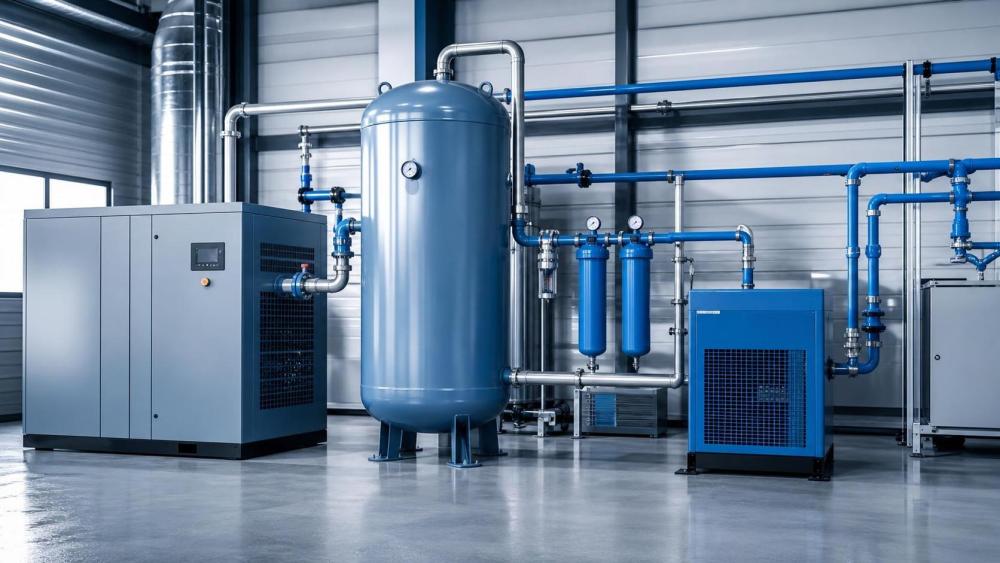
Map the actual demand pattern before you calculate anything
Receiver tanks pay off when demand is uneven. So the first serious check is not vessel size. It is the shape of consumption over time.
Look for these patterns in the compressed air system data or machine sequence:
- Very short but frequent peaks, often a few seconds long
- Batch events with recovery time between cycles
- Shift changes that bring multiple machines online at once
- Night or idle periods where the compressor hunts because demand falls too low
- One large consumer that dominates everyone else
This is where a lot of evaluations improve quickly. A plant may report “pressure instability,” but when you look closer, the problem is a 10-second demand spike every minute from one machine. That points to local buffering near the load, not necessarily a much larger central receiver.
When data logging is available, use it. A one-minute average can hide the event that matters. For receiver sizing, second-by-second behavior often tells the truth that monthly air consumption never will.
Define the usable pressure band
Tank volume only becomes useful when tied to pressure range. The air you can actually draw from storage depends on the pressure drop allowed between the upper and lower operating limits.
This sounds obvious, but many selections ignore it. A large tank with a very narrow allowable pressure band may provide less useful storage than a smaller tank operating across a wider band. On the other hand, widening the band carelessly can create tool performance issues, valve response problems, or process drift at end-use points.
The right question is: what is the minimum pressure required at the most sensitive point of use during the highest short-term draw?
Work backward from there. Include:
- pressure drop through dryers, filters, and separators,
- line losses at peak flow,
- control deadband,
- any margin needed for machines with tight pneumatic requirements.
If you skip this step, the receiver tank may look correct on paper and still let the far end of the system sag below usable pressure.
Use the sizing formula carefully, and only after the inputs are clean
Most receiver sizing methods are some variation of the same logic: how much air must be supplied from storage during a defined time period, within a defined pressure drop. That is a sound basis. The weak point is rarely the formula itself. It is the quality of the demand estimate, the time interval, and the pressure assumptions.
For selection work, keep this checklist beside the calculation:
- Are flow units consistent across compressor output, demand, and stored volume basis?
- Are you sizing for average demand or the actual peak event the tank must cover?
- Is the event duration realistic, or just a guess from memory?
- Are you using gauge pressure and absolute pressure correctly in the method you chose?
- Have you separated compressor response time from process demand duration?
That last one is easy to miss. If a variable-speed compressor can recover quickly, the tank may only need to bridge a short control lag. If a fixed-speed machine needs time to load, stabilize, and build flow, the required storage can be very different.
Do not hide a piping problem inside a bigger tank
A receiver tank can smooth pressure swings, but it cannot permanently fix poor distribution design. If pressure collapses mainly at distant machines, inspect the network before approving more storage.
Common signs that the issue is elsewhere:
- large pressure difference between compressor discharge and point of use,
- undersized branch lines serving high-demand equipment,
- filters with excessive pressure drop,
- multiple demand spikes arriving through one restricted section of pipe,
- receiver installed far from the disturbance it is meant to buffer.
In those cases, a local receiver near the intermittent user may outperform a larger central tank. Sometimes the better answer is reworked piping or a dedicated branch header. Technical evaluators should treat tank size and tank location as one decision, not two separate approvals.
Check compressor control mode before finalizing capacity
The same receiver volume behaves differently depending on compressor control strategy. A load-unload machine often benefits from enough storage to avoid short cycling and unloaded running losses. A variable-speed compressor may need less storage for stability, but not zero. It still needs some buffer to prevent aggressive speed hunting and to absorb fast process events.
Where there are multiple compressors, look at sequencing logic. One oversized receiver can delay the signal that a second machine should start, which may help or hurt depending on the setup. If the controls are already sluggish, extra storage can make the system feel calmer while response gets slower in a way operators notice later.
So the evaluation should include this simple question: Is the tank there to support the controls, or to compensate for weak controls? The first is normal design. The second needs closer scrutiny.
Account for dryer and filter placement
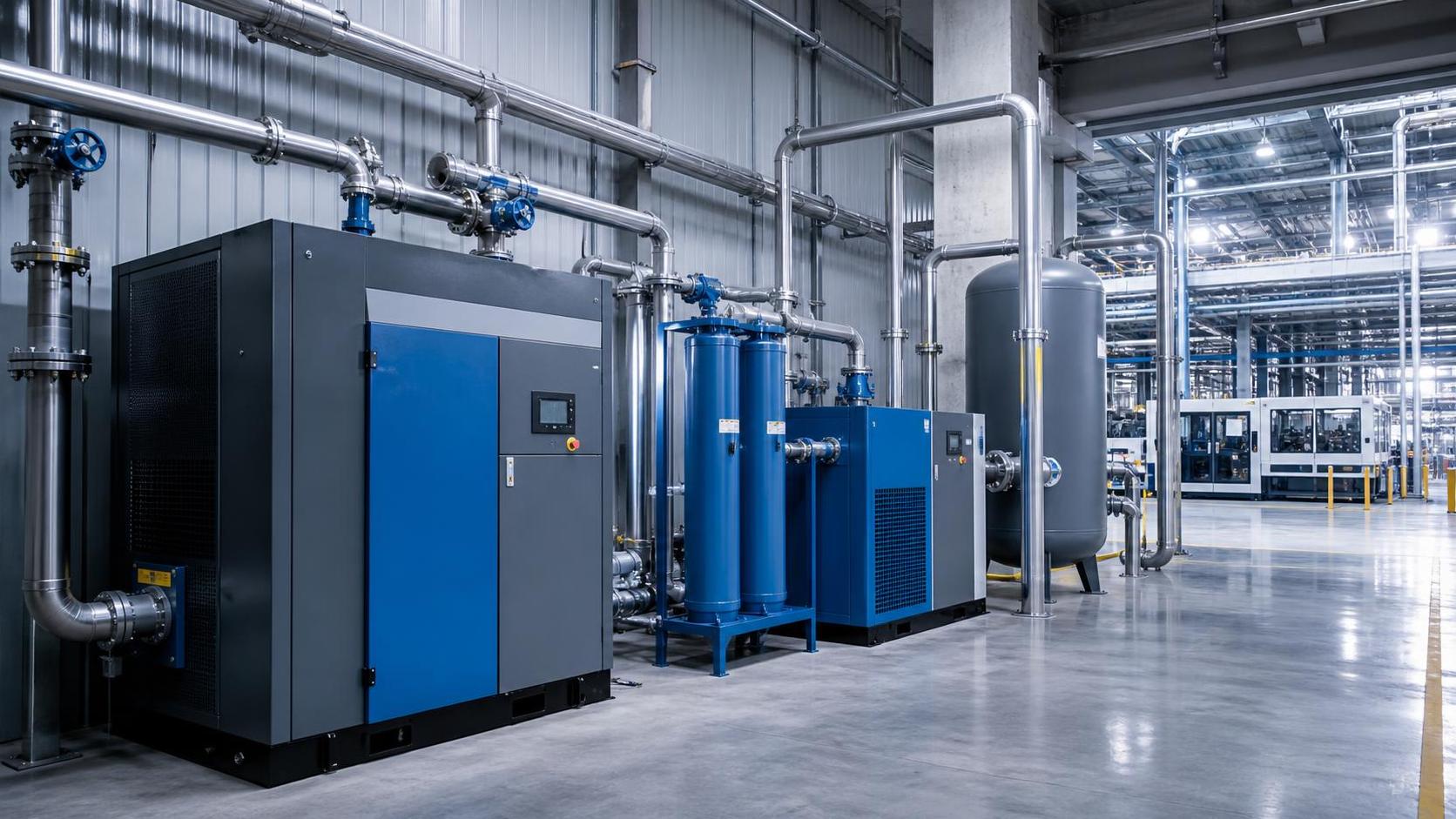
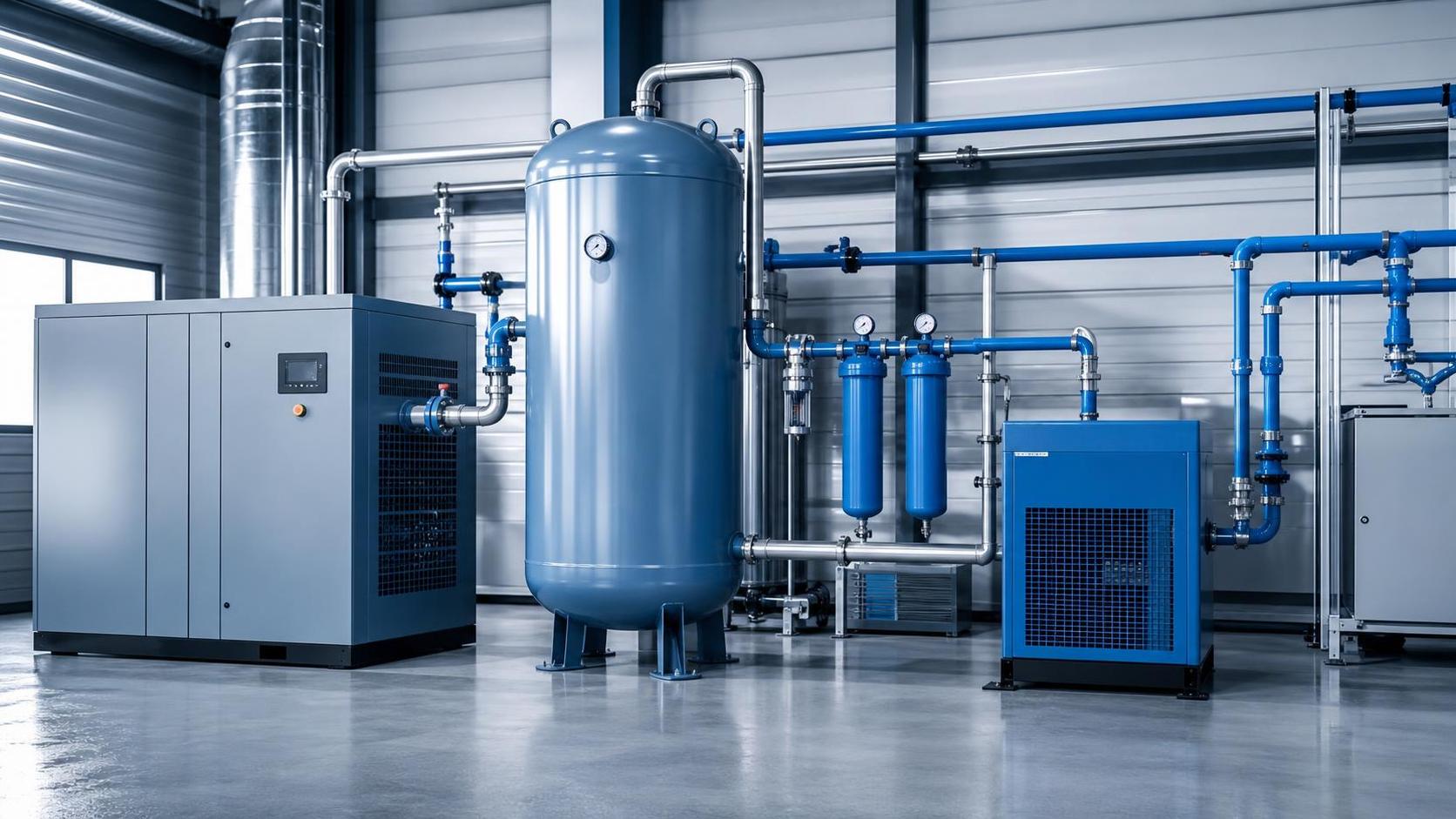
Receiver location relative to air treatment changes both pressure behavior and condensate handling. An upstream wet receiver can help cool compressed air and knock out bulk moisture before the dryer. A downstream dry receiver gives cleaner usable storage and can stabilize pressure after treatment equipment. Some systems use both because each tank is solving a different problem.
For selection, do not just ask how many liters or gallons are needed. Ask where that volume should sit in the process. A dry receiver placed downstream of a restrictive filter train may protect end users better than increasing wet-side storage. Conversely, if the dryer is struggling with inlet load swings, upstream storage may improve overall behavior more than a bigger downstream vessel.
Use a quick evaluation table before you approve the tank
Watch for the mistakes that keep recurring
A few errors show up again and again in receiver tank evaluations.
Using only a generic rule of thumb. It may get you into the right neighborhood, but it is not enough for a decision where pressure stability is already a concern.
Sizing from installed compressor capacity instead of real demand behavior. A plant can have a large compressor and still need only modest storage, or the opposite.
Ignoring future operating modes. If one more machine, one extra shift, or a different packaging cycle is already planned, the tank should be checked against that operating pattern now, not after commissioning.
Assuming bigger is automatically safer. Larger vessels take space, add cost, affect control response, and may complicate condensate management. Oversizing is not free.
A practical order for the decision
If you need a clean evaluation path, use this order.
- Identify the instability event you are trying to control.
- Measure or map the demand spike duration and frequency.
- Set the minimum acceptable pressure at the critical point of use.
- Subtract realistic treatment and piping losses to define the usable pressure band.
- Check compressor control response and staging behavior.
- Decide whether storage should be central, downstream, or local to the load.
- Then size the compressed air equipment receiver tank from those conditions.
That sequence keeps the tank tied to the pressure problem it is supposed to solve. For technical evaluators, that is the difference between approving a vessel and improving a system.
Related News
- When does process utilities engineering reduce project rework?Author :

- Where thermal efficiency optimization delivers the fastest savings in EuropeAuthor :

- What should you verify before selecting a heat transfer supplier?Author :

- What drives compressed air systems price for industrial projects?Author :

- How an industrial product knowledge comparison guide reduces sourcing riskAuthor :

- When does a procurement specification planning process reduce bid risk?Author :

- When does thermal system optimization for electronics reduce failure risk?Author :

- When high temperature process heating systems justify the higher energy costAuthor :

- How to compare sludge dewatering equipment by cake drynessAuthor :

- What to Check Before Sourcing a Gas Turbine for Distributed Power ProjectsAuthor :

- What drives industrial thermal systems price in large facility projectsAuthor :

- How to build an industrial product comparison chart that speeds up vendor selectionAuthor :

- Vacuum Technology Application Guide for Selecting the Right SystemAuthor :

- What Drives Vacuum Drying Cost in Industrial Procurement?Author :

- What Drives Compressed Air Pricing in Industrial Systems?Author :

- How Procurement Specification Planning Shapes Total Project CostAuthor :

- Compression Technology Guide: How to Compare Efficiency, Pressure Range, and Maintenance NeedsAuthor :

- How to Compare Industrial Separators by Throughput, Purity, and Maintenance LoadAuthor :

- How to Size a Compressed Air Equipment Receiver Tank for Stable PressureAuthor :

- Industrial Equipment Selection Guide: How to Compare Capacity, Duty Cycle, and Operating CostAuthor :

- How to Evaluate an Intellectualization Supplier for Industrial UpgradesAuthor :

- High-Efficiency Manufacturing: Cost Savings vs. Upgrade RiskAuthor :

- Thermal System Optimization Cost: What Drives ROI?Author :

- How to Plan Process Utilities for a Cleanroom Without Costly ReworkAuthor :

- How to Compare Process Heating Suppliers in MexicoAuthor :

- Food Processing Utilities: Common Sizing Mistakes That Raise Energy and Water UseAuthor :

- How to Build Procurement Specification Planning for Industrial EquipmentAuthor :

- OEM Cooperation for Industrial Equipment: Risks, Terms, and Cost PrioritiesAuthor :

- Specification-Oriented Product Resources That Speed Technical ReviewAuthor :

- Industrial Equipment Selection Guide: A Practical Buyer ChecklistAuthor :

- How to Compare Industrial Energy Management Systems by ROIAuthor :

- How to Evaluate a Deaerators Supplier for Long-Term Plant ReliabilityAuthor :
![]()
- How to Evaluate a Vacuum Technology Manufacturer in 2026Author :

- Thermal Efficiency Optimization Software: When the ROI Justifies DeploymentAuthor :

- How to Evaluate Application-Specific Compression Solutions by Throughput and Energy UseAuthor :

- Smart Device Thermal Management Supplier Europe: What Matters Beyond PriceAuthor :