High-Efficiency Manufacturing: Cost Savings vs. Upgrade Risk




High-Efficiency Manufacturing: Cost Savings vs. Upgrade Risk
In high-efficiency manufacturing, the promise of lower operating costs often comes with a difficult question: how much upgrade risk can your business afford? For decision-makers balancing energy efficiency, production continuity, and capital planning, the answer requires more than intuition. This article explores how to evaluate savings potential against technical, financial, and operational uncertainty in a rapidly evolving industrial landscape.
If you are reviewing a compressor replacement, a chiller retrofit, a heat recovery project, or a broader utility-system upgrade, the mistake is usually not “buying the wrong technology” in isolation. It is approving a project before the operating boundary is clear. In practice, the savings case often looks strong on paper, while the actual risk sits in downtime windows, controls integration, site utilities, maintenance capability, and load variability.
For procurement and plant leadership, a useful checklist is not a list of generic features. It is a way to pressure-test whether expected savings will still hold once the equipment is installed and asked to run in your real production environment.
Start with the cost that actually hurts
Before comparing suppliers, pin down which cost line you are trying to move. Energy is obvious, but it is rarely the only one that matters. In compressed air and thermal systems, the bigger business case can come from scrap reduction, tighter process stability, fewer unplanned stops, lower water use, or less operator intervention.
- Is the current pain mainly electricity consumption?
- Are you paying for instability, such as pressure swings, temperature drift, or vacuum inconsistency?
- Does maintenance labor or spare-part exposure outweigh energy savings?
- Is the real issue capacity margin during seasonal peaks or product changeovers?
This matters because two projects with the same projected payback can carry very different upgrade risk. A plant that needs stable dew point for sensitive production will evaluate a compressed air upgrade differently from a site mainly chasing lower kWh per unit output.
Do not approve from nameplate data alone
One of the most common buying errors in high-efficiency manufacturing is treating design-point performance as site performance. Nameplate efficiency, catalog COP, or compressor-specific power only tells part of the story. Your actual operating profile decides whether the promised savings survive commissioning.
Ask for a load profile, not just a specification sheet. For compressed air, that means understanding demand swings by shift, idle periods, leaks, pressure bands, and any high-flow intermittent users. For cooling and heat exchange systems, look at entering temperatures, seasonal ambient variation, fouling risk, partial-load operation, and control logic between parallel units.
If your team does not have measured trend data, that is a warning sign. It does not mean the project is wrong. It means the confidence level on the savings estimate is lower than many business cases admit.
A practical procurement question is simple: what percentage of annual operating hours will this system spend at the condition where its efficiency claim is strongest? If no one can answer, the proposal is still too early.
Check the hidden risk in system integration
Most upgrade headaches show up at the interfaces. Not inside the machine.
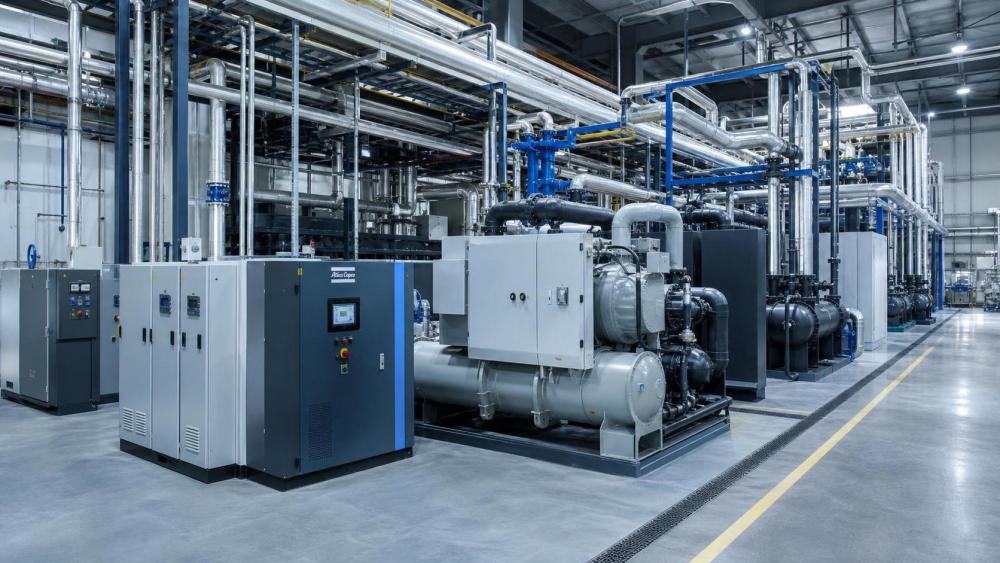
A new high-efficiency compressor may need different control sequencing with existing dryers and receivers. A heat exchanger upgrade may change pressure drop enough to affect pumps, valves, or process response. A chiller retrofit may look straightforward until the building management system or plant SCADA has to be modified.
When reviewing bids, separate equipment scope from integration scope. Many proposals are competitive on capital cost because controls work, piping changes, commissioning support, operator training, or temporary bypass arrangements are left vague. That is where budget creep starts.
Treat downtime risk as a direct cost, not a side note
This is where many cost-saving discussions become unrealistic. A project with an attractive energy payback can still be a poor decision if one failed commissioning weekend disrupts a production line with tight customer commitments.
Decision-makers should ask for a downtime scenario, not just a payback model. What happens if startup slips by 48 hours? What temporary capacity exists if a controller, VSD, or critical valve fails during ramp-up? Is there a bypass plan? Is there rental backup in the market for your operating region? These questions are especially important for pharmaceutical, semiconductor, food, and other process-sensitive sectors where utilities are not background infrastructure but part of product quality control.
If the supplier response stays at a high level, push further. Commissioning risk is part of the acquisition cost whether it appears on the quotation or not.
Look past payback and test the full cash picture
Simple payback is useful because everybody understands it. It is also too blunt for upgrades that affect production continuity.
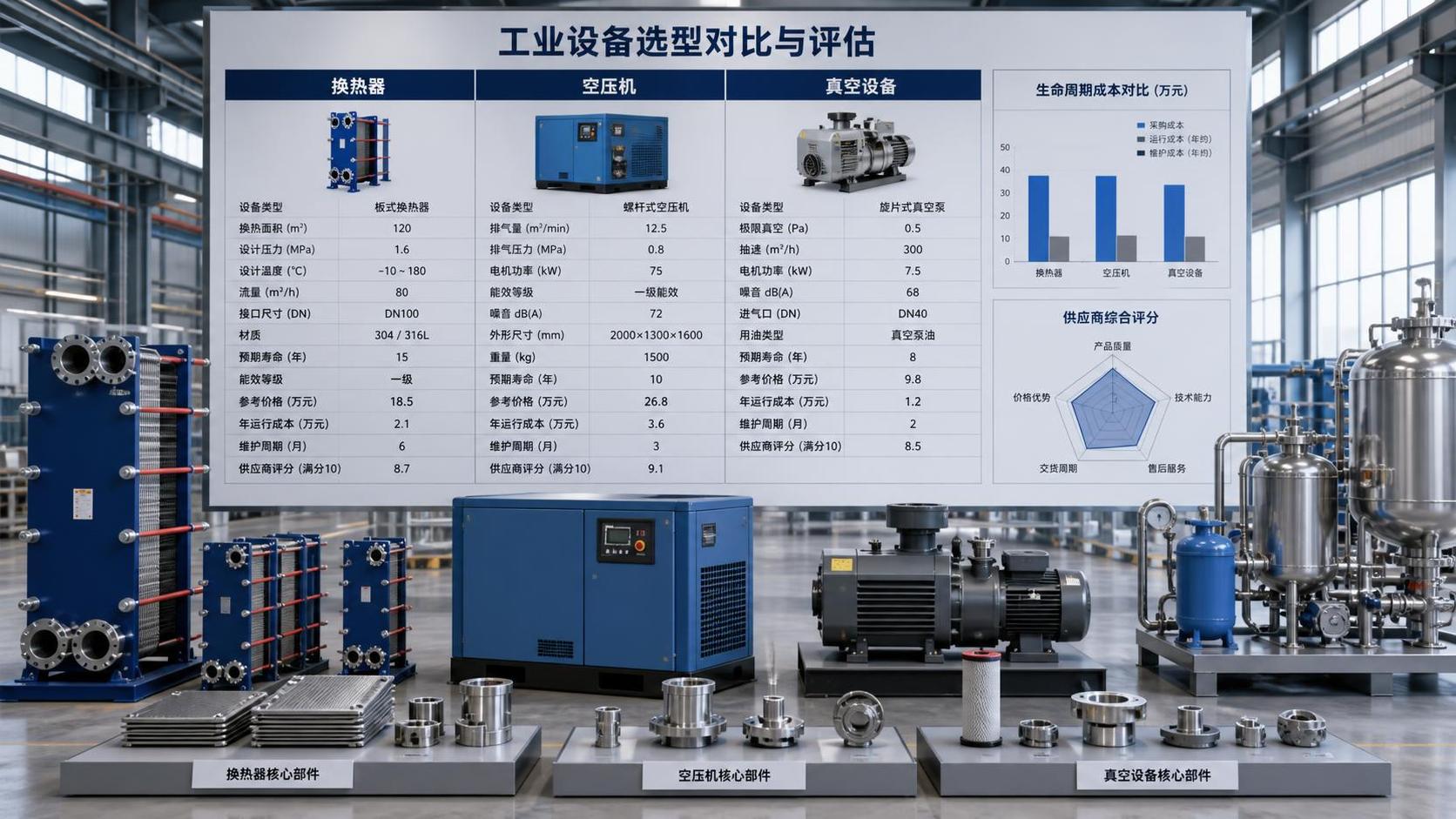
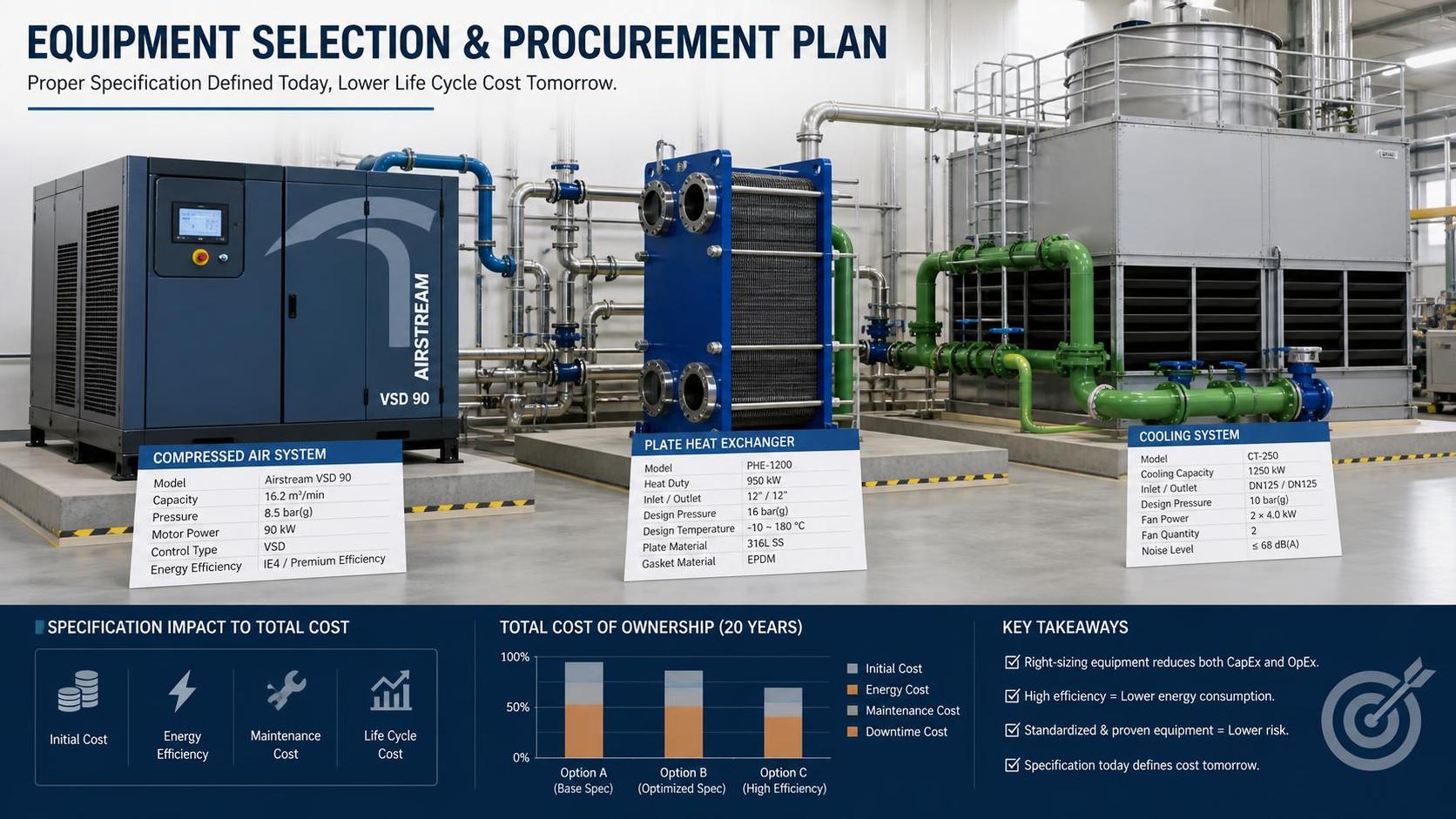
For a serious procurement decision, compare at least these cost layers:
- Installed capital cost, including integration work
- Expected energy use under partial load, not only full load
- Maintenance contracts, consumables, and critical spare parts
- Expected life of major components
- Residual value or replacement path if production demand changes
- The financial exposure of one serious outage
That last point changes decisions more than people expect. In some plants, one day of lost output outweighs a year of utility savings. In others, energy inflation or carbon-related cost exposure may justify a faster move toward efficient equipment. The right answer depends on your process economics, not on a generic ROI threshold.
Be careful with “future-proof” claims
Suppliers often position advanced systems as protection against future regulation, rising energy prices, or sustainability reporting pressure. Sometimes that is valid. Sometimes it is a sales shortcut.
A better way to test it is to ask which external variables the project is actually sensitive to. For example, refrigerant-related compliance requirements depend on jurisdiction and application, and policy details can change over time. If a proposal relies heavily on regulatory urgency, mark those assumptions as 【待核实】 until your compliance or legal team confirms the local exposure.
The same goes for vendor claims about broad decarbonization benefits. They may be directionally reasonable, but your buying decision should still rest on site-specific energy mix, operating hours, and measurable process demand.
Match technology ambition to your maintenance reality
This part gets underestimated by corporate teams that do not live with the equipment every day. A technically superior package can become a bad asset if your site lacks the maintenance discipline, digital infrastructure, or spare-parts support to keep it within design performance.
Ask blunt questions. Who will own alarm response? Can your team interpret trend data, or will every control issue become a service call? Are critical parts available locally, or are they imported with long lead times? Oil-free systems, advanced heat recovery loops, and tightly integrated automation can be excellent choices, but only if the operating model is ready for them.
A good procurement process includes the maintenance manager early. If that person is uneasy for concrete reasons, listen carefully.
Regional supply conditions matter more than brochures suggest
Global equipment markets are not uniform. Service density, spare-part availability, local engineering support, grid stability, water quality, ambient conditions, and even installer competence vary by region. A configuration that performs well in one market may carry much higher execution risk in another.
This is especially relevant when a headquarters-led sourcing strategy tries to standardize platforms across multiple plants. Standardization can help with training and purchasing leverage, but it should not override local operating constraints. In thermal and compression systems, site conditions still decide whether efficiency is durable or fragile.
A short shortlist test before you sign
When two or three options remain, use a final check that combines savings logic with upgrade risk:
- Can the supplier show performance assumptions tied to your operating profile, not a generic benchmark?
- Is integration scope written clearly enough that engineering, procurement, and operations read it the same way?
- Have you priced a realistic commissioning and contingency plan?
- Does the site have the people and support structure to maintain the selected technology properly?
- If energy prices soften or production volumes change, does the business case still stand up?
If too many answers depend on assumptions that no one has verified, you are not looking at a fast-track savings project. You are looking at a project that needs another round of technical diligence.
What experienced buyers usually decide
Experienced buyers in high-efficiency manufacturing rarely reject efficiency upgrades because they dislike innovation. They slow down when the proposed savings are real, but the execution path is vague. In most plants, that instinct is healthy.
The better decision is usually the one that keeps three things in balance: measurable operating savings, manageable installation risk, and a maintenance model the site can actually sustain. If one of those is weak, the project is not ready, no matter how attractive the energy estimate looks.
For decision-makers using market intelligence platforms such as GTC-Matrix, the practical advantage is not just seeing where technology is heading. It is using that intelligence to challenge assumptions before capital is committed: which efficiency claims fit your load profile, which upgrade paths align with your operational tolerance, and which risks belong in the budget from day one. That is where cost savings become bankable instead of theoretical.
Ready when you are. Send us a message to get started.
Related News
- How to select industrial equipment for automation with existing PLCsAuthor :

- How electricity prices shape industrial compressed air price trendsAuthor :

- Choosing air filtration systems for heavy dust in the Middle EastAuthor :

- How much does a fully installed compressed air monitoring system cost?Author :

- What documentation supports CE marking for industrial equipment?Author :

- How local support affects vacuum system costs in Southeast AsiaAuthor :

- How worldwide industry category guides help compare market opportunitiesAuthor :

- What drives sustainable thermal systems cost over their operating life?Author :

- Which industrial solution comparison criteria prevent project delays?Author :

- How Ambient Temperature and Load Profile Affect Industrial Compressor SizingAuthor :

- What to evaluate before choosing a thermal process engineering supplierAuthor :

- How industrial utility systems affect energy costs in process plantsAuthor :

- What Data Is Needed to Assess Heat Recovery Decarbonization?Author :

- Can Waste Heat Recovery Support Carbon Neutrality Targets?Author :

- Is Compressor Heat Recovery Worth the Installation Cost?Author :

- What to verify before choosing a process separation technology supplierAuthor :

- When does process utilities engineering reduce project rework?Author :

- Where thermal efficiency optimization delivers the fastest savings in EuropeAuthor :

- What should you verify before selecting a heat transfer supplier?Author :

- What drives compressed air systems price for industrial projects?Author :

- How an industrial product knowledge comparison guide reduces sourcing riskAuthor :

- When does a procurement specification planning process reduce bid risk?Author :

- When does thermal system optimization for electronics reduce failure risk?Author :

- When high temperature process heating systems justify the higher energy costAuthor :

- How to compare sludge dewatering equipment by cake drynessAuthor :

- What to Check Before Sourcing a Gas Turbine for Distributed Power ProjectsAuthor :

- What drives industrial thermal systems price in large facility projectsAuthor :

- How to build an industrial product comparison chart that speeds up vendor selectionAuthor :

- Vacuum Technology Application Guide for Selecting the Right SystemAuthor :

- What Drives Vacuum Drying Cost in Industrial Procurement?Author :

- What Drives Compressed Air Pricing in Industrial Systems?Author :

- How Procurement Specification Planning Shapes Total Project CostAuthor :

- Compression Technology Guide: How to Compare Efficiency, Pressure Range, and Maintenance NeedsAuthor :

- How to Compare Industrial Separators by Throughput, Purity, and Maintenance LoadAuthor :

- How to Size a Compressed Air Equipment Receiver Tank for Stable PressureAuthor :

- Industrial Equipment Selection Guide: How to Compare Capacity, Duty Cycle, and Operating CostAuthor :