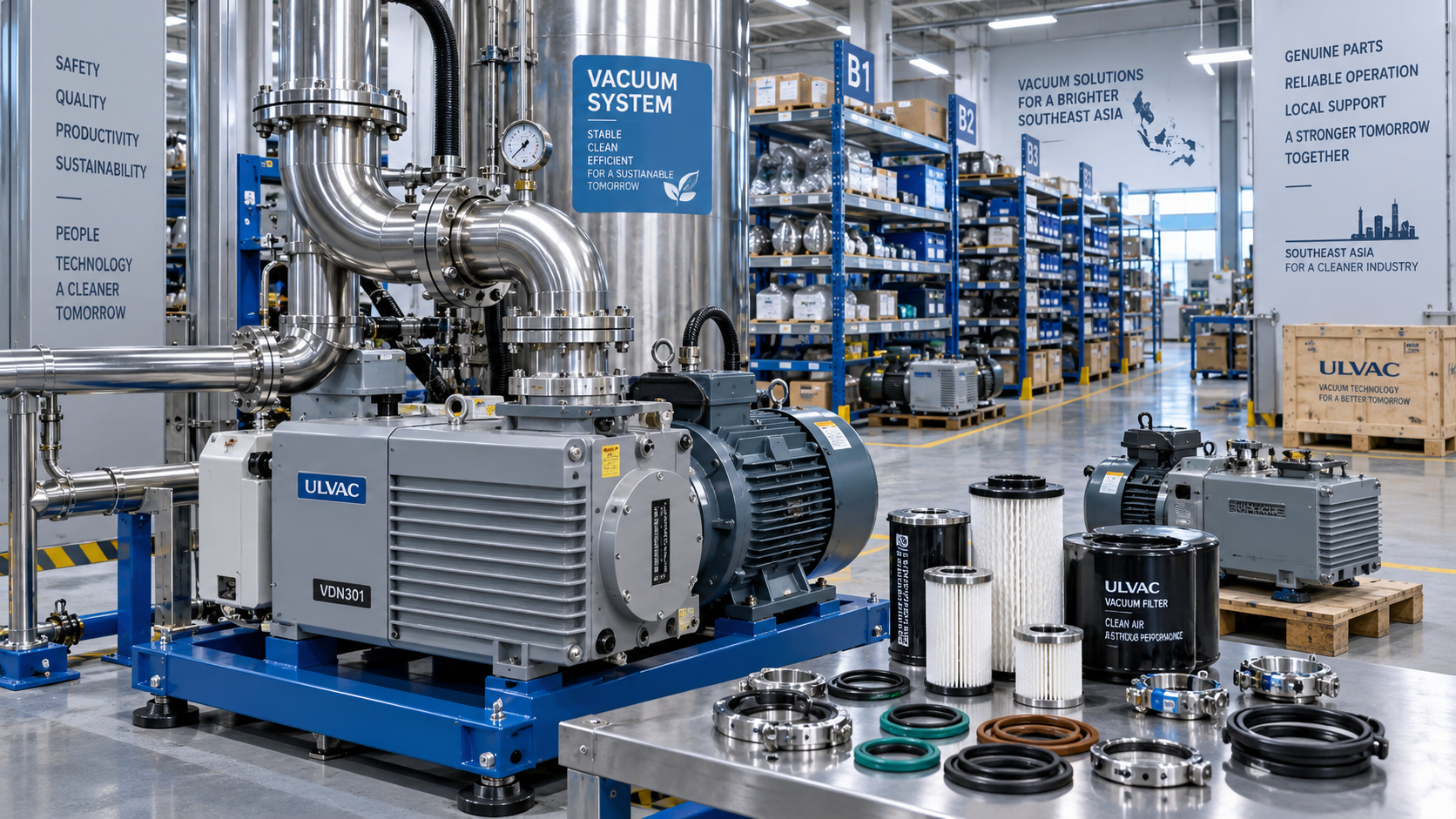




How local support affects vacuum system costs in Southeast Asia




A competitive equipment quote can hide an expensive support gap. When comparing a vacuum system in Southeast Asia, the decisive difference may not be the pump’s purchase price, but how quickly the supplier can restore the required vacuum at the installation site. Spare-parts availability, diagnostic capability, commissioning quality, and access to replacement equipment all affect the cost of keeping production running.
Local support is worth paying for when it demonstrably reduces recovery time, prevents avoidable deterioration, or keeps maintenance predictable. A nearby sales office alone does none of these things. The commercial question is whether the proposed service arrangement can deliver the right technician, part, and repair capability to the actual plant—and whether that commitment is reflected in the quotation and contract.
The cost difference appears between failure and recovery
A vacuum pump failure does not automatically equal a production stoppage. A standby pump, buffer capacity, or an independent production line may limit the impact. Conversely, a system can remain operational while insufficient vacuum slows evacuation, lengthens drying cycles, or causes packaging defects. Support costs therefore need to be assessed against the process consequence, not simply the pump’s rated capacity.
For a production-critical installation, recovery time includes several separate intervals: recognizing the fault, obtaining a diagnosis, arranging site access, delivering parts, completing repairs, and confirming acceptable performance. A supplier that answers the telephone immediately but waits for an overseas assembly may offer little advantage over a distant competitor.
Compare offers using a consistent ownership-cost boundary:
- Installed equipment cost, including commissioning and site interfaces.
- Electricity, cooling water, seal water, and other operating utilities where applicable.
- Scheduled maintenance, consumables, service labor, and travel.
- Unplanned repairs, emergency freight, and temporary replacement equipment.
- Production losses attributable to reduced performance or unavailable vacuum.
Keep production losses separate from maintenance spending so the same consequence is not counted twice. Lost contribution margin, scrapped material, and restart costs can be relevant; gross sales revenue is not automatically the correct measure of downtime. Where another line can absorb production, the financial impact may instead be overtime, rescheduling, or delayed deliveries.
“Regional coverage” must be tested at the plant location
Southeast Asia is not a single service territory. A technician based in Singapore may be geographically close to another country but still need international travel, permission to perform site work, and parts clearance. An installation on an island or far from an international airport has different recovery logistics from one near an established repair workshop.
The useful distinction is between local presence and local capability. A distributor may hold consumables but send major repairs abroad. A regional service center may have substantial workshop capability but no technician available for an urgent site visit. Neither arrangement is inherently unsuitable; the problem is pricing it as though it guarantees rapid restoration.
Ask suppliers to describe support for the specific installation address, not just provide a country coverage map. The response should identify the dispatch location, responsible service organization, applicable working hours, travel charges, and the point at which the manufacturer becomes involved. If a subcontractor will perform the work, establish who takes responsibility for diagnosis, workmanship, warranty decisions, and escalation.
A service promise becomes commercially useful only when its exclusions are visible. Weekend premiums, minimum callout charges, accommodation, remote-site transport, and border-related delays can materially change the apparent value of a support package.
Spare-parts policy can matter more than distance
The parts needed to service an oil-sealed rotary vane pump differ from those needed for a dry screw pump or a liquid ring system. Filters, lubricants, and seals may support routine maintenance, but they do not establish the ability to recover from a damaged rotor, failed drive, or control fault. Parts availability must be checked against credible failure modes for the proposed equipment.
For an oil-sealed pump, confirm the availability of specified oil, exhaust filters, seals, and relevant repair kits. For a dry screw installation, establish whether the local workshop can perform the required mechanical work and clearances, or whether it can only exchange the pump assembly. For a liquid ring system, include shaft seals and the seal-liquid circuit in the review; inadequate liquid conditions can undermine vacuum performance even when the pump itself is intact.
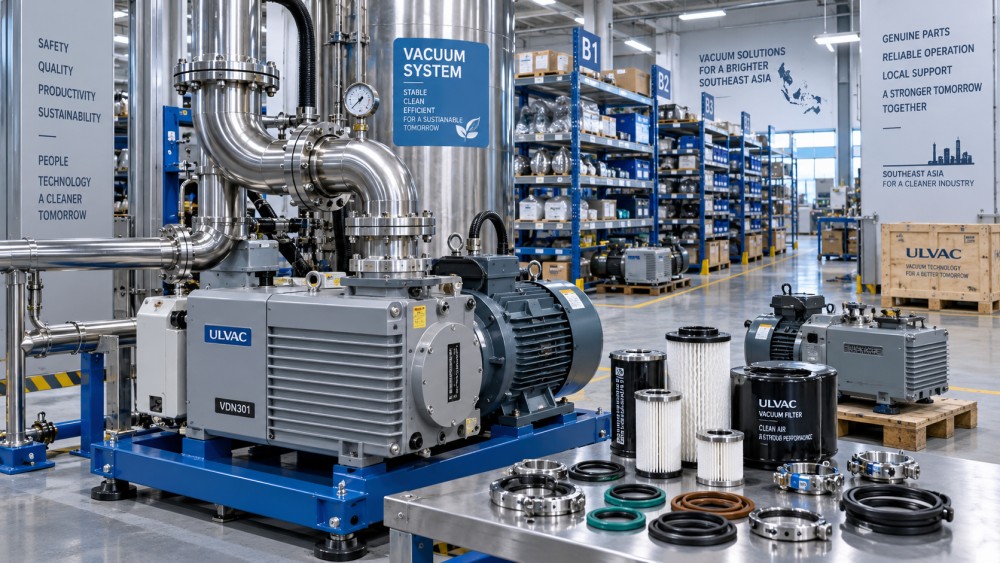
Ownership of stock also matters. “Available in the region” may mean a part is held for another customer, requires approval before release, or must move across a border. A consignment arrangement or site-held critical spare can reduce this uncertainty, but it adds capital tied up in inventory, storage requirements, and the risk of unused or obsolete parts.
A practical approach separates routine consumables from production-critical items. Routine stock should reflect the maintenance schedule and replenishment lead time. Critical stock should reflect the consequence of failure and the available recovery alternatives. There is little value in holding an expensive component that site personnel cannot safely install and the local workshop cannot fit.
Interchangeability needs equal scrutiny. Similar rated pumping speed does not guarantee that a loan unit will deliver the required performance at operating pressure. Connections, motor supply, controls, process compatibility, and exhaust handling must also match. A replacement that needs extensive piping or control changes is not an immediate recovery solution.
Commissioning quality changes operating costs long after installation
Local support can create value before any failure occurs. Commissioning should establish that the complete system reaches the required pressure and throughput under representative process conditions—not merely that the motor runs and the pump reaches its ultimate pressure with the inlet isolated.
Leaks, restrictive pipework, incorrect valve operation, unsuitable cooling conditions, and excessive process vapor can all reduce usable performance. If these problems remain unresolved, the plant may compensate through longer operating hours, additional pumps, or more frequent maintenance. The equipment purchase then appears economical while the process absorbs the extra cost.
Site conditions should be part of the commissioning scope. Ambient heat and humidity can affect cooling and condensation behavior; airborne contamination can obstruct heat-transfer surfaces. The relevance depends on the pump design, installation enclosure, process gases, and utility conditions. Treating every Southeast Asian site as having identical requirements is no more useful than ignoring the environment altogether.
The service team should document baseline operating pressure, evacuation time or throughput, power demand at defined conditions, and relevant temperatures and utility settings. These records give later troubleshooting a reference point and help distinguish equipment deterioration from changes in production load.
Energy claims also need careful boundaries. A variable-speed drive does not guarantee savings if the process requires sustained full capacity, and lower ultimate pressure does not necessarily improve the production cycle. Support has measurable value when technicians can identify unnecessary runtime, leakage, or unsuitable control settings—not simply recommend a larger pump.
Price the support premium against a realistic recovery scenario
Consider an illustrative comparison, not a market quotation. Two systems meet the same process requirements. One costs US$8,000 more to install, and its proposed local service agreement adds US$1,000 annually. Over five years, its additional direct cost is US$13,000 before discounting, assuming other operating and maintenance costs are equal.
Suppose a qualifying failure would cause 30 more hours of production interruption under the lower-priced offer because its replacement assembly must arrive from overseas. If the site calculates the net loss from unavailable vacuum at US$600 per hour, avoiding those 30 hours would be worth US$18,000. One such event would exceed the additional direct cost.
That does not prove the higher-priced offer is better. If the probability of one such event over the five-year period were only 20%, its simplified expected downtime benefit would be US$3,600—not US$18,000. The probability is a scenario assumption, not supplier evidence. A standby system that maintains production could reduce the benefit further.
This distinction prevents two common errors: treating every possible failure as certain, and treating an uncertain failure as financially irrelevant. Use several scenarios rather than presenting a single estimate as a forecast. Test no major failure, one recoverable failure, and an extended interruption, with assumptions grounded in the site’s process and maintenance arrangements.
The support premium may also reduce travel charges, planned maintenance costs, or inventory requirements. Include those savings only where the commercial terms support them. Avoid counting a replacement pump twice—as both eliminating downtime and avoiding a separate standby investment—unless the proposed arrangement genuinely delivers both benefits.
For a process with limited financial exposure, buying routine spares and training site personnel may be more economical than comprehensive service coverage. For a process where loss of vacuum immediately stops high-value output, redundancy plus qualified local support may be justified. Support and redundancy address different risks: one shortens recovery; the other helps maintain operation during recovery.
Turn service capability into enforceable purchasing terms
A meaningful service schedule distinguishes acknowledgment time from technician attendance and from restoration. Restoration cannot always be guaranteed before the fault is understood, but the agreement can define diagnostic escalation, parts dispatch, replacement-equipment access, and responsibility for progress updates.
Specify which costs are included: preventive visits, labor, consumables, travel, emergency callouts, and workshop repairs. Clarify whether quoted maintenance intervals depend on operating hours, process exposure, or inspection findings. Otherwise, a fixed annual price may cover only a narrow inspection while the expensive work remains chargeable.
Acceptance criteria should cover performance at agreed process conditions, documentation, operator training, and handover of maintenance requirements. Warranty terms should identify permitted service providers and consumables, claim procedures, and relevant exclusions. A warranty covering a failed component does not necessarily cover travel, production loss, or the time needed to obtain that component.
For specialized systems, preserve access to control backups, fault histories, parameter records, and service documentation within the supplier’s legitimate licensing and safety restrictions. If only an overseas engineer can interpret alarms or restore configuration, local mechanical support alone will not resolve the dependency.
The purchasing decision should ultimately rest on a credible recovery pathway. Where a supplier can demonstrate model-specific expertise, accessible critical parts, compatible temporary capacity, and clear commercial responsibility, a higher equipment price can buy a lower cost of interruption. Where those capabilities remain undefined, “local support” is a claim—not yet a financial benefit.
Ready when you are. Send us a message to get started.
Related News
- How electricity prices shape industrial compressed air price trendsAuthor :

- Choosing air filtration systems for heavy dust in the Middle EastAuthor :

- How much does a fully installed compressed air monitoring system cost?Author :

- What documentation supports CE marking for industrial equipment?Author :

- How local support affects vacuum system costs in Southeast AsiaAuthor :

- How worldwide industry category guides help compare market opportunitiesAuthor :

- What drives sustainable thermal systems cost over their operating life?Author :

- Which industrial solution comparison criteria prevent project delays?Author :

- How Ambient Temperature and Load Profile Affect Industrial Compressor SizingAuthor :

- What to evaluate before choosing a thermal process engineering supplierAuthor :

- How industrial utility systems affect energy costs in process plantsAuthor :

- What Data Is Needed to Assess Heat Recovery Decarbonization?Author :

- Can Waste Heat Recovery Support Carbon Neutrality Targets?Author :

- Is Compressor Heat Recovery Worth the Installation Cost?Author :

- What to verify before choosing a process separation technology supplierAuthor :

- When does process utilities engineering reduce project rework?Author :

- Where thermal efficiency optimization delivers the fastest savings in EuropeAuthor :

- What should you verify before selecting a heat transfer supplier?Author :

- What drives compressed air systems price for industrial projects?Author :

- How an industrial product knowledge comparison guide reduces sourcing riskAuthor :

- When does a procurement specification planning process reduce bid risk?Author :

- When does thermal system optimization for electronics reduce failure risk?Author :

- When high temperature process heating systems justify the higher energy costAuthor :

- How to compare sludge dewatering equipment by cake drynessAuthor :

- What to Check Before Sourcing a Gas Turbine for Distributed Power ProjectsAuthor :

- What drives industrial thermal systems price in large facility projectsAuthor :

- How to build an industrial product comparison chart that speeds up vendor selectionAuthor :

- Vacuum Technology Application Guide for Selecting the Right SystemAuthor :

- What Drives Vacuum Drying Cost in Industrial Procurement?Author :

- What Drives Compressed Air Pricing in Industrial Systems?Author :

- How Procurement Specification Planning Shapes Total Project CostAuthor :

- Compression Technology Guide: How to Compare Efficiency, Pressure Range, and Maintenance NeedsAuthor :

- How to Compare Industrial Separators by Throughput, Purity, and Maintenance LoadAuthor :

- How to Size a Compressed Air Equipment Receiver Tank for Stable PressureAuthor :

- Industrial Equipment Selection Guide: How to Compare Capacity, Duty Cycle, and Operating CostAuthor :

- How to Evaluate an Intellectualization Supplier for Industrial UpgradesAuthor :