



How much does a fully installed compressed air monitoring system cost?




How much does a fully installed compressed air monitoring system cost?
What should a plant budget for a fully installed compressed air monitoring system—and what might a supplier’s quote leave out? The compressed air monitoring price depends on more than sensors. Installation labor, pipe modifications, data connectivity, software licensing, and commissioning can all change the final investment. A useful quotation must connect those costs to a defined measurement scope, not simply offer a dashboard and a box of instruments.
For preliminary budgeting, consider allowances of US$5,000–15,000 for a limited installation, US$15,000–40,000 for broader compressor-room monitoring, and US$40,000–100,000 or more for an extensive plant-wide deployment. These are indicative planning ranges, not verified market averages or supplier quotations. Local labor rates, measurement locations, installation conditions, and integration requirements can move a project outside them. Taxes, production losses during shutdowns, and major infrastructure upgrades should be assessed separately.
Define what “fully installed” actually covers
The phrase sounds comprehensive, but suppliers may interpret it differently. One proposal may include mechanical fitting and a working display. Another may include electrical work, network configuration, historical reporting, operator training, and documented acceptance testing. Both can be described as installed systems, yet they deliver different levels of operational readiness.
A complete scope should follow the measurement chain: instruments, process connections, wiring or wireless links, gateway, data storage, software, and usable reports. It should also identify who is responsible for safe isolation, access equipment, electrical protection, and restoring the pipework after installation.
Start with the decisions the system must support. Detecting excessive weekend consumption requires a different arrangement from comparing individual compressor efficiency or allocating air costs across production departments. Buying every available measurement is rarely necessary. Buying too few can leave an attractive dashboard unable to answer the original question.
Treat these allowances as a starting point for a site survey, not a substitute for one. A compact plant with difficult pipe access can cost more to instrument than a larger facility with prepared connections and existing network infrastructure.
The measurement boundary drives the hardware bill
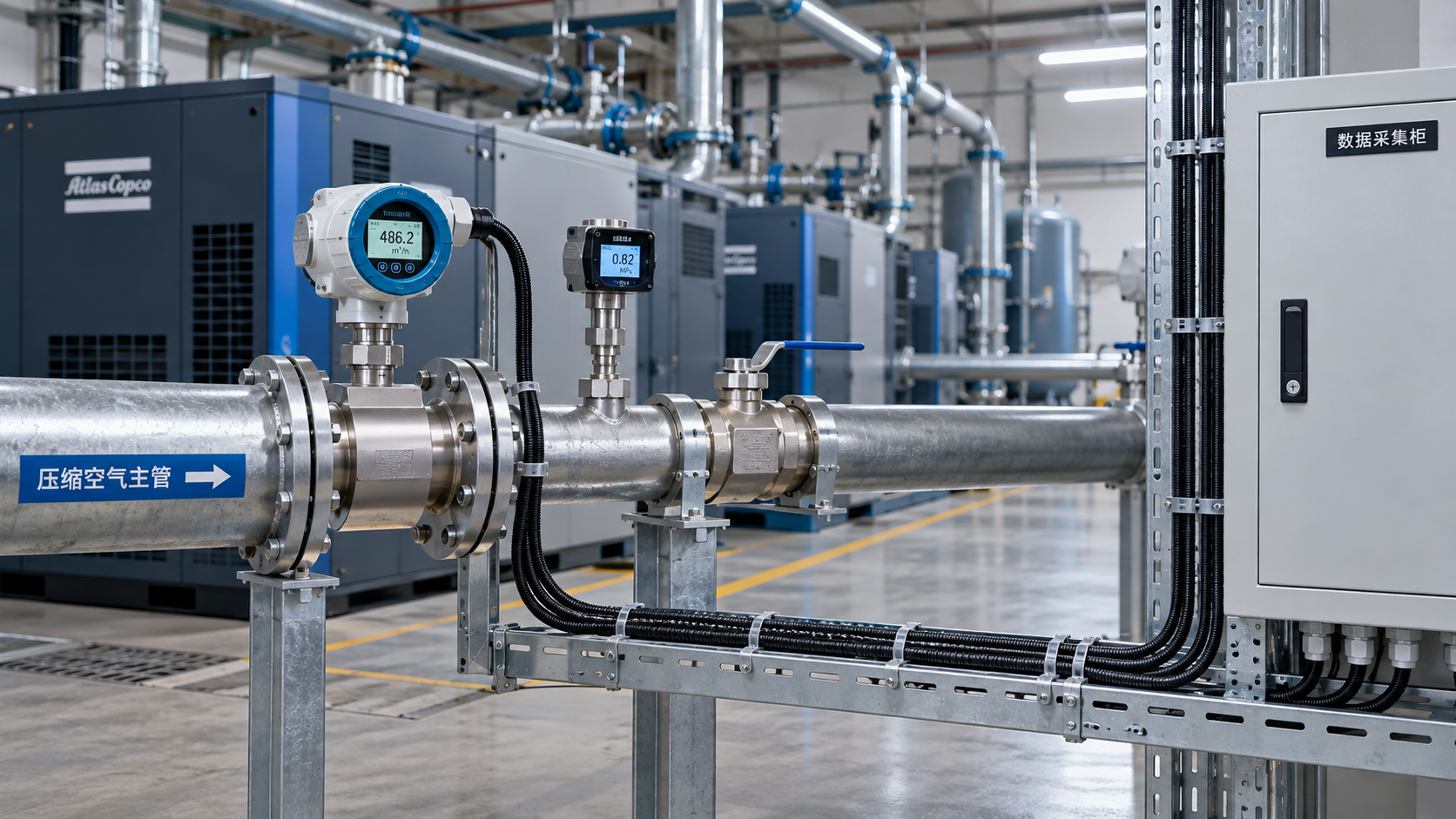
Flow, pressure, and electrical power provide the foundation for many energy-focused projects. Together, they help distinguish air demand from the energy required to supply it. Dew point, temperature, and filter differential pressure may also be justified, but each should answer a specific operational or quality question.
Location matters as much as quantity. Measuring total flow downstream of treatment equipment answers a different question from measuring compressor discharge. Dryer purge, receiver storage, and branching pipework can complicate comparisons. Power and flow measurements must cover compatible boundaries before a specific-power calculation becomes meaningful.
Ask suppliers to state the expected flow range, pressure and temperature limits, air condition, pipe dimensions, and required installation geometry. A meter selected only for peak demand may provide insufficient resolution during low-load periods—the very periods when unwanted consumption becomes easier to investigate. Measurement uncertainty across the expected operating range deserves more attention than a headline accuracy figure.
Also confirm whether reported air volume uses actual or reference conditions. Reference pressure, temperature, and moisture assumptions must be consistent across meters and reports. Otherwise, differences between departments may reflect incompatible settings rather than real consumption.
Why installation can change the price so sharply
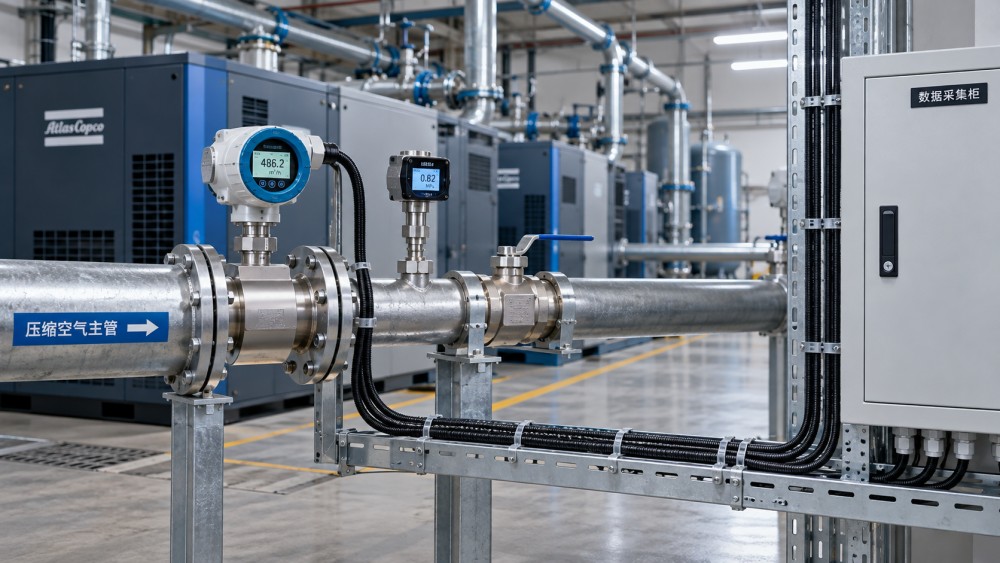
A sensor price does not reveal what it will cost to put that sensor into service. Accessible pipework with suitable connections is one situation. An overhead header requiring isolation, new fittings, access equipment, and a narrow shutdown window is another.
Insertion and inline meters create different installation requirements. Some insertion arrangements can support installation or removal under pressure, but only with appropriately rated fittings, suitable equipment, and approved procedures. Do not assume every probe supports hot tapping or safe withdrawal while pressurized. Inline meters may require pipe cutting, additional supports, and planned downtime.
Electrical power measurement introduces separate work. Existing compressor-controller data can sometimes be integrated, but its availability, resolution, and accuracy must be checked. Motor nameplate power is not a reliable replacement for measured operating power. Where independent electrical metering is needed, allow for qualified installation, panel access, and any necessary isolation.
In food, pharmaceutical, and other controlled environments, change-control procedures, documentation, cleaning restrictions, and approved work windows may add cost. The quotation should identify applicable site requirements rather than assume ordinary workshop access.
Software costs continue after commissioning
Separate the installed capital cost from recurring operating costs. Cloud subscriptions, historian licenses, cellular connectivity, support, calibration, and replacement instruments may fall outside the headline price. A low entry price is not necessarily poor value, but it becomes difficult to compare when recurring charges remain undefined.
Request a five-year ownership schedule showing the initial installation and each expected renewal. Identify whether licensing depends on measurement points, devices, users, sites, or data volume. Ask what happens if the subscription ends: can the plant still view live readings, access historical data, and export records?
Connectivity also needs a named owner. An Ethernet connection does not automatically include firewall approval, network segmentation, server configuration, or integration with an existing energy-management platform. Wireless communication can reduce cabling, but coverage and reliability should be checked in the actual plant environment.
Monitoring and control are different scopes. A system that reports inefficient compressor operation may not change sequencing or pressure settings. If automatic optimization is expected, specify the controller interfaces, operating authority, safeguards, and commissioning responsibilities separately.
Compare quotations against the same deliverables
The most useful commercial comparison is not cost per sensor. It is the cost of obtaining reliable answers to agreed operational questions. Before comparing totals, give every bidder the same measurement schedule, installation assumptions, reporting requirements, and acceptance criteria.
- Measurement schedule: tag, location, purpose, operating range, reference conditions, and required uncertainty.
- Responsibility split: mechanical work, electrical work, networking, permits, shutdowns, and access equipment.
- Data specification: sampling, recording intervals, time synchronization, retention, export format, and offline buffering.
- Commercial boundaries: freight, travel, taxes, subscription renewals, support, calibration, and change-order rates.
- Handover requirements: drawings, instrument settings, calibration records where specified, administrator access, training, and report configuration.
Commissioning should prove more than communication. Require checks for flow direction, electrical scaling, units, timestamps, and plausible readings under representative operating conditions. Confirm that the reports needed for acceptance actually work. A dashboard showing live values is not, by itself, evidence that the measurements are correct.
Build the savings case without counting invisible benefits
Monitoring reveals opportunities; maintenance and operating changes deliver most of the savings. Excessive non-production flow might indicate leakage, but it can also include legitimate continuous demand, dryer purge, or equipment left running. Investigation must separate these before assigning a financial benefit.
Use a baseline covering representative shifts and production conditions. Then evaluate specific actions: repairing confirmed leaks, isolating idle areas, adjusting sequencing, or reducing unnecessary pressure where process requirements permit. Record the implementation cost as well as the expected energy reduction.
For illustration only, a US$24,000 installation producing US$10,000 in verified annual electricity savings, with US$2,000 in annual operating costs, would have a three-year simple payback. This assumes no additional corrective-work cost; any such cost belongs in the investment calculation. These figures are arithmetic inputs, not a predicted customer result.
Avoid valuing every unit of reduced air consumption at the same electricity rate without examining compressor response. Reduced demand does not necessarily produce proportional power savings, particularly when machines continue operating unloaded. Verify the change at the electrical meter and account for production differences.
A defensible budget starts with a measurement plan
GTC-Matrix connects industrial cooling, compressed air, vacuum, and heat-exchange intelligence with energy economics. That perspective is useful here: a low compressed air monitoring price is not the same as a low cost of obtaining actionable evidence. The thermodynamic boundary, measurement quality, and ownership costs need to be evaluated together.
Before authorizing a purchase, prepare a marked-up piping layout, compressor operating information, available electrical measurements, and the decisions the system must support. Ask for a site-validated quotation separating equipment, installation, integration, commissioning, and recurring charges. If uncertainty remains high, a temporary measurement campaign may help define a smaller, better-targeted permanent system. Approve the budget when the deliverables and acceptance tests are clear—not merely when the total fits the allowance.
Ready when you are. Send us a message to get started.
Related News
- How electricity prices shape industrial compressed air price trendsAuthor :

- Choosing air filtration systems for heavy dust in the Middle EastAuthor :

- How much does a fully installed compressed air monitoring system cost?Author :

- What documentation supports CE marking for industrial equipment?Author :

- How local support affects vacuum system costs in Southeast AsiaAuthor :

- How worldwide industry category guides help compare market opportunitiesAuthor :

- What drives sustainable thermal systems cost over their operating life?Author :

- Which industrial solution comparison criteria prevent project delays?Author :

- How Ambient Temperature and Load Profile Affect Industrial Compressor SizingAuthor :

- What to evaluate before choosing a thermal process engineering supplierAuthor :

- How industrial utility systems affect energy costs in process plantsAuthor :

- What Data Is Needed to Assess Heat Recovery Decarbonization?Author :

- Can Waste Heat Recovery Support Carbon Neutrality Targets?Author :

- Is Compressor Heat Recovery Worth the Installation Cost?Author :

- What to verify before choosing a process separation technology supplierAuthor :

- When does process utilities engineering reduce project rework?Author :

- Where thermal efficiency optimization delivers the fastest savings in EuropeAuthor :

- What should you verify before selecting a heat transfer supplier?Author :

- What drives compressed air systems price for industrial projects?Author :

- How an industrial product knowledge comparison guide reduces sourcing riskAuthor :

- When does a procurement specification planning process reduce bid risk?Author :

- When does thermal system optimization for electronics reduce failure risk?Author :

- When high temperature process heating systems justify the higher energy costAuthor :

- How to compare sludge dewatering equipment by cake drynessAuthor :

- What to Check Before Sourcing a Gas Turbine for Distributed Power ProjectsAuthor :

- What drives industrial thermal systems price in large facility projectsAuthor :

- How to build an industrial product comparison chart that speeds up vendor selectionAuthor :

- Vacuum Technology Application Guide for Selecting the Right SystemAuthor :

- What Drives Vacuum Drying Cost in Industrial Procurement?Author :

- What Drives Compressed Air Pricing in Industrial Systems?Author :

- How Procurement Specification Planning Shapes Total Project CostAuthor :

- Compression Technology Guide: How to Compare Efficiency, Pressure Range, and Maintenance NeedsAuthor :

- How to Compare Industrial Separators by Throughput, Purity, and Maintenance LoadAuthor :

- How to Size a Compressed Air Equipment Receiver Tank for Stable PressureAuthor :

- Industrial Equipment Selection Guide: How to Compare Capacity, Duty Cycle, and Operating CostAuthor :

- How to Evaluate an Intellectualization Supplier for Industrial UpgradesAuthor :