



What documentation supports CE marking for industrial equipment?




What documentation supports CE marking for industrial equipment?
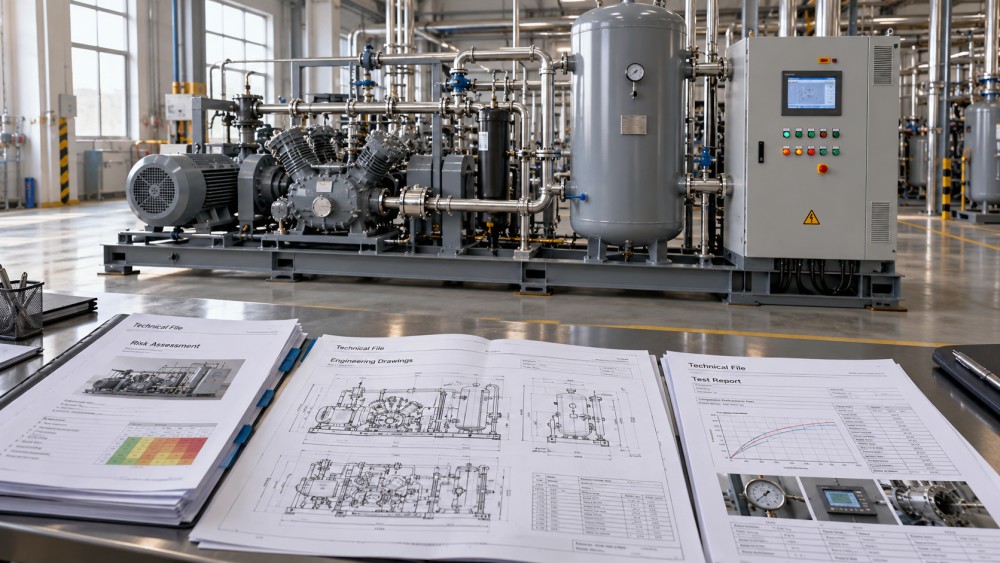
An industrial equipment specification supports CE compliance by defining what a machine is designed to do, where it can operate, and which limits must not be exceeded. It does not, by itself, demonstrate conformity. For compressors, cooling systems, vacuum packages, and heat exchangers, the supporting evidence usually includes a technical file, risk assessment, engineering calculations, test reports, instructions, and the applicable declaration of conformity.
The practical question is whether those records describe the equipment actually being supplied. A polished declaration is weak evidence if its model reference excludes the receiver, control panel, or refrigerant circuit installed on the delivered skid. Documentation review should therefore follow the equipment boundary, not just the supplier’s document index.
Establish the applicable legislation before requesting certificates
There is no universal “CE certificate” covering all industrial equipment. CE marking is the manufacturer’s declaration that the product meets applicable EU harmonisation legislation requiring that marking. Some conformity assessment routes involve a notified body; many do not.
A packaged compressor may involve machinery, pressure equipment, and electromagnetic compatibility requirements. A heat exchanger’s pressure classification depends on its design conditions, fluid classification, and other relevant parameters—not simply its industrial application. Equipment intended for potentially explosive atmospheres may also fall under ATEX product legislation.
Useful starting points include:
- Machinery: Directive 2006/42/EC applies until the main application date of Regulation (EU) 2023/1230 on 20 January 2027. Check the relevant placing-on-the-market date rather than assuming every current project uses the same legal framework.
- Pressure equipment: Directive 2014/68/EU generally covers stationary pressure equipment with a maximum allowable pressure above 0.5 bar, subject to its scope and exclusions. Classification requires more than pressure alone.
- Electromagnetic compatibility: Directive 2014/30/EU may apply to electrically controlled equipment. Its treatment of apparatus and fixed installations differs.
- Additional requirements: ATEX, electrical safety, ecodesign, and other legislation require a product-specific scope review. Not every environmental or operating obligation is a CE-marking requirement.
Electrical legislation needs particular care. For machinery covered by Directive 2006/42/EC, the Low Voltage Directive’s safety objectives apply, but the machinery directive governs the conformity assessment and placing-on-the-market obligations for those electrical hazards. Listing every familiar directive is not a substitute for determining applicability.
What the equipment specification must establish
A useful industrial equipment specification gives the compliance review a stable engineering baseline. It should identify the model and configuration, intended use, operating limits, utilities, installation conditions, and interfaces with other equipment.
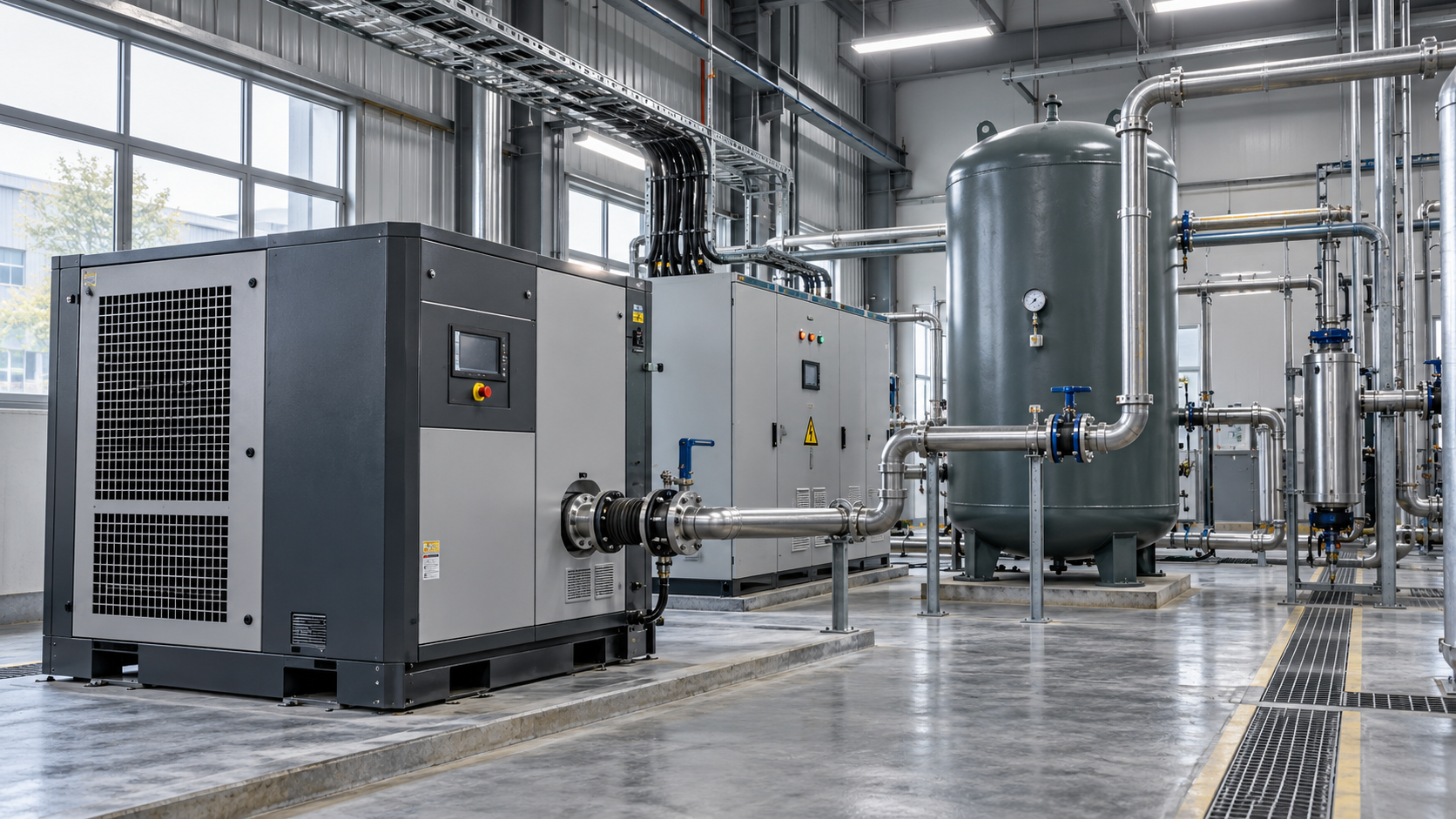
For a compressor package, that means distinguishing normal discharge pressure from maximum allowable pressure, and identifying the receiver, aftercooler, protective devices, and control functions. For a heat exchanger, each pressure chamber needs appropriate design information. For a cooling unit, refrigerant identity, operating conditions, and pressure limits must agree across the specification, drawings, nameplate, and instructions.
The most revealing discrepancies are often ordinary ones: a quotation gives one temperature limit, the manual gives another, and the pressure calculation covers neither. These are not merely editorial defects. They can change material suitability, pressure classification, or the assumptions behind a protective function.
Performance data also needs context. Rated cooling capacity, compressor power, or vacuum performance does not establish safety compliance. Record the test conditions and applicable measurement method so that a performance claim is not mistaken for evidence of pressure integrity or electrical safety.
Inside a credible technical file
The technical file is the evidence supporting the manufacturer’s conformity decision. Its required contents vary by legislation and assessment route, but it should allow the equipment’s design, manufacture, and operation to be understood and assessed.
Risk assessment linked to actual safeguards
A risk assessment should address relevant lifecycle activities, including installation, operation, cleaning, maintenance, and foreseeable misuse. ISO 12100 provides a widely used machinery risk-assessment methodology, but citing the standard is not the assessment itself.
Consider maintenance on a compressor skid. Stopping the motor does not necessarily remove trapped pressure, hot surfaces, electrical energy, or automatic restart capability. The documentation should connect these hazards to isolation arrangements, depressurisation provisions, guarding, control measures, and residual-risk instructions.
Where a safety-related control function is necessary, retain evidence of its specification and validation. A safety relay’s certificate alone does not validate the complete circuit, sensors, actuators, wiring, or software configuration.
Calculations, drawings, and verification records
Relevant records may include pressure design calculations, material specifications, fabrication drawings, electrical schematics, control descriptions, inspection results, and test reports. Pressure equipment may also require material traceability, joining qualifications, non-destructive testing records, and final assessment evidence, depending on the applicable requirements.
Test reports need a clear relationship to the delivered design. Check the tested configuration, acceptance criteria, method, result, and report approval. If evidence comes from a representative model, the file should justify why it covers the supplied variant.
Harmonised standards can provide a presumption of conformity for the requirements they cover when their references are published in the relevant EU Official Journal listing. They are generally voluntary. Check the edition, scope, restrictions, and applicable transition dates rather than accepting a standards list without review.
The declaration and instructions must match the delivery
The declaration of conformity is the manufacturer’s formal legal statement. Its required wording and contents depend on the legislation. Under the Machinery Directive, the document is an EC Declaration of Conformity; other applicable legislation uses an EU Declaration of Conformity. The heading alone does not determine validity.
Verify the manufacturer’s identity, product identification, applicable legislation, referenced standards where relevant, and authorised signature. Where notified-body involvement applies, check that the declaration includes the required body and certificate information. A declaration for a component does not automatically cover the assembled package.
Instructions should explain safe installation, commissioning, operation, maintenance, and foreseeable abnormal conditions. For thermal and compressed-air equipment, scrutinise ventilation, ambient limits, relief discharge arrangements, pressure isolation, fluid compatibility, and servicing access. Applicable language requirements must also be satisfied for the destination market.
Partly completed machinery is a different case. Under the Machinery Directive, it is supplied with a declaration of incorporation and assembly instructions, not a declaration of conformity for a complete machine. It must not be put into service until the final machinery has been declared compliant. Separate legislation may still apply to aspects of that product.
When notified-body evidence is necessary
Notified-body involvement follows the applicable legislation, product classification, and conformity assessment route. It is not triggered simply because equipment is large, expensive, or described as high risk.
Under the Pressure Equipment Directive, category and assessment module affect the required involvement. Equipment falling under sound engineering practice does not bear CE marking under that directive, although another applicable law may still require CE marking. Simple pressure vessels may instead fall under Directive 2014/29/EU; an air receiver should not automatically be assigned to the PED without checking scope.
Where a supplier provides a notified-body certificate, verify the body’s designation and relevant scope in the European Commission’s NANDO database. Then read the certificate itself: does it cover design examination, production quality assurance, a particular unit, or another defined activity? A genuine certificate can still be irrelevant to the equipment being purchased.
Review the package boundary, especially on integrated skids
A skid can combine individually compliant machines and pressure components yet introduce hazards at their interfaces. Shared controls, altered piping, restricted ventilation, and new operating sequences all deserve attention. Integration does not automatically make every collection of equipment one machinery assembly or one PED assembly; those boundaries require a reasoned assessment.
For example, a downstream valve may isolate a volume from its intended pressure protection. An external control system may restart equipment after maintenance. Neither issue is resolved by collecting component declarations. Establish who takes responsibility for the final configuration and which documentation demonstrates interface safety.
This systems-level view fits GTC-Matrix’s focus on industrial cooling, compression, vacuum, and heat exchange: thermodynamic performance and control behaviour need to be reviewed together. Efficiency information is valuable, but it cannot replace evidence that the integrated equipment remains safe throughout its specified operating envelope.
Make the documentation review a release decision
Buyers are not automatically entitled to the manufacturer’s complete technical file. It must be available to the competent authorities as required by the applicable legislation; commercially sensitive calculations do not necessarily accompany every delivery. Agree contractual access to selected evidence before purchase where verification is critical.
For acceptance, reconcile four things: delivered configuration, nameplate data, declaration scope, and operating instructions. Request clarification where a safety-critical test is missing, a pressure classification is unexplained, or an integration responsibility remains unassigned. Keep commercial document delays separate from unresolved compliance evidence.
Use the official texts on EUR-Lex and the Commission’s CE-marking guidance to verify legal requirements. Before release, ask one concrete question: can the manufacturer trace each significant hazard and applicable requirement to evidence for this exact configuration? If not, the CE mark is not the end of the review.
Ready when you are. Send us a message to get started.
Related News
- How electricity prices shape industrial compressed air price trendsAuthor :

- Choosing air filtration systems for heavy dust in the Middle EastAuthor :

- How much does a fully installed compressed air monitoring system cost?Author :

- What documentation supports CE marking for industrial equipment?Author :

- How local support affects vacuum system costs in Southeast AsiaAuthor :

- How worldwide industry category guides help compare market opportunitiesAuthor :

- What drives sustainable thermal systems cost over their operating life?Author :

- Which industrial solution comparison criteria prevent project delays?Author :

- How Ambient Temperature and Load Profile Affect Industrial Compressor SizingAuthor :

- What to evaluate before choosing a thermal process engineering supplierAuthor :

- How industrial utility systems affect energy costs in process plantsAuthor :

- What Data Is Needed to Assess Heat Recovery Decarbonization?Author :

- Can Waste Heat Recovery Support Carbon Neutrality Targets?Author :

- Is Compressor Heat Recovery Worth the Installation Cost?Author :

- What to verify before choosing a process separation technology supplierAuthor :

- When does process utilities engineering reduce project rework?Author :

- Where thermal efficiency optimization delivers the fastest savings in EuropeAuthor :

- What should you verify before selecting a heat transfer supplier?Author :

- What drives compressed air systems price for industrial projects?Author :

- How an industrial product knowledge comparison guide reduces sourcing riskAuthor :

- When does a procurement specification planning process reduce bid risk?Author :

- When does thermal system optimization for electronics reduce failure risk?Author :

- When high temperature process heating systems justify the higher energy costAuthor :

- How to compare sludge dewatering equipment by cake drynessAuthor :

- What to Check Before Sourcing a Gas Turbine for Distributed Power ProjectsAuthor :

- What drives industrial thermal systems price in large facility projectsAuthor :

- How to build an industrial product comparison chart that speeds up vendor selectionAuthor :

- Vacuum Technology Application Guide for Selecting the Right SystemAuthor :

- What Drives Vacuum Drying Cost in Industrial Procurement?Author :

- What Drives Compressed Air Pricing in Industrial Systems?Author :

- How Procurement Specification Planning Shapes Total Project CostAuthor :

- Compression Technology Guide: How to Compare Efficiency, Pressure Range, and Maintenance NeedsAuthor :

- How to Compare Industrial Separators by Throughput, Purity, and Maintenance LoadAuthor :

- How to Size a Compressed Air Equipment Receiver Tank for Stable PressureAuthor :

- Industrial Equipment Selection Guide: How to Compare Capacity, Duty Cycle, and Operating CostAuthor :

- How to Evaluate an Intellectualization Supplier for Industrial UpgradesAuthor :