Industrial Solution Comparison Guide: Key Factors That Change Total Cost




An effective industrial solution comparison guide starts where many capital reviews often stop: beyond purchase price. In cooling, compressed air, vacuum, and heat exchange systems, total cost moves with energy demand, uptime stability, maintenance intensity, compliance exposure, and replacement timing.
That shift matters more now because industrial operations are under pressure from volatile power prices, tighter emissions rules, and stricter process quality targets. A cheaper option can look efficient in a quotation, yet become expensive once service interruptions, utility use, and retrofit needs enter the picture.
Across sectors, the best comparisons connect technical design with financial outcomes. That is also the perspective behind GTC-Matrix, which tracks thermodynamic performance, compression efficiency, refrigerant policy, and demand signals shaping long-term industrial returns.
What Total Cost Really Means in Industrial Decisions
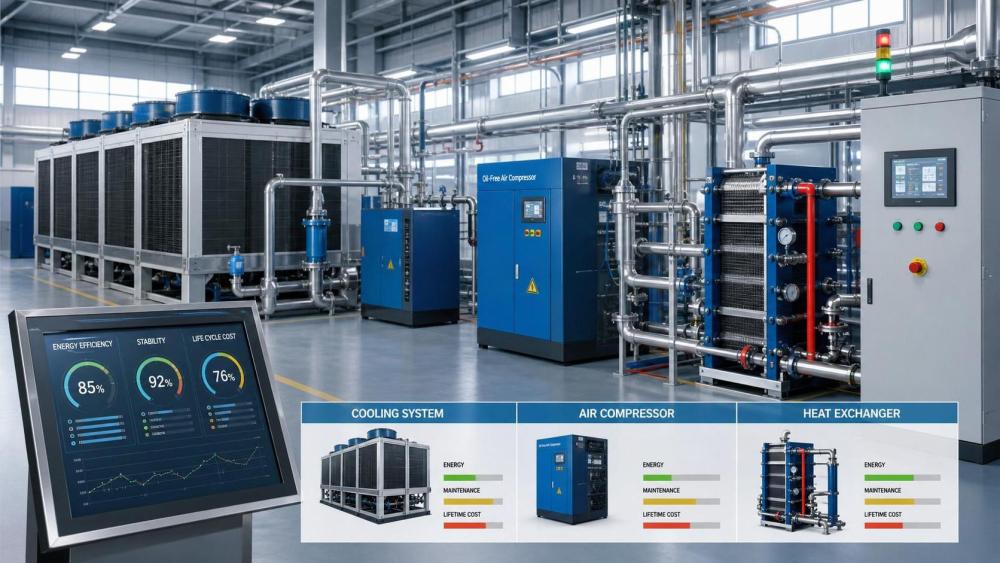
In an industrial solution comparison guide, total cost is not one number. It is the accumulated impact of technical choices over the life of an asset.
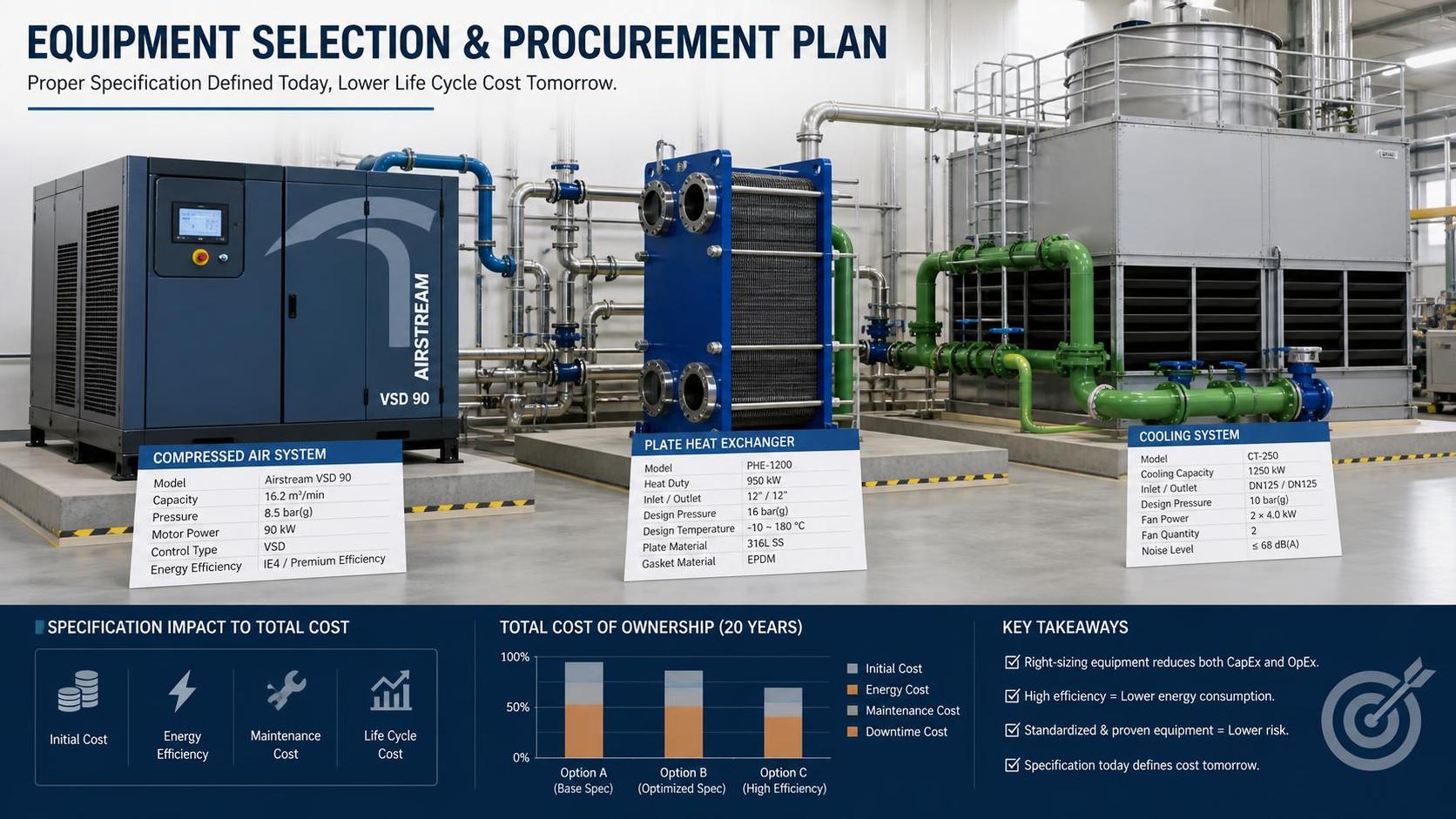
The visible part includes equipment price, installation, commissioning, and training. The less visible part includes electricity, spare parts, planned shutdowns, quality losses, refrigerant or emissions compliance, and early replacement risk.
For example, an air compressor with lower efficiency may still pass a basic sourcing screen. Over several years, however, power consumption can exceed the original capital saving by a wide margin.
The same logic applies to chillers, vacuum pumps, condensers, boilers, and heat exchangers. A system that looks simpler on paper may carry hidden operating penalties in real production conditions.
The cost layers that deserve attention
- Initial capital, including accessories, controls, and required site modifications.
- Energy intensity across normal load, partial load, and peak demand periods.
- Maintenance frequency, parts availability, and specialist service dependence.
- Downtime probability and the cost of lost production or product spoilage.
- Regulatory risk linked to refrigerants, emissions, safety, or noise limits.
- Residual value, upgrade flexibility, and expected service life.
Why This Comparison Has Become More Important
Industrial cost structures have changed. Energy is no longer a stable background input, and compliance costs are no longer a remote concern.
A practical industrial solution comparison guide now has to account for market and policy movement, not only equipment specifications. That is especially true in thermally intensive processes and compressed utility networks.
GTC-Matrix follows this shift closely. Its intelligence on energy price trends, low-GWP refrigerant policy, oil-free compression, and advanced heat exchange design reflects what industrial buyers increasingly need to compare.
The reason is simple. Technical performance no longer lives in isolation. It now affects financing assumptions, insurance expectations, sustainability reporting, and production resilience.
Signals changing the cost equation
The Factors That Most Often Distort Cost Assumptions
Many budgets fail because comparison models are too narrow. They compare line-item prices while ignoring the operating behavior of the system.
Energy performance under real load
Rated efficiency alone is not enough. Real plants rarely run at a single fixed load, and partial-load performance can drive annual cost more than peak values.
Variable-speed systems, advanced controls, and better heat transfer surfaces often justify higher capital when load profiles fluctuate. That is common in mixed manufacturing and utility-heavy sites.
Maintenance design and service intervals
Two machines with similar capacity may create very different service burdens. Filter life, lubrication needs, cleaning frequency, and technician availability all affect annual cost.
Microchannel heat exchangers, oil-free systems, and modular components can improve specific cost positions, but only when matched to site conditions and maintenance capability.
Downtime and process sensitivity
In temperature-controlled production or contamination-sensitive environments, system interruption can be more expensive than the asset itself. Downtime is not only a maintenance issue. It is a revenue issue.
That is why an industrial solution comparison guide should include redundancy logic, spare strategy, response time, and restart stability, not just mean time between failures.
Compliance exposure
Low-NOx boilers, refrigerant selection, pressure safety standards, and environmental reporting can all alter cost over the asset life. A compliant choice today may become a constrained choice tomorrow.
This is where sector intelligence matters. Policy changes in refrigerant quotas or emissions thresholds can affect serviceability, insurance acceptance, and future upgrade timing.
How Different Industrial Settings Change the Comparison
The same equipment category does not create the same business case everywhere. Context changes cost priorities.
Pharmaceutical and life science facilities
Here, clean utilities, stable thermal control, and audit-ready consistency usually outweigh the attraction of lower first cost. Validation risk and product integrity sit close to total cost.
Semiconductor and electronics production
Pure power sources, high-precision cooling, and vacuum stability are central. Small deviations can create yield loss, making performance reliability more valuable than basic price comparisons.
Food and beverage operations
Energy efficiency remains critical, but sanitation, washdown suitability, and temperature consistency also influence waste, shelf life, and operating continuity.
General manufacturing
This broader environment often has mixed duty cycles and cost pressure across utilities. The right industrial solution comparison guide usually balances energy savings with maintainability and upgrade flexibility.
A More Useful Way to Compare Options
A strong comparison process translates technical differences into business outcomes. That means evaluating each option against the operating reality of the site, not against a vendor brochure alone.
Questions worth putting into the model
- How much will annual energy cost change at actual load conditions?
- What service events are likely over three, five, and ten years?
- What is the financial effect of one unplanned outage?
- Does the design face refrigerant, emissions, or safety constraints?
- Can the system scale with future throughput or process changes?
- Are spare parts and service skills locally available?
This is where external intelligence becomes useful. GTC-Matrix adds market context to the comparison by linking technology evolution with commercial and regulatory trends.
That connection helps avoid a common mistake: approving equipment that fits the current budget but misfits the next operating cycle.
From Comparison to Better Capital Judgment
The value of an industrial solution comparison guide is not in producing a perfect forecast. Its real value is exposing which assumptions drive the largest cost swings.
In practice, that means building a short list around lifecycle evidence, not just offer price. Energy curves, maintenance plans, compliance pathways, and downtime consequences should sit in the same review frame.
The next step is straightforward. Define the operating scenario, stress-test the hidden cost factors, and compare options against the conditions the plant will actually face. That is usually where the strongest long-term decision becomes visible.
- compressed air
- heat exchange
- oil-free compression
- microchannel heat exchangers
- pure power sources
- decarbonization
- heat transfer
- energy efficiency
- heat exchange systems
- low-NOx boilers
- industrial solution comparison
- industrial solution comparison guide
- heat exchange design
- vacuum pumps
- heat exchangers
Ready when you are. Send us a message to get started.
Related News
- How to select industrial equipment for automation with existing PLCsAuthor :

- How electricity prices shape industrial compressed air price trendsAuthor :

- Choosing air filtration systems for heavy dust in the Middle EastAuthor :

- How much does a fully installed compressed air monitoring system cost?Author :

- What documentation supports CE marking for industrial equipment?Author :

- How local support affects vacuum system costs in Southeast AsiaAuthor :

- How worldwide industry category guides help compare market opportunitiesAuthor :

- What drives sustainable thermal systems cost over their operating life?Author :

- Which industrial solution comparison criteria prevent project delays?Author :

- How Ambient Temperature and Load Profile Affect Industrial Compressor SizingAuthor :

- What to evaluate before choosing a thermal process engineering supplierAuthor :

- How industrial utility systems affect energy costs in process plantsAuthor :

- What Data Is Needed to Assess Heat Recovery Decarbonization?Author :

- Can Waste Heat Recovery Support Carbon Neutrality Targets?Author :

- Is Compressor Heat Recovery Worth the Installation Cost?Author :

- What to verify before choosing a process separation technology supplierAuthor :

- When does process utilities engineering reduce project rework?Author :

- Where thermal efficiency optimization delivers the fastest savings in EuropeAuthor :

- What should you verify before selecting a heat transfer supplier?Author :

- What drives compressed air systems price for industrial projects?Author :

- How an industrial product knowledge comparison guide reduces sourcing riskAuthor :

- When does a procurement specification planning process reduce bid risk?Author :

- When does thermal system optimization for electronics reduce failure risk?Author :

- When high temperature process heating systems justify the higher energy costAuthor :

- How to compare sludge dewatering equipment by cake drynessAuthor :

- What to Check Before Sourcing a Gas Turbine for Distributed Power ProjectsAuthor :

- What drives industrial thermal systems price in large facility projectsAuthor :

- How to build an industrial product comparison chart that speeds up vendor selectionAuthor :

- Vacuum Technology Application Guide for Selecting the Right SystemAuthor :

- What Drives Vacuum Drying Cost in Industrial Procurement?Author :

- What Drives Compressed Air Pricing in Industrial Systems?Author :

- How Procurement Specification Planning Shapes Total Project CostAuthor :

- Compression Technology Guide: How to Compare Efficiency, Pressure Range, and Maintenance NeedsAuthor :

- How to Compare Industrial Separators by Throughput, Purity, and Maintenance LoadAuthor :

- How to Size a Compressed Air Equipment Receiver Tank for Stable PressureAuthor :

- Industrial Equipment Selection Guide: How to Compare Capacity, Duty Cycle, and Operating CostAuthor :