Which Vacuum Pump Specifications Matter Most for Semiconductor Processes?




The vacuum pump specification that matters most for semiconductor processes is not ultimate vacuum level. It is the pump’s ability to deliver stable effective pumping performance at the process pressure, gas load, and contamination condition that the tool actually experiences.
That single requirement combines several specifications: pumping speed across the operating range, gas throughput capacity, particle and backstreaming control, compatibility with reactive or condensable gases, and pressure-control response. A pump with an impressive base-pressure rating can still be a poor fit if it cannot handle deposition by-products, corrosive chemistry, rapid pressure transitions, or the conductance losses between the chamber and the pump.
For semiconductor manufacturing, vacuum selection is therefore a process-integration decision rather than a simple comparison of pump nameplate values. The relevant question is not “Which pump reaches the lowest pressure?” but “Can this vacuum system maintain a clean, repeatable, controllable process environment through the full recipe and maintenance cycle?”
Start with the real operating pressure, not the ultimate vacuum rating
Ultimate pressure describes the lowest pressure a pump may reach under highly favorable conditions: low gas load, clean internals, adequate warm-up, and usually no process chemistry. It is useful as a boundary condition, especially for high-vacuum applications, but it rarely determines whether a pump supports stable wafer processing.
Most semiconductor processes operate within defined pressure windows. Plasma etch, plasma-enhanced CVD, physical vapor deposition, ion implantation, diffusion-related operations, and load-lock evacuation all impose different requirements on the vacuum system. The important performance point is the pressure at which the chamber must operate while process gases are flowing and reaction products are being removed.
Gas throughput can be expressed conceptually as:
Q = P × S
where Q is gas throughput, P is pressure, and S is pumping speed. In practice, this relationship must account for the actual gas composition, temperature, foreline pressure, exhaust restriction, and the conductance of valves, traps, piping, and fittings.
A pump may have adequate nominal pumping speed but still fail to maintain chamber pressure if the gas path is restrictive. The chamber sees effective pumping speed, not the speed printed in a catalog. Long forelines, undersized pipework, sharp bends, isolation valves, particle traps, and high-conductance-limiting components can reduce the usable speed substantially, particularly at lower pressures where molecular flow becomes important.
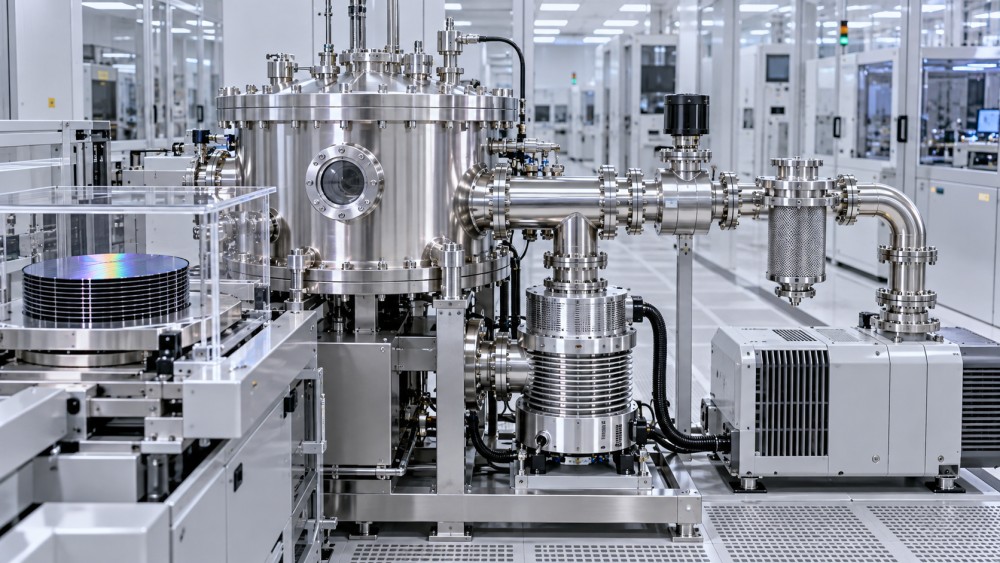
For this reason, pump selection should begin with a pressure-versus-throughput requirement for each recipe step: pumpdown, gas stabilization, plasma ignition, steady-state processing, purge, vent, and chamber clean. A single maximum flow figure does not capture these conditions.
Pumping speed matters only when it is specified at the right pressure
Pumping speed is commonly treated as the primary vacuum pump specification, but it must be read carefully. A speed value without a stated pressure range, gas type, inlet condition, and backing configuration has limited value for semiconductor process design.
Dry vacuum pumps often show pumping characteristics that vary considerably over the rough-vacuum and medium-vacuum region. Turbomolecular pumps have their own speed curves, compression-ratio behavior, and backing-pump requirements. A system serving a process chamber may combine a high-vacuum pump with a dry backing pump, while a process such as etch or CVD may depend heavily on a dry process pump and foreline configuration.
The selection calculation should use the chamber pressure required by the recipe, then determine the gas throughput at that pressure. It should also include transient demand. A system that holds pressure in a steady state but responds too slowly to gas-flow changes, throttle-valve movement, or plasma transitions can create process instability even when its nominal capacity appears sufficient.
Pressure-control behavior is especially important where a throttle valve regulates chamber pressure. The pump, valve, chamber volume, gas delivery system, and control loop act as one system. Excessive pump capacity is not automatically beneficial if it makes stable control difficult or forces the valve to operate near an unstable position. Conversely, too little reserve capacity can leave no margin for chamber seasoning, filter loading, by-product accumulation, or recipe changes.
In contamination-sensitive processes, cleanliness can outrank vacuum depth
Semiconductor vacuum systems are judged not only by pressure but also by what they introduce into the process environment. Oil vapor, seal wear, particles, metallic contamination, elastomer outgassing, moisture, and reaction by-products can all affect chamber cleanliness and process repeatability.
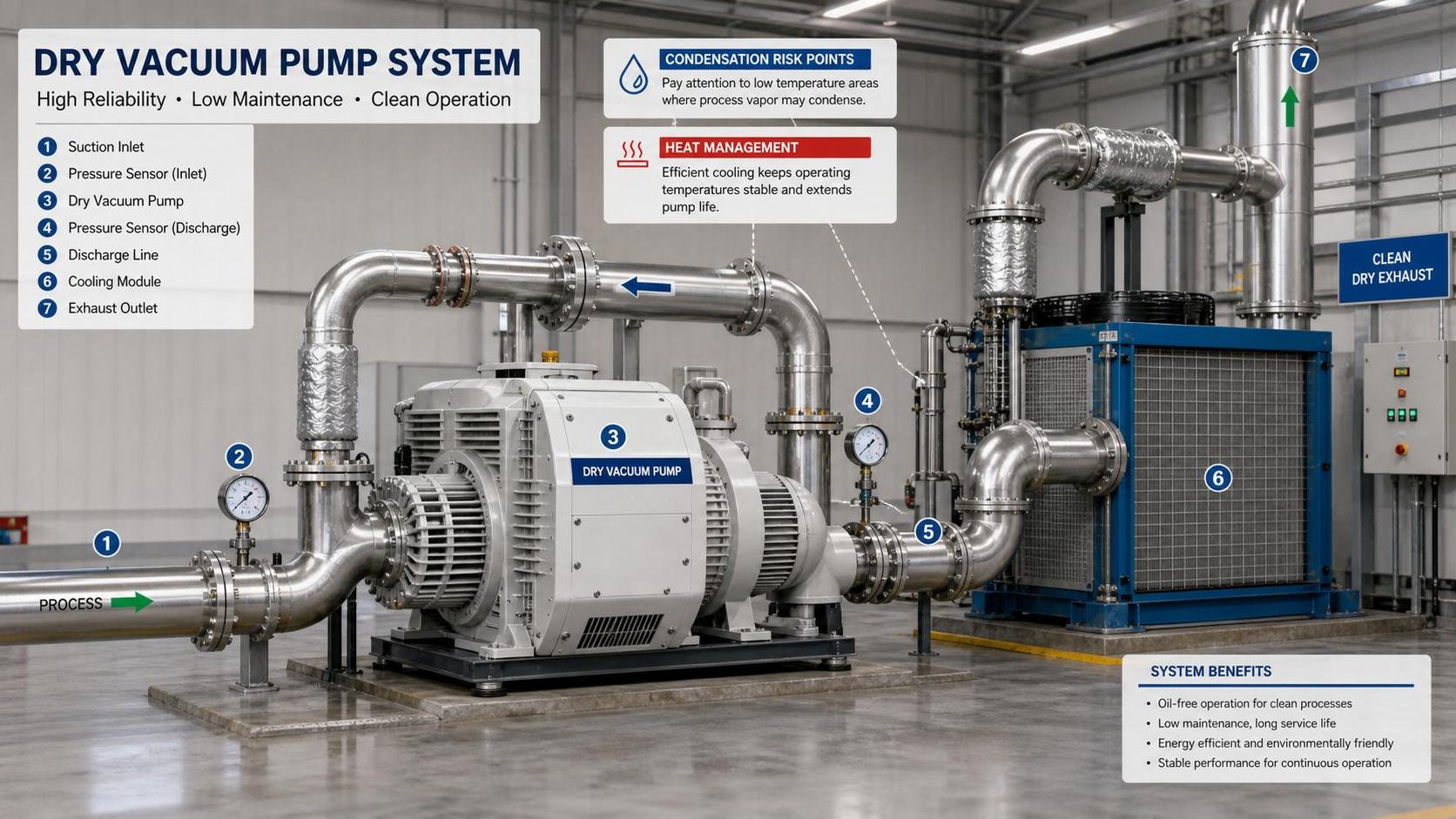
This is why dry pumping technology is widely relevant to contamination-sensitive semiconductor duties. A dry pump avoids direct hydrocarbon contact between the pumping mechanism and process gas in the way associated with oil-sealed designs. That does not mean every dry pump is automatically suitable. Internal clearances, surface materials, purge arrangements, bearing isolation, exhaust design, and maintenance condition still influence particulate and chemical contamination risk.
For high-vacuum systems, backstreaming control requires equal attention. A turbomolecular pump, cryogenic pump, or other high-vacuum stage may require a backing arrangement that prevents foreline contaminants from migrating toward the chamber. The complete train matters: chamber valves, foreline filters, traps where appropriate, pump isolation, purge logic, and shutdown behavior all affect cleanliness.
Particle specifications should be evaluated in the context of the process tool and contamination-control plan rather than as an isolated pump attribute. A process handling films that shed particles, or chemistry that creates condensable solids, may require dedicated foreline management and more frequent inspection. A clean pump connected to an unmanaged foreline can still become part of a contamination pathway.
Gas compatibility determines whether the pump remains reliable between service intervals
Semiconductor process gases are rarely benign. Depending on the application, the vacuum system may encounter corrosive halogen-containing gases, oxidizers, dopants, flammable gases, moisture-sensitive precursors, condensable vapors, and solid-forming reaction products. These conditions can change the priority of specifications completely.
For reactive gas service, material compatibility is critical. Pump internals, seals, bearings, coatings, exhaust components, and associated piping must tolerate the chemistry and operating temperature. Corrosion can impair clearances, create particles, increase leakage, degrade compression performance, and shorten service intervals. Chemical compatibility should be established for the full expected gas mixture, including cleaning gases, chamber-clean by-products, purge gases, and accidental or abnormal operating conditions.
Condensation behavior is equally important. Many process by-products do not remain gaseous as they travel through a cooler foreline or pump stage. If vapor condenses, it may form liquid deposits, sticky residues, or powders. These deposits can restrict flow, unbalance rotating components, interfere with valves, and increase the risk of abrupt pump failure.
Specifications worth examining include operating-temperature control, purge-gas requirements, heated foreline capability, allowable particulate loading, inlet filtration arrangements, corrosion-resistant materials, and exhaust treatment compatibility. A pump must also be matched to the intended abatement system. The exhaust stream may carry unreacted process gases and hazardous by-products; a vacuum pump is not a substitute for properly engineered gas abatement and facility safety controls.
Compression ratio and foreline pressure are process-relevant, not secondary details
For high-vacuum applications, compression ratio is often more informative than ultimate pressure alone. It describes how effectively a pump suppresses the reverse flow of gases from the backing side toward the chamber. This matters when residual gases, light gases, or backing-pump contaminants could affect the chamber environment.
Different gases behave differently. Hydrogen and helium are notably difficult to compress compared with heavier gases, so performance claims based on nitrogen may not represent behavior in a process with substantial light-gas loading. Where the gas mix includes hydrogen, helium, or other low-molecular-weight gases, the relevant speed and compression data should be reviewed for those conditions rather than inferred from a single reference gas.
Foreline pressure also deserves close attention. If the backing pump cannot maintain the required pressure under load, the high-vacuum pump may lose effective compression performance or operate outside its preferred range. This can reduce chamber performance, lengthen pumpdown, and increase vulnerability during process transitions.
Leak rate and moisture control affect repeatability more than they appear to
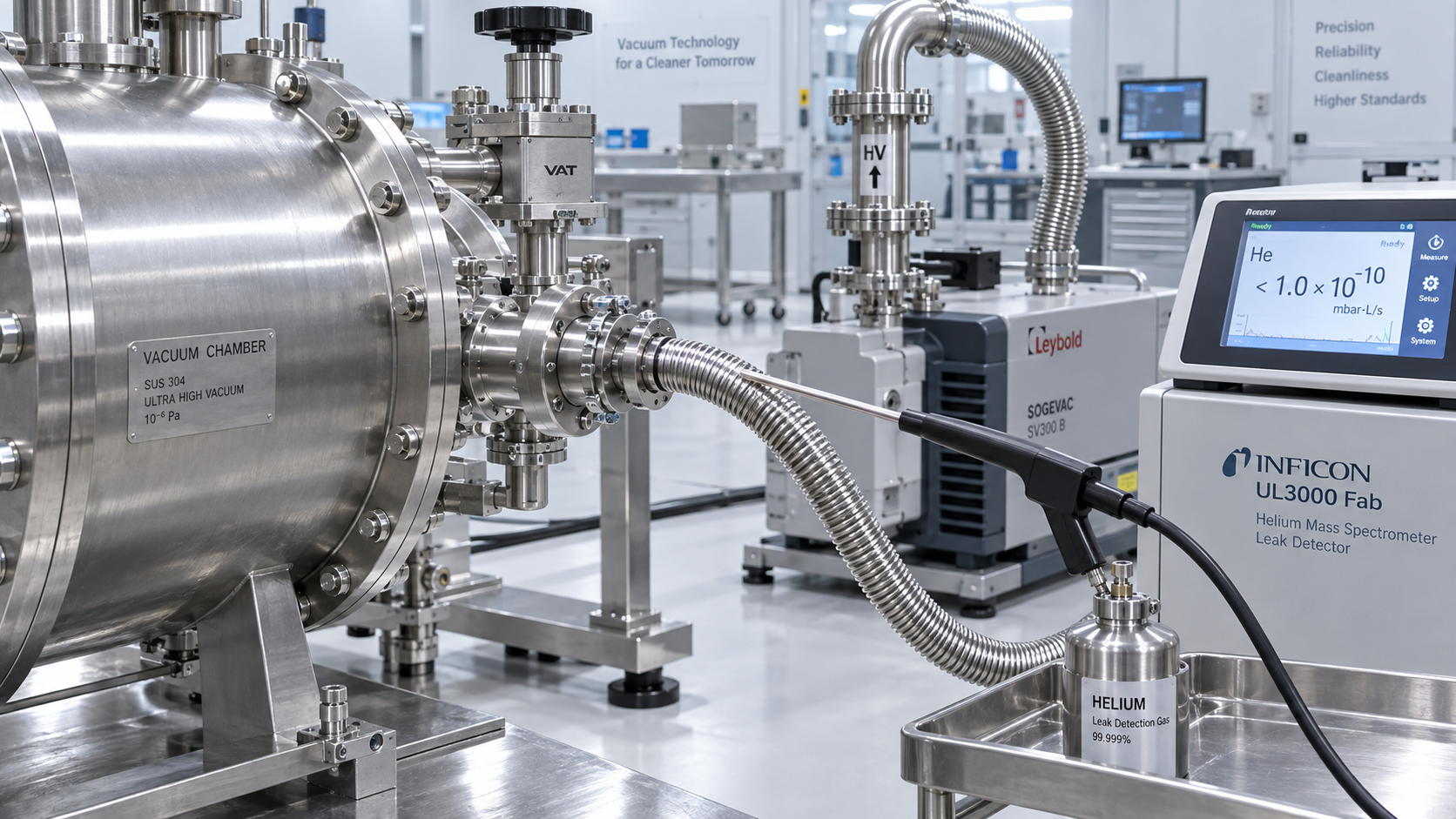
Leaks are not simply an inconvenience during pumpdown qualification. They introduce atmospheric gases, water vapor, and potentially particles into a controlled environment. Even a small leak can complicate base-pressure recovery, residual-gas interpretation, process conditioning, and repeatability.
A vacuum system should therefore be assessed for its practical leak integrity: flange design, seal selection, valve quality, welds, service access, and the potential for leaks after repeated thermal cycling or maintenance. The acceptable leak rate depends on chamber volume, target pressure, gas load, process sensitivity, and pump capacity. A generic “low leak rate” statement is not enough; the system requirement must be tied to process conditions.
Water vapor is particularly relevant because it adsorbs on chamber and line surfaces, extends pumpdown time, and may affect moisture-sensitive processes. The pump alone cannot solve a system with poor material selection, inadequate bakeout capability, contaminated vent gas, or frequent exposure to ambient air. Clean dry venting and controlled purge practices can be as important as the selected pump.
Consider pumpdown time as a production constraint, but do not size on pumpdown alone
Load locks, transfer chambers, and process chambers may have explicit cycle-time expectations. Pumpdown time depends on chamber volume, initial pressure, target pressure, surface outgassing, water load, conductance, valve behavior, and pump speed over changing pressure ranges.
Fast evacuation can improve tool availability, but sizing a pump only for the fastest theoretical pumpdown can lead to an unnecessarily large system or unstable pressure control during processing. The more useful approach is to separate the duty cycle:
- initial evacuation from atmospheric pressure;
- roughing and crossover to high-vacuum operation where applicable;
- steady-state process-gas removal;
- chamber-clean and purge duty;
- recovery after venting or maintenance.
Each stage may place different demands on the pump train. A configuration optimized for rapid load-lock cycling may not be the right configuration for a chamber processing corrosive, powder-forming chemistry for extended periods.
Energy use and utilities should be evaluated as operating conditions, not headline claims
Vacuum pumps can consume significant electrical power and may require cooling water, nitrogen purge, exhaust extraction, and abatement support. These requirements influence operating cost, facility capacity, installation complexity, and resilience during utility disturbances.
Energy assessment should use the expected duty profile. A pump that appears efficient at one operating point may consume differently during idle operation, roughing, high gas load, purge, or regeneration. Variable-speed control can be useful in some applications, but it must not compromise pressure stability, chemical handling, or response time.
Cooling-water quality, temperature range, flow stability, and alarm interlocks also matter. In chemically demanding service, inadequate cooling can accelerate deposit formation or alter internal temperatures enough to affect process-gas handling. Utility specifications should be reviewed alongside the pump, not after the process tool has been installed.
The specification review should follow the process recipe
A practical evaluation begins by translating the recipe into vacuum-system requirements. For every process state, define the chamber pressure, gas species, maximum and normal flow, expected by-products, required pressure stability, chamber volume, cycle time, and contamination constraints. Then map those conditions through the actual gas path to determine effective speed, thermal behavior, chemical exposure, and exhaust demand.
The resulting specification is usually more valuable than a request for “the highest pumping speed” or “the lowest ultimate vacuum.” It identifies whether the system needs dry chemical resistance, enhanced purge capability, powder handling, a specific backing arrangement, low-vibration installation, tight leak control, or a pressure-control strategy designed around a narrow process window.
The decisive vacuum pump specification for semiconductor processes is therefore best understood as usable process performance: stable effective pumping speed and gas handling at the required pressure, delivered without adding contamination or creating an unacceptable maintenance burden. Ultimate vacuum remains relevant, but only when it is connected to the actual chamber, chemistry, conductance, and control conditions that determine wafer-process consistency.
Related News
- Which Vacuum Pump Specifications Matter Most for Semiconductor Processes?Author :Vacuum Process Fellow

- How to find leaks in vacuum pump systems before pump performance dropsAuthor :Vacuum Process Fellow

- How to size a Roots blower for vacuum process equipmentAuthor :Vacuum Process Fellow

- How vacuum level affects vacuum process efficiencyAuthor :Vacuum Process Fellow

- China Imposes Temporary Helium Export BanAuthor :Vacuum Process Fellow

- Semiconductor Vacuum Systems Factory Checklist for Process Stability and Cleanroom UseAuthor :Vacuum Process Fellow

- Vacuum Process Optimization Services: Signs Your Line Needs a Performance ReviewAuthor :Vacuum Process Fellow

- Vacuum Chambers for Cleanroom Use: Key Design Points That Prevent ContaminationAuthor :Vacuum Process Fellow

- Vacuum Distillation Systems: Key Performance Metrics That Affect Product PurityAuthor :Vacuum Process Fellow

- Vietnam Halts High Vacuum Pump Import Licenses for 30 DaysAuthor :Vacuum Process Fellow

- Vacuum Technology Database: What to Check Before Using Technical DataAuthor :Vacuum Process Fellow

- Dry Pump Vacuum System Design Mistakes That Raise DowntimeAuthor :Vacuum Process Fellow

- When Vacuum Systems Lose Performance: Common Causes and FixesAuthor :Vacuum Process Fellow
![]()
- EU Tightens EN 13445-3 Weld Testing for Vacuum VesselsAuthor :Vacuum Process Fellow
![]()
- EPA Cuts R-1234ze(E) Quota 35%, Tightening Vacuum Cooling SupplyAuthor :Vacuum Process Fellow
 Quota 35%, Tightening Vacuum Cooling Supply")
- ICA Warns of Tight Copper Alloy Supply for Vacuum PumpsAuthor :Vacuum Process Fellow

- Vacuum System Leak Detection: Signs, Tests, and FixesAuthor :Vacuum Process Fellow

- How to Compare Vacuum Systems Factory Capabilities for Stable Process UptimeAuthor :Vacuum Process Fellow

- Vacuum Pump Lead Times Extend to 26 WeeksAuthor :Vacuum Process Fellow

- Semiconductor Vacuum Systems Explained for Stable Process YieldAuthor :Vacuum Process Fellow

- Vacuum Process Efficiency: 7 Hidden Causes of Energy LossAuthor :Vacuum Process Fellow

- Vacuum Technology Solutions for Stable Low-Pressure ProductionAuthor :Vacuum Process Fellow

- Vacuum Processes: Common Efficiency Losses and FixesAuthor :Vacuum Process Fellow

- Common Vacuum Processes Problems and How to Prevent DowntimeAuthor :Vacuum Process Fellow

- Tantalum Spike Extends Vacuum Crucible Lead TimesAuthor :Vacuum Process Fellow

- Vacuum Process Efficiency: 5 Hidden Losses to Check FirstAuthor :Vacuum Process Fellow

- How Heat Transfer Design Impacts Vacuum Process EfficiencyAuthor :Vacuum Process Fellow

- EN 13445-4:2026 Takes Effect for High-Vacuum ComponentsAuthor :Vacuum Process Fellow

- EU Vacuum Components Face New EN 13445-4:2026 Leak Test RuleAuthor :Vacuum Process Fellow

- UBS: Fed Cut View May Ease Vacuum Pump Lead TimesAuthor :Vacuum Process Fellow

- Vacuum Processes: Common Causes of Unstable PerformanceAuthor :Vacuum Process Fellow
![]()
- SiC Certification Signals New Entry Path for Vacuum and Compressor DrivesAuthor :Vacuum Process Fellow
![]()
- How to Choose the Right Vacuum System for Process StabilityAuthor :Vacuum Process Fellow

- Vacuum Technology Selection: What Matters Most for Stable Process PerformanceAuthor :Vacuum Process Fellow

- Vacuum Processes: How to Reduce Contamination and Improve Cycle ConsistencyAuthor :Vacuum Process Fellow

- ITC 337 Probe Puts TOPCon Supply Chain Under ReviewAuthor :Vacuum Process Fellow