



How does base pressure affect film purity in vacuum deposition?




Lower base pressure generally improves film purity by reducing the residual gas available to react with or become trapped in a growing film. But the pressure reading alone is not a purity specification. A chamber with a lower total pressure can still produce a contaminated coating if its residual gas contains reactive species, its source releases impurities during heating, or deposition proceeds slowly enough for contaminants to accumulate.
This distinction matters when a deposition system reaches its specified base pressure yet produces films with unexpected resistivity, optical absorption, poor adhesion, or inconsistent composition. The useful comparison is not simply “which system pumps lower?” It is how much unwanted material reaches and remains at the substrate relative to the intended film flux, under actual deposition conditions.
Base pressure describes the starting environment, not the entire process
Base pressure is the chamber pressure reached before process gas introduction or deposition, under defined pumping and conditioning conditions. Its meaning depends on whether the chamber is empty or loaded, whether the substrate heater is operating, how long pumping has continued, and whether the source has been conditioned. An empty, cold chamber measurement can substantially understate the contamination load of a production cycle.
Working pressure is different. In sputtering, introduced argon usually dominates the total pressure during deposition. In thermal or electron-beam evaporation, source heating and material evaporation change the gas environment even without intentional process gas. Consequently, a favorable base pressure establishes a cleaner starting point but does not prove that the environment stays clean after the shutter opens.
Separate three potential impurity sources when interpreting film results:
- Residual chamber gases: water vapor, oxygen, hydrocarbons, and other species released by surfaces or admitted through leaks.
- Process-related inputs: impurities in sputtering gas, reactive gas, targets, evaporation charges, fixtures, or heated substrates.
- Material transferred unintentionally: particles, crucible contamination, source spitting, or material resputtered from chamber components.
Lowering base pressure primarily addresses the first category. It may reveal problems in the others, but it does not remove them automatically.
The controlling balance: contaminant arrival versus film growth
Residual molecules continuously strike the substrate. For a gas species in thermal equilibrium, its molecular impingement rate can be estimated from:
J = P / √(2πmkBT)
Here, J is the number of molecules arriving per unit area per second, P is that species’ partial pressure, m is its molecular mass, kB is Boltzmann’s constant, and T is gas temperature. Using SI units gives J in molecules per square meter per second. The important implication is direct: at the same temperature, reducing a contaminant’s partial pressure reduces its arrival rate proportionally.
Arrival is not the same as incorporation. A molecule may reflect, adsorb temporarily, dissociate, react, or become buried. Sticking probability depends on the gas, deposited material, surface condition, and temperature. Fresh titanium, for example, reacts strongly with oxygen-bearing species; a less reactive surface can behave very differently at the same pressure.
A useful screening quantity is the ratio of contaminant incorporation flux to deposited-material flux. The latter can be estimated from film growth rate, density, and molar mass. This comparison explains why slow deposition can demand a cleaner environment: fewer intended atoms arrive between contaminant impacts. Increasing deposition rate may reduce the relative exposure, but can also change density, stress, morphology, and source outgassing.
For scale, a kinetic-gas calculation for water vapor at 300 K and a partial pressure of 10−6 Torr gives an arrival rate of approximately 5 × 10¹⁴ molecules/cm2/s. This is an illustrative calculation, not a measured film-contamination result. Actual incorporation depends on surface chemistry and growth conditions; it cannot be read directly from pressure.
The same reasoning makes pauses important. A clean substrate waiting before deposition, or an exposed interface between layers, receives residual-gas exposure without a competing film flux. Interface contamination can therefore remain significant even when the average impurity content of a thick coating appears acceptable.
Residual gas composition can outweigh the total reading
Total pressure combines species with very different consequences. Water often dominates an insufficiently conditioned chamber after air exposure. Oxygen can oxidize reactive metals. Hydrocarbons may contribute carbonaceous contamination, particularly under energetic particle or electron exposure. Nitrogen can be an unwanted reactant for some materials, while deliberately supplied nitrogen is essential in nitride deposition.
Hydrogen-rich residual gas and water-rich residual gas should not be treated as equivalent merely because the gauge readings match. Their effects depend on the film: hydrogen may be comparatively benign in one application and unacceptable in another.
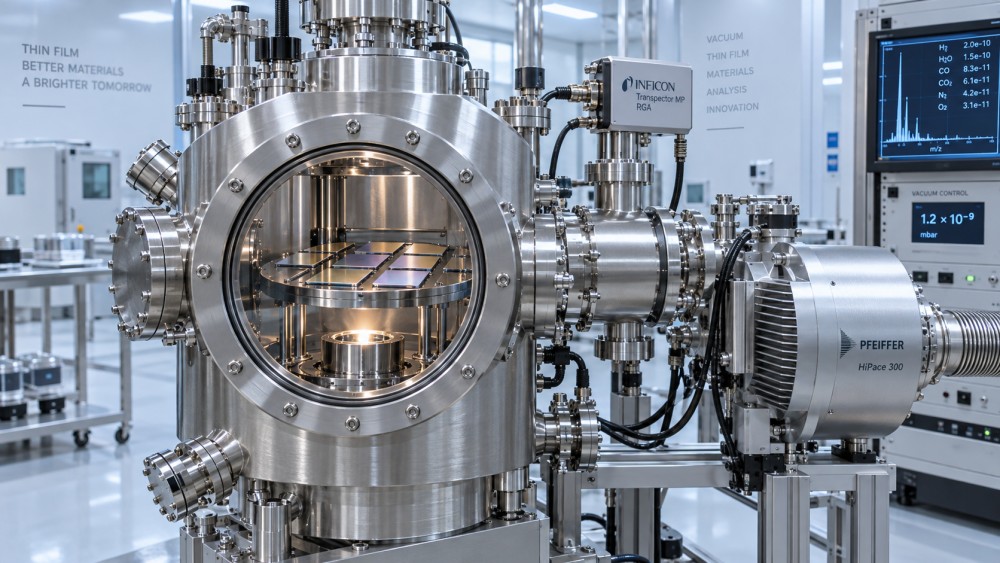
A residual gas analyzer helps distinguish these possibilities, but individual mass peaks are not unique chemical labels. For example, mass 28 can include nitrogen and carbon monoxide. Fragmentation patterns, instrument background, calibration, and process context must support interpretation. A spectrum acquired near the pump may also differ from conditions near the substrate.
When a lower reading fails to improve the film
Consider a chamber that pumps down satisfactorily while cold but shows degraded film properties once substrate heating begins. The problem may be a heated polymer component, absorbed moisture in fixtures, or contamination on the substrate rather than inadequate ultimate pump pressure. Installing a larger pump without locating the gas source may produce little improvement.
Pumping speed at the chamber is limited by conductance. A high-speed pump connected through a restrictive valve, narrow port, or long line may deliver much less effective pumping speed where contamination is generated. Under a simplified steady-state model, pressure follows P ≈ Q/Seff, where Q is gas load and Seff is effective pumping speed. Reducing gas load can therefore be more useful than increasing nominal pump capacity.
Gauge behavior adds another complication. Many vacuum gauges have gas-dependent sensitivity, and instrument placement affects what they measure. Comparing two systems requires compatible gauge types, correction conventions, and operating states. A pressure near a pump inlet should not automatically be treated as the pressure at a heated substrate.
Freshly deposited reactive material can also getter residual gases and lower the measured pressure. Such a decrease does not necessarily mean the contamination source disappeared: some gas may now be captured by deposited material, potentially including the growing film.
A practical investigation sequence
- Define the film failure. Establish whether the concern is bulk oxygen, carbon, an oxidized interface, particles, or a property change without confirmed chemistry. Resistivity and adhesion are useful indicators, but neither uniquely identifies contamination.
- Standardize the pressure comparison. Record chamber loading, vent history, pumping duration, temperature, gauge location, and source condition. Compare like-for-like cycles rather than unrelated minimum readings.
- Measure through the complete recipe. Track pressure and, where equipment permits, residual gas composition during substrate heating, source conditioning, gas admission, deposition, and cooling. Correlate changes with specific operations.
- Separate leaks from gas release. Use appropriate leak testing to investigate external leakage. Pressure-rise testing can help characterize gas load, but outgassing, trapped volumes, and temperature changes complicate interpretation.
- Change one plausible cause at a time. Examples include cleaning a fixture, replacing an unsuitable material, conditioning the source, or correcting a restrictive pumping path. Keep deposition parameters stable enough to interpret the result.
- Verify the deposited film. Repeat the relevant chemical and functional measurements after correction. Accepting an improved pressure trace without checking the film leaves the original question unanswered.
Surface analysis needs careful interpretation. A film exposed to air can develop surface oxide or adsorb carbon after deposition. X-ray photoelectron spectroscopy may characterize that surface rather than the as-grown bulk; sputter depth profiling can introduce artifacts. Choose surface, interface, or bulk analysis according to the suspected failure, with suitable handling controls.
Choosing improvements without over-specifying the vacuum system
For teams comparing vacuum technologies, deposition process requirements should determine the pumping architecture—not the lowest pressure advertised for an unloaded chamber. Useful improvements depend on the dominant contamination mechanism.
Reduce the gas load before adding pumping capacity
Clean substrates and fixtures, compatible low-outgassing materials, controlled venting, and reduced air exposure address contamination at its origin. Bakeout can accelerate water removal, but temperature limits of seals, instruments, adhesives, and chamber assemblies must be respected. Source conditioning should occur with the substrate protected where the process allows; conditioning itself can release gas and particles.
Trapped volumes and poorly vented joints can behave as persistent gas sources. Correcting these features may improve recovery after maintenance more effectively than extending pump-down indefinitely.
Match pumping to the species and operating conditions
Turbomolecular, cryogenic, and other high-vacuum pumping approaches have different gas-handling characteristics and maintenance requirements. Water capture, light-gas performance, process-gas throughput, backing-system cleanliness, and regeneration or service needs all affect usable performance. Oil-free pumping can remove one potential contamination pathway, but does not compensate for dirty chamber surfaces or contaminated process gases.
Where working gas dominates, examine gas purity, delivery-line cleanliness, purging practices, and the impurity load during flow. A cleaner base vacuum cannot fully compensate for contaminants continuously introduced during deposition.
Set acceptance criteria around the film, then qualify the pressure window
There is no universal base-pressure threshold that guarantees a pure film. A reactive metal deposited slowly may require much tighter control of oxygen-bearing species than a faster-grown, less reactive coating. Reactive deposition adds another distinction: intended oxygen or nitrogen must be controlled as part of film stoichiometry, not classified automatically as contamination.
A useful equipment acceptance specification identifies the loaded chamber state, thermal conditions, pump-down interval, gauge convention, and relevant residual-gas limits. It then links these conditions to demonstrated film composition and functional requirements across repeat runs. Where necessary, specify exposure during interlayer pauses and the maximum acceptable pressure excursions during heating or source operation.
Further pressure reduction is justified when unwanted gas incorporation remains the limiting mechanism. Once source purity, substrate preparation, particles, or transfer exposure dominate, spending more on ultimate vacuum may not improve the coating. The defensible operating window is the one that reproducibly meets film requirements under the actual recipe, including its most contamination-sensitive interfaces.
Ready when you are. Send us a message to get started.
Related News
- How does base pressure affect film purity in vacuum deposition?Author :Vacuum Process Fellow

- How to size vacuum process equipment for the required pump-down timeAuthor :Vacuum Process Fellow

- Which vacuum specification best protects semiconductor process yield?Author :Vacuum Process Fellow

- How Can Contamination Be Prevented in a Semiconductor Vacuum Chamber?Author :Vacuum Process Fellow

- Which Vacuum Pump Specifications Matter Most for Semiconductor Processes?Author :Vacuum Process Fellow

- How to find leaks in vacuum pump systems before pump performance dropsAuthor :Vacuum Process Fellow

- How to size a Roots blower for vacuum process equipmentAuthor :Vacuum Process Fellow

- How vacuum level affects vacuum process efficiencyAuthor :Vacuum Process Fellow

- China Imposes Temporary Helium Export BanAuthor :Vacuum Process Fellow

- Semiconductor Vacuum Systems Factory Checklist for Process Stability and Cleanroom UseAuthor :Vacuum Process Fellow

- Vacuum Process Optimization Services: Signs Your Line Needs a Performance ReviewAuthor :Vacuum Process Fellow

- Vacuum Chambers for Cleanroom Use: Key Design Points That Prevent ContaminationAuthor :Vacuum Process Fellow

- Vacuum Distillation Systems: Key Performance Metrics That Affect Product PurityAuthor :Vacuum Process Fellow

- Vietnam Halts High Vacuum Pump Import Licenses for 30 DaysAuthor :Vacuum Process Fellow

- Vacuum Technology Database: What to Check Before Using Technical DataAuthor :Vacuum Process Fellow

- Dry Pump Vacuum System Design Mistakes That Raise DowntimeAuthor :Vacuum Process Fellow

- When Vacuum Systems Lose Performance: Common Causes and FixesAuthor :Vacuum Process Fellow
![]()
- EU Tightens EN 13445-3 Weld Testing for Vacuum VesselsAuthor :Vacuum Process Fellow
![]()
- EPA Cuts R-1234ze(E) Quota 35%, Tightening Vacuum Cooling SupplyAuthor :Vacuum Process Fellow
 Quota 35%, Tightening Vacuum Cooling Supply")
- ICA Warns of Tight Copper Alloy Supply for Vacuum PumpsAuthor :Vacuum Process Fellow

- Vacuum System Leak Detection: Signs, Tests, and FixesAuthor :Vacuum Process Fellow

- How to Compare Vacuum Systems Factory Capabilities for Stable Process UptimeAuthor :Vacuum Process Fellow

- Vacuum Pump Lead Times Extend to 26 WeeksAuthor :Vacuum Process Fellow

- Semiconductor Vacuum Systems Explained for Stable Process YieldAuthor :Vacuum Process Fellow

- Vacuum Process Efficiency: 7 Hidden Causes of Energy LossAuthor :Vacuum Process Fellow

- Vacuum Technology Solutions for Stable Low-Pressure ProductionAuthor :Vacuum Process Fellow

- Vacuum Processes: Common Efficiency Losses and FixesAuthor :Vacuum Process Fellow

- Common Vacuum Processes Problems and How to Prevent DowntimeAuthor :Vacuum Process Fellow

- Tantalum Spike Extends Vacuum Crucible Lead TimesAuthor :Vacuum Process Fellow

- Vacuum Process Efficiency: 5 Hidden Losses to Check FirstAuthor :Vacuum Process Fellow

- How Heat Transfer Design Impacts Vacuum Process EfficiencyAuthor :Vacuum Process Fellow

- EN 13445-4:2026 Takes Effect for High-Vacuum ComponentsAuthor :Vacuum Process Fellow

- EU Vacuum Components Face New EN 13445-4:2026 Leak Test RuleAuthor :Vacuum Process Fellow

- UBS: Fed Cut View May Ease Vacuum Pump Lead TimesAuthor :Vacuum Process Fellow

- Vacuum Processes: Common Causes of Unstable PerformanceAuthor :Vacuum Process Fellow
![]()
- SiC Certification Signals New Entry Path for Vacuum and Compressor DrivesAuthor :Vacuum Process Fellow
![]()