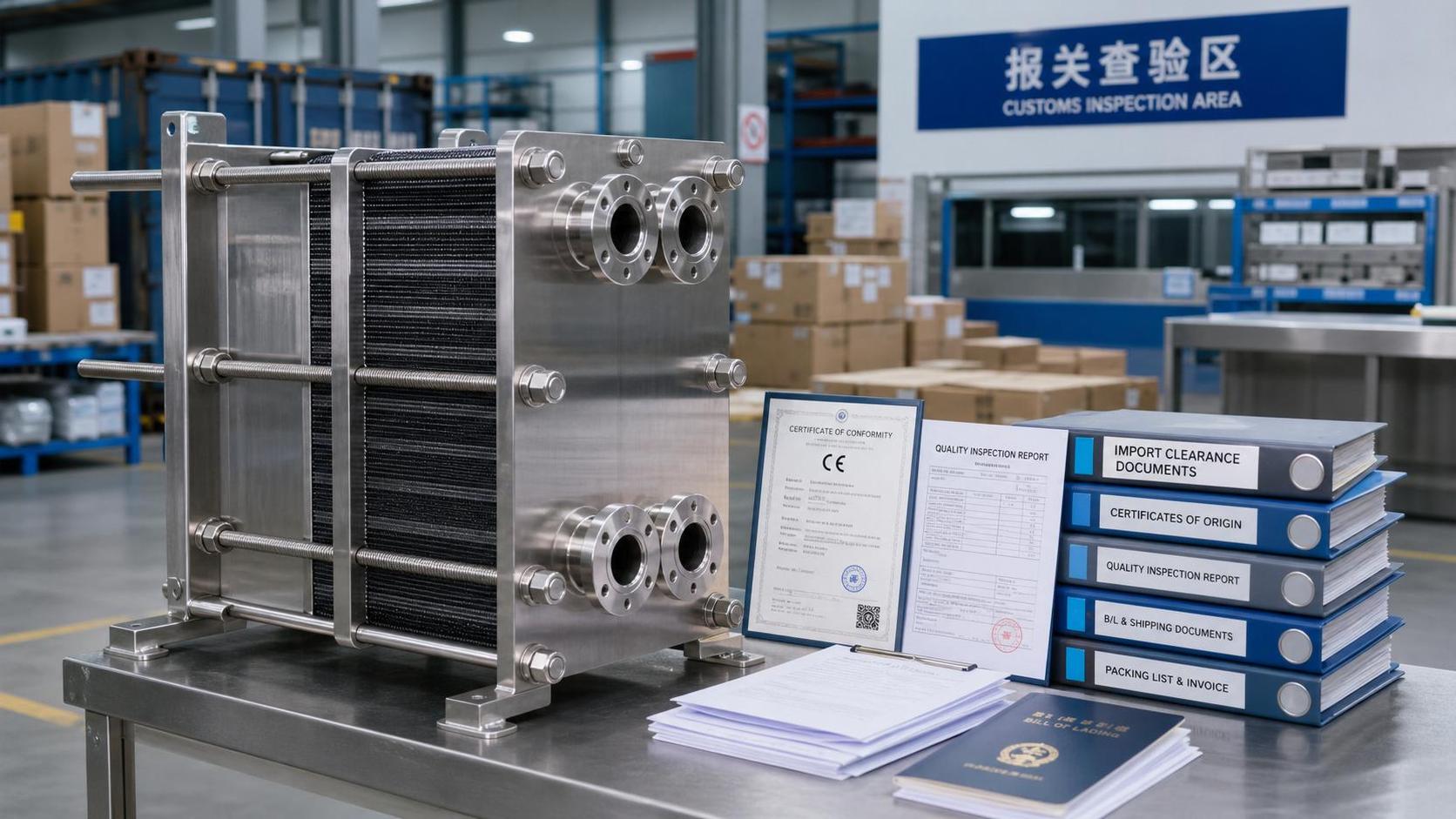
Vietnam Mandates Vietnamese Energy Labels & VIEC for Plate Exchangers from July 2026




Starting 1 July 2026, all imported plate heat exchangers entering Vietnam must carry Vietnamese-language energy efficiency labels and hold valid Vietnam Energy Efficiency Certification (VIEC). Announced by the Ministry of Industry and Trade (MOIT) on 23 May 2026 via Circular 12/2026/TT-BCT, this requirement directly affects exporters, importers, and supply chain actors engaged in thermal equipment trade between Vietnam and key manufacturing countries—including China. Given its enforcement timeline, mandatory labeling format, and certification cost implications, the regulation warrants close attention from firms involved in HVAC&R, industrial process equipment, and cross-border energy-efficient machinery trade.
Event Overview
On 23 May 2026, Vietnam’s Ministry of Industry and Trade (MOIT) issued Circular 12/2026/TT-BCT, stipulating that, effective 1 July 2026, all imported plate heat exchangers must: (1) bear a Vietnamese-language energy efficiency label compliant with national standard TCVN 12921:2025; and (2) be certified under the Vietnam Energy Efficiency Certification (VIEC) scheme. Non-compliant shipments will be rejected by Ho Chi Minh City Customs. Chinese suppliers are required to complete local-language label printing and VIEC type-testing prior to shipment, with estimated per-batch certification costs ranging from USD 1,200 to USD 1,800.
Industries Affected
Direct Exporters (e.g., Chinese manufacturers shipping to Vietnam)
These companies face immediate compliance obligations before goods clear customs. The requirement applies at the point of importation—meaning responsibility for label accuracy, language conformity, and certification validity rests fully with the exporter or its authorized local representative. Failure to meet either condition triggers automatic rejection, leading to demurrage, rework, or return costs.
Importers & Distributors in Vietnam
Vietnamese importers must now verify VIEC status and label compliance for every incoming consignment. As MOIT delegates enforcement to customs authorities—not third-party auditors—documentation must be complete and pre-validated. This shifts due diligence upstream and increases administrative burden during customs declaration and post-clearance verification.
Supply Chain Service Providers (e.g., certification consultants, label printers, logistics agents)
Providers offering VIEC support or multilingual labeling services may see increased demand—but only for those with verified capacity to perform TCVN 12921:2025–aligned testing and label production. The regulation does not recognize foreign certifications or English-only labels, narrowing the pool of qualified service partners.
Key Considerations and Recommended Actions
Monitor official implementation guidance from MOIT and Vietnam Standards Institute (TCVN)
Circular 12/2026/TT-BCT references TCVN 12921:2025 but does not publish full test protocols or label layout specifications within the circular itself. Stakeholders should track updates from the National Standards Institute (STAMEQ) and MOIT’s Department of Energy Efficiency for technical annexes and transitional provisions.
Confirm VIEC certification scope and validity for specific plate exchanger models
VIEC is a type-based certification—not product batch-based. Suppliers must ensure their submitted test samples represent the full range of configurations (e.g., plate material, gasket type, pressure rating) covered under each certificate. Model-level coverage must be explicitly validated with the certifying body prior to shipment.
Integrate Vietnamese-language labeling into pre-shipment quality control workflows
Labels must be physically affixed before customs release—and must include legible, non-removable Vietnamese text meeting font size, contrast, and durability requirements outlined in TCVN 12921:2025. Printing must occur locally or via MOIT-approved offshore facilities; no on-site translation or sticker-over-printing is permitted.
Factor in $1,200–$1,800 per-batch certification costs when quoting export orders
This cost range reflects current estimates for VIEC type-testing and documentation processing. It excludes label printing, sample shipping, or potential retesting fees. Exporters should treat this as a fixed pre-shipment cost—not an optional add-on—and adjust pricing or lead time accordingly for orders scheduled after 1 July 2026.
Editorial Observation / Industry Perspective
Observably, this regulation signals Vietnam’s broader shift toward enforcing energy efficiency standards across imported industrial equipment—not just consumer appliances. While plate heat exchangers are a relatively niche segment, their inclusion indicates MOIT’s intent to expand VIEC coverage to thermally intensive components used in food processing, pharmaceuticals, and power generation. Analysis shows the timing—just over one year after publication—suggests MOIT expects stakeholders to use the interim period for system alignment, not policy challenge. From an industry perspective, this is less a sudden compliance shock and more a formalized step in Vietnam’s gradual alignment with ASEAN energy labeling frameworks. However, its strict language requirement and zero-tolerance enforcement posture make it operationally consequential for near-term trade flows.
Conclusion
This regulation establishes a binding, date-certain compliance threshold for a defined category of industrial thermal equipment entering Vietnam. It does not introduce new energy performance thresholds—but rather enforces existing standards through mandatory labeling and certification. For affected stakeholders, it is best understood not as a market barrier, but as a procedural checkpoint requiring advance coordination across technical, linguistic, and regulatory domains. Current readiness hinges less on strategic pivots and more on disciplined execution of label localization, test planning, and documentation validation ahead of the 1 July 2026 deadline.
Source: Vietnam Ministry of Industry and Trade (MOIT), Circular 12/2026/TT-BCT, issued 23 May 2026.
Further details on TCVN 12921:2025 test methods and VIEC application procedures remain pending official publication by STAMEQ and MOIT’s Department of Energy Efficiency—these are subject to ongoing monitoring.
Ready when you are. Send us a message to get started.
Related News
- How corrugation angle affects heat transfer in plate heat exchangersAuthor :Thermodynamics Analyst

- When do plate heat exchangers suit Middle East seawater cooling?Author :Thermodynamics Analyst

- When does gasketed plate heat exchanger technology suit your process?Author :Thermodynamics Analyst

- When does heat recovery improve data center cooling efficiency?Author :Thermodynamics Analyst

- How Do I Verify Heat Transfer Calculations in a Supplier Quotation?Author :Thermodynamics Analyst

- How to evaluate a plate heat exchangers supplier before orderingAuthor :Thermodynamics Analyst

- EU Tightens Fatigue Checks for Plate Heat ExchangersAuthor :Thermodynamics Analyst

- EU PFAS Rule Adds New Export Filing for Cooling EquipmentAuthor :Thermodynamics Analyst

- EU EN 13445-4:2026 Adds Fatigue Report RequirementAuthor :Thermodynamics Analyst

- EU Updates EN 13445-4 for Plate ExchangersAuthor :Thermodynamics Analyst

- How to Compare Energy-Efficient Heat Exchange SolutionsAuthor :Thermodynamics Analyst

- Brazed Plate Exchanger Design: 7 Factors That Affect Heat TransferAuthor :Thermodynamics Analyst

- EU CBAM Pilot List Adds Plate ExchangersAuthor :Thermodynamics Analyst

- How Heat Exchange Systems Improve Temperature Control StabilityAuthor :Thermodynamics Analyst

- Japan to Require Efficiency Labels for Plate ExchangersAuthor :Thermodynamics Analyst

- EU REACH Adds PFAS Ban for Plate Heat ExchangersAuthor :Thermodynamics Analyst

- India Enforces BIS Rule for Plate Heat ExchangersAuthor :Thermodynamics Analyst

- DIN EN 13445-6:2026 Tightens Plate Exchanger CE RulesAuthor :Thermodynamics Analyst

- EU REACH Restricts PFAS Seals for Plate Heat ExchangersAuthor :Thermodynamics Analyst

- India Mandates BIS Certification for Imported Plate ExchangersAuthor :Thermodynamics Analyst

- Vietnam Requires QR Labels on Imported Plate Heat ExchangersAuthor :Thermodynamics Analyst

- EU EN 13445-4:2026 Tightens NDT Rules for Heat ExchangersAuthor :Thermodynamics Analyst

- EPA Clears R-1234ze(E) for Plate Exchanger SystemsAuthor :Thermodynamics Analyst
 for Plate Exchanger Systems")
- Heat Exchange Equipment Selection: Key Performance Checks Before You Compare ModelsAuthor :Thermodynamics Analyst

- ASHRAE 90.1-2026 Raises Plate Exchanger Efficiency ThresholdAuthor :Thermodynamics Analyst

- Heat Exchange Systems: How to Choose the Right SetupAuthor :Thermodynamics Analyst

- EPA SNAP 89 Takes Effect for Plate ExchangersAuthor :Thermodynamics Analyst

- How to Compare Heat Exchange Solutions for Lower Energy UseAuthor :Thermodynamics Analyst

- EPA SNAP 89 Expands Filing Rules for Plate Heat ExchangersAuthor :Thermodynamics Analyst

- EPA SNAP update adds filing rule for plate heat exchangersAuthor :Thermodynamics Analyst

- Industrial Heat Recovery: Where the Payback Is Fastest in 2026Author :Thermodynamics Analyst

- California EPR Deadline Nears for Cooling Equipment MakersAuthor :Thermodynamics Analyst

- Heat Exchanger Technology: Plate vs Shell and Tube for EfficiencyAuthor :Thermodynamics Analyst

- Industrial Heat Recovery Options for High-Temperature ProcessesAuthor :Thermodynamics Analyst

- Heat Transfer Problems in Process Lines: Causes and Practical FixesAuthor :Thermodynamics Analyst

- India Tightens Plate Exchanger Import Clearance RulesAuthor :Thermodynamics Analyst