How to Improve Heat Exchanger Efficiency Without Major Retrofit




How to Improve Heat Exchanger Efficiency Without Major Retrofit
Improving heat exchanger efficiency does not always require a major rebuild. In many plants, the biggest losses come from small performance drifts that stay hidden for months.
That matters because even a modest drop in thermal transfer can push up energy use, raise operating pressure, and reduce process stability.
In practical terms, better heat exchanger efficiency often starts with better observation. You need to know where heat transfer is weakening, why it is happening, and how fast the loss is growing.
For industrial teams, that means focusing on fouling, flow balance, control logic, temperature approach, and maintenance discipline before considering capital projects.
The good news is that many of these issues can be corrected during routine operation. That reduces downtime risk while extending equipment value.
Start with the Real Performance Baseline
If you want to improve heat exchanger efficiency, begin with a clean baseline. Nameplate values are useful, but they rarely reflect actual operating conditions.
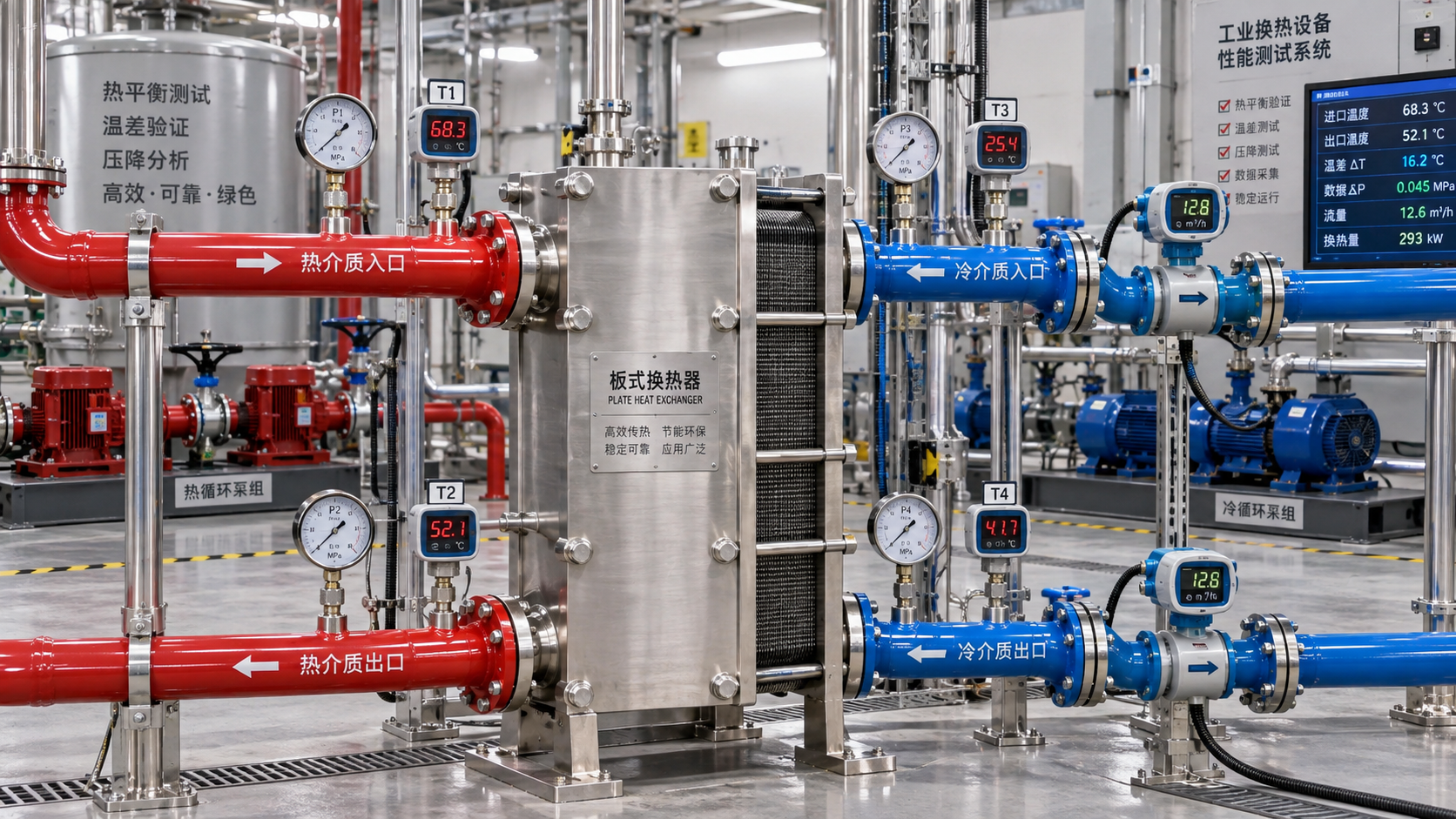
Capture inlet and outlet temperatures, pressure drop, flow rate, fluid properties, and duty across normal, peak, and low-load periods.
Then compare actual heat duty against design expectations. A small deviation may be normal. A persistent gap usually points to an operational loss.
In many facilities, the first surprise is data quality. Sensors may drift, pressure taps may clog, and flowmeters may not match the real process profile.
Before changing hardware, verify instrumentation. Better measurement often becomes the fastest path to better heat exchanger efficiency.
What to check first
- Temperature approach at both ends of the exchanger.
- Pressure drop trend versus historical values.
- Actual flow distribution through parallel units.
- Seasonal utility changes affecting cooling or heating media.
- Control valve position stability during load swings.
Attack Fouling Before It Becomes a Capacity Problem
Fouling remains one of the most common reasons for poor heat exchanger efficiency. It reduces thermal conductivity and often increases pressure drop at the same time.
The challenge is that fouling rarely appears as a sudden failure. It builds slowly, so operators may adapt the process around it without noticing the energy penalty.
Look for gradual rise in utility demand, slower temperature pull-down, wider outlet variation, or higher pump load. These are early warning signs.
Cleaning schedules should be based on performance trend, not fixed calendar intervals alone. In real operations, duty loss matters more than elapsed time.
Low-disruption fouling actions
- Review water chemistry, suspended solids, and scaling tendency.
- Adjust filtration or side-stream treatment where contamination is recurring.
- Use targeted cleaning during short maintenance windows.
- Track fouling factor trend after each cleaning cycle.
- Document which process conditions accelerate deposit formation.
This is where disciplined monitoring pays off. Once fouling behavior is understood, improving heat exchanger efficiency becomes much more predictable.
Correct Flow Imbalance and Bypass Losses
Another overlooked issue is poor flow distribution. A heat exchanger may appear undersized when the real problem is uneven flow through channels, passes, or parallel units.
In actual plants, small bypasses and control workarounds can seriously reduce heat exchanger efficiency. Fluid takes the easiest path, not the intended one.
Check whether valves are leaking internally, whether bypass lines remain cracked open, and whether one exchanger in a bank is carrying too much duty.
You should also confirm that pumps and fans still operate near their expected curve. Equipment drift upstream can damage thermal performance downstream.
Common balance fixes
- Rebalance parallel branches using measured pressure and flow.
- Repair passing valves that create hidden recirculation.
- Remove temporary line configurations left from past shutdowns.
- Review exchanger sequencing during partial load operation.
These are not glamorous changes, but they can restore heat exchanger efficiency faster than a hardware upgrade.
Tune Control Logic and Operating Setpoints
From recent operating trends, a clearer signal is emerging. Control quality increasingly determines whether installed heat transfer area is used effectively.
Many systems lose heat exchanger efficiency because setpoints are overly conservative. Operators may keep extra utility flow or unnecessary temperature margins to avoid process alarms.
That approach feels safe, but it often wastes energy. It may also hide a degrading exchanger until the problem becomes expensive.
Review control loop response, valve hunting, deadband settings, and utility reset logic. Stable process control supports stable thermal transfer.
High-value control improvements
- Reduce unnecessary utility overfeed during low-load periods.
- Align outlet temperature targets with actual process need.
- Use trend alarms for slow performance decline, not only trips.
- Synchronize exchanger control with compressor, chiller, or boiler response.
For industrial cooling and compression networks, these steps often deliver measurable gains without touching the exchanger shell or core.
Match Utility Conditions to Process Reality
Heat exchanger efficiency depends on both sides of the system. Plants sometimes focus only on the process stream and ignore utility-side drift.
Cooling water temperature, condenser cleanliness, steam quality, glycol concentration, and air-side blockage can all reduce available thermal driving force.
This also means one exchanger problem may begin somewhere else. A dirty cooling tower or unstable compressed air heat recovery loop can trigger system-wide losses.
For evaluators, the practical question is simple. Is the exchanger underperforming, or is the utility condition weaker than assumed?
Use Data Trends to Prioritize No-Retrofit Actions
Not every deviation deserves the same response. The strongest approach is to rank issues by energy impact, process risk, and ease of correction.
That is especially useful in sites managing industrial cooling, vacuum processes, compressed air packages, and multiple heat exchange loops at once.
A simple performance dashboard can help. Track duty, approach temperature, pressure drop, cleaning interval, utility cost, and downtime exposure together.
When those indicators are reviewed consistently, heat exchanger efficiency moves from a maintenance issue to an operating decision supported by evidence.
A practical decision sequence
- Validate sensor accuracy and baseline duty.
- Identify fouling, imbalance, or control losses.
- Estimate energy cost of each loss mechanism.
- Implement the lowest-disruption correction first.
- Recheck heat exchanger efficiency after each action.
This method prevents unnecessary retrofit spending. More importantly, it reveals where process discipline can outperform capital replacement.
Conclusion
To improve heat exchanger efficiency without a major retrofit, focus first on what operations can change now. That usually means better data, better cleaning timing, better flow balance, and smarter control.
Across energy-intensive industries, the most reliable gains often come from removing hidden losses rather than adding new hardware.
For teams tracking thermal performance, this also creates a stronger basis for later investment decisions. You can justify upgrades with evidence, not assumption.
GTC-Matrix continues to observe this shift closely. As industrial systems pursue decarbonization, smarter heat exchanger efficiency management is becoming a practical advantage, not just a technical target.
The next step is straightforward: measure the gap, isolate the loss, correct the operating cause, and confirm the result. That is how thermal performance improves without unnecessary disruption.
Ready when you are. Send us a message to get started.
Related News
- How corrugation angle affects heat transfer in plate heat exchangersAuthor :Thermodynamics Analyst

- When do plate heat exchangers suit Middle East seawater cooling?Author :Thermodynamics Analyst

- When does gasketed plate heat exchanger technology suit your process?Author :Thermodynamics Analyst

- When does heat recovery improve data center cooling efficiency?Author :Thermodynamics Analyst

- How Do I Verify Heat Transfer Calculations in a Supplier Quotation?Author :Thermodynamics Analyst

- How to evaluate a plate heat exchangers supplier before orderingAuthor :Thermodynamics Analyst

- EU Tightens Fatigue Checks for Plate Heat ExchangersAuthor :Thermodynamics Analyst

- EU PFAS Rule Adds New Export Filing for Cooling EquipmentAuthor :Thermodynamics Analyst

- EU EN 13445-4:2026 Adds Fatigue Report RequirementAuthor :Thermodynamics Analyst

- EU Updates EN 13445-4 for Plate ExchangersAuthor :Thermodynamics Analyst

- How to Compare Energy-Efficient Heat Exchange SolutionsAuthor :Thermodynamics Analyst

- Brazed Plate Exchanger Design: 7 Factors That Affect Heat TransferAuthor :Thermodynamics Analyst

- EU CBAM Pilot List Adds Plate ExchangersAuthor :Thermodynamics Analyst

- How Heat Exchange Systems Improve Temperature Control StabilityAuthor :Thermodynamics Analyst

- Japan to Require Efficiency Labels for Plate ExchangersAuthor :Thermodynamics Analyst

- EU REACH Adds PFAS Ban for Plate Heat ExchangersAuthor :Thermodynamics Analyst

- India Enforces BIS Rule for Plate Heat ExchangersAuthor :Thermodynamics Analyst

- DIN EN 13445-6:2026 Tightens Plate Exchanger CE RulesAuthor :Thermodynamics Analyst

- EU REACH Restricts PFAS Seals for Plate Heat ExchangersAuthor :Thermodynamics Analyst

- India Mandates BIS Certification for Imported Plate ExchangersAuthor :Thermodynamics Analyst

- Vietnam Requires QR Labels on Imported Plate Heat ExchangersAuthor :Thermodynamics Analyst

- EU EN 13445-4:2026 Tightens NDT Rules for Heat ExchangersAuthor :Thermodynamics Analyst

- EPA Clears R-1234ze(E) for Plate Exchanger SystemsAuthor :Thermodynamics Analyst
 for Plate Exchanger Systems")
- Heat Exchange Equipment Selection: Key Performance Checks Before You Compare ModelsAuthor :Thermodynamics Analyst

- ASHRAE 90.1-2026 Raises Plate Exchanger Efficiency ThresholdAuthor :Thermodynamics Analyst

- Heat Exchange Systems: How to Choose the Right SetupAuthor :Thermodynamics Analyst

- EPA SNAP 89 Takes Effect for Plate ExchangersAuthor :Thermodynamics Analyst

- How to Compare Heat Exchange Solutions for Lower Energy UseAuthor :Thermodynamics Analyst

- EPA SNAP 89 Expands Filing Rules for Plate Heat ExchangersAuthor :Thermodynamics Analyst

- EPA SNAP update adds filing rule for plate heat exchangersAuthor :Thermodynamics Analyst

- Industrial Heat Recovery: Where the Payback Is Fastest in 2026Author :Thermodynamics Analyst

- California EPR Deadline Nears for Cooling Equipment MakersAuthor :Thermodynamics Analyst

- Heat Exchanger Technology: Plate vs Shell and Tube for EfficiencyAuthor :Thermodynamics Analyst

- Industrial Heat Recovery Options for High-Temperature ProcessesAuthor :Thermodynamics Analyst

- Heat Transfer Problems in Process Lines: Causes and Practical FixesAuthor :Thermodynamics Analyst

- India Tightens Plate Exchanger Import Clearance RulesAuthor :Thermodynamics Analyst