



Industrial Heat Recovery: Where the Payback Is Fastest in 2026




Why is industrial heat recovery getting faster payback attention in 2026?
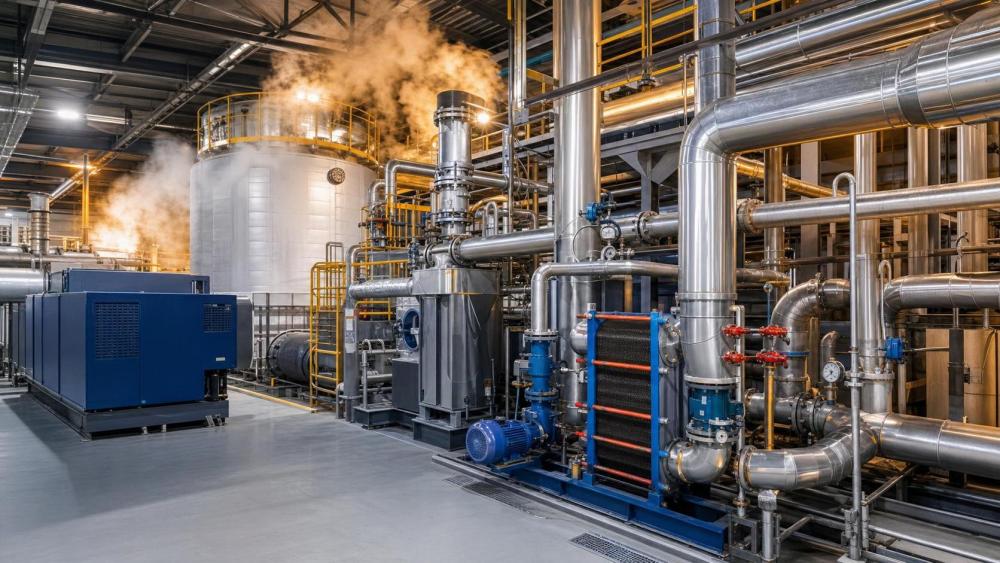
Industrial heat recovery is no longer a side project in plant efficiency reviews.
In 2026, it sits much closer to core capital planning because energy waste is easier to quantify than many productivity claims.
That matters when budget approval depends on visible savings, defensible assumptions, and low implementation friction.
In simple terms, the fastest returns usually come from heat that is already leaving the site through exhaust, cooling loops, compressors, boilers, or drying systems.
Instead of buying all thermal energy again, a plant reuses part of it for preheating, hot water, space heating, or process support.
The appeal is practical.
Savings can often be tied to reduced fuel use, lower electricity demand, or smaller boiler loading within the first reporting cycle.
This is also why industrial heat recovery is being tracked more closely by intelligence platforms such as GTC-Matrix.
Its coverage of compression, cooling, vacuum, and heat exchange helps connect thermodynamic performance with capital decision logic.
For many facilities, the question is no longer whether waste heat exists.
The better question is where recovery delivers the shortest and cleanest payback case.
Where does industrial heat recovery usually pay back the fastest?
The quickest payback rarely comes from the hottest stream alone.
It comes from the best match between waste heat source, recovery technology, and a stable internal heat demand.
In actual projects, several applications appear again and again because the economics are easier to prove.
- Air compressor heat recovery for hot water or space heating in facilities with long operating hours.
- Boiler stack heat recovery where feedwater preheating immediately cuts fuel consumption.
- Oven, dryer, and furnace exhaust recovery in food, chemicals, metals, and building materials processing.
- Refrigeration and chiller heat reclaim where rejected heat can support washdown, domestic hot water, or low-temperature process loads.
- Process cooling loop recovery where warm water can replace purchased heating in adjacent operations.
Compressed air systems deserve special attention.
They often run continuously, waste significant heat, and use standardized recovery packages with limited operational disruption.
That combination can make industrial heat recovery easier to approve than more customized thermal retrofits.
By contrast, a very hot exhaust stream may look impressive on paper but underperform financially if demand is seasonal or intermittent.
The fastest payback is usually found where recovered heat is consumed consistently, close by, and without complex storage.
How can you tell whether a site has a strong heat recovery case or a marginal one?
A good industrial heat recovery project is not defined by enthusiasm.
It is defined by measurable thermal balance.
Before comparing vendors or equipment concepts, it helps to screen the opportunity with a simple decision table.
If most answers fall in the left column, the economics are usually worth deeper engineering.
If several warning signs appear together, the project may still work, but payback will likely stretch.
A common mistake is to value only theoretical heat volume.
More useful is the share of heat that can actually displace purchased energy under real operating conditions.
Which costs and assumptions usually decide approval speed?
Approval usually moves faster when the model stays simple and auditable.
For industrial heat recovery, several cost drivers deserve closer attention than brochure-level efficiency claims.
What should be included in the payback model?
- Installed equipment cost, not just exchanger or recovery module price.
- Piping, controls, pumps, ducting, insulation, and integration labor.
- Planned downtime cost if tie-ins affect production.
- Maintenance burden, including fouling, cleaning, and control recalibration.
- Expected offset value based on actual fuel and power tariffs.
What assumptions deserve stress testing?
Run at least three scenarios.
Use base, conservative, and high-utilization cases rather than one optimistic estimate.
This matters because industrial heat recovery economics can shift quickly when production volume changes.
Energy price outlook also matters, but it should not carry the whole business case.
The strongest projects remain attractive even under moderate energy prices.
That is one reason sector intelligence is becoming more valuable.
GTC-Matrix, for example, follows the intersection of energy costs, equipment evolution, and thermal-system efficiency.
That broader context helps teams avoid approving projects based on temporary spikes alone.
What are the most common mistakes when comparing industrial heat recovery options?
Most underperforming projects do not fail because heat recovery is unsound.
They fail because matching, controls, or operating assumptions were weak from the start.
Several mistakes appear repeatedly across sectors.
- Choosing the hottest stream instead of the most usable stream.
- Ignoring part-load behavior in compressors, boilers, or process lines.
- Underestimating fouling risk in dirty exhaust or contaminated fluids.
- Missing control integration needs between recovery loops and existing utilities.
- Counting carbon benefits twice while overstating direct energy savings.
Another common issue is comparing technologies without comparing temperature lift requirements.
A basic heat exchanger, a heat pump, and a thermal storage-assisted setup may all recover energy, but they solve different problems.
The lower-risk option is often the one that fits existing process conditions with fewer moving parts.
In food, pharma, semiconductors, and precision manufacturing, purity and temperature control can outweigh pure energy volume.
That is where intelligence-led evaluation becomes useful, especially when thermal performance must align with process quality and compliance.
So where should the first screening effort begin?
A sensible starting point is not a vendor list.
It is a short map of the site’s largest heat losses and the nearest repeatable heat demands.
For many facilities, that first screen quickly narrows the field to two or three realistic industrial heat recovery opportunities.
The next step is to rank them by four practical filters.
- How continuous the waste heat source is.
- How directly the recovered heat offsets purchased energy.
- How difficult the installation is during normal operations.
- How clearly post-installation savings can be verified.
That approach usually surfaces quick-win cases such as compressor heat reclaim, boiler economizers, or low-complexity process water preheating.
More complex options should not be ignored.
They simply belong in a second wave, after the site proves its recovery strategy with cleaner economics.
The broader lesson is clear.
Industrial heat recovery pays back fastest where thermodynamics, operations, and capital discipline point in the same direction.
For 2026 planning, it makes sense to review waste-heat streams with the same rigor used for major utility purchases.
Start with measured losses, test demand matching, compare conservative scenarios, and use market intelligence to validate assumptions.
That creates a stronger basis for deciding which projects deserve immediate engineering and which ones should wait.
Related News
- How to evaluate a plate heat exchangers supplier before orderingAuthor :Thermodynamics Analyst

- EU Tightens Fatigue Checks for Plate Heat ExchangersAuthor :Thermodynamics Analyst

- EU PFAS Rule Adds New Export Filing for Cooling EquipmentAuthor :Thermodynamics Analyst

- EU EN 13445-4:2026 Adds Fatigue Report RequirementAuthor :Thermodynamics Analyst

- EU Updates EN 13445-4 for Plate ExchangersAuthor :Thermodynamics Analyst

- How to Compare Energy-Efficient Heat Exchange SolutionsAuthor :Thermodynamics Analyst

- Brazed Plate Exchanger Design: 7 Factors That Affect Heat TransferAuthor :Thermodynamics Analyst

- EU CBAM Pilot List Adds Plate ExchangersAuthor :Thermodynamics Analyst

- How Heat Exchange Systems Improve Temperature Control StabilityAuthor :Thermodynamics Analyst

- Japan to Require Efficiency Labels for Plate ExchangersAuthor :Thermodynamics Analyst

- EU REACH Adds PFAS Ban for Plate Heat ExchangersAuthor :Thermodynamics Analyst

- India Enforces BIS Rule for Plate Heat ExchangersAuthor :Thermodynamics Analyst

- DIN EN 13445-6:2026 Tightens Plate Exchanger CE RulesAuthor :Thermodynamics Analyst

- EU REACH Restricts PFAS Seals for Plate Heat ExchangersAuthor :Thermodynamics Analyst

- India Mandates BIS Certification for Imported Plate ExchangersAuthor :Thermodynamics Analyst

- Vietnam Requires QR Labels on Imported Plate Heat ExchangersAuthor :Thermodynamics Analyst

- EU EN 13445-4:2026 Tightens NDT Rules for Heat ExchangersAuthor :Thermodynamics Analyst

- EPA Clears R-1234ze(E) for Plate Exchanger SystemsAuthor :Thermodynamics Analyst
 for Plate Exchanger Systems")
- Heat Exchange Equipment Selection: Key Performance Checks Before You Compare ModelsAuthor :Thermodynamics Analyst

- ASHRAE 90.1-2026 Raises Plate Exchanger Efficiency ThresholdAuthor :Thermodynamics Analyst

- Heat Exchange Systems: How to Choose the Right SetupAuthor :Thermodynamics Analyst

- EPA SNAP 89 Takes Effect for Plate ExchangersAuthor :Thermodynamics Analyst

- How to Compare Heat Exchange Solutions for Lower Energy UseAuthor :Thermodynamics Analyst

- EPA SNAP 89 Expands Filing Rules for Plate Heat ExchangersAuthor :Thermodynamics Analyst

- EPA SNAP update adds filing rule for plate heat exchangersAuthor :Thermodynamics Analyst

- Industrial Heat Recovery: Where the Payback Is Fastest in 2026Author :Thermodynamics Analyst

- California EPR Deadline Nears for Cooling Equipment MakersAuthor :Thermodynamics Analyst

- Heat Exchanger Technology: Plate vs Shell and Tube for EfficiencyAuthor :Thermodynamics Analyst

- Industrial Heat Recovery Options for High-Temperature ProcessesAuthor :Thermodynamics Analyst

- Heat Transfer Problems in Process Lines: Causes and Practical FixesAuthor :Thermodynamics Analyst

- India Tightens Plate Exchanger Import Clearance RulesAuthor :Thermodynamics Analyst

- SABIC Methanol Force Majeure Extended to Q4 2026Author :Thermodynamics Analyst

- How to Improve Heat Exchanger Efficiency Without Major RetrofitAuthor :Thermodynamics Analyst

- Plate Heat Exchange vs Shell & Tube: Which Fits Your Process Better?Author :Thermodynamics Analyst

- Heat Transfer Basics: What Affects Efficiency Most?Author :Thermodynamics Analyst
![]()
- Microchannel Heat Exchangers vs Plate Exchangers: Key Trade-OffsAuthor :Thermodynamics Analyst