China Extends US, South Korea Polysilicon Duties to 2031




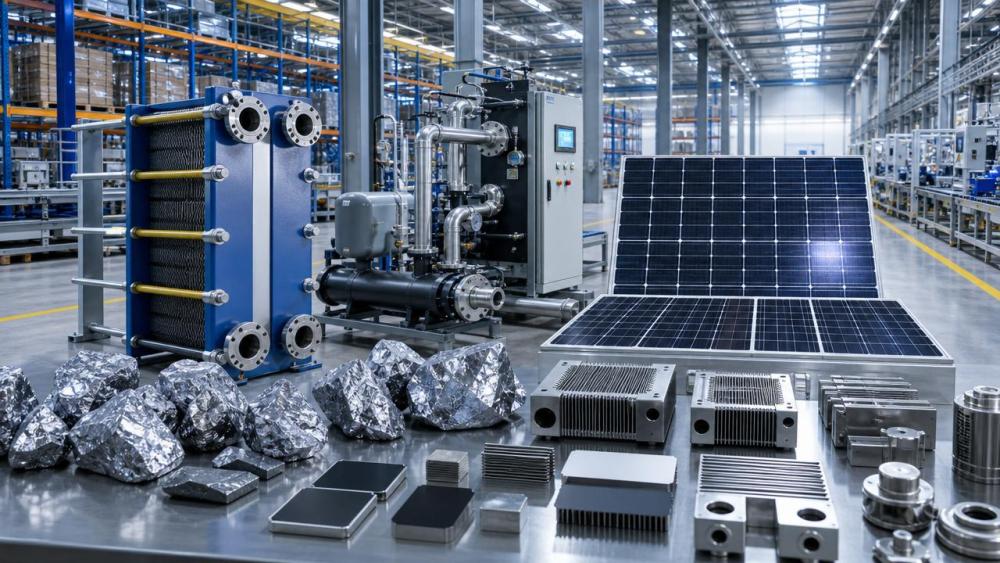
On January 14, 2026, market attention turned to China’s decision to keep anti-dumping and countervailing duties in place on solar-grade polysilicon originating in the United States and South Korea for another five years. While the measure is aimed at the photovoltaic upstream segment, it deserves broader industry attention because it may indirectly raise BOM costs and extend delivery timelines for silicon-based temperature-control components used in PV-thermal hybrid systems, plate heat exchangers for CSP plants, and high-temperature heat transfer oil circulation equipment.
What the ministry announcement confirmed
According to an announcement released by China’s Ministry of Commerce on January 13, 2026, China will continue to levy anti-dumping and countervailing duties on solar-grade polysilicon originating in the United States and South Korea for five years.
The confirmed duty ranges provided in the input are as follows: anti-dumping duties on US-origin products at 53.3% to 57%, countervailing duties on US-origin products at 0% to 2.1%, and anti-dumping duties on South Korea-origin products at 4.4% to 113.8%.
The information provided also makes clear that the policy is centered on the PV upstream segment, but that its effect may indirectly be felt in the cost structure and delivery cycle of silicon-based temperature-control components used in certain thermal management and heat exchange applications linked to solar energy systems.
Where the pressure may appear across the chain
Procurement teams exposed through silicon-based control parts
From an industry perspective, buyers of components used in PV-thermal coupling systems, CSP plate heat exchanger applications, and high-temperature heat transfer oil circulation equipment may need to watch for indirect cost transmission. The reason is not that the announcement directly targets those end systems, but that silicon-based temperature-control elements within them may face higher BOM pressure and longer lead times.
Equipment manufacturers balancing cost and delivery
For manufacturers of plate heat exchangers, thermal circulation equipment, and related system assemblies, the main concern is likely to be at the component integration level. Analysis shows the impact may show up less in a single headline material line and more in procurement coordination, quotation updates, delivery scheduling, and contract execution where silicon-based parts are involved.
Supply chain service providers and distributors monitoring timing risk
For intermediaries handling sourcing, stocking, or project delivery coordination, what deserves closer attention is timing rather than only price. If upstream policy continuity feeds into slower component availability, the pressure may be reflected in replenishment plans, document matching, shipment commitments, and downstream customer communication.
Project owners and end users watching system-level budgets
For project-side buyers and end users, especially those evaluating solar-linked thermal equipment packages, the practical issue may be whether indirect component cost increases begin to affect overall system budgeting or installation schedules. Observably, this is most relevant where silicon-based temperature-control components are not core headline items but still matter for system reliability and delivery completeness.
What companies should track now
Separate the confirmed policy from downstream execution impact
The confirmed fact is the extension of duties for another five years. The downstream cost and lead-time effect on heat exchange and thermal control equipment should be treated as an impact path to monitor, not as a fully quantified result. Companies should avoid treating all anticipated cost pressure as already realized in every order or project.
Review component categories tied to silicon-based control functions
Companies involved in PV-thermal hybrid systems, CSP heat exchange packages, and high-temperature thermal oil circulation equipment should identify which purchased items rely on silicon-based temperature-control components. The immediate value of this step is practical: it helps determine where BOM sensitivity and delivery risk may emerge first.
Prepare supplier and documentation checks more carefully
Analysis shows procurement and supply-chain teams should pay closer attention to supplier qualifications, product origin-related documentation, and fulfillment timing for affected categories. Even where the policy impact is indirect, execution risk can still appear through quotation validity, order confirmation, and delivery commitments.
Keep customer communication aligned with actual procurement conditions
For manufacturers and service providers, it is important to distinguish between policy signal and actual order impact when communicating with customers. If delivery cycles or pricing assumptions change, the basis should be explained through current procurement conditions rather than broad market claims that are not confirmed by the information at hand.
Why this looks like more than a short-term headline
Analysis shows this development is better understood as a medium- to longer-duration policy signal rather than a one-off market fluctuation, because the extension period is five years. At the same time, it should not be overstated as an immediate and uniform cost shock across all thermal equipment segments. More appropriately, it signals that companies linked to solar-related thermal systems should continue watching how upstream trade measures translate into real purchasing, lead-time, and quoting conditions downstream.
Observably, the key industry question is not only whether duties remain in place, but how far their influence travels beyond core PV material transactions. That is why this item matters to equipment and system businesses that may not sit directly inside polysilicon trade flows but still depend on silicon-based components in critical subassemblies.
How this news is best understood at this stage
At this stage, the announcement clearly confirms policy continuity through 2031 for the specified duties on US- and South Korea-origin solar-grade polysilicon. The broader industry meaning lies in the possibility of indirect cost and delivery pressure spreading into selected solar-thermal and heat exchange equipment categories. A neutral reading is that this is neither just a short-term pricing story nor a fully settled downstream outcome; it is a policy development with operational implications that relevant companies should continue to verify in procurement and project execution.
Basis of this article and follow-up points
This article is based on the user-provided news title, event date, and event summary. The core factual basis comes from the stated Ministry of Commerce announcement date, the specified duty ranges for US- and South Korea-origin solar-grade polysilicon, the five-year extension period, and the stated indirect impact on BOM cost and delivery cycles for silicon-based temperature-control components in relevant thermal system applications.
Source types commonly relevant to this kind of industry update may include official government announcements, company disclosures, industry association updates, authoritative media reporting, and standards-related documents. A specific official source link was not provided in the input, so continued verification remains necessary. Follow-up attention should focus on whether subsequent official wording, supply-chain execution, and project-side procurement conditions provide clearer evidence of how strongly the upstream measure is transmitted into downstream thermal equipment costs and delivery schedules.
Ready when you are. Send us a message to get started.
Related News
- How corrugation angle affects heat transfer in plate heat exchangersAuthor :Thermodynamics Analyst

- When do plate heat exchangers suit Middle East seawater cooling?Author :Thermodynamics Analyst

- When does gasketed plate heat exchanger technology suit your process?Author :Thermodynamics Analyst

- When does heat recovery improve data center cooling efficiency?Author :Thermodynamics Analyst

- How Do I Verify Heat Transfer Calculations in a Supplier Quotation?Author :Thermodynamics Analyst

- How to evaluate a plate heat exchangers supplier before orderingAuthor :Thermodynamics Analyst

- EU Tightens Fatigue Checks for Plate Heat ExchangersAuthor :Thermodynamics Analyst

- EU PFAS Rule Adds New Export Filing for Cooling EquipmentAuthor :Thermodynamics Analyst

- EU EN 13445-4:2026 Adds Fatigue Report RequirementAuthor :Thermodynamics Analyst

- EU Updates EN 13445-4 for Plate ExchangersAuthor :Thermodynamics Analyst

- How to Compare Energy-Efficient Heat Exchange SolutionsAuthor :Thermodynamics Analyst

- Brazed Plate Exchanger Design: 7 Factors That Affect Heat TransferAuthor :Thermodynamics Analyst

- EU CBAM Pilot List Adds Plate ExchangersAuthor :Thermodynamics Analyst

- How Heat Exchange Systems Improve Temperature Control StabilityAuthor :Thermodynamics Analyst

- Japan to Require Efficiency Labels for Plate ExchangersAuthor :Thermodynamics Analyst

- EU REACH Adds PFAS Ban for Plate Heat ExchangersAuthor :Thermodynamics Analyst

- India Enforces BIS Rule for Plate Heat ExchangersAuthor :Thermodynamics Analyst

- DIN EN 13445-6:2026 Tightens Plate Exchanger CE RulesAuthor :Thermodynamics Analyst

- EU REACH Restricts PFAS Seals for Plate Heat ExchangersAuthor :Thermodynamics Analyst

- India Mandates BIS Certification for Imported Plate ExchangersAuthor :Thermodynamics Analyst

- Vietnam Requires QR Labels on Imported Plate Heat ExchangersAuthor :Thermodynamics Analyst

- EU EN 13445-4:2026 Tightens NDT Rules for Heat ExchangersAuthor :Thermodynamics Analyst

- EPA Clears R-1234ze(E) for Plate Exchanger SystemsAuthor :Thermodynamics Analyst
 for Plate Exchanger Systems")
- Heat Exchange Equipment Selection: Key Performance Checks Before You Compare ModelsAuthor :Thermodynamics Analyst

- ASHRAE 90.1-2026 Raises Plate Exchanger Efficiency ThresholdAuthor :Thermodynamics Analyst

- Heat Exchange Systems: How to Choose the Right SetupAuthor :Thermodynamics Analyst

- EPA SNAP 89 Takes Effect for Plate ExchangersAuthor :Thermodynamics Analyst

- How to Compare Heat Exchange Solutions for Lower Energy UseAuthor :Thermodynamics Analyst

- EPA SNAP 89 Expands Filing Rules for Plate Heat ExchangersAuthor :Thermodynamics Analyst

- EPA SNAP update adds filing rule for plate heat exchangersAuthor :Thermodynamics Analyst

- Industrial Heat Recovery: Where the Payback Is Fastest in 2026Author :Thermodynamics Analyst

- California EPR Deadline Nears for Cooling Equipment MakersAuthor :Thermodynamics Analyst

- Heat Exchanger Technology: Plate vs Shell and Tube for EfficiencyAuthor :Thermodynamics Analyst

- Industrial Heat Recovery Options for High-Temperature ProcessesAuthor :Thermodynamics Analyst

- Heat Transfer Problems in Process Lines: Causes and Practical FixesAuthor :Thermodynamics Analyst

- India Tightens Plate Exchanger Import Clearance RulesAuthor :Thermodynamics Analyst