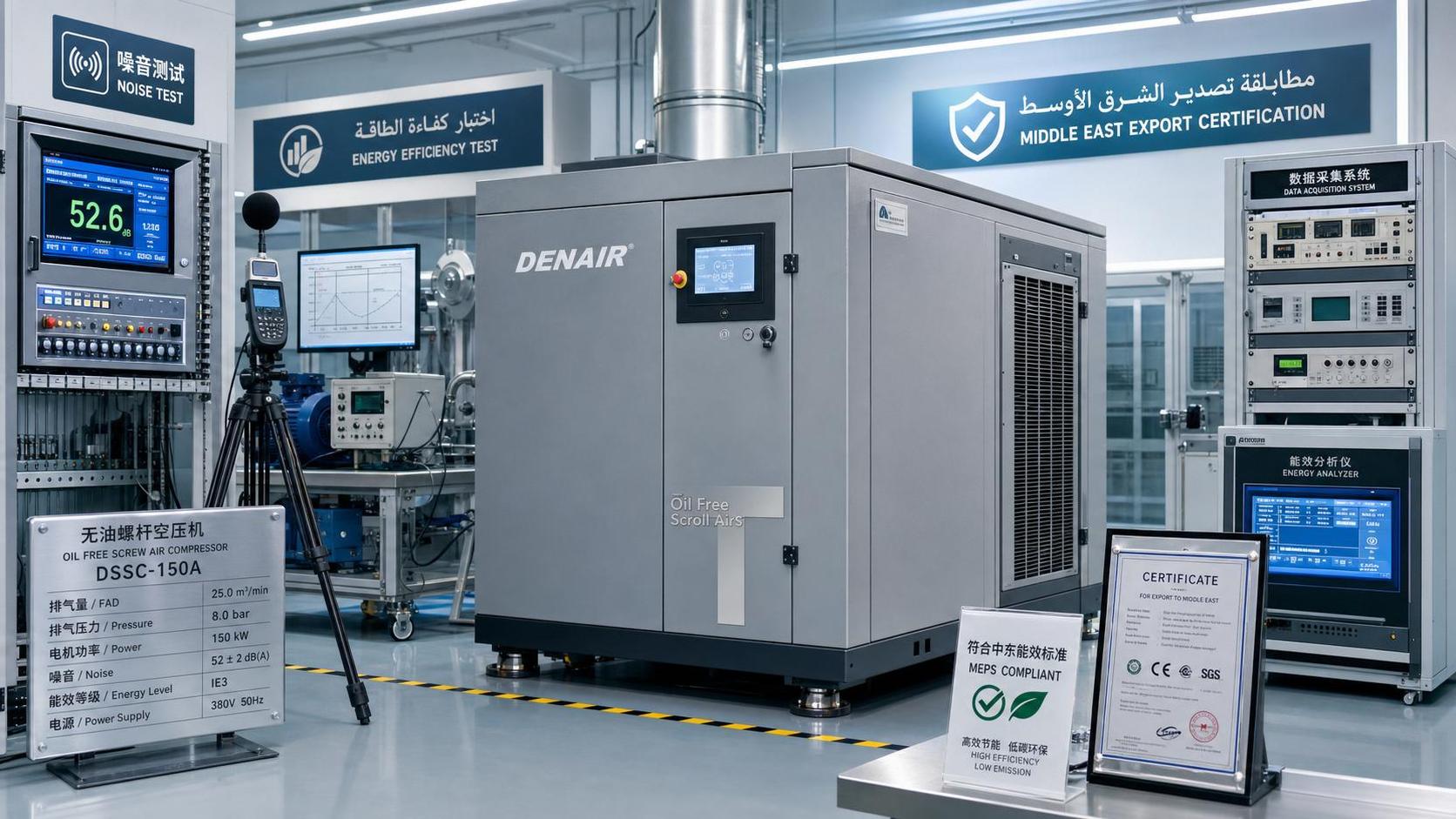




IEC 63349-2:2026 makes energy certification mandatory




On June 23, 2026, the IEC made IEC 63349-2:2026 mandatory worldwide for newly designed and exported oil-free screw compressors, turning energy performance verification into a direct market-access condition rather than a voluntary technical reference. For exporters, manufacturers, buyers, certification-related service providers, and supply chain teams, the immediate issue is not only product compliance, but also whether testing, documentation, and shipment readiness can meet the new clearance requirements adopted by 32 WTO members.

The rule change now tied to customs clearance
According to the provided information, IEC 63349-2:2026 became mandatory globally on June 23, 2026.
The standard applies to all newly designed and exported oil-free screw compressors.
The updated requirements significantly tighten energy-efficiency test accuracy and leakage-rate limits, and they also require a third-party certification report.
The European Union, South Korea, Australia, and a total of 32 WTO members have adopted this standard as a mandatory basis for market access.
Products without the required certification will be refused customs clearance in the relevant markets.
Where the pressure is likely to appear first
Export shipments face a documentation threshold
From an industry perspective, exporters are likely to be affected first because the change is directly linked to market entry and customs release. The main impact is expected in pre-shipment compliance review, contract fulfillment, and customs documentation preparation. What deserves closer attention is whether third-party certification reports and related technical files are aligned with the new standard before goods are dispatched.
Manufacturers may need tighter testing alignment
Analysis shows that manufacturers of oil-free screw compressors may face pressure in product validation and release procedures, because the standard raises the bar for test accuracy and leakage-rate control. The practical concern is not only product design, but also whether internal test results, third-party verification, and export documentation can support the same compliance position.
Procurement and buyer-side qualification checks may become stricter
Buyers and procurement teams may also be affected where tender specifications, supplier approval, and delivery acceptance rely on market-access compliance. Observably, a purchase decision may now depend more heavily on whether suppliers can present valid third-party certification materials for the covered product category and destination market.
Certification and testing services move closer to delivery risk control
Certification-related companies and testing service providers may see their role move closer to transaction execution rather than general technical support. For supply chain coordination, the relevant issue is whether certification timing, report availability, and document consistency can support booking, customs filing, and handover schedules.
What companies should review now
Check whether covered products fall within the mandatory scope
Analysis shows that companies involved with newly designed or exported oil-free screw compressors should first verify whether specific product lines and pending shipments fall within the mandatory scope described in the provided information. This is especially relevant for export planning and specification matching.
Reconfirm certification files and technical documents
What deserves closer attention is the completeness of third-party certification reports and the consistency of related technical materials. Where contracts, bids, customs files, or customer submissions refer to energy performance or leakage control, companies may need to review whether those documents still match the new mandatory standard.
Watch for execution language in tenders and trade paperwork
Observably, even when the rule itself is clear, the practical burden often appears in bid documents, buyer specifications, customs submissions, and supplier qualification requests. Since the provided information does not include detailed implementation wording for each market, companies should closely monitor how the mandatory basis is reflected in transaction documents.
Prepare for timing risks around shipment and delivery
From an industry perspective, businesses should pay attention to whether certification readiness could affect shipping schedules, acceptance timing, or cross-border delivery commitments. The provided information confirms a refusal of customs clearance for uncertified products, but it does not define market-by-market operational timelines, so execution details still require ongoing review.
Why this matters beyond a standard update
Analysis shows that this development is better understood as a market-access enforcement signal rather than a routine technical revision. The combination of stricter test accuracy, tighter leakage limits, mandatory third-party certification, and adoption by 32 WTO members means the standard now reaches into trade execution, supplier qualification, and delivery control.
At the same time, it is also more appropriate to understand this as a rule change with confirmed direction but still evolving market practice. The provided information establishes the mandatory requirement and the customs consequence, yet companies still need to observe how certification interpretation, procurement language, and transaction-level enforcement develop in practice.
How to read the current stage of the change
From an industry perspective, the most reasonable conclusion at this stage is that IEC 63349-2:2026 should be treated as an already effective compliance gate for covered exports, not as a distant policy trend. The immediate significance lies in the shift from technical benchmarking to mandatory certification-linked access.
Observably, however, this is not a basis for broad claims about final market outcomes, cost effects, or uniform enforcement speed across all participants. A more neutral reading is that the rule has clearly landed, while the detailed business impact will depend on how buyers, certifiers, customs processes, and supplier documents align in the months ahead.
Basis of this article and what still needs verification
This article is generated from the user-provided title, event date, and event summary. For developments of this kind, relevant source types typically include official announcements, regulator publications, customs or trade authority notices, industry association updates, standard-setting organization documents, and reporting by established professional media.
No specific official source link was provided in the input, so the underlying official link and subsequent implementation materials still need to be continuously verified. What remains worth tracking includes detailed enforcement language, certification interpretation, tender-document changes, market feedback, and how companies are carrying out compliance in actual export transactions.
Related News
- How to verify compressed air cleanroom standards before installationAuthor :Pneumatic Power Engineer

- When oil free vacuum pumps make sense for European cleanroom projectsAuthor :Pneumatic Power Engineer

- When do pure air compression systems need ISO 8573-1 Class 0?Author :Pneumatic Power Engineer

- How do compressed air systems for electronics prevent contamination?Author :Pneumatic Power Engineer

- When does an oil-free process vacuum pump justify its higher cost?Author :Pneumatic Power Engineer

- Does ISO 9001 certification apply to compressed air quality?Author :Pneumatic Power Engineer

- How to Specify Clean Compressed Air Systems in Southeast Asia for Food and Pharma PlantsAuthor :Pneumatic Power Engineer

- How to Compare Oil Free Vacuum Pumps for Clean Process RequirementsAuthor :Pneumatic Power Engineer

- How to Evaluate a Clean Compressed Air Systems Supplier for ISO 8573-1 ComplianceAuthor :Pneumatic Power Engineer

- How to Choose the Right Oil-Free Vacuum PumpAuthor :Pneumatic Power Engineer

- VDI 2083 Update Makes Class 0 Proof MandatoryAuthor :Pneumatic Power Engineer

- When to Use Oil Free Vacuum Pumps for High Purity LinesAuthor :Pneumatic Power Engineer

- Compressed Air Solutions: When Oil-Free Systems Lower Total Operating CostAuthor :Pneumatic Power Engineer

- ATMOsphere Europe 2026 Adds Oil-free Systems ZoneAuthor :Pneumatic Power Engineer

- Oil-Free Compressors: Key Selection Criteria for Clean Air SystemsAuthor :Pneumatic Power Engineer

- How to Compare Oil Free Centrifugal Compressors for Stable Plant Air SupplyAuthor :Pneumatic Power Engineer

- Compressed Air Class 0 vs Oil-Free: What Really MattersAuthor :Pneumatic Power Engineer

- Oil-Free Compression Class 0: What the Standard Really Means in ProductionAuthor :Pneumatic Power Engineer

- Air Compression Cost Comparison: Oil-Free vs Screw Systems in Daily OperationAuthor :Pneumatic Power Engineer

- Saudi SASO Tightens IEC 63349-2 for Oil-Free CompressorsAuthor :Pneumatic Power Engineer

- Saudi SASO Tightens Oil-Free Compressor Efficiency RulesAuthor :Pneumatic Power Engineer

- Pure Air Compression Systems for Clean Production LinesAuthor :Pneumatic Power Engineer

- IEC 63349-2:2026 makes energy certification mandatoryAuthor :Pneumatic Power Engineer

- IEC 63349-2:2026 Sets New Entry Rules for Oil-Free Screw CompressorsAuthor :Pneumatic Power Engineer

- IEC 63349-2:2026 Takes Effect for Oil-Free Screw CompressorsAuthor :Pneumatic Power Engineer

- IEC 63349-2:2026 Sets New Efficiency Gate for Oil-Free Screw CompressorsAuthor :Pneumatic Power Engineer

- IEC 63349-2:2026 Takes Effect for Oil-Free Screw CompressorsAuthor :Pneumatic Power Engineer

- SABIC Methanol Force Majeure Extended, Tightening R134a/R407C FeedstocksAuthor :Pneumatic Power Engineer

- How to Evaluate Pneumatic Power Systems for Stable OutputAuthor :Pneumatic Power Engineer

- Oil-Free Compression vs Lubricated Systems: Key Trade-OffsAuthor :Pneumatic Power Engineer
![]()
- Oil-Free Compression: 2026 Cost and Compliance Trade-OffsAuthor :Pneumatic Power Engineer

- Oil-Free Compression: Cost and Contamination RisksAuthor :Pneumatic Power Engineer
![]()
- Euro PMI Drop Delays Oil-Free Systems OrdersAuthor :Pneumatic Power Engineer

- Germany/France May PMI Decline; Oil-free Systems EU Projects DelayedAuthor :Pneumatic Power Engineer
![]()
- Compression Technology Options for Cleaner Oil-Free Air SupplyAuthor :Pneumatic Power Engineer

- TUV Rheinland Enforces Full-Chain Class 0 Certification for Oil-Free SystemsAuthor :Pneumatic Power Engineer