AI-Driven Predictive Maintenance for Oil-Free Systems Gains Export Traction




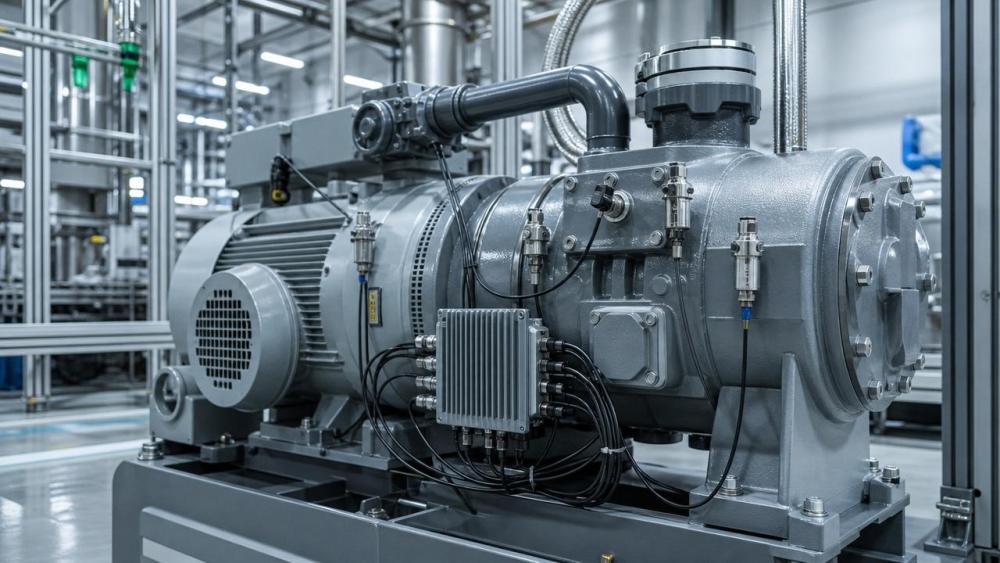
Oil-free compression systems manufacturers in Guangdong, Shandong, and other provinces are accelerating integration of AI-based predictive maintenance capabilities—spurred by recent provincial AI industry policy rollouts. With bearing life prediction accuracy now at 92.7%, the technology is being embedded in exported units to food processing facilities in Thailand and Vietnam, and automotive component production lines in Mexico. This development carries implications for industrial equipment exporters, system integrators, certification-dependent OEMs, and global supply chain stakeholders serving regulated manufacturing sectors.
Event Overview
Recent provincial policy initiatives in Guangdong and Shandong have prioritized AI industrialization, prompting local oil-free systems manufacturers to co-establish AI fault-prediction joint laboratories with universities. As a result, bearing life prediction accuracy for oil-free air compressors has reached 92.7%. Algorithm modules supporting this capability are now deployed within exported complete units—delivered to food plants in Thailand and Vietnam, and to automotive parts production lines in Mexico. Separately, the capability has been referenced in Appendix B of the newly revised TÜV Rheinland Guideline for Oil-Free Compressed Air Systems.
Industries Affected
Industrial Equipment Exporters
Exporters of oil-free compressed air systems face evolving technical expectations in key growth markets—including Southeast Asia and Latin America—where end-users increasingly require embedded predictive analytics as part of system validation. The inclusion of algorithm modules in shipped units signals a shift from hardware-only delivery toward software-integrated solutions.
System Integrators Serving Regulated Sectors
Integrators working with food, pharmaceutical, or automotive clients must now account for predictive maintenance functionality during specification and commissioning. Since TÜV Rheinland’s updated guideline references this capability in Appendix B, integrators may encounter new documentation or verification requests—especially for projects requiring compliance with ISO 8573-1 Class 0 or automotive OEM-specific air quality protocols.
OEMs Dependent on Third-Party Certification
OEMs sourcing oil-free compression systems for final assembly (e.g., packaging lines, battery dry rooms) may see tightening technical clauses in procurement specifications. The reference in TÜV Rheinland’s guideline does not constitute mandatory certification—but it establishes a benchmark that high-end buyers may voluntarily adopt during vendor evaluation.
What Enterprises and Practitioners Should Monitor and Do Now
Track updates to regional AI implementation roadmaps
Provincial AI policies (e.g., Guangdong’s 2024–2026 Action Plan) remain under active refinement. Enterprises should monitor official announcements—not just for funding eligibility, but for emerging requirements around data interoperability, algorithm traceability, and edge-device certification frameworks applicable to embedded predictive modules.
Verify technical scope of ‘predictive maintenance’ in export contracts
Since algorithm modules are now bundled with hardware exports, purchasers should clarify contractual terms: Is the module licensed per unit? Is firmware update support included? Are failure prediction outputs compatible with local MES or CMMS platforms? Ambiguity here may affect long-term operational cost and compliance posture.
Distinguish between guideline reference and regulatory mandate
The inclusion in TÜV Rheinland’s guideline Appendix B reflects industry recognition—not legal obligation. Buyers and suppliers should avoid conflating this with harmonized standards (e.g., EN/ISO). Current adoption remains voluntary and market-driven; however, early alignment with its technical expectations may reduce future qualification lead times.
Assess readiness for algorithm-related supply chain handoffs
Manufacturers exporting integrated predictive modules should review internal processes for software version control, cybersecurity documentation (e.g., IEC 62443 alignment), and cross-border data handling—particularly where real-time vibration or temperature telemetry is transmitted to cloud-based analytics platforms outside the host country.
Editorial Observation / Industry Perspective
Observably, this development signals an early-stage convergence of industrial AI deployment and export competitiveness—not yet a standardized requirement, but increasingly a differentiating factor in competitive tenders and certification reviews. Analysis shows the 92.7% accuracy figure reflects lab-validated performance under controlled conditions; field accuracy across diverse ambient, load, and maintenance regimes remains subject to ongoing validation. From an industry standpoint, the TÜV Rheinland reference is best understood as a leading indicator: it reflects growing technical consensus among third-party certifiers that predictive capability adds measurable value in risk-sensitive applications—but it does not yet trigger mandatory redesign or re-certification cycles.
Current more appropriate interpretation is that this represents a capability signal—not a compliance threshold. Its significance lies less in immediate enforceability and more in its role as a reference point shaping buyer expectations, RFP language, and long-term product roadmap planning across the oil-free compression ecosystem.
In summary, the integration of AI-driven predictive maintenance into oil-free compression systems marks a functional evolution in how reliability assurance is delivered—and increasingly, how it is valued across international industrial markets. For stakeholders, this is not yet a regulatory inflection point, but rather a strategic inflection in technical differentiation and customer engagement. It is better understood today as an emerging expectation in premium segments—not a universal standard, nor a near-term compliance obligation.
Source: Publicly announced provincial AI industrial policy documents (Guangdong, Shandong); verified project deployments reported via manufacturer press releases and TÜV Rheinland’s published guideline revision notice. Ongoing observation is warranted regarding actual adoption rates in end-user sites and any subsequent incorporation into formal certification schemes beyond Appendix B.
Ready when you are. Send us a message to get started.
Related News
- How to verify food-grade purity in compressed air systemsAuthor :Pneumatic Power Engineer

- What determines the price of pure air compression systems?Author :Pneumatic Power Engineer

- How to size oil-free compressors for instrumentation air demandAuthor :Pneumatic Power Engineer

- How Class 0 oil-free compressors protect product quality in food productionAuthor :Pneumatic Power Engineer

- How to verify compressed air cleanroom standards before installationAuthor :Pneumatic Power Engineer

- When oil free vacuum pumps make sense for European cleanroom projectsAuthor :Pneumatic Power Engineer

- When do pure air compression systems need ISO 8573-1 Class 0?Author :Pneumatic Power Engineer

- How do compressed air systems for electronics prevent contamination?Author :Pneumatic Power Engineer

- When does an oil-free process vacuum pump justify its higher cost?Author :Pneumatic Power Engineer

- Does ISO 9001 certification apply to compressed air quality?Author :Pneumatic Power Engineer

- How to Specify Clean Compressed Air Systems in Southeast Asia for Food and Pharma PlantsAuthor :Pneumatic Power Engineer

- How to Compare Oil Free Vacuum Pumps for Clean Process RequirementsAuthor :Pneumatic Power Engineer

- How to Evaluate a Clean Compressed Air Systems Supplier for ISO 8573-1 ComplianceAuthor :Pneumatic Power Engineer

- How to Choose the Right Oil-Free Vacuum PumpAuthor :Pneumatic Power Engineer

- VDI 2083 Update Makes Class 0 Proof MandatoryAuthor :Pneumatic Power Engineer

- When to Use Oil Free Vacuum Pumps for High Purity LinesAuthor :Pneumatic Power Engineer

- Compressed Air Solutions: When Oil-Free Systems Lower Total Operating CostAuthor :Pneumatic Power Engineer

- ATMOsphere Europe 2026 Adds Oil-free Systems ZoneAuthor :Pneumatic Power Engineer

- Oil-Free Compressors: Key Selection Criteria for Clean Air SystemsAuthor :Pneumatic Power Engineer

- How to Compare Oil Free Centrifugal Compressors for Stable Plant Air SupplyAuthor :Pneumatic Power Engineer

- Compressed Air Class 0 vs Oil-Free: What Really MattersAuthor :Pneumatic Power Engineer

- Oil-Free Compression Class 0: What the Standard Really Means in ProductionAuthor :Pneumatic Power Engineer

- Air Compression Cost Comparison: Oil-Free vs Screw Systems in Daily OperationAuthor :Pneumatic Power Engineer

- Saudi SASO Tightens IEC 63349-2 for Oil-Free CompressorsAuthor :Pneumatic Power Engineer

- Saudi SASO Tightens Oil-Free Compressor Efficiency RulesAuthor :Pneumatic Power Engineer

- Pure Air Compression Systems for Clean Production LinesAuthor :Pneumatic Power Engineer

- IEC 63349-2:2026 makes energy certification mandatoryAuthor :Pneumatic Power Engineer

- IEC 63349-2:2026 Sets New Entry Rules for Oil-Free Screw CompressorsAuthor :Pneumatic Power Engineer

- IEC 63349-2:2026 Takes Effect for Oil-Free Screw CompressorsAuthor :Pneumatic Power Engineer

- IEC 63349-2:2026 Sets New Efficiency Gate for Oil-Free Screw CompressorsAuthor :Pneumatic Power Engineer

- IEC 63349-2:2026 Takes Effect for Oil-Free Screw CompressorsAuthor :Pneumatic Power Engineer

- SABIC Methanol Force Majeure Extended, Tightening R134a/R407C FeedstocksAuthor :Pneumatic Power Engineer

- How to Evaluate Pneumatic Power Systems for Stable OutputAuthor :Pneumatic Power Engineer

- Oil-Free Compression vs Lubricated Systems: Key Trade-OffsAuthor :Pneumatic Power Engineer
![]()
- Oil-Free Compression: 2026 Cost and Compliance Trade-OffsAuthor :Pneumatic Power Engineer

- Oil-Free Compression: Cost and Contamination RisksAuthor :Pneumatic Power Engineer
![]()