How to Evaluate a Clean Compressed Air Systems Supplier for ISO 8573-1 Compliance




How to Evaluate a Clean Compressed Air Systems Supplier for ISO 8573-1 Compliance
Choosing a clean compressed air systems supplier for ISO 8573-1 compliance is usually where technical teams discover whether a vendor understands air quality as a process requirement or just as a sales claim. The difference shows up fast. One supplier talks about “clean air” in general terms. Another can tell you exactly which purity class is realistic at the point of use, how oil aerosol will be measured, what dew point is guaranteed under summer load, and which parts of the system still sit outside their warranty boundary.
That is the level you want. ISO 8573-1 is not a decorative certificate. It is a classification framework for contaminants in compressed air, mainly particles, water, and oil. A supplier worth shortlisting should be able to connect that framework to your application, your utilities layout, your maintenance reality, and your validation method. If they cannot do that, the risk is not abstract. It can mean rejected product, damaged instruments, unstable processes, or a compliance debate nobody wants during an audit.
Here is the checklist experienced evaluators usually work through before they trust a supplier’s ISO 8573-1 story.
Start with the required purity class, not the equipment brochure
A surprising number of evaluations still begin with compressor type. That is too early. First define the required air quality by application and by sampling point. ISO 8573-1 classes are assigned by contaminant category, so you may need one class for particles, another for water, and another for oil. A packaging line, a pneumatic actuator bank, and an aseptic process area may all live in the same plant but require different treatment logic.
Ask the supplier to state, in writing, the target class for each relevant use point. If they only quote a single global class for the whole system without discussing location, flow variation, and downstream exposure, treat that as a warning sign. Point-of-discharge performance and point-of-use performance are not the same thing.
- Which ISO 8573-1 edition is being referenced【待核实 in project documents if not clearly stated】
- Whether the class applies at the compressor outlet, after treatment, or at the end-use branch
- Whether upset conditions, startup periods, and low-load operation are included in the claim
- Whether the supplier distinguishes between average operating performance and guaranteed limits
Check whether they understand the full ISO 8573 family, not just ISO 8573-1
ISO 8573-1 gives the classification scheme. Verification usually depends on related test methods in other parts of the ISO 8573 series. A technically credible supplier should know this without being prompted. If they promise Class 1 oil, for example, but cannot explain how oil aerosol, liquid oil, and oil vapor are considered in verification, the claim is incomplete.
You do not need them to recite every document number from memory. You do need them to show a test and validation pathway that matches the contaminants being claimed. That matters especially in pharmaceutical, electronics, food, and other contamination-sensitive applications where acceptance often depends on the method as much as the result.
Look past “oil-free” language and verify the contamination control logic
One of the most common mistakes is assuming that an oil-free compressor automatically solves ISO 8573-1 compliance. It may reduce one source of contamination, but it does not remove all oil risk from the system. Ambient hydrocarbon intake, compressor room conditions, backup machines, maintenance practices, and downstream materials can still affect oil content.
Ask the supplier where oil can still enter the air stream, even in an oil-free package. Serious vendors usually answer comfortably: intake air, carryover from connected systems, installation contamination, or desiccant bed issues in some designs. Sales-driven vendors tend to answer with slogans.
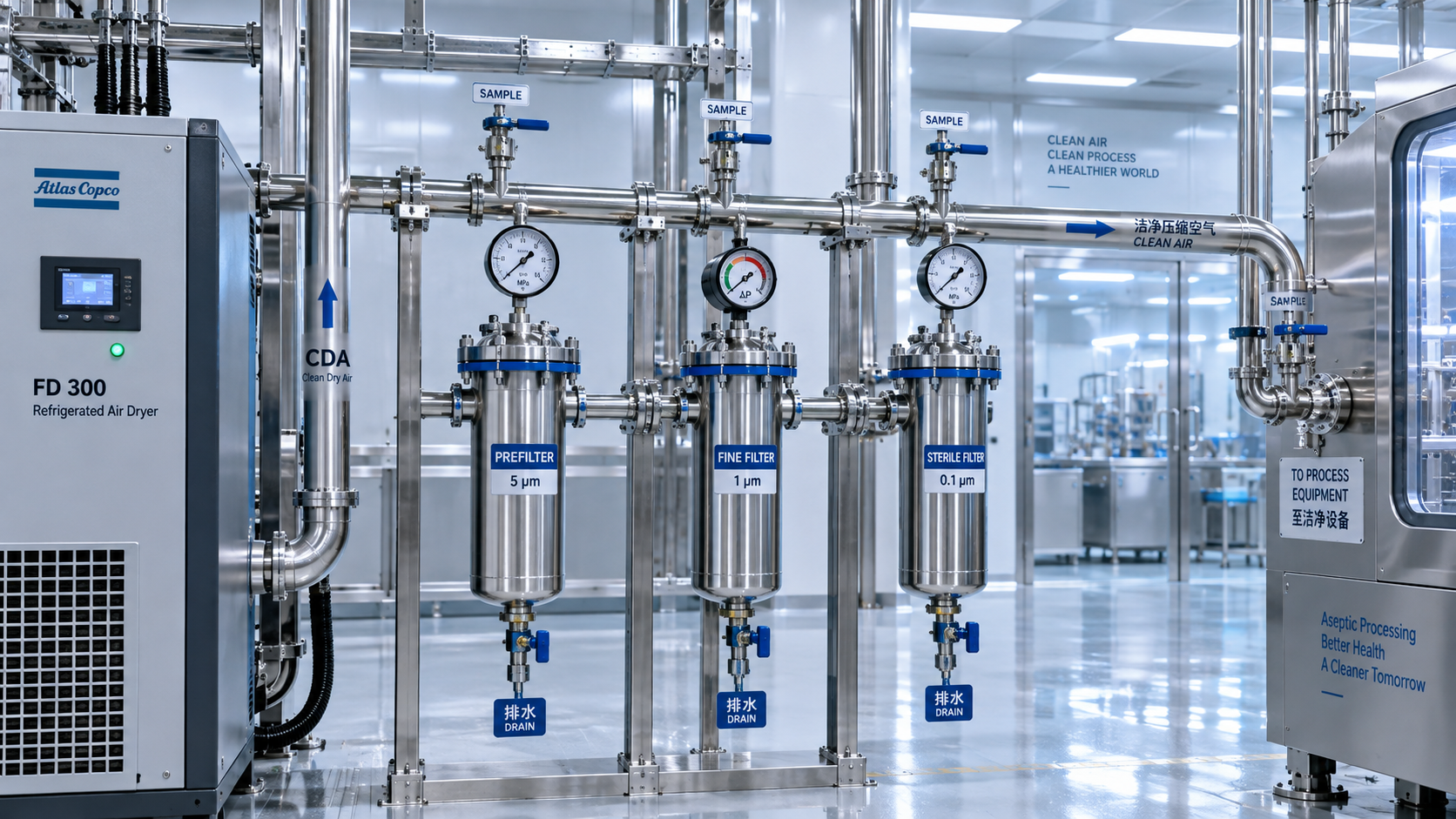
The same goes for filters. A stack of fine filters on a datasheet is not enough. You want to know differential pressure behavior, replacement intervals, bypass risk, and whether the filter train was sized for the actual flow profile rather than for the nominal compressor rating only.
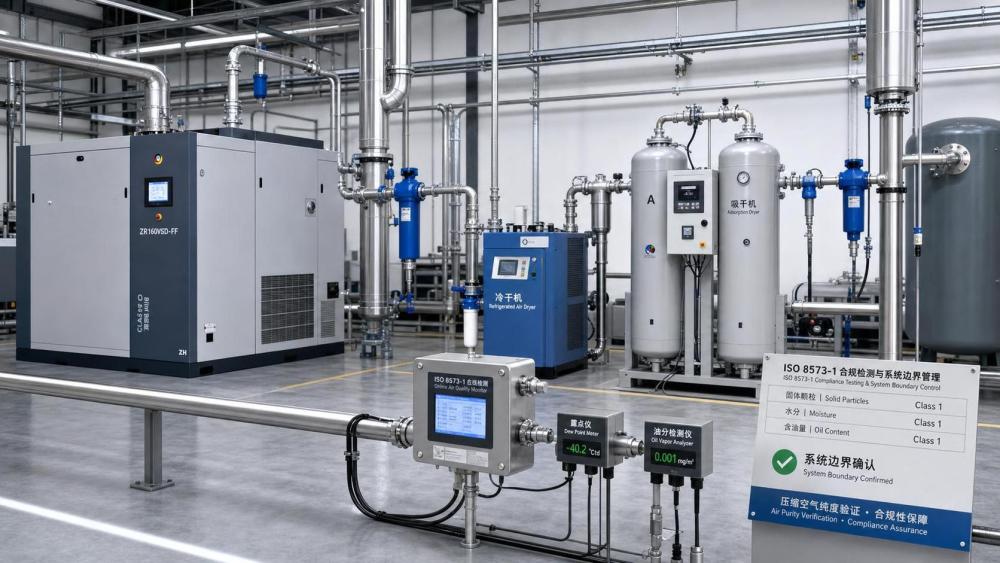
Make them show the system boundary
A supplier can honestly deliver a compliant treatment package and still leave you with non-compliant air at the process. Usually that happens because the system boundary was never made explicit. Piping dead legs, old carbon steel headers, condensate traps, receiver tanks, branch filters, flexible hoses, and point-of-use regulators can all undo a clean design.
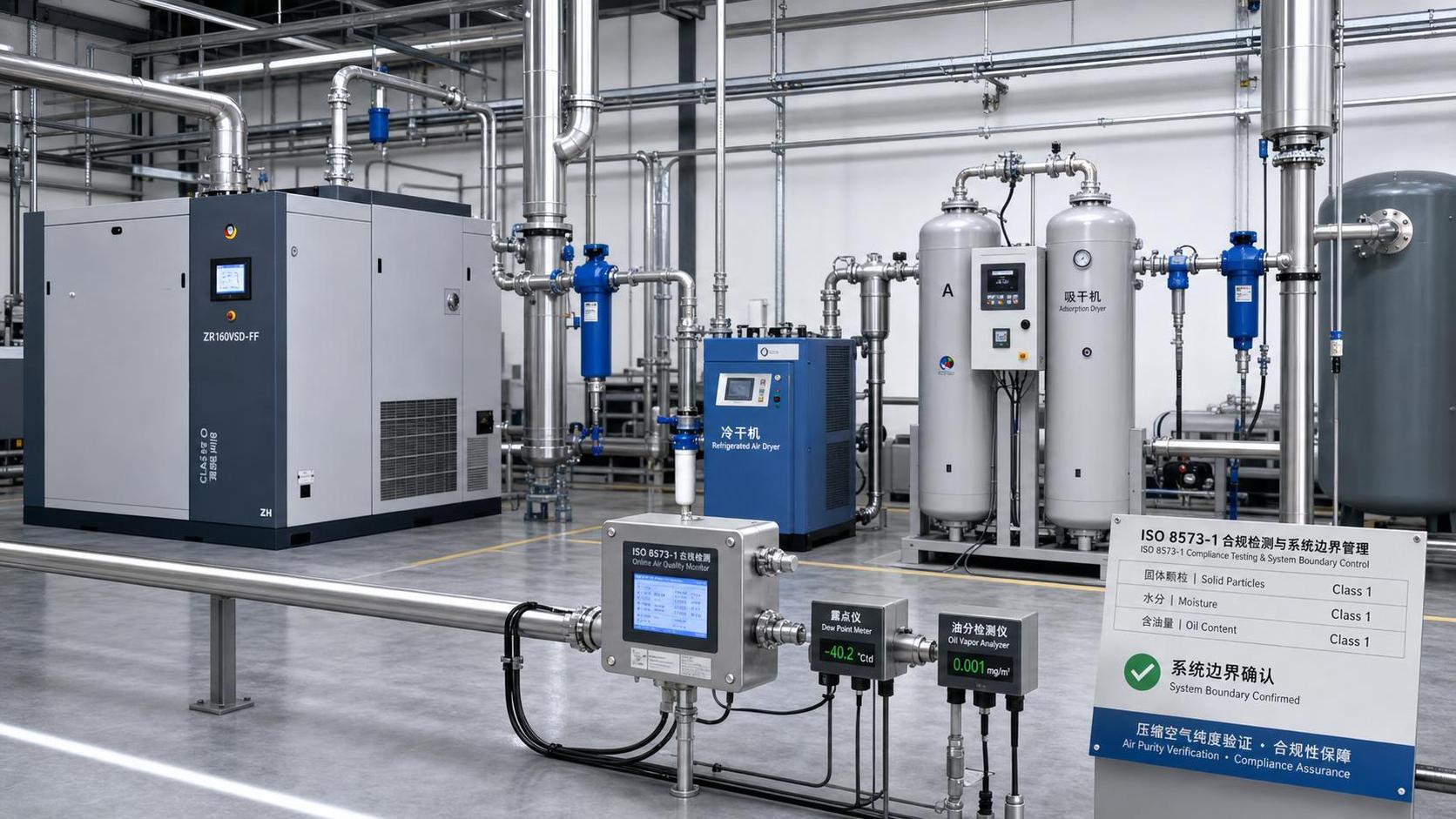
In practical evaluations, ask for a marked-up P&ID or system diagram showing where purity is guaranteed and where it is only assumed. If the supplier’s quote ends at the dryer outlet, that may be perfectly acceptable, but it should be clear. Technical evaluators get into trouble when procurement thinks the supplier owns “clean air compliance” while the supplier only owns “equipment supply.”
Pressure dew point claims deserve a hard look
Water class performance often looks fine on paper because suppliers quote dryer nameplate capability under standard conditions. Real installations are messier. Inlet temperature drifts, seasonal humidity swings, partial loads, purge losses, and neglected drains can all move the actual pressure dew point away from the quoted number.
Ask three simple things. What pressure dew point is guaranteed? Under what inlet conditions? And how is it monitored over time? If the answer stops at “our dryer can achieve X,” keep going. You need guaranteed delivered performance under your operating envelope, not just catalog capability.
A useful cross-check is whether the supplier asks about the installation environment before finalizing the dryer selection. If they never ask, they are probably sizing from a template.
Sampling and validation are where weak suppliers get exposed
Compressed air testing is easy to misuse. Sampling point selection, line cleanliness, stabilization time, test frequency, and instrument suitability all matter. A supplier who genuinely supports ISO 8573-1 compliance should be able to discuss commissioning tests and periodic verification without hand-waving.
This is worth writing into the evaluation checklist:
- Define the sampling locations before order placement.
- Require an agreed acceptance protocol tied to operating conditions.
- Confirm who provides instruments or third-party testing.
- Ask how nonconformance will be investigated if one contaminant misses class.
If the supplier becomes vague here, assume that post-installation troubleshooting will become your problem.
Evaluate service capability, because compliance is not a one-time event
Many systems pass startup validation and drift later. Filters saturate. Drains fail open or closed. Desiccant ages. Instrument calibration is ignored. Compressors get swapped during expansion. Someone connects a non-qualified branch during maintenance. None of this is unusual.
So evaluate the supplier’s after-sales structure with the same seriousness as the initial design. Can they provide maintenance intervals linked to contamination risk? Do they offer air quality revalidation support? Can they supply replacement elements locally? What is their position on alarm thresholds for dew point and differential pressure? These are not “nice to have” questions when the compressed air is part of a controlled utility.
For multinational projects, also check regional service consistency. A supplier may be technically strong in one market and thinly supported in another. GTC-Matrix readers dealing with cross-border sourcing will recognize this pattern quickly: the specification travels well, but the service response does not always travel with it.
Watch for documentation gaps that usually predict project friction
Experienced evaluators often catch weak suppliers before any equipment arrives, just by reading the documents. A technically solid proposal usually includes a defined purity target, system scope, utility assumptions, treatment sequence, control philosophy, maintenance expectations, and exclusions. A weak one leans on broad marketing terms such as “medical grade,” “food grade,” or “ISO compliant” without tying them to a measured class and a validation path.
Be cautious with any of the following:
- No written statement of ISO 8573-1 class by contaminant
- No reference to operating conditions behind the claim
- No distinction between equipment capability and installed-system performance
- No acceptance criteria for commissioning
- No maintenance assumptions behind the warranty or performance guarantee
Match the supplier to the application, not just the standard
Two suppliers can both understand ISO 8573-1 and still differ sharply in suitability. That is because the standard does not replace application knowledge. Semiconductor utilities, fermentation air, instrument air, PET blowing, and general factory pneumatics do not fail in the same way. The right clean compressed air systems supplier will ask questions that reflect your process risk, not just your desired class code.
If your process is sensitive, ask them to walk through likely failure modes in your specific setting. Not theoretical risks. Real ones: condensate breakthrough during summer peaks, particle shedding after piping modification, hydrocarbon ingress from intake location, or loss of class at remote points during low flow. A supplier who has seen these problems before is usually more valuable than one with the slicker brochure.
A practical close-out before you shortlist
Before moving a supplier to the final round, ask for one concise technical compliance statement. It should name the ISO 8573-1 target class by contaminant, define the guaranteed boundary, describe the treatment architecture, identify the validation method, and state the operating assumptions. This single document often tells you more than hours of presentation slides.
If they can produce that cleanly, answer detailed questions without evasion, and tie their proposal to your real operating conditions, you are probably dealing with a supplier that understands compliance as an engineering responsibility. If they cannot, keep looking. In compressed air quality, vague confidence is expensive.
Ready when you are. Send us a message to get started.
Related News
- Can oil-free vacuum pumps handle semiconductor etching gases?Author :Pneumatic Power Engineer

- AIRERA Showcases TUV Class 0-Certified Oil-Free Screw Compressor at COMVACAuthor :Pneumatic Power Engineer

- How to verify food-grade purity in compressed air systemsAuthor :Pneumatic Power Engineer

- What determines the price of pure air compression systems?Author :Pneumatic Power Engineer

- How to size oil-free compressors for instrumentation air demandAuthor :Pneumatic Power Engineer

- How Class 0 oil-free compressors protect product quality in food productionAuthor :Pneumatic Power Engineer

- How to verify compressed air cleanroom standards before installationAuthor :Pneumatic Power Engineer

- When oil free vacuum pumps make sense for European cleanroom projectsAuthor :Pneumatic Power Engineer

- When do pure air compression systems need ISO 8573-1 Class 0?Author :Pneumatic Power Engineer

- How do compressed air systems for electronics prevent contamination?Author :Pneumatic Power Engineer

- When does an oil-free process vacuum pump justify its higher cost?Author :Pneumatic Power Engineer

- Does ISO 9001 certification apply to compressed air quality?Author :Pneumatic Power Engineer

- How to Specify Clean Compressed Air Systems in Southeast Asia for Food and Pharma PlantsAuthor :Pneumatic Power Engineer

- How to Compare Oil Free Vacuum Pumps for Clean Process RequirementsAuthor :Pneumatic Power Engineer

- How to Evaluate a Clean Compressed Air Systems Supplier for ISO 8573-1 ComplianceAuthor :Pneumatic Power Engineer

- How to Choose the Right Oil-Free Vacuum PumpAuthor :Pneumatic Power Engineer

- VDI 2083 Update Makes Class 0 Proof MandatoryAuthor :Pneumatic Power Engineer

- When to Use Oil Free Vacuum Pumps for High Purity LinesAuthor :Pneumatic Power Engineer

- Compressed Air Solutions: When Oil-Free Systems Lower Total Operating CostAuthor :Pneumatic Power Engineer

- ATMOsphere Europe 2026 Adds Oil-free Systems ZoneAuthor :Pneumatic Power Engineer

- Oil-Free Compressors: Key Selection Criteria for Clean Air SystemsAuthor :Pneumatic Power Engineer

- How to Compare Oil Free Centrifugal Compressors for Stable Plant Air SupplyAuthor :Pneumatic Power Engineer

- Compressed Air Class 0 vs Oil-Free: What Really MattersAuthor :Pneumatic Power Engineer

- Oil-Free Compression Class 0: What the Standard Really Means in ProductionAuthor :Pneumatic Power Engineer

- Air Compression Cost Comparison: Oil-Free vs Screw Systems in Daily OperationAuthor :Pneumatic Power Engineer

- Saudi SASO Tightens IEC 63349-2 for Oil-Free CompressorsAuthor :Pneumatic Power Engineer

- Saudi SASO Tightens Oil-Free Compressor Efficiency RulesAuthor :Pneumatic Power Engineer

- Pure Air Compression Systems for Clean Production LinesAuthor :Pneumatic Power Engineer

- IEC 63349-2:2026 makes energy certification mandatoryAuthor :Pneumatic Power Engineer

- IEC 63349-2:2026 Sets New Entry Rules for Oil-Free Screw CompressorsAuthor :Pneumatic Power Engineer

- IEC 63349-2:2026 Takes Effect for Oil-Free Screw CompressorsAuthor :Pneumatic Power Engineer

- IEC 63349-2:2026 Sets New Efficiency Gate for Oil-Free Screw CompressorsAuthor :Pneumatic Power Engineer

- IEC 63349-2:2026 Takes Effect for Oil-Free Screw CompressorsAuthor :Pneumatic Power Engineer

- SABIC Methanol Force Majeure Extended, Tightening R134a/R407C FeedstocksAuthor :Pneumatic Power Engineer

- How to Evaluate Pneumatic Power Systems for Stable OutputAuthor :Pneumatic Power Engineer

- Oil-Free Compression vs Lubricated Systems: Key Trade-OffsAuthor :Pneumatic Power Engineer
![]()