



Baidu AI Developer Conference 2026 Launches Oil-free Systems Digital Twin Model




On May 13, 2026, at the Create2026 Baidu AI Developer Conference in Beijing, Baidu Intelligent Cloud and ShenGu Group jointly launched the Oil-free Systems full-lifecycle digital twin model — a certified, SaaS-delivered operational simulation and diagnostics solution for oil-free compressors. This development is especially relevant for global industrial equipment service providers, energy infrastructure operators, and precision manufacturing firms engaged in high-reliability rotating machinery.
Event Overview
On May 13, 2026, during the Create2026 Baidu AI Developer Conference held in Beijing, Baidu Intelligent Cloud and ShenGu Group announced the launch of the Oil-free Systems digital twin model. The model supports real-time simulation and fault inference across 17 parameters—including bearing temperature, vibration spectrum, and aerodynamic film pressure—and has obtained DNV GL certification. It is offered as a SaaS subscription service with English, Arabic, and Spanish language interfaces, and provides on-demand, hourly-billed remote diagnostics for compressor service providers worldwide.
Industries Affected by This Development
Compressor Service Providers
These firms directly deliver maintenance, condition monitoring, and predictive diagnostics for oil-free compressors used in petrochemical, semiconductor, pharmaceutical, and hydrogen energy applications. The model’s hourly billing and multilingual SaaS interface lower entry barriers for regional service partners, potentially reshaping pricing models and technical support expectations.
Industrial Equipment OEMs (Original Equipment Manufacturers)
OEMs integrating oil-free compressor systems—especially those targeting export markets or compliance-sensitive sectors—may face growing demand to embed or interoperate with certified digital twin platforms. The DNV GL certification signals rising third-party validation requirements for AI-augmented operational models in safety-critical applications.
Energy Infrastructure Operators
Operators managing air separation units, hydrogen compression stations, or biogas upgrading facilities rely on continuous uptime and traceable reliability metrics. The model’s real-time parameter simulation may influence how operators evaluate vendor-provided digital services, particularly where regulatory reporting or insurance underwriting references DNV GL–validated tools.
What Relevant Enterprises or Practitioners Should Monitor and Do Now
Track official documentation and API specifications from Baidu Intelligent Cloud
Current public information confirms availability and certification status but does not detail integration protocols, data ownership terms, or SLA definitions. Service providers evaluating adoption should monitor official release notes and developer portal updates for interoperability constraints.
Assess compatibility with existing monitoring hardware and SCADA environments
The model’s utility depends on alignment with field sensor types (e.g., piezoelectric accelerometers, MEMS pressure transducers) and communication standards (e.g., OPC UA, Modbus TCP). Firms should verify whether their current instrumentation stack meets minimum input requirements before committing to trial deployments.
Review contractual terms for multilingual support and geographic service scope
While English, Arabic, and Spanish interfaces are confirmed, regional deployment may involve local data residency, latency thresholds, or certification reciprocity (e.g., whether DNV GL certification applies uniformly across jurisdictions). Legal and compliance teams should examine subscription agreements for jurisdiction-specific clauses.
Evaluate cost structure against traditional diagnostic engagement models
Hourly-billed diagnostics represent a departure from fixed-fee annual contracts or per-incident service calls. Operations managers should benchmark expected usage frequency, typical session duration, and escalation pathways to assess total cost of ownership over 12–24 months.
Editorial Perspective / Industry Observation
Observably, this launch is less an immediate operational shift and more a signal of institutional convergence: cloud AI providers, heavy equipment manufacturers, and international certification bodies are aligning around standardized, auditable digital twin frameworks for critical rotating equipment. Analysis shows that the emphasis on DNV GL certification—not just internal validation—suggests growing market expectation for third-party assurance in AI-driven industrial analytics. From an industry perspective, this reflects a broader transition from proprietary OEM diagnostic tools toward interoperable, cloud-native service layers. It is not yet a de facto standard, but it marks one of the first publicly disclosed, certified, and commercially available digital twin offerings focused specifically on oil-free compressor systems — making it a reference point for future platform comparisons.
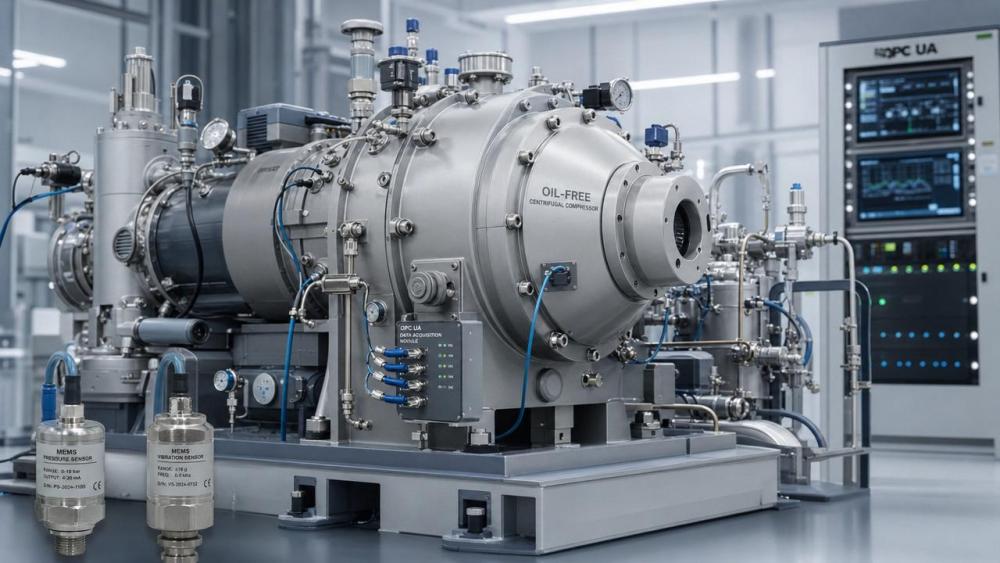
Concluding, this initiative signifies a step toward modular, certifiable AI services in industrial operations — not a wholesale replacement for domain expertise or on-site engineering, but a new layer of scalable, auditable support. It is best understood today not as a finished ecosystem, but as an early-stage, regulated-access capability that invites careful evaluation rather than immediate adoption.
Source: Official announcements from Baidu Intelligent Cloud and ShenGu Group at the Create2026 Baidu AI Developer Conference, May 13, 2026. Note: Integration specifications, commercial terms beyond language support and billing unit, and regional rollout timelines remain pending further disclosure and are subject to ongoing observation.
Related News
- How to verify compressed air cleanroom standards before installationAuthor :Pneumatic Power Engineer

- When oil free vacuum pumps make sense for European cleanroom projectsAuthor :Pneumatic Power Engineer

- When do pure air compression systems need ISO 8573-1 Class 0?Author :Pneumatic Power Engineer

- How do compressed air systems for electronics prevent contamination?Author :Pneumatic Power Engineer

- When does an oil-free process vacuum pump justify its higher cost?Author :Pneumatic Power Engineer

- Does ISO 9001 certification apply to compressed air quality?Author :Pneumatic Power Engineer

- How to Specify Clean Compressed Air Systems in Southeast Asia for Food and Pharma PlantsAuthor :Pneumatic Power Engineer

- How to Compare Oil Free Vacuum Pumps for Clean Process RequirementsAuthor :Pneumatic Power Engineer

- How to Evaluate a Clean Compressed Air Systems Supplier for ISO 8573-1 ComplianceAuthor :Pneumatic Power Engineer

- How to Choose the Right Oil-Free Vacuum PumpAuthor :Pneumatic Power Engineer

- VDI 2083 Update Makes Class 0 Proof MandatoryAuthor :Pneumatic Power Engineer

- When to Use Oil Free Vacuum Pumps for High Purity LinesAuthor :Pneumatic Power Engineer

- Compressed Air Solutions: When Oil-Free Systems Lower Total Operating CostAuthor :Pneumatic Power Engineer

- ATMOsphere Europe 2026 Adds Oil-free Systems ZoneAuthor :Pneumatic Power Engineer

- Oil-Free Compressors: Key Selection Criteria for Clean Air SystemsAuthor :Pneumatic Power Engineer

- How to Compare Oil Free Centrifugal Compressors for Stable Plant Air SupplyAuthor :Pneumatic Power Engineer

- Compressed Air Class 0 vs Oil-Free: What Really MattersAuthor :Pneumatic Power Engineer

- Oil-Free Compression Class 0: What the Standard Really Means in ProductionAuthor :Pneumatic Power Engineer

- Air Compression Cost Comparison: Oil-Free vs Screw Systems in Daily OperationAuthor :Pneumatic Power Engineer

- Saudi SASO Tightens IEC 63349-2 for Oil-Free CompressorsAuthor :Pneumatic Power Engineer

- Saudi SASO Tightens Oil-Free Compressor Efficiency RulesAuthor :Pneumatic Power Engineer

- Pure Air Compression Systems for Clean Production LinesAuthor :Pneumatic Power Engineer

- IEC 63349-2:2026 makes energy certification mandatoryAuthor :Pneumatic Power Engineer

- IEC 63349-2:2026 Sets New Entry Rules for Oil-Free Screw CompressorsAuthor :Pneumatic Power Engineer

- IEC 63349-2:2026 Takes Effect for Oil-Free Screw CompressorsAuthor :Pneumatic Power Engineer

- IEC 63349-2:2026 Sets New Efficiency Gate for Oil-Free Screw CompressorsAuthor :Pneumatic Power Engineer

- IEC 63349-2:2026 Takes Effect for Oil-Free Screw CompressorsAuthor :Pneumatic Power Engineer

- SABIC Methanol Force Majeure Extended, Tightening R134a/R407C FeedstocksAuthor :Pneumatic Power Engineer

- How to Evaluate Pneumatic Power Systems for Stable OutputAuthor :Pneumatic Power Engineer

- Oil-Free Compression vs Lubricated Systems: Key Trade-OffsAuthor :Pneumatic Power Engineer
![]()
- Oil-Free Compression: 2026 Cost and Compliance Trade-OffsAuthor :Pneumatic Power Engineer

- Oil-Free Compression: Cost and Contamination RisksAuthor :Pneumatic Power Engineer
![]()
- Euro PMI Drop Delays Oil-Free Systems OrdersAuthor :Pneumatic Power Engineer

- Germany/France May PMI Decline; Oil-free Systems EU Projects DelayedAuthor :Pneumatic Power Engineer
![]()
- Compression Technology Options for Cleaner Oil-Free Air SupplyAuthor :Pneumatic Power Engineer

- TUV Rheinland Enforces Full-Chain Class 0 Certification for Oil-Free SystemsAuthor :Pneumatic Power Engineer