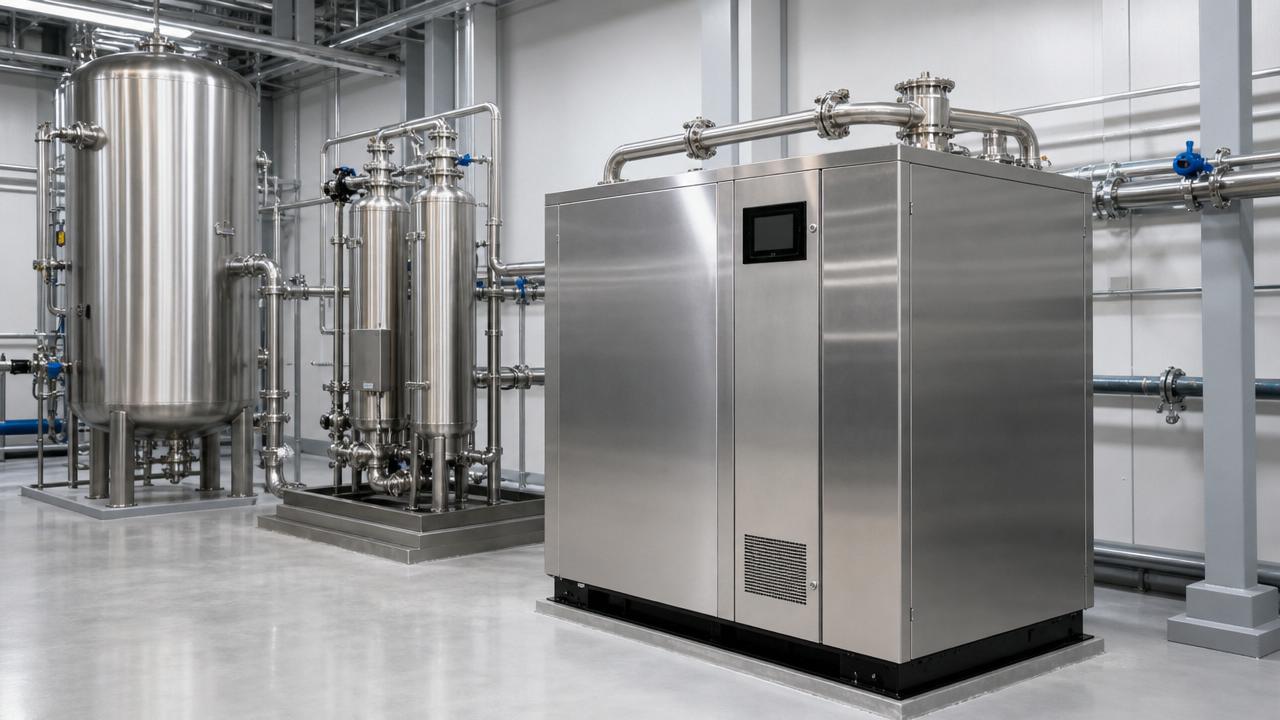




How to Compare Oil Free Vacuum Pumps for Clean Process Requirements




What “oil-free” really means in clean vacuum selection
The biggest mistake in comparing oil free vacuum pumps is to treat “oil-free” as a complete answer. In clean processes, it is only the starting point. A pump may be marketed as oil-free because there is no oil in the compression chamber, yet the system still has to be judged for backstreaming risk, particle generation, seal arrangement, purge requirements, exhaust treatment, and behavior under the actual gas load. For pharmaceutical drying, semiconductor transfer, food packaging, or laboratory vacuum duty, the question is not simply whether the pump contains oil. The question is whether the vacuum system preserves process purity under real operating conditions.
That distinction matters because “clean” means different things across industries. In semiconductor manufacturing, even trace hydrocarbons or unstable base pressure can create yield problems. In food and beverage applications, the concern is often product contact risk, washdown compatibility, and reliable operation over repetitive cycles. In pharmaceutical environments, cleaning validation, material compatibility, and the ability to avoid cross-contamination often carry more weight than chasing the lowest possible ultimate vacuum. Technical evaluation starts to improve as soon as these process meanings are separated from the generic label.
Compare the duty, not just the headline specification
Many comparisons go off track because buyers line up brochures by ultimate vacuum alone. That is useful, but incomplete. Clean process vacuum is usually defined by a duty profile: required pressure range, gas composition, flow stability, cycle frequency, ambient conditions, and uptime expectation. A pump that looks impressive on paper may be a poor fit if its best performance appears only at a narrow operating point.
A better comparison begins with a few operating questions:
- Is the process dominated by deep vacuum, rough vacuum, or repeated pump-down cycles?
- Are vapors present, and if so, are they condensable, corrosive, solvent-laden, or water-heavy?
- Does the process require steady-state holding or fast evacuation?
- Will the pump run continuously, intermittently, or in batches?
- Is the system part of a cleanroom, GMP area, utility room, or production floor with harsher ambient conditions?
These questions often matter more than a small difference in catalog vacuum level. In practice, a contamination-sensitive line tends to value stable performance under its actual gas load over a theoretical endpoint reached in ideal test conditions.
Pump type changes the decision logic
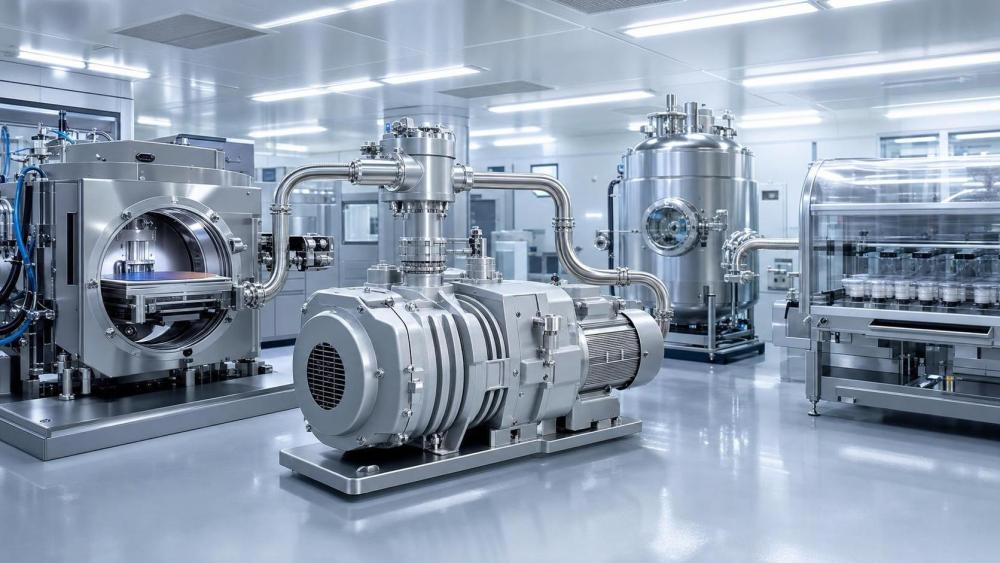
Oil free vacuum pumps are not one category in any practical sense. Dry screw, claw, scroll, diaphragm, side channel, and liquid ring designs behave very differently. Comparing them as if they were interchangeable usually leads to the wrong shortlist.
Dry screw pumps are often considered when the process needs deeper vacuum, good vapor handling, and industrial durability, but they bring their own evaluation points: internal temperature management, tolerance to particulates, seal design, and the maintenance burden associated with demanding gases. Scroll pumps are widely used in cleaner, lower-throughput duties and can be attractive for laboratories or certain analytical processes because of quiet operation and clean pumping characteristics, though tip seal wear becomes part of the lifecycle calculation. Diaphragm pumps are useful where chemical resistance and simple oil-free operation matter more than high pumping speed or deep vacuum. Claw pumps are often effective in rough vacuum ranges and can work well for packaging or pneumatic conveying support, but may not suit every purity or pressure requirement.
This is why a serious comparison does not ask, “Which oil free vacuum pump is best?” It asks, “Which pumping principle is best matched to this contamination risk, pressure band, gas stream, and maintenance regime?”
Key parameters that deserve more attention
Ultimate pressure and nominal pumping speed should stay on the list, but several other parameters often decide whether the installation works smoothly six months later.
The point is not to turn every purchase into a laboratory study. It is to avoid making a clean process decision from a one-line pressure claim.
Purity risk is often upstream and downstream of the pump
Another common misunderstanding is that pump selection alone guarantees cleanliness. In reality, system design is part of the contamination outcome. If the suction line traps condensate, if the exhaust is poorly managed, or if dead legs allow residue to accumulate, an oil-free pump will not rescue the process. Evaluators should look at inlet filtration, condensate management, purge strategy, valves, pipework materials, and whether the layout makes maintenance clean or messy.
This is especially relevant in sectors with hygiene or validation concerns. A well-chosen pump can still become the weak point if the broader vacuum package is hard to drain, difficult to sanitize around, or prone to process carryover. For that reason, some of the most useful supplier discussions happen around system architecture rather than the pump block itself.
Standards and certifications help, but only within their scope
Technical evaluators often ask for certifications early, and that is sensible. Still, it helps to be precise about what each document proves. A material declaration, a cleanroom suitability claim, or a food-contact related statement does not automatically confirm process compatibility in every installation. The same applies to motor efficiency classifications, CE-related conformity in relevant markets, or safety documentation. These are important screening tools, but they do not replace application engineering.
In contamination-sensitive sectors, the practical question is whether the documentation supports your internal qualification path. Can the supplier clearly identify wetted materials? Are maintenance intervals and replacement parts defined? Is there a documented procedure for handling process vapors, cleaning, or shutdown after challenging duty? Strong documentation reduces uncertainty; vague claims increase commissioning risk.
Energy and maintenance belong in the same conversation
It is easy to praise oil free vacuum pumps for eliminating oil changes in the compression chamber, but this can hide the real ownership picture. Some dry technologies lower contamination risk while demanding tighter control of wear parts, cooling conditions, or scheduled rebuilds. Others are mechanically simpler but less efficient at a given duty point. The right comparison combines energy behavior and maintenance structure, because one often shifts the economics of the other.
For example, in a process with frequent start-stop cycles, a pump that looks efficient at continuous load may lose ground if repeated cycling shortens service intervals or disrupts pressure stability. In a high-uptime plant, planned maintenance windows may matter more than the absolute spare parts cost. Where energy pricing is volatile, actual part-load performance becomes more valuable than a generic efficiency claim. This is exactly the kind of analysis that separates a clean specification from a robust plant decision.
Where comparisons usually go wrong
Three patterns show up repeatedly in vacuum evaluations. One is overvaluing ultimate vacuum when the process never operates near that level. Another is assuming all dry pumps are equally clean, without checking wear mechanisms, sealing arrangements, and gas compatibility. The third is ignoring process transients. A pump may perform well in steady operation yet struggle during pump-down, solvent spikes, humid batches, or upset conditions.
There is also a softer issue that causes expensive mistakes: the pressure to standardize one pump technology across very different plants. Standardization can simplify procurement and spares, but it should not erase application differences. Clean process requirements are usually too specific for that shortcut to work everywhere.
A practical way to shortlist
A disciplined shortlist often uses three filters. The first is process fit: pressure range, gas load, contamination risk, and materials compatibility. The second is operational fit: energy profile, controls, noise, heat rejection, maintenance method, and available service support. The third is qualification fit: documentation, traceability, and the ease of integrating the pump into plant standards or regulated procedures.
If two models still look similar after that, ask for performance evidence tied to the duty profile rather than generic literature. In some projects that means pump curves and vapor-handling details. In others it means confirming service intervals under a known process condition. The closer the discussion gets to the real gas stream and real operating window, the less likely the comparison is to drift into marketing language.
The better decision is usually the one with fewer assumptions
When clean process requirements are involved, oil free vacuum pumps should be compared as part of a contamination-control strategy, not as isolated equipment items. The strongest evaluations usually come from teams that define what “clean” means in their own process, then test every pump option against that meaning: pressure stability, gas compatibility, service discipline, and system design included.
That approach tends to produce quieter decisions. Fewer assumptions about purity. Fewer surprises after installation. And a much clearer reason for choosing one technology over another than the phrase “oil-free” could ever provide on its own.
Related News
- When do pure air compression systems need ISO 8573-1 Class 0?Author :Pneumatic Power Engineer

- How do compressed air systems for electronics prevent contamination?Author :Pneumatic Power Engineer

- When does an oil-free process vacuum pump justify its higher cost?Author :Pneumatic Power Engineer

- Does ISO 9001 certification apply to compressed air quality?Author :Pneumatic Power Engineer

- How to Specify Clean Compressed Air Systems in Southeast Asia for Food and Pharma PlantsAuthor :Pneumatic Power Engineer

- How to Compare Oil Free Vacuum Pumps for Clean Process RequirementsAuthor :Pneumatic Power Engineer

- How to Evaluate a Clean Compressed Air Systems Supplier for ISO 8573-1 ComplianceAuthor :Pneumatic Power Engineer

- How to Choose the Right Oil-Free Vacuum PumpAuthor :Pneumatic Power Engineer

- VDI 2083 Update Makes Class 0 Proof MandatoryAuthor :Pneumatic Power Engineer

- When to Use Oil Free Vacuum Pumps for High Purity LinesAuthor :Pneumatic Power Engineer

- Compressed Air Solutions: When Oil-Free Systems Lower Total Operating CostAuthor :Pneumatic Power Engineer

- ATMOsphere Europe 2026 Adds Oil-free Systems ZoneAuthor :Pneumatic Power Engineer

- Oil-Free Compressors: Key Selection Criteria for Clean Air SystemsAuthor :Pneumatic Power Engineer

- How to Compare Oil Free Centrifugal Compressors for Stable Plant Air SupplyAuthor :Pneumatic Power Engineer

- Compressed Air Class 0 vs Oil-Free: What Really MattersAuthor :Pneumatic Power Engineer

- Oil-Free Compression Class 0: What the Standard Really Means in ProductionAuthor :Pneumatic Power Engineer

- Air Compression Cost Comparison: Oil-Free vs Screw Systems in Daily OperationAuthor :Pneumatic Power Engineer

- Saudi SASO Tightens IEC 63349-2 for Oil-Free CompressorsAuthor :Pneumatic Power Engineer

- Saudi SASO Tightens Oil-Free Compressor Efficiency RulesAuthor :Pneumatic Power Engineer

- Pure Air Compression Systems for Clean Production LinesAuthor :Pneumatic Power Engineer

- IEC 63349-2:2026 makes energy certification mandatoryAuthor :Pneumatic Power Engineer

- IEC 63349-2:2026 Sets New Entry Rules for Oil-Free Screw CompressorsAuthor :Pneumatic Power Engineer

- IEC 63349-2:2026 Takes Effect for Oil-Free Screw CompressorsAuthor :Pneumatic Power Engineer

- IEC 63349-2:2026 Sets New Efficiency Gate for Oil-Free Screw CompressorsAuthor :Pneumatic Power Engineer

- IEC 63349-2:2026 Takes Effect for Oil-Free Screw CompressorsAuthor :Pneumatic Power Engineer

- SABIC Methanol Force Majeure Extended, Tightening R134a/R407C FeedstocksAuthor :Pneumatic Power Engineer

- How to Evaluate Pneumatic Power Systems for Stable OutputAuthor :Pneumatic Power Engineer

- Oil-Free Compression vs Lubricated Systems: Key Trade-OffsAuthor :Pneumatic Power Engineer
![]()
- Oil-Free Compression: 2026 Cost and Compliance Trade-OffsAuthor :Pneumatic Power Engineer

- Oil-Free Compression: Cost and Contamination RisksAuthor :Pneumatic Power Engineer
![]()
- Euro PMI Drop Delays Oil-Free Systems OrdersAuthor :Pneumatic Power Engineer

- Germany/France May PMI Decline; Oil-free Systems EU Projects DelayedAuthor :Pneumatic Power Engineer
![]()
- Compression Technology Options for Cleaner Oil-Free Air SupplyAuthor :Pneumatic Power Engineer

- TUV Rheinland Enforces Full-Chain Class 0 Certification for Oil-Free SystemsAuthor :Pneumatic Power Engineer

- Sustainable Manufacturing and Oil-Free Systems: Where Reliability Improves MostAuthor :Pneumatic Power Engineer

- TUV Rheinland Releases New Oil-Free Systems Certification White PaperAuthor :Pneumatic Power Engineer