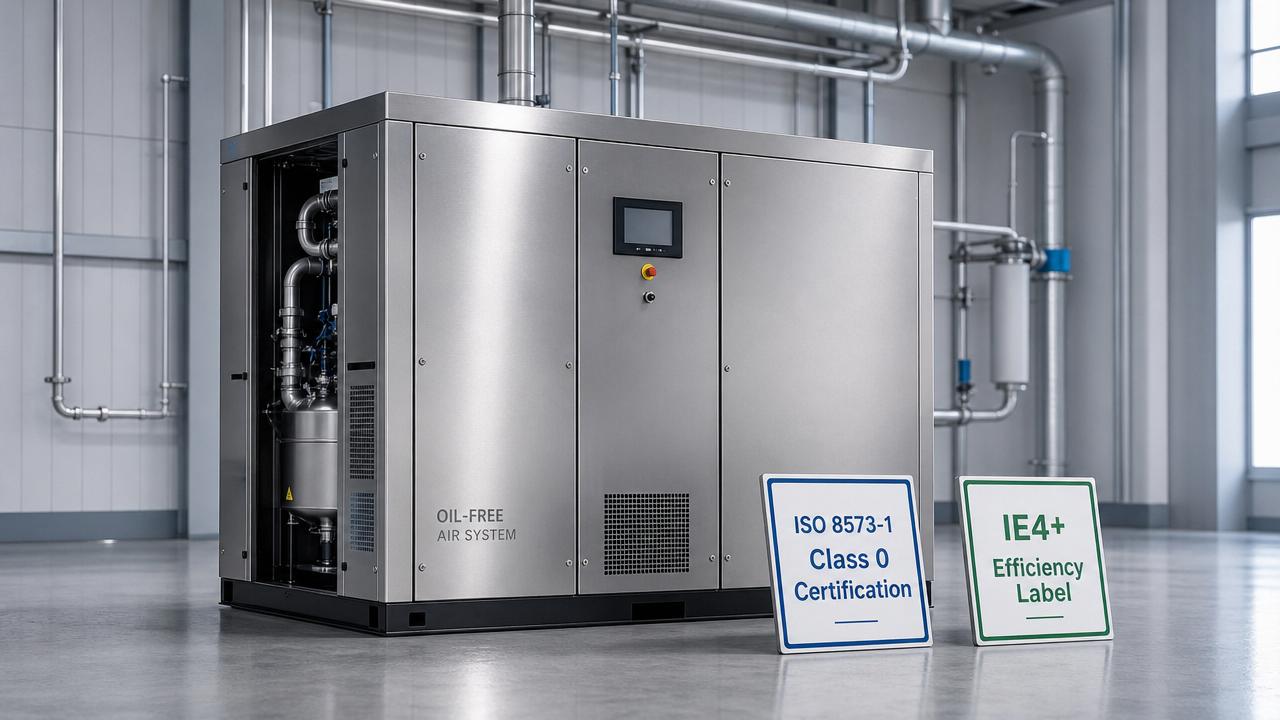




How Class 0 oil-free compressors protect product quality in food production




Compressed air becomes a product-quality issue the moment it can touch food, food-contact surfaces, packaging interiors, or equipment that directly handles ingredients. In these areas, the question is not whether the air system is reliable enough to keep machinery running. It is whether the air can introduce a contaminant that is difficult to see, difficult to trace, and costly to remove from a finished product.
Oil-free compressors Class 0 are designed to remove compressor-generated oil from that risk equation. Their value in food production is not simply that they are “cleaner” compressors. They help create a more defensible compressed-air control strategy where an internal lubrication failure is far less likely to become a contamination event in conveying, mixing, filling, packaging, or cleaning operations.
That distinction matters because a conventional lubricated compressor can run efficiently for years, while still leaving the plant dependent on downstream filtration and maintenance discipline to prevent oil carryover. For indirect utility air, that approach may be appropriate. For air that could affect the product, a Class 0 oil-free source is often the stronger starting point.
Where compressed air can affect food quality
Not every compressed-air line deserves the same level of control. A plant should begin by mapping where the air goes, what it contacts, and what happens if an airborne contaminant reaches that point. Treating all air as either “food-grade” or “general utility” is too broad to support a useful risk assessment.
Higher-risk uses commonly include pneumatic conveying of powders and grains, air agitation or aeration, product drying, blow-off after washing, container drying before filling, aseptic or protective-air applications, and air used inside primary packaging equipment. Air may also contact utensils, molds, transfer lines, or surfaces that will later touch food.
Even apparently indirect uses need scrutiny. For example, air used to clear a photoeye, dry a cap, or actuate equipment near an open filling zone can migrate toward exposed product. The risk depends on distance, enclosure design, airflow direction, cleaning practice, and whether the product is covered at that point. The right question is not only, “Does compressed air touch the food?” It is also, “Could contaminants from this air stream reasonably reach food or food-contact surfaces?”
Oil contamination is especially troublesome because it can create several problems at once: visible residue, off-odors, packaging defects, surface films that interfere with sealing, and an investigation burden when a contamination source cannot be ruled out quickly. In dry-food processes, fine airborne oil aerosols can also adhere to powders or accumulate inside product-contact equipment without creating an obvious immediate signal.
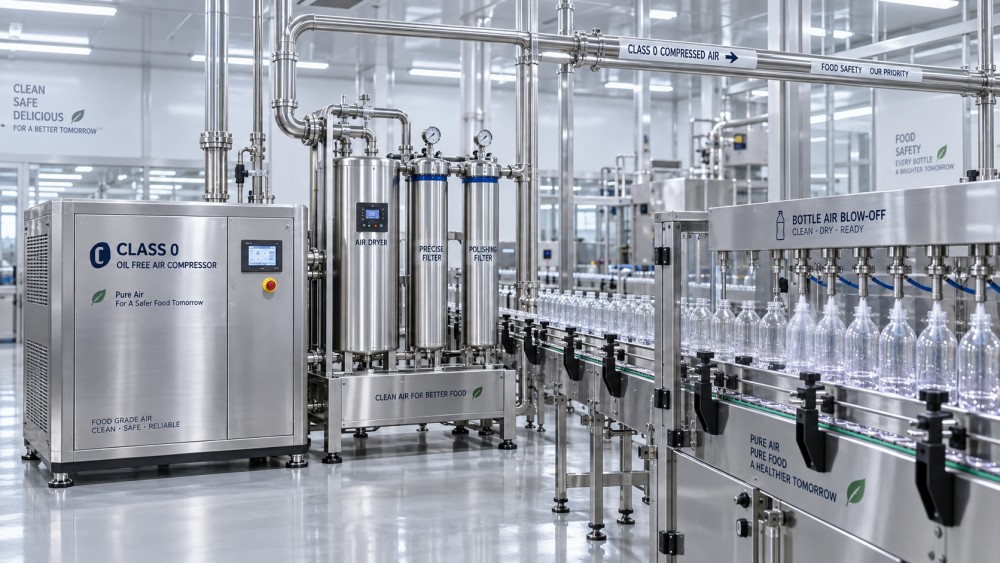
What Class 0 changes, and what it does not
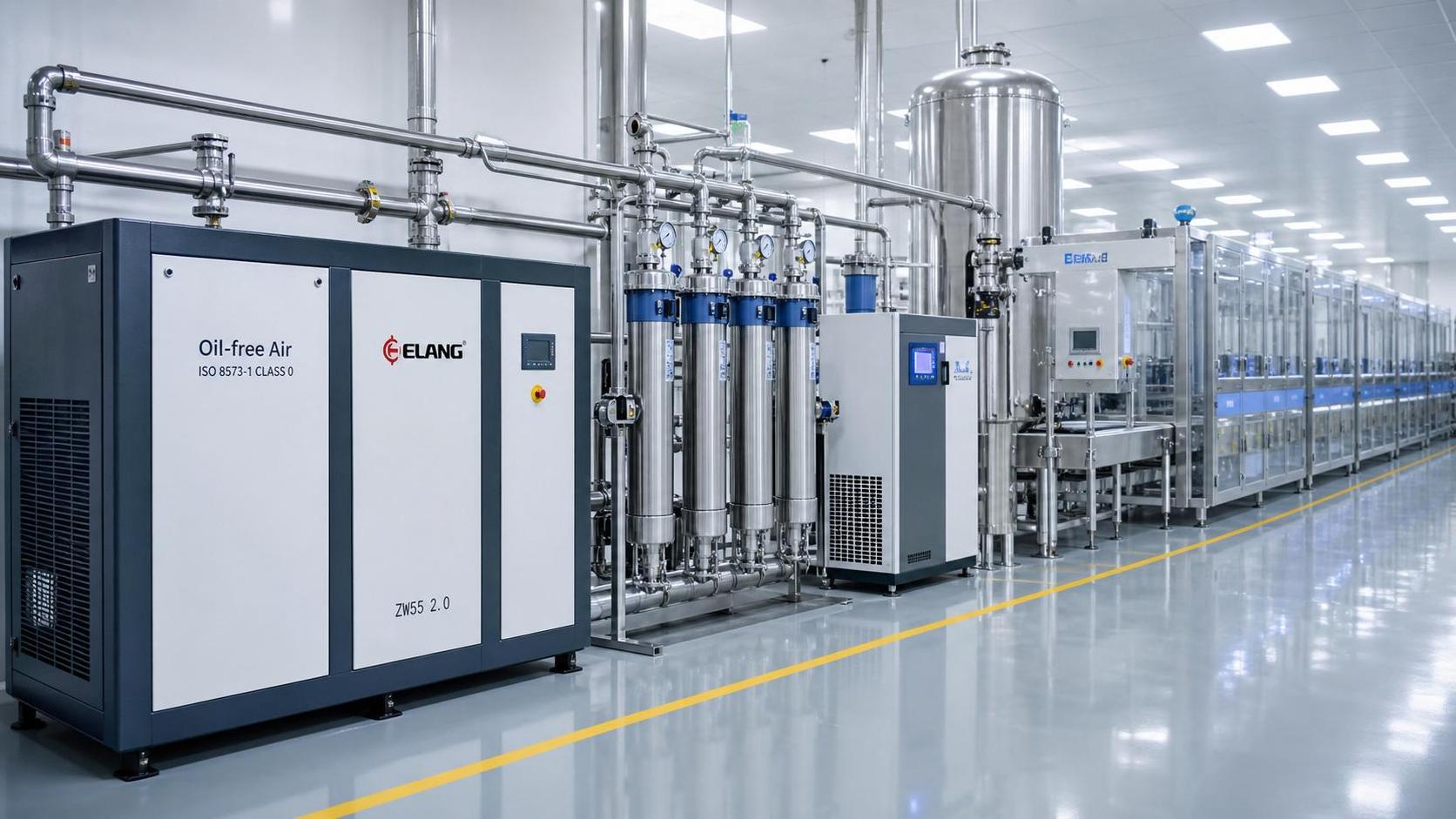
Class 0 refers to an oil-free compression approach verified against the most stringent oil-content classification for compressed air under the relevant testing framework. In practical food-production terms, it means the compression stage is engineered so that lubricating oil is not introduced into the air stream by the compressor itself.
This reduces a major source of risk, but it does not mean the air leaving every point of use is automatically suitable for every food application. A Class 0 compressor protects against compressor-generated oil; it does not remove all possible contaminants from the wider system.
Ambient intake air may contain dust, humidity, microorganisms, vehicle exhaust, or process vapors. Storage receivers can collect condensate. Corroded or poorly maintained distribution piping can release particles. Filters can be installed incorrectly, damaged during service, or allowed to exceed their service life. A point-of-use hose used for non-food maintenance may be connected to a sensitive line. Each of these can compromise air quality without changing the fact that the compressor itself is oil-free.
The useful way to view Class 0 is as source control. It eliminates the need to rely on coalescing filters as the only barrier between a lubricated compressor and a sensitive food process. Downstream treatment remains important, but it becomes a system for managing moisture, particles, microbiological conditions, and local process needs, rather than the sole defense against a compressor oil event.
Why source control is stronger than filter-only protection
A lubricated compressor can be paired with effective filtration, and such systems have a place in many industrial settings. The limitation arises when the food-safety consequence of filter failure is high. Filters depend on correct sizing, differential-pressure monitoring, replacement intervals, drain performance, and installation integrity. They can be overwhelmed by an abnormal carryover event or undermined by a bypass, damaged seal, or maintenance error.
With an oil-free source, the system has one less critical failure pathway. This changes the quality discussion from “Are our filters always performing perfectly?” to “Are we maintaining the remaining air-treatment and distribution controls properly?” That is still a serious responsibility, but it is a more manageable one.
This is not an argument for installing Class 0 equipment on every air line in a facility. It is an argument for matching the source technology to the consequence of failure. A remote workshop line used for general pneumatic tools may be managed differently from a line that blows moisture from bottles immediately before filling.
Protecting the product requires a complete air-quality chain
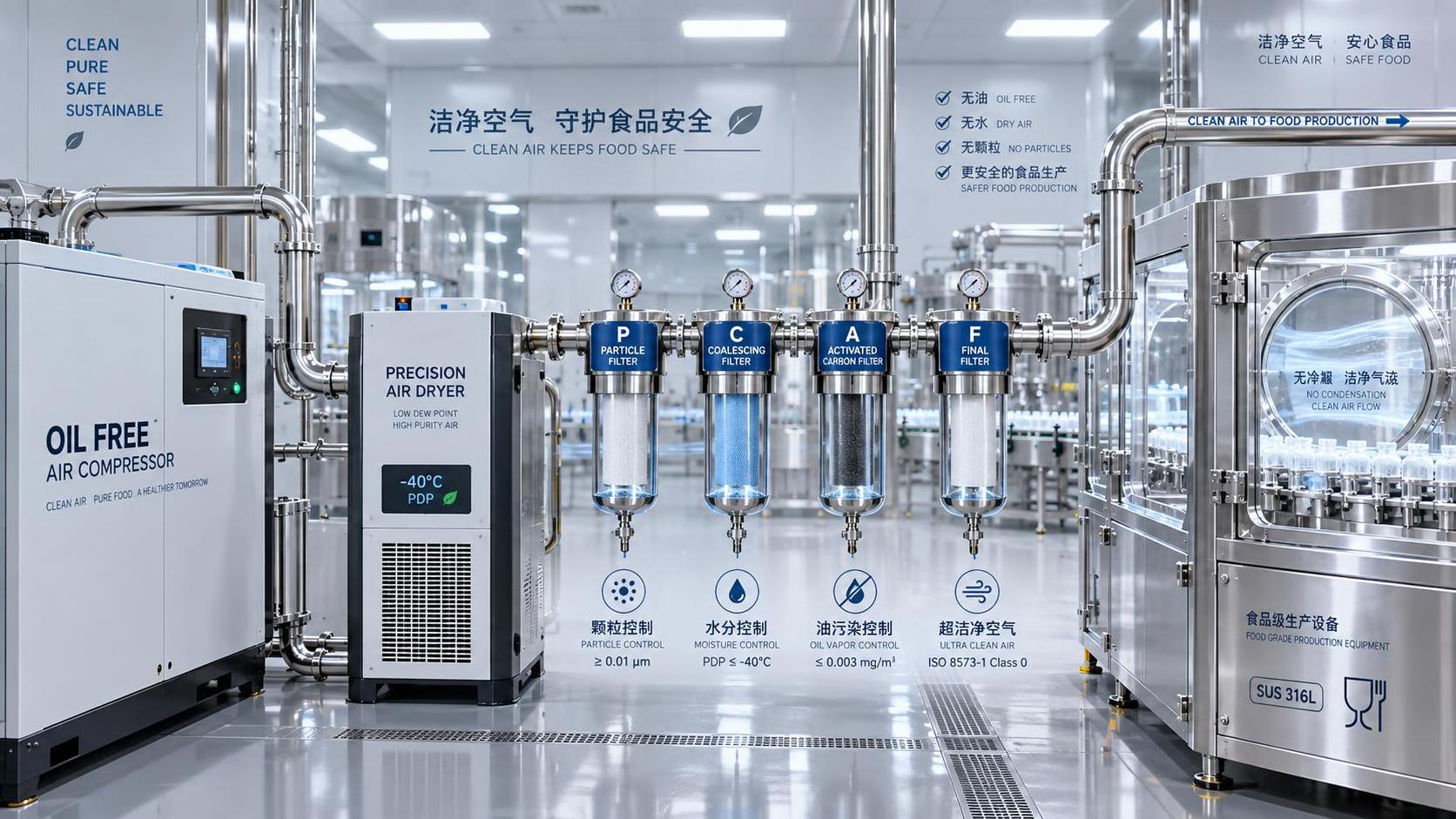
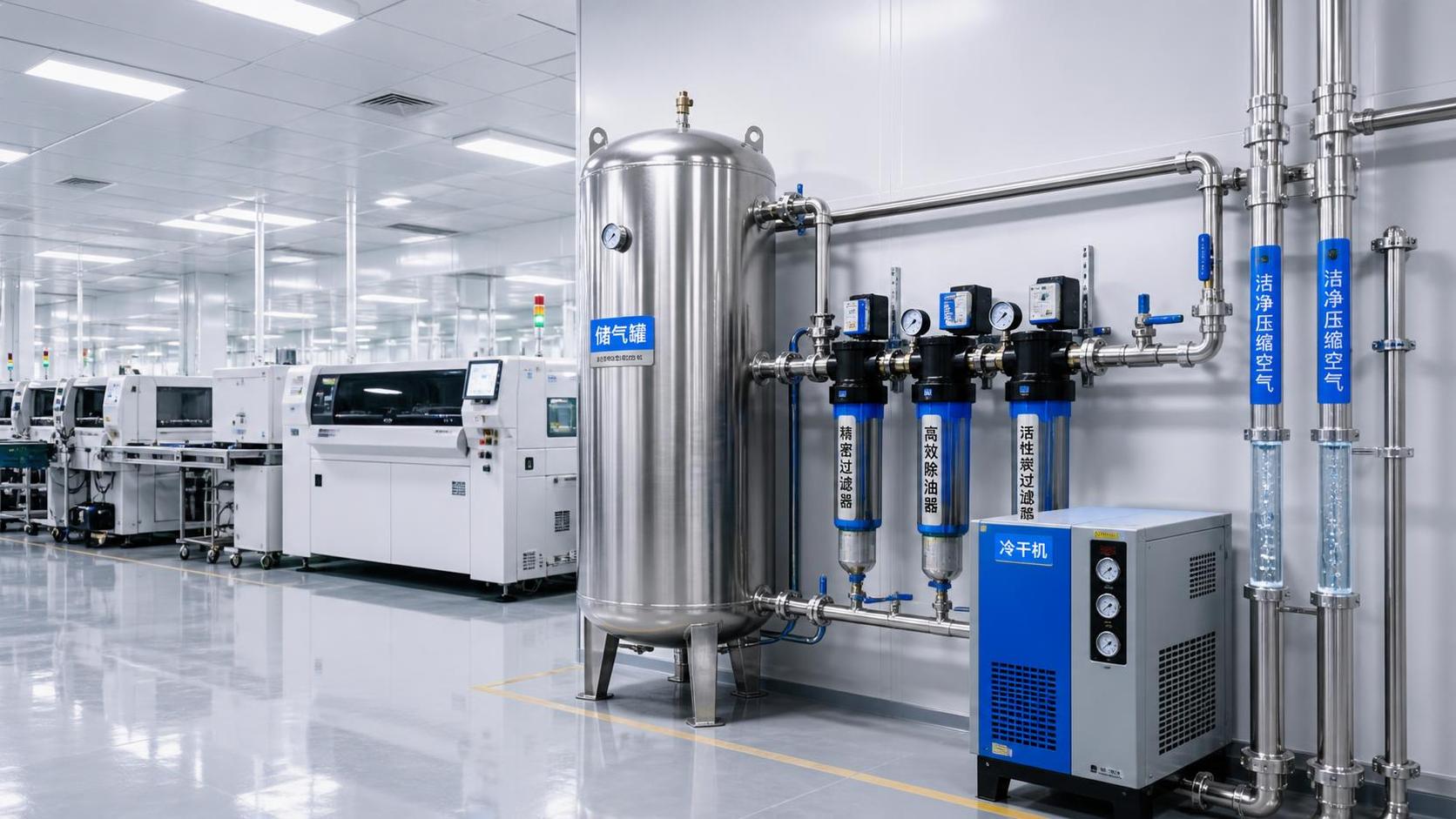
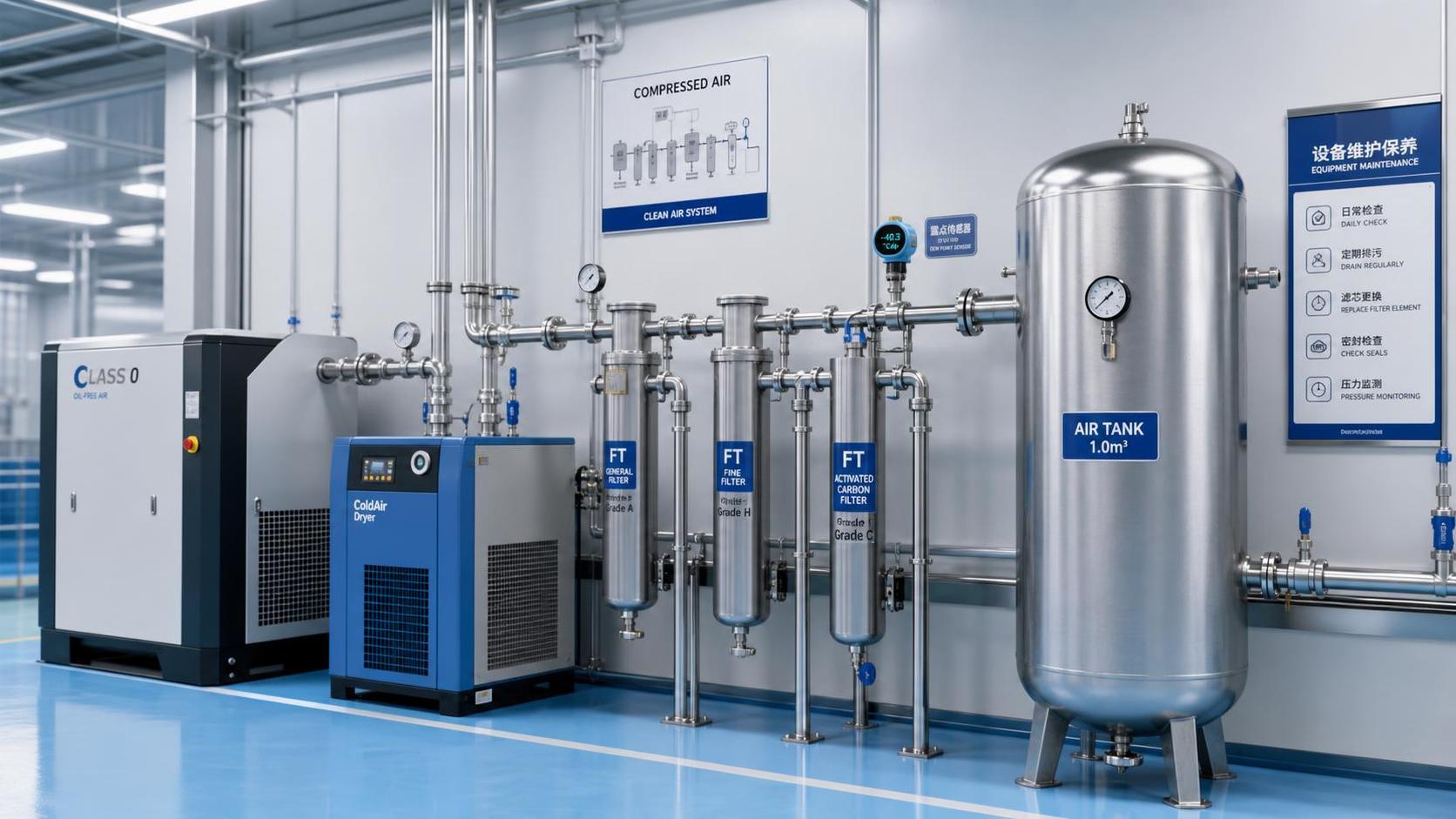
A Class 0 compressor is most effective when the rest of the compressed-air system supports the same hygiene objective. The following controls deserve attention before treating an oil-free installation as a finished solution.
Start with the intake location
The compressor cannot create clean air from a poor intake environment. An intake positioned near truck traffic, boiler exhaust, cooling-tower drift, dust-generating operations, or chemical vents brings avoidable contaminants into the system. The intake should be located where the surrounding air is as clean and stable as the site layout allows, then protected with suitable inlet filtration.
Control water before it becomes a quality problem
Compressed air naturally concentrates moisture from the intake air. If water remains in the system, it can support corrosion, carry particles downstream, affect powders, and create unfavorable conditions in piping and receivers. Dryers, drains, receiver management, and properly sloped distribution lines should be selected around the pressure, flow profile, ambient conditions, and use point.
Dry air is not always the same as hygienically controlled air. Overdrying may waste energy in some applications, while insufficient drying can damage product or equipment. The target should follow the application risk and the operating environment, not a one-size-fits-all setting.
Use filtration for the contaminants that still remain
Point-of-use filtration can be necessary even with oil-free compression. Particle filters may protect sensitive valves or open-package zones. Fine filtration may be needed where very clean process air is required. Where microbial control is relevant, the filtration approach, sterilization capability, replacement method, and location need to match the process rather than being copied from a general utility-air installation.
Filters should be treated as controlled components, not passive accessories. Record their location, specification, installation date, change criteria, and inspection history. A filter that is technically suitable but poorly maintained can create false confidence.
Keep distribution pipes and connections within scope
Air quality is often lost after the compressor room. Dead legs can trap moisture. Old pipework can shed scale. Flexible hoses may be incompatible with the cleaning environment or used interchangeably between clean and dirty tasks. Quick-connect fittings can introduce debris during maintenance. A hygienic compressed-air plan should identify which branches serve sensitive points of use and apply clearer controls to those branches.
Match the compressor decision to the application, not the compressor room
The compressor is usually purchased centrally, but the justification should be built from the highest-risk point-of-use applications. This prevents two common errors: specifying an unnecessarily elaborate system for low-risk utility air, or selecting a general-purpose system and later attempting to retrofit controls around a direct-contact process.
For bulk pneumatic conveying, consider whether air enters the product stream or only moves material through a sealed route. If it enters the stream, moisture control and particulate management may be as important as the oil-free source. For container blow-off and drying, assess the possibility that air reaches the inside of a package. For air knives near exposed product, review airflow paths and nearby sources of debris. For pneumatic actuators, determine whether exhaust air can reach food or open packaging.
Batch operations deserve special attention because they can be harder to investigate after the fact. If a process uses compressed air intermittently for mixing, purging, or cleaning, a quality deviation may affect only some lots. Clear valve identification, operating instructions, and traceable maintenance records can narrow the investigation and reduce unnecessary product holds.
Common decisions that weaken an otherwise good system
Assuming “oil-free” describes the entire air network. It describes the compression source, not the condition of every pipe, receiver, filter, drain, and hose downstream. The air-quality plan must cover the route to use.
Using one specification for every application. A central system may feed both food-contact and non-food equipment. The solution may require separate branches, local treatment, or defined restrictions on where certain hoses and connectors can be used.
Choosing equipment only by maximum flow demand. Peak flow matters, but so do pressure stability, duty cycle, turndown, drying requirements, redundancy expectations, and the impact of a shutdown. An undersized or poorly controlled system can lead operators to add temporary hoses, bypass equipment, or use unsuitable backup air during production pressure.
Ignoring maintenance access. A hygienic design that cannot be serviced without opening uncontrolled pathways will eventually create risk. Filter change procedures, drain inspection, temporary connections, spare components, and restart checks should be defined before the system enters routine use.
Relying on certificates without verifying the installation. Compressor documentation supports the source-air decision. It does not prove that air quality is preserved at the packaging line or product-contact point. The installation and the operating controls must be assessed as a whole.
A practical implementation sequence
For an existing plant, replacement decisions become clearer when the work is done in this order:
- Map every compressed-air use. Mark direct product contact, indirect exposure near open product, packaging contact, cleaning use, and general utility use.
- Rank each point by consequence. Consider product exposure, ability to detect contamination, batch size, shelf-life sensitivity, and whether an alternative barrier exists.
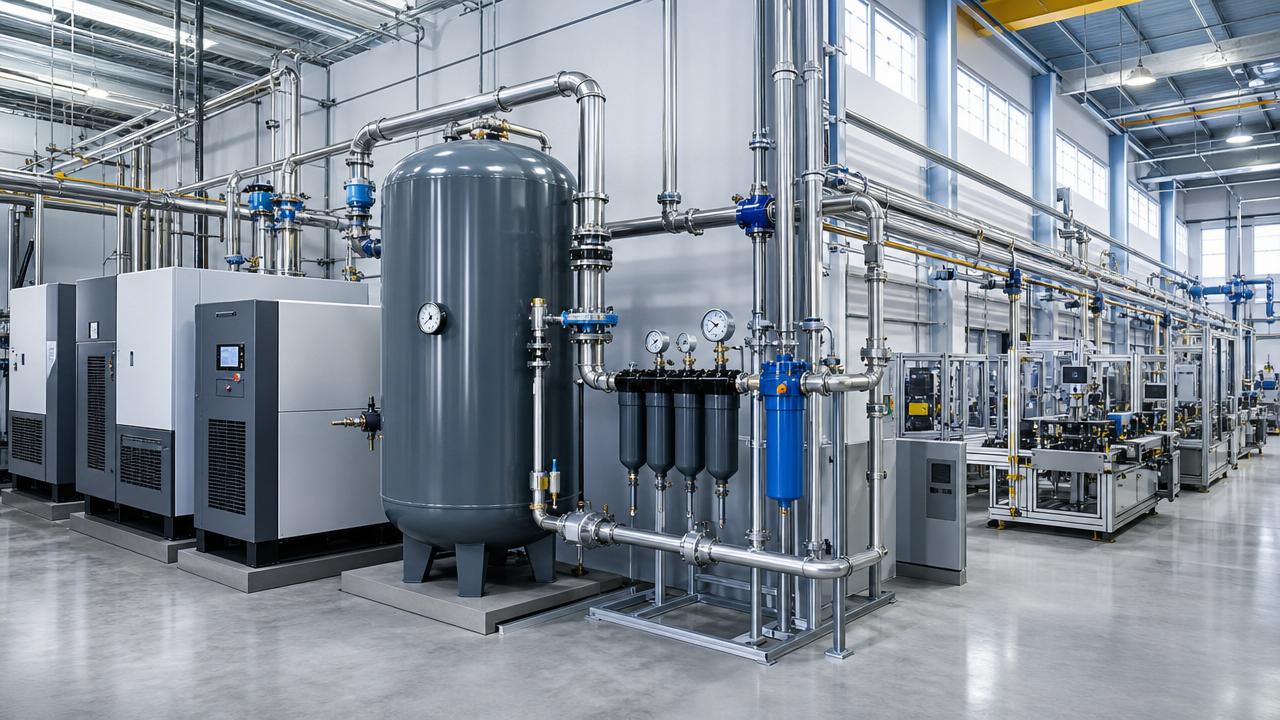
- Trace the full air path. Include compressor intake, compression, aftercooling, drying, storage, filters, piping, hoses, fittings, and point-of-use devices.
- Define the required controls for each risk group. This may include oil-free compression, drying, filtration, dedicated branches, inspection routines, or point-of-use protection.
- Build controls into routine operations. Maintenance schedules, line-clearance procedures, change records, alarm responses, and staff responsibilities should be linked to the risk assessment.
The final step is often where systems lose effectiveness. Air quality is not protected by a purchase order alone. It is protected when the operational team can recognize abnormal conditions, isolate affected lines, and restore service without improvising around the approved design.
When Class 0 is the appropriate choice
Class 0 oil-free compression is especially compelling when air contacts food, enters primary packaging, supports processes where residues would be difficult to detect, or serves high-consequence hygiene zones. It can also reduce the complexity of explaining contamination controls during internal reviews and supplier assessments because the system begins with a source that does not add lubrication oil to the compressed air stream.
It may be less critical for isolated, non-product utility tasks where air cannot reasonably migrate toward food or food-contact surfaces. Even then, the decision should account for future process changes. A utility line may later be repurposed for cleaning, packaging support, or a new production cell. Designing clear separation between utility and sensitive air uses avoids accidental scope creep.
Energy use remains part of the decision. Oil-free equipment should be evaluated as a complete operating system, including control strategy, pressure requirement, air leakage, dryer selection, heat recovery potential, and maintenance requirements. The cleanest source will not deliver an efficient plant if excessive pressure, leaks, or poor distribution force it to run harder than necessary.
Questions worth answering before approving a system
A sound project brief should answer four questions in plain operational terms: Where can compressed air contact the product or package? Which contaminants are unacceptable at each location? What controls protect air quality from intake to use point? How will the plant demonstrate that those controls remain in place after maintenance, expansion, or a production upset?
GTC-Matrix follows the intersection of compressed-air technology, process reliability, and energy performance across food and other sensitive manufacturing environments. For food operations, the most useful insight is rarely a generic claim about “clean air.” It is understanding how source selection, air treatment, distribution design, and operating discipline work together to keep compressed air from becoming a hidden variable in product quality.
Class 0 technology gives that system a stronger foundation. It should be selected where the consequences of compressor-originated oil are unacceptable, then supported by clean intake practices, moisture management, application-specific filtration, controlled distribution, and records that make the air system auditable in normal operation as well as during an incident.
Related News
- How to size oil-free compressors for instrumentation air demandAuthor :Pneumatic Power Engineer

- How Class 0 oil-free compressors protect product quality in food productionAuthor :Pneumatic Power Engineer

- How to verify compressed air cleanroom standards before installationAuthor :Pneumatic Power Engineer

- When oil free vacuum pumps make sense for European cleanroom projectsAuthor :Pneumatic Power Engineer

- When do pure air compression systems need ISO 8573-1 Class 0?Author :Pneumatic Power Engineer

- How do compressed air systems for electronics prevent contamination?Author :Pneumatic Power Engineer

- When does an oil-free process vacuum pump justify its higher cost?Author :Pneumatic Power Engineer

- Does ISO 9001 certification apply to compressed air quality?Author :Pneumatic Power Engineer

- How to Specify Clean Compressed Air Systems in Southeast Asia for Food and Pharma PlantsAuthor :Pneumatic Power Engineer

- How to Compare Oil Free Vacuum Pumps for Clean Process RequirementsAuthor :Pneumatic Power Engineer

- How to Evaluate a Clean Compressed Air Systems Supplier for ISO 8573-1 ComplianceAuthor :Pneumatic Power Engineer

- How to Choose the Right Oil-Free Vacuum PumpAuthor :Pneumatic Power Engineer

- VDI 2083 Update Makes Class 0 Proof MandatoryAuthor :Pneumatic Power Engineer

- When to Use Oil Free Vacuum Pumps for High Purity LinesAuthor :Pneumatic Power Engineer

- Compressed Air Solutions: When Oil-Free Systems Lower Total Operating CostAuthor :Pneumatic Power Engineer

- ATMOsphere Europe 2026 Adds Oil-free Systems ZoneAuthor :Pneumatic Power Engineer

- Oil-Free Compressors: Key Selection Criteria for Clean Air SystemsAuthor :Pneumatic Power Engineer

- How to Compare Oil Free Centrifugal Compressors for Stable Plant Air SupplyAuthor :Pneumatic Power Engineer

- Compressed Air Class 0 vs Oil-Free: What Really MattersAuthor :Pneumatic Power Engineer

- Oil-Free Compression Class 0: What the Standard Really Means in ProductionAuthor :Pneumatic Power Engineer

- Air Compression Cost Comparison: Oil-Free vs Screw Systems in Daily OperationAuthor :Pneumatic Power Engineer

- Saudi SASO Tightens IEC 63349-2 for Oil-Free CompressorsAuthor :Pneumatic Power Engineer

- Saudi SASO Tightens Oil-Free Compressor Efficiency RulesAuthor :Pneumatic Power Engineer

- Pure Air Compression Systems for Clean Production LinesAuthor :Pneumatic Power Engineer

- IEC 63349-2:2026 makes energy certification mandatoryAuthor :Pneumatic Power Engineer

- IEC 63349-2:2026 Sets New Entry Rules for Oil-Free Screw CompressorsAuthor :Pneumatic Power Engineer

- IEC 63349-2:2026 Takes Effect for Oil-Free Screw CompressorsAuthor :Pneumatic Power Engineer

- IEC 63349-2:2026 Sets New Efficiency Gate for Oil-Free Screw CompressorsAuthor :Pneumatic Power Engineer

- IEC 63349-2:2026 Takes Effect for Oil-Free Screw CompressorsAuthor :Pneumatic Power Engineer

- SABIC Methanol Force Majeure Extended, Tightening R134a/R407C FeedstocksAuthor :Pneumatic Power Engineer

- How to Evaluate Pneumatic Power Systems for Stable OutputAuthor :Pneumatic Power Engineer

- Oil-Free Compression vs Lubricated Systems: Key Trade-OffsAuthor :Pneumatic Power Engineer
![]()
- Oil-Free Compression: 2026 Cost and Compliance Trade-OffsAuthor :Pneumatic Power Engineer

- Oil-Free Compression: Cost and Contamination RisksAuthor :Pneumatic Power Engineer
![]()
- Euro PMI Drop Delays Oil-Free Systems OrdersAuthor :Pneumatic Power Engineer

- Germany/France May PMI Decline; Oil-free Systems EU Projects DelayedAuthor :Pneumatic Power Engineer
![]()