How to assess a thermal systems factory's production capacity




A thermal systems factory’s stated annual output offers little assurance that a specific order will ship on time. A useful capacity assessment starts with the required equipment, delivery schedule, testing scope and available production hours, then follows the order through the processes most likely to constrain it. The result should be a delivery commitment supported by evidence, with any overtime, outsourcing and expediting costs visible in the quotation.
Capacity is specific to the product mix. A factory that produces a steady stream of standard cooling skids may have limited room for a custom heat exchanger requiring unusual materials, qualified welding procedures and a witnessed pressure test. Ask for capacity in terms of the proposed order and its critical operations, rather than accepting a single figure for units per month.
Translate the order into a production load
Begin with a clear scope: equipment configuration, quantities, required materials, design documentation, inspection points and the dates when drawings and components will be available. Identify the intended delivery pattern as well. A requirement for several units at the end of a quarter places a different load on assembly and testing from the same quantity released in stages.
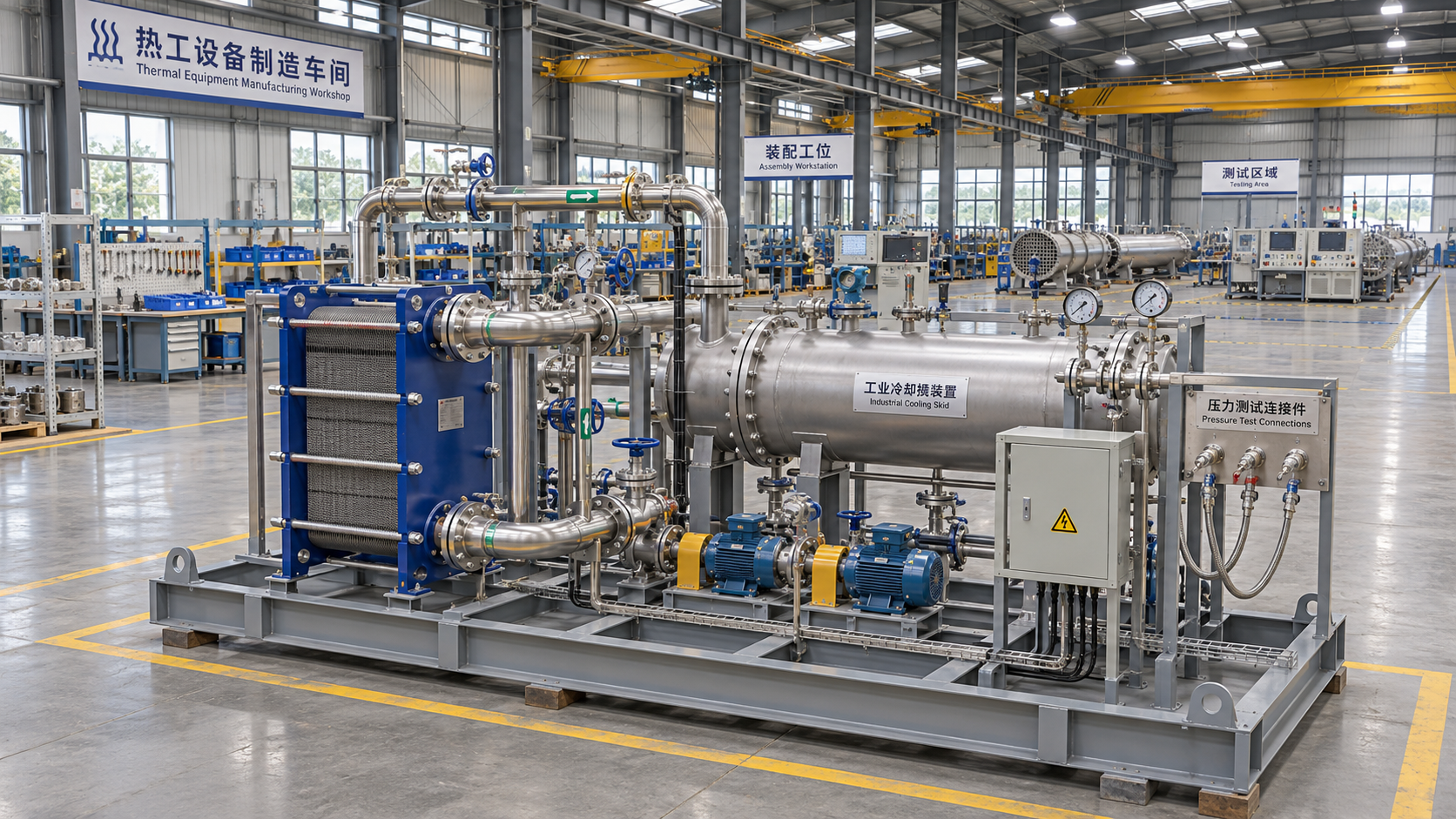
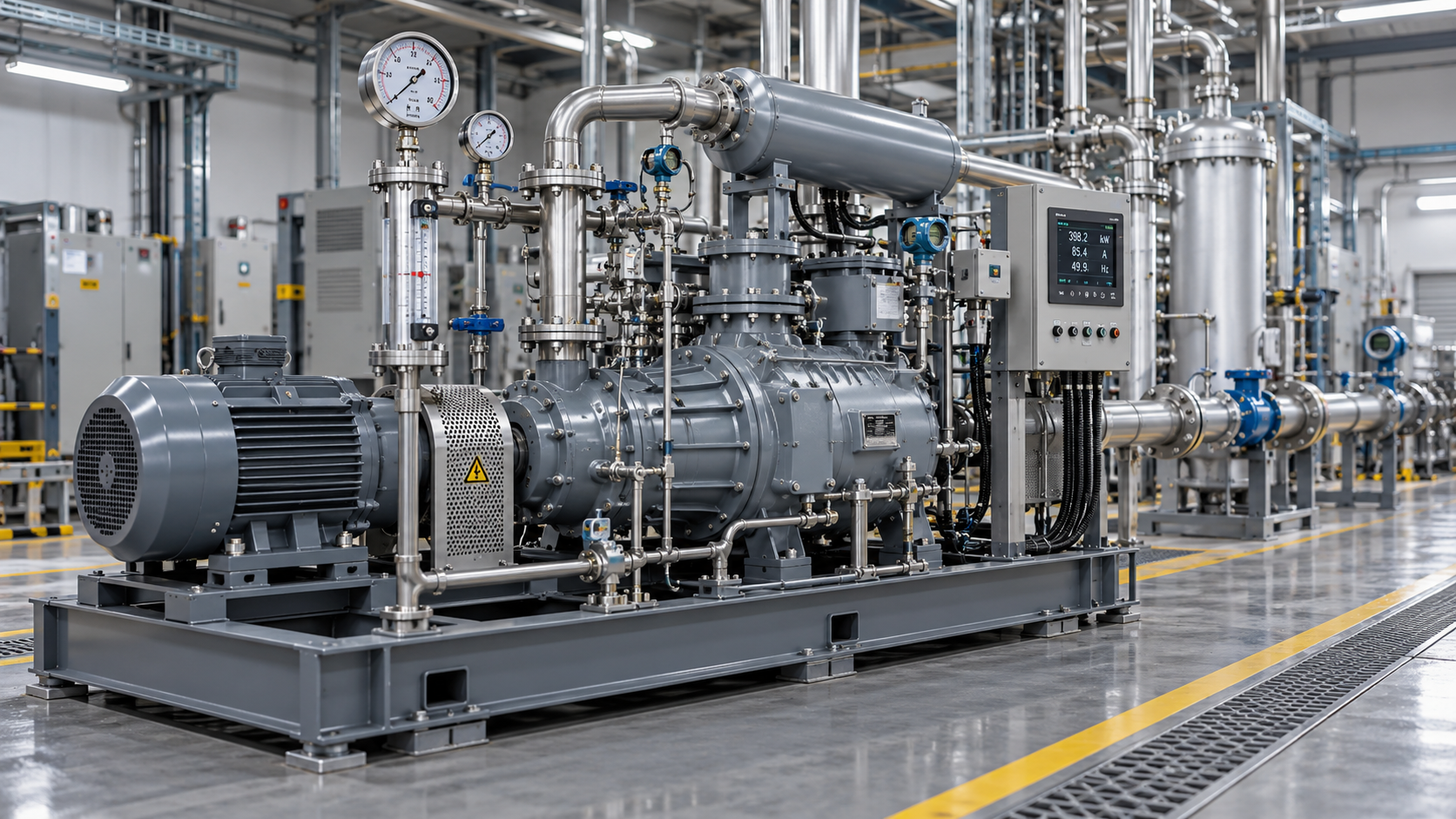
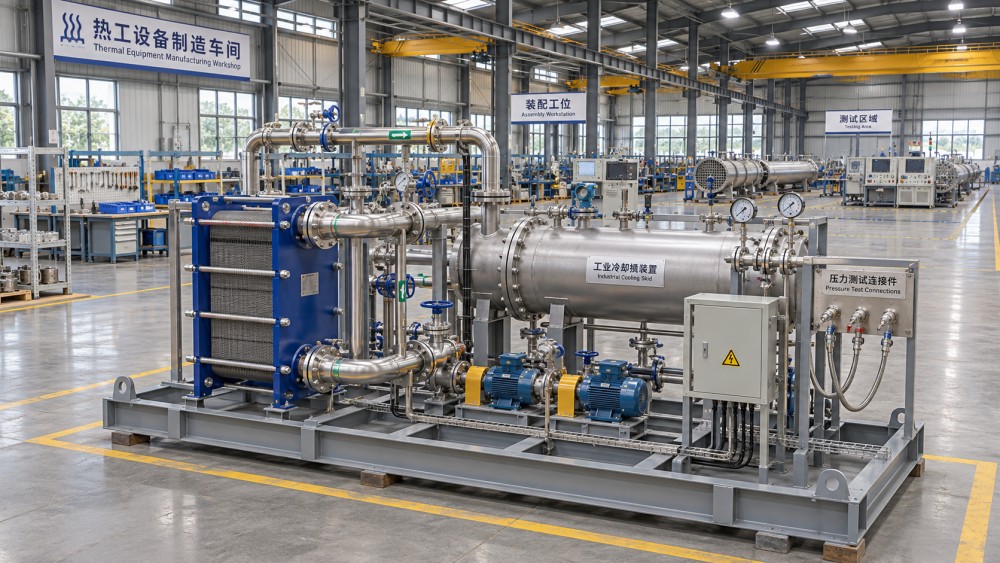
Request a production routing for a representative unit. It should show the major operations, estimated hours, planned work centers and external processes. For a packaged thermal system, the route could include fabrication, heat exchanger production or receipt, piping, electrical assembly, controls integration, leak testing and performance testing. A factory that buys finished heat exchangers will have a different constraint from one that forms and joins them in-house.
Compare the proposed routing with recent orders of similar complexity. Product photographs and a list of installed machines establish capabilities, but completed job records provide stronger evidence of the hours and sequence involved. When confidentiality limits access, anonymized schedules, work orders or inspection records can still show whether comparable equipment has passed through the facility.
Find the operation that sets the pace
A production line moves only as fast as its most constrained resource over the relevant period. That resource may be a welding station, a brazing furnace, a pressure-test bay, an electrical technician or the engineering staff needed to release drawings. The bottleneck can shift as the order moves through the factory.
For each critical operation, compare the hours needed for the proposed order with the hours realistically available after existing commitments. Use the same period for both sides of the calculation. Available hours should reflect planned shifts, maintenance, setup and changeovers; the number of machines alone does not establish usable capacity. If a furnace handles several assemblies in one cycle, loading limits and product compatibility matter as much as cycle time.
Consider a simplified example: an order needs 120 hours at a test bay during a particular month. The bay has 160 scheduled hours, but existing work and planned maintenance account for 70. The remaining 90 hours leave a 30-hour gap before allowing for retesting or disruption. A second shift or an approved external facility could close the gap, but the schedule and quotation should identify who supplies that capacity and when it becomes available. The figures illustrate the calculation; they are not a benchmark for any factory.
Pay attention to shared resources. A test bay may serve several product lines, while a skilled welder may be assigned across fabrication areas. Counting the same resource as fully available to multiple orders produces an optimistic schedule. Request a load plan that includes committed work, expected completion dates and the assumptions behind any unconfirmed capacity.
Separate rated capacity from demonstrated output
Rated output describes what a factory expects to produce under stated conditions. Demonstrated output shows what it has completed under actual conditions. Neither is useful without the product mix, period and definition of completion. “Finished” could mean mechanically assembled, tested, packed or ready for dispatch; each represents a different point in the delivery schedule.
Ask for recent throughput and on-time completion records for comparable work, together with the number of shifts used. A period dominated by repeat orders may overstate capacity for a custom project with engineering reviews and special inspection requirements. Conversely, a factory recovering from a major equipment outage may show a low output that no longer represents its normal operating state. Seek the explanation and supporting schedule rather than treating either figure as a standalone verdict.
Work in progress also needs context. A full shop floor can indicate strong demand, but it can also conceal assemblies waiting for parts, engineering approval or rework. Trace a few jobs from release to completion and ask how long they spent waiting between operations. Long queues immediately before testing or final assembly are especially relevant when the proposed order has a fixed dispatch date.
Examine engineering and material readiness
Physical production capacity is useful only after the design is sufficiently defined. Custom dimensions, connection locations, refrigerant or fluid selection, controls and site interfaces can all affect fabrication. Establish when the factory will submit drawings, how long review is allowed and what happens if comments require redesign. A delivery promise calculated from order placement is misleading if it assumes immediate approval of information that is still being negotiated.
Material availability should be tied to the bill of materials and the production plan. Identify long-lead items such as compressors, controls, specialty alloys, valves or heat-transfer components where they apply to the design. Ask whether the quoted lead time is supported by a current supplier commitment, stock already allocated to the order or an assumption that still needs confirmation.
Allocation matters. A component listed as available in inventory may already be reserved for another project. Likewise, an alternative material or component is useful only if its performance, compatibility and required approvals fit the specification. Changing a heat exchanger material, for example, can affect corrosion resistance, joining procedures and inspection requirements, adding engineering work even when the substitute is physically available.
Where a critical operation is outsourced, include the subcontractor in the capacity picture. The factory should be able to show the planned scope, turnaround time, transport allowance and inspection responsibilities. Outsourcing expands capacity only when a suitable slot and the required process capability are available for the order.
Test capacity is production capacity
Thermal equipment often remains incomplete until its specified inspections and tests are accepted. Establish which tests are included, where they take place and which conditions the facility can reproduce. A pressure or leak test confirms a different aspect of the assembly from a functional or thermal performance test. A factory may be able to perform one in-house while relying on another site for the rest.
Compare the test facility with the equipment’s size and operating envelope. Electrical supply, cooling or heating utilities, fluid flow, instrumentation, connections and safe handling space can all limit what is tested. If a full-load test is unavailable, agree on the proposed partial-load test, calculations or alternative verification before the order is placed. The acceptance criteria and any unresolved limits should be documented rather than left to the dispatch stage.
Witnessed tests add scheduling dependencies. A completed unit may wait for an inspector, a suitable test slot or resolution of an observation. Ask how retesting is accommodated and whether the delivery schedule includes time for corrective work. First-pass acceptance records for comparable equipment can help distinguish a realistic allowance from a schedule that assumes every unit will pass immediately.
Connect the capacity assessment to price and delivery terms
Compare quotations on the same production and acceptance basis. A lower base price can exclude testing, special documentation, packing, external processing or the cost of holding a production slot. An accelerated schedule may rely on overtime or premium freight for critical components. These measures are legitimate, but their price and availability should be explicit.
Request a milestone schedule that links engineering release, material receipt, fabrication, testing and dispatch. For each milestone, record the responsible party and the information or approval needed to proceed. This makes it easier to distinguish a factory delay from a late design change or a review period that exceeded the agreed allowance.
Capacity reservations also need a clear basis. A tentative production window is weaker than a slot tied to an accepted order, defined scope and agreed release dates. Establish how changes to quantity, specification or delivery sequence affect the slot and price. If demand could increase, ask for a separate quotation and lead time for the additional units instead of assuming the original capacity extends to them.
Resolve gaps before treating a date as firm
Bring the evidence together around the most constrained operation. If the factory has enough fabrication hours but no confirmed test slot, the delivery date remains exposed. If components are secured but drawings are still open, the next decision may be to freeze interfaces before releasing material. A capacity gap does not automatically rule out a supplier; it requires an agreed remedy with a named resource, cost and schedule effect.
Before accepting the commitment, reconcile the order quantity and delivery dates with the current load plan, subcontractor confirmations and test arrangements. Keep those assumptions with the commercial agreement so that later changes can be evaluated against the capacity originally offered.
Ready when you are. Send us a message to get started.
Related News
- How to assess a thermal systems factory's production capacityAuthor :

- How does capacity affect the price of energy conversion systems?Author :

- How to prioritize industrial decarbonization projectsAuthor :

- How does cooling capacity affect electronics cooling solution prices?Author :

- How to write measurable requirements in a procurement specificationAuthor :

- How to select industrial equipment for automation with existing PLCsAuthor :

- How electricity prices shape industrial compressed air price trendsAuthor :

- Choosing air filtration systems for heavy dust in the Middle EastAuthor :

- How much does a fully installed compressed air monitoring system cost?Author :

- What documentation supports CE marking for industrial equipment?Author :

- How local support affects vacuum system costs in Southeast AsiaAuthor :

- How worldwide industry category guides help compare market opportunitiesAuthor :

- What drives sustainable thermal systems cost over their operating life?Author :

- Which industrial solution comparison criteria prevent project delays?Author :

- How Ambient Temperature and Load Profile Affect Industrial Compressor SizingAuthor :

- What to evaluate before choosing a thermal process engineering supplierAuthor :

- How industrial utility systems affect energy costs in process plantsAuthor :

- What Data Is Needed to Assess Heat Recovery Decarbonization?Author :

- Can Waste Heat Recovery Support Carbon Neutrality Targets?Author :

- Is Compressor Heat Recovery Worth the Installation Cost?Author :

- What to verify before choosing a process separation technology supplierAuthor :

- When does process utilities engineering reduce project rework?Author :

- Where thermal efficiency optimization delivers the fastest savings in EuropeAuthor :

- What should you verify before selecting a heat transfer supplier?Author :

- What drives compressed air systems price for industrial projects?Author :

- How an industrial product knowledge comparison guide reduces sourcing riskAuthor :

- When does a procurement specification planning process reduce bid risk?Author :

- When does thermal system optimization for electronics reduce failure risk?Author :

- When high temperature process heating systems justify the higher energy costAuthor :

- How to compare sludge dewatering equipment by cake drynessAuthor :

- What to Check Before Sourcing a Gas Turbine for Distributed Power ProjectsAuthor :

- What drives industrial thermal systems price in large facility projectsAuthor :

- How to build an industrial product comparison chart that speeds up vendor selectionAuthor :

- Vacuum Technology Application Guide for Selecting the Right SystemAuthor :

- What Drives Vacuum Drying Cost in Industrial Procurement?Author :

- What Drives Compressed Air Pricing in Industrial Systems?Author :