US EPA Mandates GWP and Leak Rate Labeling for Imported Scroll Compressors Starting July 2026




The U.S. Environmental Protection Agency (EPA) has introduced new labeling requirements for imported scroll compressors, effective July 1, 2026 — a regulatory shift poised to impact global manufacturers, exporters, and supply chain stakeholders serving the U.S. HVACR, automotive, and cold chain markets.
Regulatory Implementation Timeline and Core Requirements
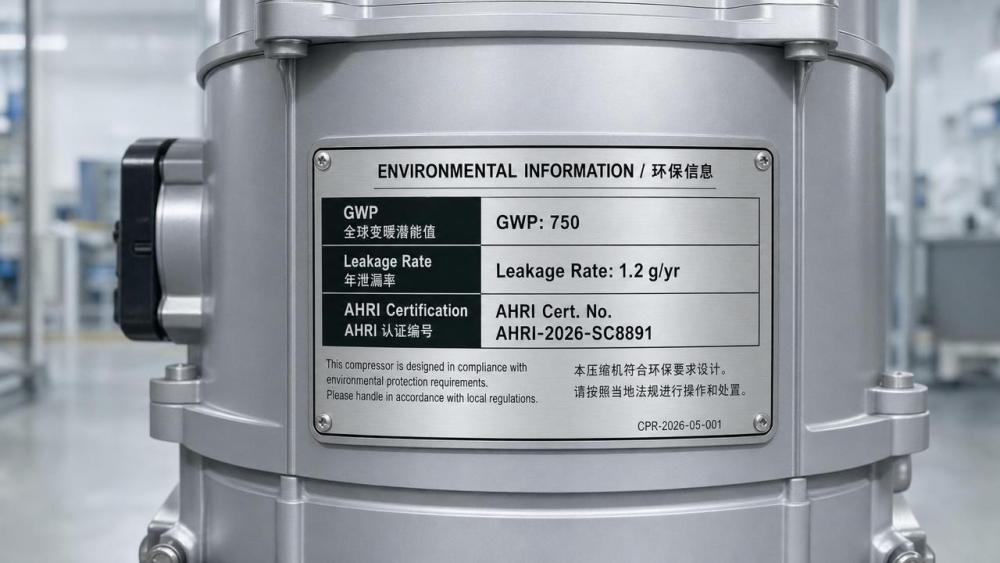
On May 29, 2026, the EPA signed the Enhanced Labeling Rule for Imported Refrigeration Equipment. Under this rule, all scroll compressors entering the U.S. market — including those used in automotive air conditioning, heat pumps, and refrigerated transport or cold storage systems — must display bilingual (English/Chinese) energy and environmental labels on both outer packaging and nameplates starting July 1, 2026. These labels must clearly disclose: (1) the Global Warming Potential (GWP) of the refrigerant employed; (2) the annual leakage rate in grams per year (g/yr); and (3) the AHRI certification number. Non-compliant shipments will be detained by U.S. Customs and Border Protection (CBP) and subject to an administrative penalty equal to 15% of the batch’s declared value.
Impact Across Supply Chain Roles
Export-oriented trading companies
These entities face immediate operational adjustments: label verification must now be integrated into pre-shipment quality checks. Failure to confirm bilingual compliance and AHRI traceability may trigger CBP holds, disrupting delivery schedules and increasing demurrage costs. Documentation management — especially bilingual label proofs and AHRI certificate validity — becomes a critical control point.
Raw material and component procurement firms
Procurement teams must now verify that refrigerant suppliers provide certified GWP data aligned with EPA-referenced AR4 or AR6 assessment methodologies. Where compressors integrate proprietary refrigerant blends, procurement contracts must explicitly require GWP disclosure and leakage test reports compliant with AHRI Standard 700 or equivalent EPA-recognized protocols.
Manufacturers of scroll compressors
Production lines require updated labeling workflows — including bilingual print templates, QC checkpoints for label accuracy, and integration of leakage testing into final assembly validation. Manufacturers must also ensure their AHRI certification remains active and covers the exact model configurations being exported, as mismatched certification numbers constitute non-compliance.
Supply chain service providers
Fulfillment centers, logistics coordinators, and customs brokers must upgrade documentation handling systems to flag and validate required labeling elements before U.S. entry. This includes cross-checking GWP values against EPA’s approved refrigerant list and verifying that leakage rate figures reflect actual measured performance — not theoretical or default values.
Key Compliance Priorities for Exporters
AHRI certification alignment and renewal
Exporters must confirm that each compressor model carries a current, scope-matched AHRI certification. Recertification timelines, model-specific test reports, and certificate expiration dates must be tracked proactively — especially for variants differing only in refrigerant charge or sealing design.
Bilingual label design and verification
Labels must meet EPA-specified font size, contrast, and placement criteria. Both English and Chinese text must be legible, technically accurate, and consistent across packaging and nameplate. Translation of technical terms (e.g., “leakage rate”) must follow AHRI or ISO terminology standards — not literal translation.
Leakage rate measurement protocol adherence
The mandated g/yr figure must derive from standardized testing — typically per AHRI 760 or ISO 5149-2 — under defined operating conditions (e.g., 100% capacity, ambient 35°C). Manufacturers cannot substitute manufacturer-declared values without third-party verification accepted by EPA.
Pre-shipment documentation audit
Before dispatch, exporters should compile a compliance dossier including: AHRI certificate copy, leakage test report, GWP reference sheet (citing IPCC AR6 or EPA SNAP listing), and high-resolution label proofs. CBP may request these upon entry.
Industry Perspective: Beyond Compliance Toward Systemic Readiness
Analysis shows this rule signals a broader tightening of U.S. environmental accountability for upstream components — not just end-use equipment. From an industry perspective, the dual-language requirement reflects growing emphasis on transparency for global supply chains, while the GWP + leakage combination underscores EPA’s shift toward lifecycle emissions tracking. What deserves closer attention is the implied expectation that manufacturers maintain real-time traceability between refrigerant batches, compressor models, and certified test data — a capability many mid-tier suppliers have not yet institutionalized. Observably, lead times for AHRI recertification and leakage testing are likely to extend, potentially compressing order-to-ship windows for U.S.-bound shipments post-July 2026.
Strategic Implications for Market Access
This regulation does not ban any refrigerant or technology outright, but it raises the operational threshold for U.S. market access. It effectively transforms labeling from a marketing or informational function into a verifiable compliance checkpoint — integrating environmental performance metrics directly into trade documentation. For manufacturers, success hinges less on product design alone and more on the robustness of their compliance infrastructure: certified testing partnerships, bilingual technical documentation governance, and agile label management systems. The rule reinforces that environmental claims must now be empirically anchored — not merely declared.
Source Attribution and Ongoing Monitoring
This article was generated based solely on the user-provided title, event date (2026-07-01), and summary. Specific official source links were not provided in the input and should be verified continuously. Stakeholders are advised to monitor upcoming EPA guidance documents, CBP implementation bulletins, and AHRI’s updates on labeling interpretation — particularly regarding acceptable leakage test methodologies, bilingual formatting exceptions, and enforcement phase-in periods. Industry feedback on label readability, certification scalability, and small-batch exemptions remains pending formal EPA consultation.
Ready when you are. Send us a message to get started.
Related News
- How corrugation angle affects heat transfer in plate heat exchangersAuthor :Thermodynamics Analyst

- R22 Prices Retreat as China's Refrigerant Market Faces Tight Quotas and Soft DemandAuthor :Cryogenic Systems Expert

- How to select industrial equipment for automation with existing PLCsAuthor :

- Carrier Plans $600 Million Manufacturing and Engineering Center in Fort WorthAuthor :

- How electricity prices shape industrial compressed air price trendsAuthor :

- Chemours Faces Investor Lawsuit Over Opteon Refrigerant Sales ForecastsAuthor :Cryogenic Systems Expert

- Choosing air filtration systems for heavy dust in the Middle EastAuthor :

- LG Expands R290 Monobloc Heat Pump Range with New 12–16 kW ModelsAuthor :Cryogenic Systems Expert

- How to size a chiller for pharmaceutical cleanroom temperature controlAuthor :Cryogenic Systems Expert

- Kentucky Regulators Approve $191 Million Cooling Tower at Mitchell Coal PlantAuthor :Thermodynamics Analyst

- How much does a fully installed compressed air monitoring system cost?Author :

- What documentation supports CE marking for industrial equipment?Author :

- When do plate heat exchangers suit Middle East seawater cooling?Author :Thermodynamics Analyst

- EU Issues Updated Guidance on Industrial Refrigeration Efficiency and F-gas AlternativesAuthor :Cryogenic Systems Expert

- How does base pressure affect film purity in vacuum deposition?Author :Vacuum Process Fellow

- Do U.S. refrigerant regulations require replacing R-410A systems?Author :Cryogenic Systems Expert

- When does variable gas flow justify a custom screw compressor system?Author :Pneumatic Power Engineer

- How local support affects vacuum system costs in Southeast AsiaAuthor :

- How worldwide industry category guides help compare market opportunitiesAuthor :

- How to verify food-grade purity in compressed air systemsAuthor :Pneumatic Power Engineer

- When high-pressure waste heat recovery boilers make economic senseAuthor :Thermal Energy Strategist

- How to size compressed air equipment for pneumatic toolsAuthor :Pneumatic Power Engineer

- How to size vacuum process equipment for the required pump-down timeAuthor :Vacuum Process Fellow

- What determines the price of pure air compression systems?Author :Pneumatic Power Engineer

- How steam generation efficiency shapes thermal power system designAuthor :Thermal Energy Strategist

- What drives sustainable thermal systems cost over their operating life?Author :

- Which vacuum specification best protects semiconductor process yield?Author :Vacuum Process Fellow

- When do smart thermal systems with sensors reduce chiller energy use?Author :Cryogenic Systems Expert

- When does gasketed plate heat exchanger technology suit your process?Author :Thermodynamics Analyst

- How to size oil-free compressors for instrumentation air demandAuthor :Pneumatic Power Engineer

- How Class 0 oil-free compressors protect product quality in food productionAuthor :Pneumatic Power Engineer

- Which industrial solution comparison criteria prevent project delays?Author :

- Chiller Optimization Checklist for Rising Energy Use and Unstable Cooling OutputAuthor :Cryogenic Systems Expert

- How to Specify a High-Precision Temperature Chiller for Tight-Tolerance ProcessesAuthor :Cryogenic Systems Expert

- Designing Energy-Efficient Industrial Cooling for Variable Process LoadsAuthor :Cryogenic Systems Expert

- Low-GWP Cooling Solutions for Process Plants: Comparing Safety, Efficiency, and CostAuthor :Cryogenic Systems Expert