Industrial Cooling for Plastic Processing: How to Size for Stable Cycle Times




Industrial Cooling for Plastic Processing: How to Size for Stable Cycle Times
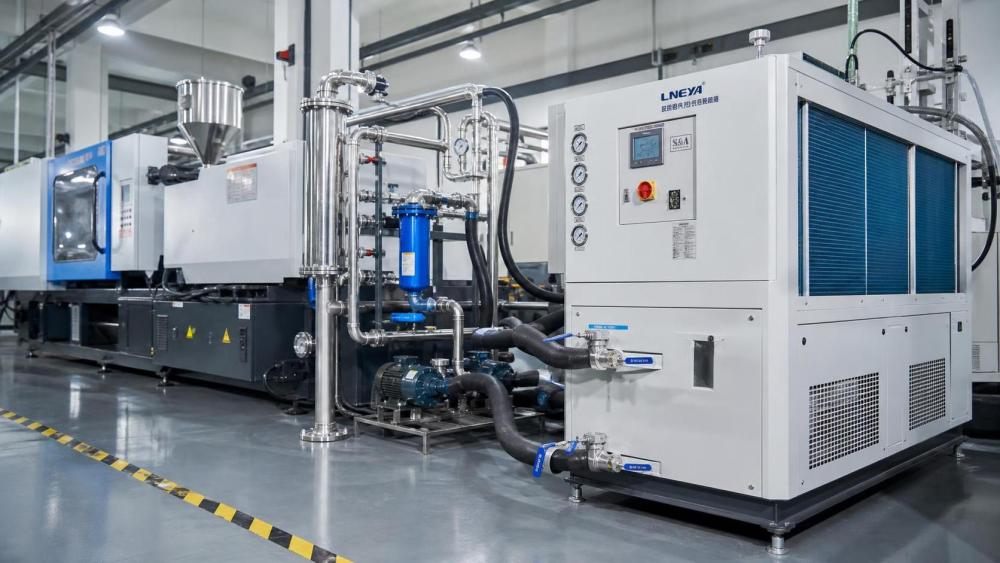
Stable cycle times in plastics manufacturing begin with thermal control, not only machine settings. When cooling is undersized or poorly matched, every downstream variable becomes harder to manage.
That is why industrial cooling for plastic processing matters during equipment evaluation. It affects part quality, mold recovery, scrap rates, throughput, and energy cost at the same time.
In practical terms, sizing is about balancing heat removal with real operating conditions. The goal is stable water temperature, repeatable cycles, and enough margin for production swings.
For decision-making, the best approach is not to start with nameplate tons alone. Start with the process, then calculate heat load, then test system fit.
Why Cooling Stability Drives Cycle Time Performance
Plastic processing converts thermal energy into shape. Cooling then removes that energy fast enough to lock dimensions, finish, and material properties within a tight process window.
If water temperature drifts, mold surface temperature also drifts. That changes solidification time, shrinkage behavior, and often the pressure profile needed to maintain part consistency.
More noticeably, unstable industrial cooling for plastic processing can create hidden variability. Operators may respond by slowing cycles, raising hold time, or overcompensating elsewhere.
That usually protects output in the short term. It also masks the real issue, which is insufficient or poorly controlled thermal capacity.
From a selection perspective, cooling stability should be tied to three production outcomes:
- Cycle time repeatability across shifts and seasons
- Part-to-part dimensional and visual consistency
- Energy performance without unnecessary oversizing
Start with the Real Heat Load
The first sizing mistake is using rough machine counts without a thermal breakdown. A better method is to map every major source of heat entering the cooling loop.
In most plastic processing lines, the main cooling load comes from the mold or tool. Secondary loads may include hydraulic oil, barrel zones, dryers, vacuum equipment, and ambient heat gain.
For injection molding, start with resin throughput, melt temperature, mold temperature, and cycle target. For extrusion, focus on line speed, barrel load, die cooling, and downstream calibration.
A simplified evaluation usually includes these inputs:
- Material type and hourly throughput
- Heat removed per kilogram of processed resin
- Required supply water temperature
- Allowed temperature rise across the process
- Simultaneous equipment demand, not installed demand
This is where industrial cooling for plastic processing becomes a calculation exercise, not a catalog exercise. You need actual load diversity and real operating overlap.
Many plants discover their peak load lasts only part of the day. Others find that one mold family creates the true design condition for the whole utility system.
A Practical Heat Load Formula
For water-side estimation, use the standard relationship between flow and temperature rise. It gives a quick reality check before detailed vendor modeling.
Cooling capacity = flow rate × specific heat × density × temperature difference.
In day-to-day selection, this means tighter allowable temperature rise requires either more flow or more total cooling capacity. Both affect pump sizing and utility cost.
Match Chiller Capacity to Process Demands
After defining heat load, the next step is matching chiller output to the process temperature window. Capacity at one rating point may not equal capacity at your operating point.
That point is often missed during industrial cooling for plastic processing reviews. A unit rated at standard conditions may deliver less when lower leaving water temperatures are required.
Always compare:
- Nominal capacity versus actual capacity at design temperatures
- Minimum and maximum flow stability range
- Control accuracy under partial load conditions
- Ambient derating for air-cooled systems
- Future load expansion allowance
A sensible margin is usually better than aggressive oversizing. Excess capacity can short-cycle compressors, weaken control precision, and increase both capital and maintenance burden.
In many evaluations, a variable-capacity system or staged configuration works better than one large fixed-capacity machine. It tracks load changes more smoothly.
Air-Cooled or Water-Cooled?
The answer depends on site conditions, not preference alone. Air-cooled chillers reduce water infrastructure needs, but ambient temperature directly affects condensing performance.
Water-cooled systems often deliver better efficiency and steadier performance, especially in hot climates or high-duty facilities. They do, however, add cooling tower and water treatment complexity.
Evaluate Flow, Pressure, and Distribution
Cooling capacity alone is not enough. Industrial cooling for plastic processing also depends on whether the system can deliver flow uniformly to each mold or process zone.
Poor hydraulic distribution creates warm spots and unstable return temperatures. The chiller may appear correctly sized while the process still suffers from uneven heat removal.
During assessment, review these points carefully:
- Required flow per mold circuit or cooling zone
- Pressure drop across manifolds, hoses, valves, and tools
- Pump curve fit at normal and peak demand
- Need for buffer tanks or decoupled primary-secondary loops
- Filtration quality to protect narrow cooling channels
This also means distribution design should be part of any buying decision. A strong chiller paired with weak hydraulic design rarely gives stable cycle times.
Quick Comparison Table for Evaluation
Avoid the Most Common Sizing Errors
Several issues appear repeatedly in industrial cooling for plastic processing projects. Most are preventable when thermal data, hydraulic data, and operating patterns are reviewed together.
Watch for these mistakes:
- Selecting by machine horsepower instead of process heat load
- Assuming all tools run at peak demand simultaneously
- Ignoring seasonal ambient extremes
- Using large safety factors without control analysis
- Skipping pressure drop checks through aging plant piping
- Forgetting water quality, fouling, and maintenance access
From recent market changes, energy pricing has made these errors more expensive. Bigger systems are no longer seen as automatically safer when lifecycle cost becomes visible.
A clearer signal is the shift toward measurable efficiency under real load profiles. That changes how buyers judge industrial cooling for plastic processing solutions today.
A Practical Selection Framework
A disciplined review process keeps sizing grounded in production reality. It also makes supplier proposals easier to compare on equal terms.
- Define the critical process window for temperature and cycle time.
- Calculate real simultaneous heat load by product family and shift.
- Confirm required flow, pressure, and return temperature assumptions.
- Check chiller capacity at actual entering and leaving conditions.
- Compare part-load control behavior, not just full-load capacity.
- Review utility integration, maintenance, and expansion scenarios.
This framework keeps industrial cooling for plastic processing aligned with what production really needs: stable heat removal, predictable costs, and fewer surprises after startup.
For organizations tracking broader thermal system trends, GTC-Matrix continues to monitor how efficiency standards, refrigerant transitions, and precision cooling demand are reshaping system selection.
The most reliable decision is usually the one built on measured load, verified hydraulics, and realistic operating conditions. That is the foundation for stable cycle times and consistent plastic processing performance.
Related News
- How Smart Thermal Systems Improve Industrial Cooling EfficiencyAuthor :Cryogenic Systems Expert

- How to Choose Process Cooling Equipment for Stable Temperature ControlAuthor :Cryogenic Systems Expert

- EU Finalizes 2026 HFC Quota Cut for R-134a ChillersAuthor :Cryogenic Systems Expert

- EU Tightens HFC-134a Quotas for Industrial ChillersAuthor :Cryogenic Systems Expert

- REACH SVHC Update Pressures HFC-134a Chiller Supply ChainsAuthor :Cryogenic Systems Expert

- EU PFAS Coolant Ban Reshapes Chiller ExportsAuthor :Cryogenic Systems Expert

- EU REACH Restricts PFAS Cooling Media ImportsAuthor :Cryogenic Systems Expert

- EU Ecodesign Rule Takes Effect for Industrial ChillersAuthor :Cryogenic Systems Expert

- EU REACH Rule Takes Effect for PFAS in Industrial Cooling ExportsAuthor :Cryogenic Systems Expert

- Industrial Cooling for Plastic Processing: How to Size for Stable Cycle TimesAuthor :Cryogenic Systems Expert

- EU F-Gas Update Bars R404A/R507 in Commercial CoolingAuthor :Cryogenic Systems Expert

- DOE Raises Chiller Efficiency Standard From October 2026Author :Cryogenic Systems Expert

- India Mandates BIS Energy Certification for Industrial ChillersAuthor :Cryogenic Systems Expert

- Energy-Efficient Heat Exchange for Process Cooling: Cost vs PaybackAuthor :Cryogenic Systems Expert

- EPA R-134a Import Ban Takes Effect on July 13, 2026Author :Cryogenic Systems Expert

- India BIS Rule Takes Effect for Industrial ChillersAuthor :Cryogenic Systems Expert

- EPA Cuts R134a Import Quotas 20% From July 10Author :Cryogenic Systems Expert

- How to Compare Energy-Efficient Cooling Systems for Factory Expansion ProjectsAuthor :Cryogenic Systems Expert

- Chiller Price Index Rises 11.3% in Q2Author :Cryogenic Systems Expert

- Saudi SASO Tightens Chiller Import Compliance From July 10Author :Cryogenic Systems Expert

- Dubai Opens Fast-Track Chiller TendersAuthor :Cryogenic Systems Expert

- Japan Raises Chiller COP Floor to 6.2 From Sept. 1Author :Cryogenic Systems Expert
![]()
- Compact Thermal Management in Smart Devices: Common Failure RisksAuthor :Cryogenic Systems Expert

- Thermal Management for Batteries: Cooling Methods ComparedAuthor :Cryogenic Systems Expert

- How Compact Thermal Design Extends Smart Device UptimeAuthor :Cryogenic Systems Expert

- Shanghai-Rotterdam Reefer Rates Jump 37% in a WeekAuthor :Cryogenic Systems Expert

- Process Cooling Equipment Low Maintenance: What Cuts Downtime Over 5 Years?Author :Cryogenic Systems Expert

- Semiconductor Cooling Solutions: Which Design Works Best for High-Density Tools?Author :Cryogenic Systems Expert

- Semiconductor Thermal Management Systems: Preventing Yield Loss from Heat DriftAuthor :Cryogenic Systems Expert

- EPA Clears R-1234ze(E) for Industrial ChillersAuthor :Cryogenic Systems Expert
 for Industrial Chillers")
- DOE Raises Chiller IEER Floor to 12.8 From Oct. 2026Author :Cryogenic Systems Expert

- Singapore Refrigeration Show Adds Green Compliance HubAuthor :Cryogenic Systems Expert

- How Food Industry Temperature Control Systems Reduce Product LossAuthor :Cryogenic Systems Expert

- EU REACH Adds 12 SVHCs, Raising Chiller Compliance RiskAuthor :Cryogenic Systems Expert

- Precision Temperature Control Air Cooling: Key Setup Mistakes That Reduce StabilityAuthor :Cryogenic Systems Expert

- India BEE Eyes APF Labels for Imported ChillersAuthor :Cryogenic Systems Expert