New Maritime Code Shifts No-Collection Liability to Shippers from May 1




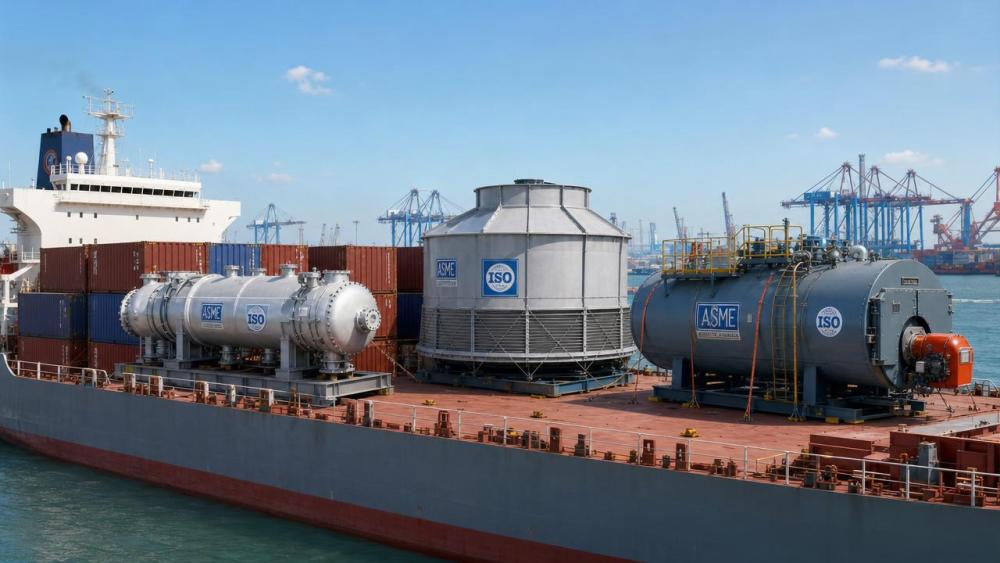
Effective May 1, 2026, the revised People’s Republic of China Maritime Code—specifically Article 93—reassigns primary liability for uncollected cargo at discharge ports from consignees to shippers. This legal change significantly affects international trade in large-scale, customs-complex industrial equipment, including cooling towers, biomass boilers, and shell-and-tube heat exchangers, and reshapes risk allocation under FOB and CIF contracts.
Legal Change Effective May 1, 2026
As of May 1, 2026, Article 93 of the newly amended Maritime Code of the People’s Republic of China formally transfers responsibility for cargo left uncollected at the destination port from the consignee to the shipper. The provision applies regardless of contract type but has immediate operational implications for FOB and CIF shipments of oversized, high-compliance industrial equipment. Under the revised rule, shippers—including Chinese exporters—bear initial legal and financial exposure for demurrage, storage, disposal, and related port charges when consignees fail to complete import clearance or physical collection.
Impact Across Trade and Supply Chain Roles
Direct Exporters
Exporters of industrial equipment now face heightened pre-shipment accountability. Previously insulated under standard FOB terms, they must now verify overseas buyers’ import eligibility, customs broker engagement, and local regulatory capacity *before* vessel departure—not after arrival. Failure to do so may trigger direct liability under Article 93.
Manufacturers and Equipment Suppliers
Manufacturers delivering turnkey systems or large components (e.g., ASME BPVC-certified boilers or ISO 14001-aligned heat exchangers) must align delivery schedules with buyers’ documented import readiness. Production planning, packaging, and documentation release are now interdependent with foreign regulatory timelines—not just engineering milestones.
Supply Chain Service Providers
Freight forwarders, customs brokers, and logistics integrators serving industrial exports must revise service scopes and contractual disclaimers. Their role shifts from facilitation to active verification: confirming that consignee-side import authorizations (e.g., import licenses, safety certifications, or environmental compliance clearances) are secured and communicated prior to loading.
Procurement and Sourcing Entities
Overseas buyers—particularly in emerging markets with fragmented customs infrastructure—must initiate import qualification processes earlier in procurement cycles. Delayed appointment of licensed customs agents or incomplete submission of technical documentation (e.g., CE marking files, pressure vessel declarations) now directly exposes their Chinese suppliers to statutory liability.
Key Compliance Priorities for Exporters
Strengthen Pre-shipment Documentation Coordination
Integrate consignee-provided import license numbers, customs broker contact details, and proof of regulatory approval into the shipping instruction checklist. Treat these as mandatory prerequisites—not optional attachments—before releasing goods to carriers.
Revise Contractual Risk Boundaries in FOB/CIF Terms
Explicitly define in sales contracts the point at which consignee import readiness becomes a condition precedent to shipment. Include clauses requiring written confirmation of customs agent appointment and estimated time-in-port clearance window—backed by verifiable evidence.
Adapt to Equipment-Specific Clearance Timelines
Account for extended customs processing durations for regulated equipment: biomass boilers may require emissions certification; cooling towers may face local water-use or noise ordinances; shell-and-tube heat exchangers often demand pressure equipment conformity assessments. Build buffer periods into delivery commitments accordingly.
Enhance Cross-Border Communication Protocols
Establish formal, auditable communication channels (e.g., shared digital portals with timestamped document uploads) between exporter, buyer, and appointed customs agent to demonstrate due diligence in verifying consignee preparedness—critical for potential liability defense.
Industry Observation: From Transactional to Collaborative Risk Management
Analysis shows this amendment signals a structural shift—from treating cargo handover as a discrete transactional milestone to framing it as a collaborative, end-to-end compliance process. Observably, the burden is no longer solely on port authorities or consignees to resolve clearance delays; instead, shippers are now legally incentivized to co-validate regulatory pathways *upstream*. What deserves closer attention is how this accelerates adoption of integrated trade compliance platforms among mid-sized exporters—and raises the bar for technical documentation quality, particularly for equipment subject to dual-use, environmental, or pressure-system regulations.
Strategic Implications for Industrial Trade
This revision does not eliminate traditional Incoterms® responsibilities—but overlays them with enforceable domestic statutory obligations. For exporters of capital equipment, it transforms contract negotiation from a pricing-and-timing exercise into a joint regulatory alignment effort. The long-term effect may be tighter integration between engineering, legal, and logistics functions—and greater emphasis on pre-qualification of overseas trading partners’ compliance capacity—not just financial or technical capability.
Source Information and Verification Guidance
This article is based exclusively on the user-provided title, effective date (May 1, 2026), and event summary. Specific official source links were not provided in the input and should be verified continuously. Stakeholders are advised to monitor forthcoming judicial interpretations, Ministry of Transport implementation notices, and updates to customs administrative guidance—particularly regarding evidentiary standards for proving consignee readiness and thresholds for invoking Article 93 liability.
Ready when you are. Send us a message to get started.
Related News
- How corrugation angle affects heat transfer in plate heat exchangersAuthor :Thermodynamics Analyst

- R22 Prices Retreat as China's Refrigerant Market Faces Tight Quotas and Soft DemandAuthor :Cryogenic Systems Expert

- How to select industrial equipment for automation with existing PLCsAuthor :

- Carrier Plans $600 Million Manufacturing and Engineering Center in Fort WorthAuthor :

- How electricity prices shape industrial compressed air price trendsAuthor :

- Chemours Faces Investor Lawsuit Over Opteon Refrigerant Sales ForecastsAuthor :Cryogenic Systems Expert

- Choosing air filtration systems for heavy dust in the Middle EastAuthor :

- LG Expands R290 Monobloc Heat Pump Range with New 12–16 kW ModelsAuthor :Cryogenic Systems Expert

- How to size a chiller for pharmaceutical cleanroom temperature controlAuthor :Cryogenic Systems Expert

- Kentucky Regulators Approve $191 Million Cooling Tower at Mitchell Coal PlantAuthor :Thermodynamics Analyst

- How much does a fully installed compressed air monitoring system cost?Author :

- What documentation supports CE marking for industrial equipment?Author :

- When do plate heat exchangers suit Middle East seawater cooling?Author :Thermodynamics Analyst

- EU Issues Updated Guidance on Industrial Refrigeration Efficiency and F-gas AlternativesAuthor :Cryogenic Systems Expert

- How does base pressure affect film purity in vacuum deposition?Author :Vacuum Process Fellow

- Do U.S. refrigerant regulations require replacing R-410A systems?Author :Cryogenic Systems Expert

- When does variable gas flow justify a custom screw compressor system?Author :Pneumatic Power Engineer

- How local support affects vacuum system costs in Southeast AsiaAuthor :

- How worldwide industry category guides help compare market opportunitiesAuthor :

- How to verify food-grade purity in compressed air systemsAuthor :Pneumatic Power Engineer

- When high-pressure waste heat recovery boilers make economic senseAuthor :Thermal Energy Strategist

- How to size compressed air equipment for pneumatic toolsAuthor :Pneumatic Power Engineer

- How to size vacuum process equipment for the required pump-down timeAuthor :Vacuum Process Fellow

- What determines the price of pure air compression systems?Author :Pneumatic Power Engineer

- How steam generation efficiency shapes thermal power system designAuthor :Thermal Energy Strategist

- What drives sustainable thermal systems cost over their operating life?Author :

- Which vacuum specification best protects semiconductor process yield?Author :Vacuum Process Fellow

- When do smart thermal systems with sensors reduce chiller energy use?Author :Cryogenic Systems Expert

- When does gasketed plate heat exchanger technology suit your process?Author :Thermodynamics Analyst

- How to size oil-free compressors for instrumentation air demandAuthor :Pneumatic Power Engineer

- How Class 0 oil-free compressors protect product quality in food productionAuthor :Pneumatic Power Engineer

- Which industrial solution comparison criteria prevent project delays?Author :

- Chiller Optimization Checklist for Rising Energy Use and Unstable Cooling OutputAuthor :Cryogenic Systems Expert

- How to Specify a High-Precision Temperature Chiller for Tight-Tolerance ProcessesAuthor :Cryogenic Systems Expert

- Designing Energy-Efficient Industrial Cooling for Variable Process LoadsAuthor :Cryogenic Systems Expert

- Low-GWP Cooling Solutions for Process Plants: Comparing Safety, Efficiency, and CostAuthor :Cryogenic Systems Expert