EU REACH Restricts New Fluorinated Substances for Vacuum & Refrigeration Components




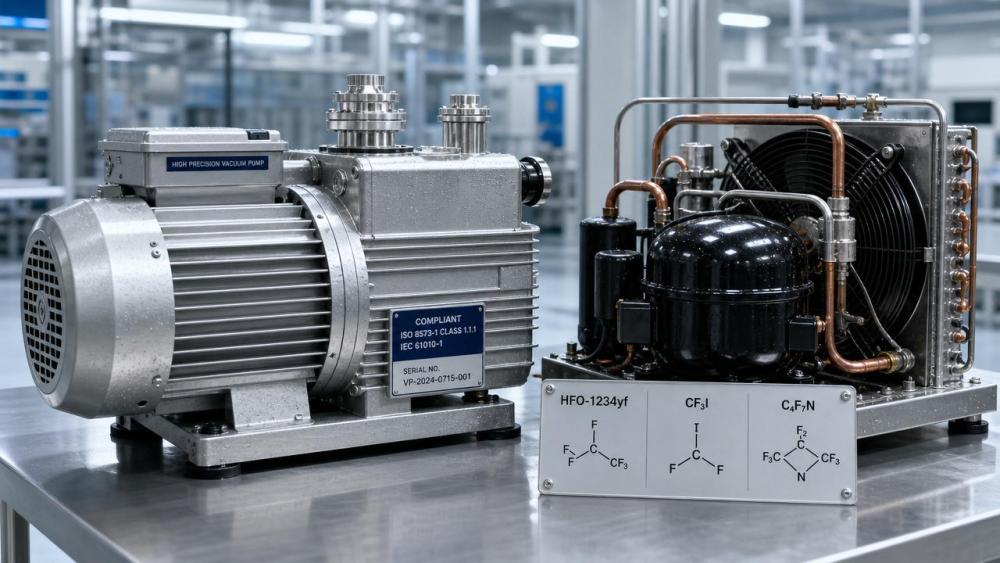
On 28 May 2026, the European Chemicals Agency (ECHA) officially amended Annex XVII of the EU REACH Regulation, introducing new restrictions on three fluorinated alternatives—HFO-1234yf derivatives, CF₃I-based flame retardants, and C₄F₇N mixtures. The measures directly impact manufacturers and exporters of high-vacuum pumps, liquid-ring vacuum systems, and industrial refrigerant cycle components.
Regulatory Update: Key Facts Confirmed
The ECHA published the updated REACH Annex XVII on 28 May 2026. It imposes restrictions on the use and import of HFO-1234yf derivatives, CF₃I-based flame retardants, and C₄F₇N mixtures specifically in high-vacuum pumps, liquid-ring vacuum systems, and industrial cold media circulation components. Enforcement begins on 1 November 2026. Affected exporters must submit SVHC notifications and complete technical documentation filing prior to that date.
Supply Chain Impact Across Roles
Direct Exporters
These entities face immediate customs clearance risks post–1 November 2026 if products contain restricted substances above threshold levels. Compliance verification—including substance concentration checks and declaration alignment with EU importer obligations—must be integrated into pre-shipment workflows.
Raw Material Suppliers
Suppliers of fluorinated intermediates or functional additives must now provide updated safety data sheets (SDS), full composition disclosures, and REACH-compliant declarations. Traceability from batch-level synthesis to final formulation becomes critical for downstream compliance validation.
Component Manufacturers
Producers of vacuum pumps and refrigerant-cycle hardware must reassess material specifications, especially for seals, lubricants, and thermal interface materials where fluorinated compounds may be present as unintended impurities or performance enhancers. Requalification testing under revised substance limits is likely required.
Supply Chain Service Providers
Logistics partners, conformity assessment bodies, and technical documentation agents must adapt reporting templates and verification protocols to include SVHC screening, Annex XVII restriction mapping, and evidence of technical file submission—not just CE marking or RoHS declarations.
Priority Actions for Exporting Enterprises
SVHC Notification & Technical File Submission
Exporters placing articles containing any of the newly restricted substances above 0.1% w/w on the EU market must notify ECHA via the SCIP database and prepare comprehensive technical dossiers—including substance identity, usage conditions, exposure scenarios, and risk management measures—by 31 October 2026.
Material Composition Review & Supplier Engagement
Manufacturers should conduct full bill-of-materials (BOM) audits, prioritising components with fluorinated polymers, coatings, or refrigerant blends. Direct engagement with Tier-2 and Tier-3 suppliers is essential to obtain updated substance declarations and analytical test reports.
Technical Specification Alignment
Engineering teams must revise product datasheets, tender responses, and OEM technical agreements to explicitly exclude the three restricted substance categories—and confirm compatibility with alternative chemistries such as hydrocarbons, ammonia, or non-fluorinated perfluoropolyethers (PFPEs) where functionally viable.
Industry Perspective: Beyond Compliance
Analysis shows this amendment reflects a broader regulatory shift—from targeting legacy PFAS toward controlling next-generation fluorinated substitutes with emerging environmental persistence concerns. Observably, the six-month implementation window (May–November 2026) compresses typical supply chain requalification cycles, particularly for custom-engineered vacuum systems requiring long-lead-time materials. It is more appropriate to understand this as both a regulatory tightening and a de facto technology gatekeeping mechanism, accelerating demand for fluorine-free alternatives and intensifying scrutiny on upstream chemical transparency.
Strategic Implications for Global Manufacturers
This update signals that REACH compliance is no longer limited to static substance lists but increasingly encompasses dynamic substitution pathways and life-cycle chemical stewardship. For vacuum and refrigeration equipment makers, proactive substitution planning—coupled with robust supplier qualification and technical documentation infrastructure—is becoming a core competitive capability, not merely a trade barrier to overcome.
Source Information & Verification Notes
This article is generated exclusively from the provided title, event date (28 May 2026), and summary. Specific official source links were not provided in the input and should be verified continuously. Stakeholders are advised to monitor upcoming ECHA guidance documents, national enforcement interpretations, procurement specification updates from major EU industrial buyers, and technical clarifications from notified bodies regarding SVHC notification scope and C₄F₇N mixture classification thresholds.
Ready when you are. Send us a message to get started.
Related News
- How corrugation angle affects heat transfer in plate heat exchangersAuthor :Thermodynamics Analyst

- R22 Prices Retreat as China's Refrigerant Market Faces Tight Quotas and Soft DemandAuthor :Cryogenic Systems Expert

- How to select industrial equipment for automation with existing PLCsAuthor :

- Carrier Plans $600 Million Manufacturing and Engineering Center in Fort WorthAuthor :

- How electricity prices shape industrial compressed air price trendsAuthor :

- Chemours Faces Investor Lawsuit Over Opteon Refrigerant Sales ForecastsAuthor :Cryogenic Systems Expert

- Choosing air filtration systems for heavy dust in the Middle EastAuthor :

- LG Expands R290 Monobloc Heat Pump Range with New 12–16 kW ModelsAuthor :Cryogenic Systems Expert

- How to size a chiller for pharmaceutical cleanroom temperature controlAuthor :Cryogenic Systems Expert

- Kentucky Regulators Approve $191 Million Cooling Tower at Mitchell Coal PlantAuthor :Thermodynamics Analyst

- How much does a fully installed compressed air monitoring system cost?Author :

- What documentation supports CE marking for industrial equipment?Author :

- When do plate heat exchangers suit Middle East seawater cooling?Author :Thermodynamics Analyst

- EU Issues Updated Guidance on Industrial Refrigeration Efficiency and F-gas AlternativesAuthor :Cryogenic Systems Expert

- How does base pressure affect film purity in vacuum deposition?Author :Vacuum Process Fellow

- Do U.S. refrigerant regulations require replacing R-410A systems?Author :Cryogenic Systems Expert

- When does variable gas flow justify a custom screw compressor system?Author :Pneumatic Power Engineer

- How local support affects vacuum system costs in Southeast AsiaAuthor :

- How worldwide industry category guides help compare market opportunitiesAuthor :

- How to verify food-grade purity in compressed air systemsAuthor :Pneumatic Power Engineer

- When high-pressure waste heat recovery boilers make economic senseAuthor :Thermal Energy Strategist

- How to size compressed air equipment for pneumatic toolsAuthor :Pneumatic Power Engineer

- How to size vacuum process equipment for the required pump-down timeAuthor :Vacuum Process Fellow

- What determines the price of pure air compression systems?Author :Pneumatic Power Engineer

- How steam generation efficiency shapes thermal power system designAuthor :Thermal Energy Strategist

- What drives sustainable thermal systems cost over their operating life?Author :

- Which vacuum specification best protects semiconductor process yield?Author :Vacuum Process Fellow

- When do smart thermal systems with sensors reduce chiller energy use?Author :Cryogenic Systems Expert

- When does gasketed plate heat exchanger technology suit your process?Author :Thermodynamics Analyst

- How to size oil-free compressors for instrumentation air demandAuthor :Pneumatic Power Engineer

- How Class 0 oil-free compressors protect product quality in food productionAuthor :Pneumatic Power Engineer

- Which industrial solution comparison criteria prevent project delays?Author :

- Chiller Optimization Checklist for Rising Energy Use and Unstable Cooling OutputAuthor :Cryogenic Systems Expert

- How to Specify a High-Precision Temperature Chiller for Tight-Tolerance ProcessesAuthor :Cryogenic Systems Expert

- Designing Energy-Efficient Industrial Cooling for Variable Process LoadsAuthor :Cryogenic Systems Expert

- Low-GWP Cooling Solutions for Process Plants: Comparing Safety, Efficiency, and CostAuthor :Cryogenic Systems Expert