EU F-Gas Regulation Update Takes Effect June 1, 2026




Starting June 1, 2026, the revised EU F-Gas Regulation enters into full force, restricting imports of new industrial refrigeration equipment containing fluorinated greenhouse gases (F-gases) with a global warming potential (GWP) of 2500 or higher — including R404A and R507. This development directly affects manufacturers and exporters of industrial chillers, cold storage systems, and screw compressors supplying the EU market, particularly those based in China. The regulation signals a tightening compliance threshold for refrigerant-related product certification and environmental documentation.
Event Overview
The European Commission has officially announced that the updated F-Gas Regulation will apply from June 1, 2026. Under the revised rules, the import of new industrial refrigeration equipment charged with refrigerants having GWP ≥ 2500 is prohibited. Covered equipment includes condensing units, industrial chillers, and ultra-low-temperature compressor systems. Affected products must be accompanied by an Environmental Product Declaration (EPD) and verified refrigerant charge documentation.
Industries Affected
Export-oriented manufacturing enterprises
Manufacturers producing industrial chillers, cold storage units, and screw compressor systems for export to the EU face immediate compliance requirements. Non-compliant units cannot enter the EU market after June 1, 2026. Impact manifests in production planning, technical specifications, and pre-shipment documentation — especially EPD preparation and refrigerant charge verification.
Supply chain and logistics service providers
Third-party logistics firms, customs brokers, and certification support services handling EU-bound refrigeration equipment must now verify refrigerant type, GWP value, and supporting documentation prior to shipment. Delays or rejections may occur if EPDs or charge certifications are missing or incomplete.
Component and refrigerant procurement teams
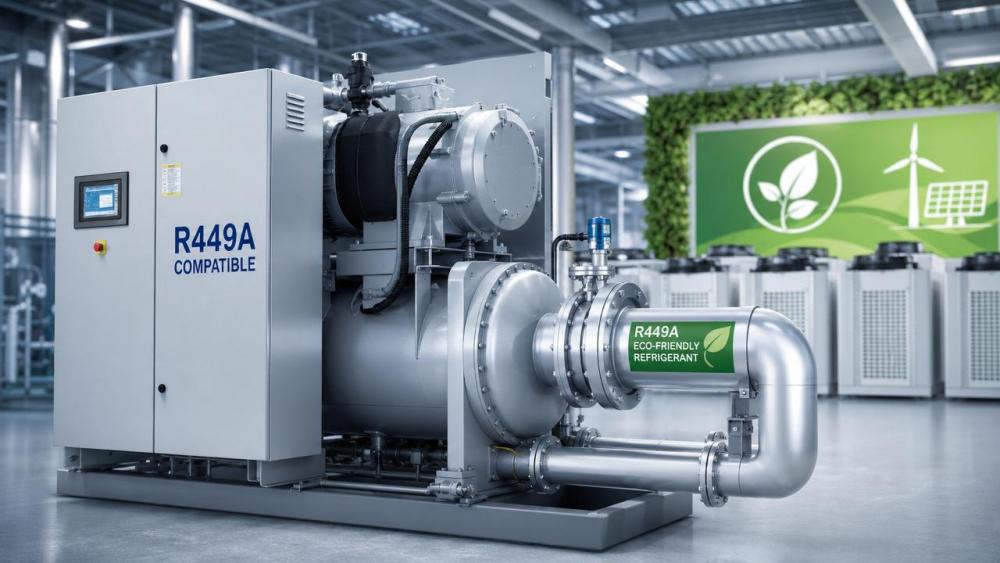
Procurement units sourcing refrigerants or refrigerant-charged subassemblies must ensure suppliers provide traceable, GWP-compliant alternatives (e.g., R448A, R449A, or natural refrigerants). Use of legacy high-GWP refrigerants in final assembly — even if sourced separately — may invalidate full-system compliance.
Key Actions for Enterprises and Practitioners
Monitor official guidance and enforcement timelines
While the regulation takes effect on June 1, 2026, implementation details — such as accepted EPD formats, verification bodies, and transitional provisions for pending shipments — remain subject to updates from the European Commission and national competent authorities. Enterprises should track official notices via the EU’s F-Gas Portal and national environmental agencies.
Review product portfolios by refrigerant type and application
Identify all models currently using R404A or R507 — especially industrial chillers and ultra-low-temperature compressors — and assess whether redesign, retrofit, or substitution is feasible before the deadline. Prioritize models with highest EU export volume or longest lead time for certification.
Distinguish between regulatory signal and operational readiness
Analysis shows this restriction targets only new equipment imports; it does not retroactively ban operation or maintenance of existing units in the EU. However, servicing may require certified low-GWP refrigerants, affecting spare parts and after-sales logistics.
Prepare documentation and cross-functional alignment early
EPD generation requires life-cycle assessment (LCA) data, often coordinated across R&D, procurement, and sustainability teams. Start internal alignment now: confirm data ownership, select LCA software or external providers, and validate refrigerant charge records against actual production batches.
Editorial Perspective / Industry Observation
Observably, this update functions less as a sudden policy shift and more as a scheduled escalation within the EU’s phased F-gas phase-down framework. It reflects a maturing regulatory environment where environmental performance is increasingly embedded in market access criteria — not just emissions reporting. From an industry perspective, the requirement for EPDs marks a transition toward lifecycle transparency as a baseline trade condition. Current attention should focus less on whether the rule applies, and more on how quickly companies can align technical, documentation, and supply chain processes to meet verifiable thresholds — rather than relying on generic declarations or vendor assurances.
Conclusion: The June 1, 2026 F-Gas restriction is not an isolated compliance checkpoint but a structural inflection point for export-oriented refrigeration manufacturers. It underscores that refrigerant choice, documentation rigor, and environmental accountability are now inseparable from product design and international market access. Enterprises are advised to treat this as a process-driven adaptation — not a one-time filing task — and to interpret the regulation as a signal of broader regulatory convergence around climate-aligned product standards.
Source: European Commission Official Announcement (F-Gas Regulation (EU) No 517/2014, as amended); Implementation timeline confirmed in Commission Delegated Regulation (EU) 2023/XXX (pending official publication number).
Note: Exact delegated regulation number and EPD format specifications remain under final review; ongoing monitoring is recommended.
Ready when you are. Send us a message to get started.
Related News
- How corrugation angle affects heat transfer in plate heat exchangersAuthor :Thermodynamics Analyst

- R22 Prices Retreat as China's Refrigerant Market Faces Tight Quotas and Soft DemandAuthor :Cryogenic Systems Expert

- How to select industrial equipment for automation with existing PLCsAuthor :

- Carrier Plans $600 Million Manufacturing and Engineering Center in Fort WorthAuthor :

- How electricity prices shape industrial compressed air price trendsAuthor :

- Chemours Faces Investor Lawsuit Over Opteon Refrigerant Sales ForecastsAuthor :Cryogenic Systems Expert

- Choosing air filtration systems for heavy dust in the Middle EastAuthor :

- LG Expands R290 Monobloc Heat Pump Range with New 12–16 kW ModelsAuthor :Cryogenic Systems Expert

- How to size a chiller for pharmaceutical cleanroom temperature controlAuthor :Cryogenic Systems Expert

- Kentucky Regulators Approve $191 Million Cooling Tower at Mitchell Coal PlantAuthor :Thermodynamics Analyst

- How much does a fully installed compressed air monitoring system cost?Author :

- What documentation supports CE marking for industrial equipment?Author :

- When do plate heat exchangers suit Middle East seawater cooling?Author :Thermodynamics Analyst

- EU Issues Updated Guidance on Industrial Refrigeration Efficiency and F-gas AlternativesAuthor :Cryogenic Systems Expert

- How does base pressure affect film purity in vacuum deposition?Author :Vacuum Process Fellow

- Do U.S. refrigerant regulations require replacing R-410A systems?Author :Cryogenic Systems Expert

- When does variable gas flow justify a custom screw compressor system?Author :Pneumatic Power Engineer

- How local support affects vacuum system costs in Southeast AsiaAuthor :

- How worldwide industry category guides help compare market opportunitiesAuthor :

- How to verify food-grade purity in compressed air systemsAuthor :Pneumatic Power Engineer

- When high-pressure waste heat recovery boilers make economic senseAuthor :Thermal Energy Strategist

- How to size compressed air equipment for pneumatic toolsAuthor :Pneumatic Power Engineer

- How to size vacuum process equipment for the required pump-down timeAuthor :Vacuum Process Fellow

- What determines the price of pure air compression systems?Author :Pneumatic Power Engineer

- How steam generation efficiency shapes thermal power system designAuthor :Thermal Energy Strategist

- What drives sustainable thermal systems cost over their operating life?Author :

- Which vacuum specification best protects semiconductor process yield?Author :Vacuum Process Fellow

- When do smart thermal systems with sensors reduce chiller energy use?Author :Cryogenic Systems Expert

- When does gasketed plate heat exchanger technology suit your process?Author :Thermodynamics Analyst

- How to size oil-free compressors for instrumentation air demandAuthor :Pneumatic Power Engineer

- How Class 0 oil-free compressors protect product quality in food productionAuthor :Pneumatic Power Engineer

- Which industrial solution comparison criteria prevent project delays?Author :

- Chiller Optimization Checklist for Rising Energy Use and Unstable Cooling OutputAuthor :Cryogenic Systems Expert

- How to Specify a High-Precision Temperature Chiller for Tight-Tolerance ProcessesAuthor :Cryogenic Systems Expert

- Designing Energy-Efficient Industrial Cooling for Variable Process LoadsAuthor :Cryogenic Systems Expert

- Low-GWP Cooling Solutions for Process Plants: Comparing Safety, Efficiency, and CostAuthor :Cryogenic Systems Expert