R32 Surge Adds 12% to Chiller Export Costs




On June 22, 2026, industry monitoring showed R32 refrigerant prices moving above CNY 65,000 per ton after mainstream quotations had already reached CNY 63,000 per ton in mid-June, marking a ten-year high. For the industrial cooling equipment trade, this is not only a price story but also a signal that quota-constrained compliant supply is tightening in a way that can directly affect export costing, quotation discipline, delivery planning, and customer budget reviews for industrial chillers and condensing units.
Tighter quota conditions are now visible in market pricing
Confirmed information indicates that mainstream R32 quotations reached CNY 63,000 per ton in mid-June 2026 and exceeded CNY 65,000 per ton by June 22.
The event summary states that the national quota ceiling is fixed at 797,800 tons. It also states that output control by major producers, together with simultaneous demand from new energy vehicles, cold chain applications, and the seasonal air-conditioning market, has kept compliant supply tight.
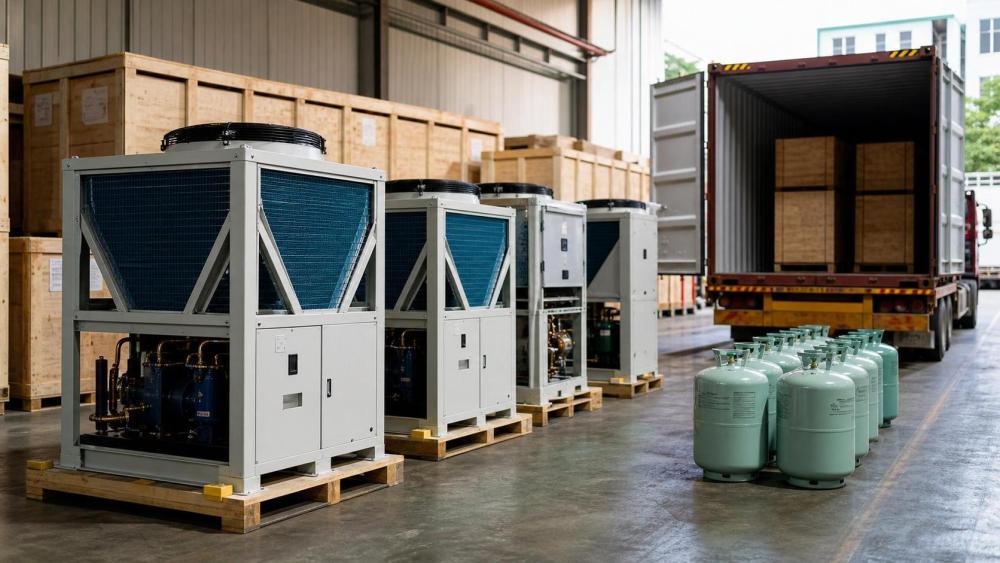
The same summary further confirms that the increase has directly raised the BOM cost and end-market quotations of export products such as industrial chillers and condensing units, while affecting overseas buyers' procurement budgets and delivery assessments.
Where the pressure is likely to appear first in cross-border business
Export quotations face narrower room for adjustment
From an industry perspective, exporters of industrial chillers and related cooling equipment are likely to feel the impact first because refrigerant cost changes feed directly into BOM calculations and final offers. What deserves closer attention is whether existing quotations, bid validity periods, and delivery commitments still match current input costs when compliant R32 supply remains tight.
Procurement teams need to focus on compliant sourcing
For raw material and component procurement teams, the issue is not only price escalation but also the availability of compliant goods under a fixed quota environment. Analysis shows that supplier qualification review, purchase timing, and documentation consistency become more sensitive when compliant cargo is described as continuously tight.
Overseas buyers may reassess budgets and lead times
Buyers and project procurement teams on the overseas side may be affected through revised equipment pricing and changed delivery expectations. In practical terms, this can influence internal budget approval, purchase sequencing, and acceptance of quotation adjustments, especially for products where refrigerant-related cost is a visible share of the export offer.
Supply-chain service providers may see more schedule coordination risk
Supply-chain and delivery coordination parties may need to pay closer attention to order locking, shipment timing, and document alignment if upstream supply remains constrained. Observably, tighter compliant supply can increase the need for clearer confirmation on material readiness before exporters finalize dispatch commitments.
What companies should review now
Check whether technical and compliance files still align with current supply plans
Analysis shows that exporters and manufacturers should review whether procurement files, technical documentation, and product-related records remain consistent with the refrigerant supply route actually being used. This is especially relevant where compliant sourcing conditions may influence order execution.
Revisit quotation validity and delivery wording
What deserves closer attention is whether sales contracts, bid documents, and external quotations need clearer wording on validity periods, price adjustment boundaries, or delivery assumptions. The input does not provide detailed execution rules, so this should be understood as a practical review point rather than a confirmed change in formal trade requirements.
Watch customer-side approval and tender feedback
For export-oriented businesses, customer procurement behavior may shift before any broader rule clarification appears in writing. Observably, changes in budget review, bid comparison, or project timing can emerge as an early market response when BOM and terminal quotations rise.
Track follow-up signals instead of assuming immediate stabilization
It is more appropriate to understand the current development as an active execution signal from the supply side rather than a completed adjustment cycle. Companies should continue monitoring official wording, market implementation, and any changes reflected in tender documents, compliance checks, or delivery negotiations.
Why this matters beyond a single price spike
Analysis shows that the significance of this event lies in the interaction between quota limits and compliant supply availability. The immediate issue is cost, but the broader industry relevance is that procurement, export pricing, and delivery decisions are now being shaped by a tighter rule-bound supply environment rather than by demand alone.
Observably, this makes the development more useful as an execution-level signal than as a stand-alone commodity price headline. The industry therefore has reason to keep watching how market participants translate this pressure into quotation policies, sourcing behavior, and customer communication.
A practical reading of the current development
The current event is best read as a confirmed market change with compliance and trade implications already reaching equipment exporters, rather than as a fully settled industry outcome. Based on the provided information, the most rational conclusion is that companies involved in industrial chillers, condensing units, procurement, and export delivery should treat R32 supply tightness as an immediate operating factor while continuing to watch how execution practices evolve.
Basis of this article and points still requiring verification
This article is generated from the user-provided news title, event date, and event summary. For events of this type, commonly relevant source categories may include official announcements, regulatory releases, customs or trade authority information, industry association updates, standards documents, and reporting by established professional media.
No specific official source link was provided in the input, so further verification is still required. What still needs continued observation includes any later official clarification, compliance interpretation, tender document adjustments, market feedback, and how companies implement procurement and delivery decisions in response to the tighter R32 supply situation.
Related News
- How to Compare Semiconductor Cooling Solutions by Heat Load and Uptime RiskAuthor :Cryogenic Systems Expert

- EU Label Deadline Hits China Chiller ExportsAuthor :Cryogenic Systems Expert

- How Smart Thermal Systems Improve Industrial Cooling EfficiencyAuthor :Cryogenic Systems Expert

- How to Choose Process Cooling Equipment for Stable Temperature ControlAuthor :Cryogenic Systems Expert

- EU Finalizes 2026 HFC Quota Cut for R-134a ChillersAuthor :Cryogenic Systems Expert

- EU Tightens HFC-134a Quotas for Industrial ChillersAuthor :Cryogenic Systems Expert

- REACH SVHC Update Pressures HFC-134a Chiller Supply ChainsAuthor :Cryogenic Systems Expert

- EU PFAS Coolant Ban Reshapes Chiller ExportsAuthor :Cryogenic Systems Expert

- EU REACH Restricts PFAS Cooling Media ImportsAuthor :Cryogenic Systems Expert

- EU Ecodesign Rule Takes Effect for Industrial ChillersAuthor :Cryogenic Systems Expert

- EU REACH Rule Takes Effect for PFAS in Industrial Cooling ExportsAuthor :Cryogenic Systems Expert

- Industrial Cooling for Plastic Processing: How to Size for Stable Cycle TimesAuthor :Cryogenic Systems Expert

- EU F-Gas Update Bars R404A/R507 in Commercial CoolingAuthor :Cryogenic Systems Expert

- DOE Raises Chiller Efficiency Standard From October 2026Author :Cryogenic Systems Expert

- India Mandates BIS Energy Certification for Industrial ChillersAuthor :Cryogenic Systems Expert

- Energy-Efficient Heat Exchange for Process Cooling: Cost vs PaybackAuthor :Cryogenic Systems Expert

- EPA R-134a Import Ban Takes Effect on July 13, 2026Author :Cryogenic Systems Expert

- India BIS Rule Takes Effect for Industrial ChillersAuthor :Cryogenic Systems Expert

- EPA Cuts R134a Import Quotas 20% From July 10Author :Cryogenic Systems Expert

- How to Compare Energy-Efficient Cooling Systems for Factory Expansion ProjectsAuthor :Cryogenic Systems Expert

- Chiller Price Index Rises 11.3% in Q2Author :Cryogenic Systems Expert

- Saudi SASO Tightens Chiller Import Compliance From July 10Author :Cryogenic Systems Expert

- Dubai Opens Fast-Track Chiller TendersAuthor :Cryogenic Systems Expert

- Japan Raises Chiller COP Floor to 6.2 From Sept. 1Author :Cryogenic Systems Expert
![]()
- Compact Thermal Management in Smart Devices: Common Failure RisksAuthor :Cryogenic Systems Expert

- Thermal Management for Batteries: Cooling Methods ComparedAuthor :Cryogenic Systems Expert

- How Compact Thermal Design Extends Smart Device UptimeAuthor :Cryogenic Systems Expert

- Shanghai-Rotterdam Reefer Rates Jump 37% in a WeekAuthor :Cryogenic Systems Expert

- Process Cooling Equipment Low Maintenance: What Cuts Downtime Over 5 Years?Author :Cryogenic Systems Expert

- Semiconductor Cooling Solutions: Which Design Works Best for High-Density Tools?Author :Cryogenic Systems Expert

- Semiconductor Thermal Management Systems: Preventing Yield Loss from Heat DriftAuthor :Cryogenic Systems Expert

- EPA Clears R-1234ze(E) for Industrial ChillersAuthor :Cryogenic Systems Expert
 for Industrial Chillers")
- DOE Raises Chiller IEER Floor to 12.8 From Oct. 2026Author :Cryogenic Systems Expert

- Singapore Refrigeration Show Adds Green Compliance HubAuthor :Cryogenic Systems Expert

- How Food Industry Temperature Control Systems Reduce Product LossAuthor :Cryogenic Systems Expert

- EU REACH Adds 12 SVHCs, Raising Chiller Compliance RiskAuthor :Cryogenic Systems Expert