Thermal Management for Batteries: Cooling Methods Compared




Thermal Management for Batteries: Cooling Methods Compared
Thermal management for batteries has moved from a design detail to a core project decision.
For energy storage, EV platforms, telecom backup, and industrial mobility, heat now drives both technical risk and commercial outcome.
That shift is easy to explain.
Higher energy density improves runtime and footprint, but it also makes thermal behavior less forgiving.
A weak cooling choice can shorten battery life, reduce charging speed, trigger imbalance, and raise safety exposure.
A better thermal management for batteries strategy does the opposite.
It protects temperature uniformity, keeps performance stable, and lowers total lifecycle cost.
This matters even more when battery systems operate under variable loads, harsh climates, or tight space constraints.
In practical selection work, the question is not which method is most advanced.
The real question is which cooling method fits the project profile with the fewest tradeoff surprises.
That is where a structured comparison becomes useful.
What Thermal Management for Batteries Must Actually Deliver
Before comparing hardware, define what success looks like.
Thermal management for batteries is not only about lowering peak temperature.
It must also control temperature spread between cells, modules, and racks.
Even moderate hotspots can accelerate aging if neighboring cells stay cooler.
That imbalance creates uneven capacity fade and makes battery management systems work harder.
A sound battery cooling method should support five outcomes:
- Stable operating temperature across full duty cycles
- Low cell-to-cell temperature variation
- Fast heat removal during charging and peak discharge
- Reasonable energy use from pumps, fans, or chillers
- Maintainability over years of field operation
From recent market shifts, another signal is becoming clearer.
Cooling systems are now judged against project bankability, warranty exposure, and service complexity.
That means thermal management for batteries must be evaluated as a full system decision, not a component purchase.
Air Cooling: Simple, Familiar, and Still Useful
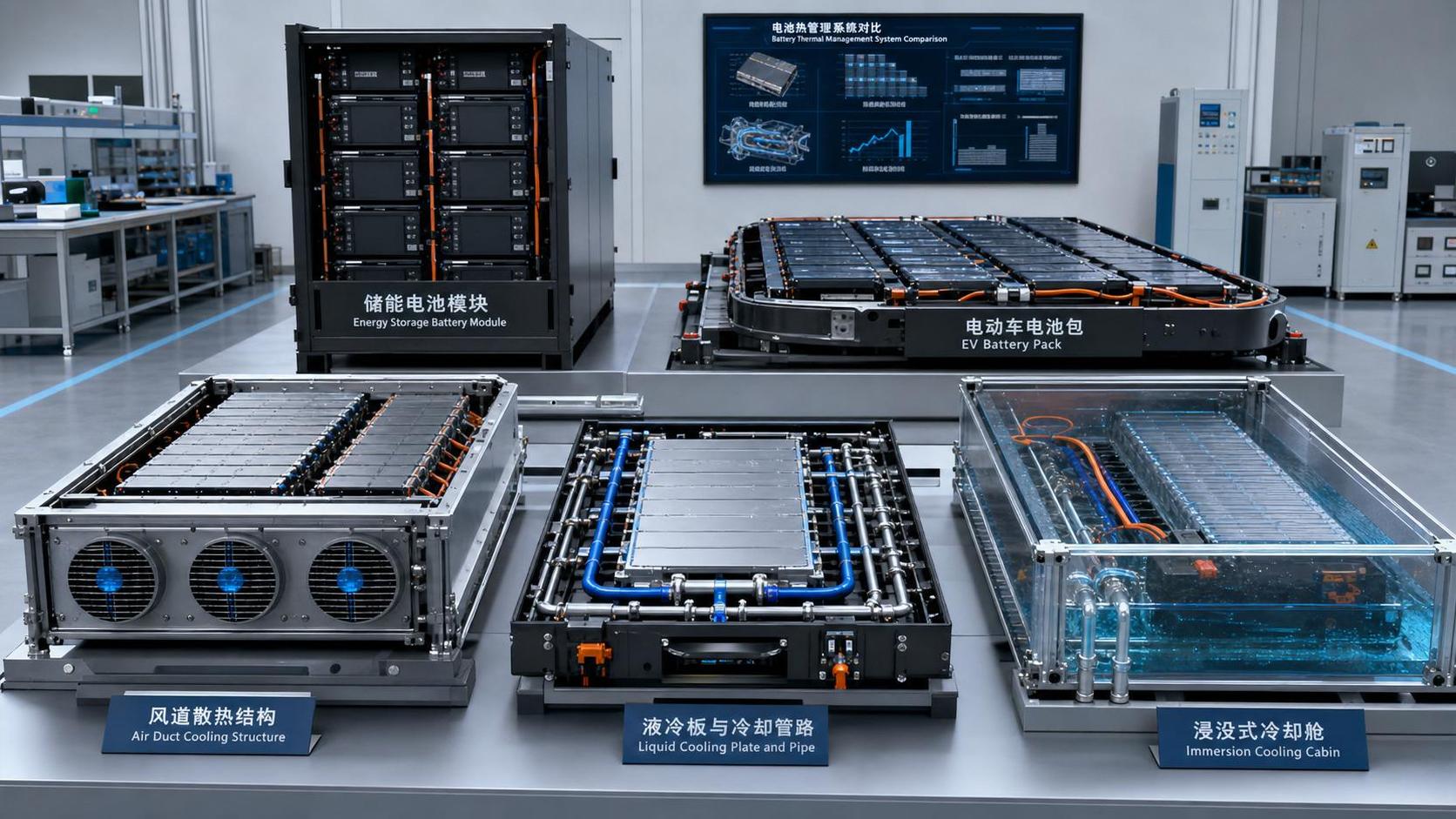
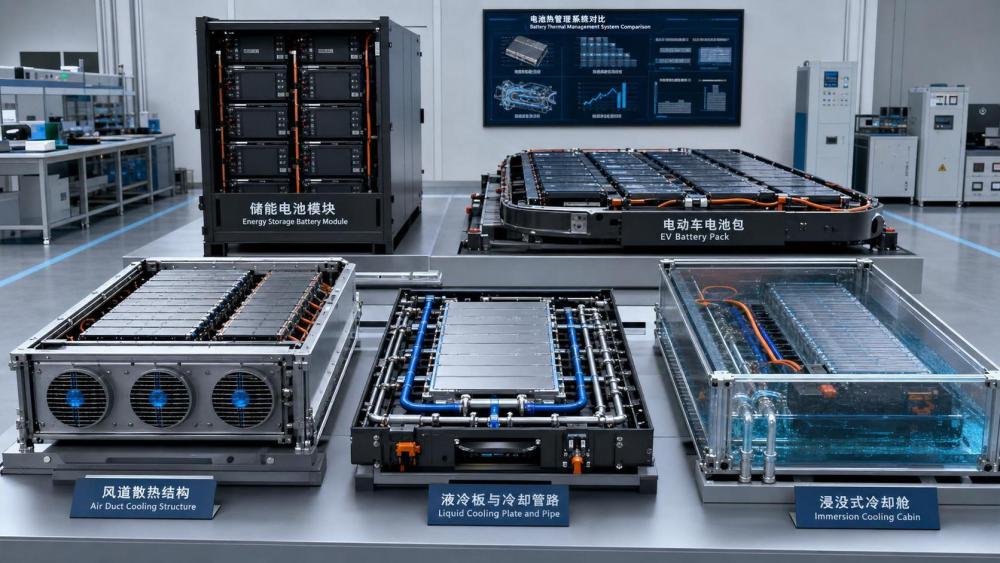
Air cooling remains the most straightforward battery thermal management option.
It uses fans, ducts, vents, and enclosure design to move heat away from cells.
Its main advantage is obvious.
Air systems are usually lower in upfront cost, lighter in weight, and easier to install.
They also avoid liquid leakage concerns and reduce integration complexity.
This method fits projects such as:
- Low to medium power storage systems
- Moderate ambient temperature environments
- Installations with relaxed packaging density
- Projects prioritizing low capital expenditure
Still, air cooling reaches its limits quickly.
Air has low heat capacity compared with liquid.
As battery packs become denser, airflow paths get harder to optimize.
The result can be uneven cooling, noise, dust buildup, and reduced thermal control under peak conditions.
For projects facing frequent fast charging or high cycle rates, air cooling may create a long-term bottleneck.
Liquid Cooling: The Mainstream Choice for High-Demand Systems
Liquid cooling has become the preferred thermal management for batteries in demanding applications.
The reason is straightforward.
Liquid transfers heat far more effectively than air, especially in compact battery architectures.
Typical designs use cold plates, coolant channels, pumps, valves, and heat exchangers.
Some systems also connect to chillers or broader thermal loops.
Its advantages are hard to ignore:
- Better heat removal under high power loads
- Tighter temperature uniformity across modules
- Support for faster charging profiles
- Stronger performance in hot climates
- Higher design flexibility for dense battery layouts
This also explains why liquid cooling now dominates utility storage, premium EVs, and heavy-duty electric platforms.
Even so, the method brings new responsibilities.
Thermal management for batteries using liquid systems needs careful sealing, coolant selection, corrosion control, and service planning.
Parasitic power from pumps and chillers also affects efficiency calculations.
In real projects, liquid cooling usually wins when uptime, power density, and warranty stability matter more than minimal first cost.
Phase-Change and Immersion Cooling: Advanced but Not Always Necessary
Advanced battery cooling methods are gaining attention, especially phase-change materials and immersion cooling.
These approaches target extreme heat loads, compact designs, or premium performance goals.
Phase-change materials absorb heat during material transition, which helps smooth short-term temperature spikes.
That can improve transient control, but it does not remove heat forever.
Eventually, stored heat still needs to leave the system.
Immersion cooling places cells or modules in dielectric fluid for direct thermal contact.
This can deliver exceptional uniformity and strong thermal response.
But advanced solutions raise practical questions:
- Material compatibility over long operating periods
- Field service procedures and spare parts availability
- Certification and safety validation effort
- Higher initial cost and integration learning curve
For niche applications, those tradeoffs may be acceptable.
For mainstream deployment, they often require stronger justification than vendors first suggest.
In other words, the most advanced thermal management for batteries is not automatically the most bankable one.
Cooling Methods Compared for Project Selection
A side-by-side view helps turn technical debate into a selection framework.
This comparison highlights an important pattern.
Thermal management for batteries should be selected by operating profile, not by trend alone.
When heat load, climate severity, and lifecycle expectations rise together, simple systems often stop being truly economical.
A Practical Decision Framework
In actual business cases, selection improves when teams ask sharper questions early.
Use this sequence when evaluating thermal management for batteries:
- Define worst-case heat generation during charge, discharge, and ambient peaks.
- Set acceptable temperature spread, not only maximum temperature.
- Map available installation space and service access limits.
- Estimate energy use of the cooling loop across the full year.
- Test maintenance assumptions, including fluid replacement, filters, and downtime.
- Compare warranty risk and lifecycle cost, not just procurement price.
This approach usually changes the answer.
A low-cost air design may look attractive on paper, yet lose value through accelerated degradation.
A liquid system may cost more upfront, yet protect output, availability, and replacement schedules.
That is why the best battery thermal management decision usually emerges from total system economics.
Final View: Match the Cooling Method to the Risk Profile
There is no universal winner in thermal management for batteries.
Air cooling still works where heat loads stay modest and budgets stay tight.
Liquid cooling leads where performance, density, and reliability carry more weight.
Phase-change and immersion solutions deserve attention when conventional methods cannot meet the operating envelope.
The more useful decision principle is simple.
Choose the battery cooling method that manages thermal risk with the least lifecycle friction.
For teams evaluating future-ready systems, that often means looking beyond equipment specifications.
It means checking service models, climate resilience, energy consumption, and expansion plans together.
That broader view is where better project outcomes usually begin.
For complex industrial projects, the strongest thermal management for batteries choice is the one that stays reliable after commissioning, not just convincing during procurement.
Related News
- How Smart Thermal Systems Improve Industrial Cooling EfficiencyAuthor :Cryogenic Systems Expert

- How to Choose Process Cooling Equipment for Stable Temperature ControlAuthor :Cryogenic Systems Expert

- EU Finalizes 2026 HFC Quota Cut for R-134a ChillersAuthor :Cryogenic Systems Expert

- EU Tightens HFC-134a Quotas for Industrial ChillersAuthor :Cryogenic Systems Expert

- REACH SVHC Update Pressures HFC-134a Chiller Supply ChainsAuthor :Cryogenic Systems Expert

- EU PFAS Coolant Ban Reshapes Chiller ExportsAuthor :Cryogenic Systems Expert

- EU REACH Restricts PFAS Cooling Media ImportsAuthor :Cryogenic Systems Expert

- EU Ecodesign Rule Takes Effect for Industrial ChillersAuthor :Cryogenic Systems Expert

- EU REACH Rule Takes Effect for PFAS in Industrial Cooling ExportsAuthor :Cryogenic Systems Expert

- Industrial Cooling for Plastic Processing: How to Size for Stable Cycle TimesAuthor :Cryogenic Systems Expert

- EU F-Gas Update Bars R404A/R507 in Commercial CoolingAuthor :Cryogenic Systems Expert

- DOE Raises Chiller Efficiency Standard From October 2026Author :Cryogenic Systems Expert

- India Mandates BIS Energy Certification for Industrial ChillersAuthor :Cryogenic Systems Expert

- Energy-Efficient Heat Exchange for Process Cooling: Cost vs PaybackAuthor :Cryogenic Systems Expert

- EPA R-134a Import Ban Takes Effect on July 13, 2026Author :Cryogenic Systems Expert

- India BIS Rule Takes Effect for Industrial ChillersAuthor :Cryogenic Systems Expert

- EPA Cuts R134a Import Quotas 20% From July 10Author :Cryogenic Systems Expert

- How to Compare Energy-Efficient Cooling Systems for Factory Expansion ProjectsAuthor :Cryogenic Systems Expert

- Chiller Price Index Rises 11.3% in Q2Author :Cryogenic Systems Expert

- Saudi SASO Tightens Chiller Import Compliance From July 10Author :Cryogenic Systems Expert

- Dubai Opens Fast-Track Chiller TendersAuthor :Cryogenic Systems Expert

- Japan Raises Chiller COP Floor to 6.2 From Sept. 1Author :Cryogenic Systems Expert
![]()
- Compact Thermal Management in Smart Devices: Common Failure RisksAuthor :Cryogenic Systems Expert

- Thermal Management for Batteries: Cooling Methods ComparedAuthor :Cryogenic Systems Expert

- How Compact Thermal Design Extends Smart Device UptimeAuthor :Cryogenic Systems Expert

- Shanghai-Rotterdam Reefer Rates Jump 37% in a WeekAuthor :Cryogenic Systems Expert

- Process Cooling Equipment Low Maintenance: What Cuts Downtime Over 5 Years?Author :Cryogenic Systems Expert

- Semiconductor Cooling Solutions: Which Design Works Best for High-Density Tools?Author :Cryogenic Systems Expert

- Semiconductor Thermal Management Systems: Preventing Yield Loss from Heat DriftAuthor :Cryogenic Systems Expert

- EPA Clears R-1234ze(E) for Industrial ChillersAuthor :Cryogenic Systems Expert
 for Industrial Chillers")
- DOE Raises Chiller IEER Floor to 12.8 From Oct. 2026Author :Cryogenic Systems Expert

- Singapore Refrigeration Show Adds Green Compliance HubAuthor :Cryogenic Systems Expert

- How Food Industry Temperature Control Systems Reduce Product LossAuthor :Cryogenic Systems Expert

- EU REACH Adds 12 SVHCs, Raising Chiller Compliance RiskAuthor :Cryogenic Systems Expert

- Precision Temperature Control Air Cooling: Key Setup Mistakes That Reduce StabilityAuthor :Cryogenic Systems Expert

- India BEE Eyes APF Labels for Imported ChillersAuthor :Cryogenic Systems Expert