Industrial Refrigeration Costs: What Impacts ROI Most in 2026




Why does industrial refrigeration ROI look different in 2026?
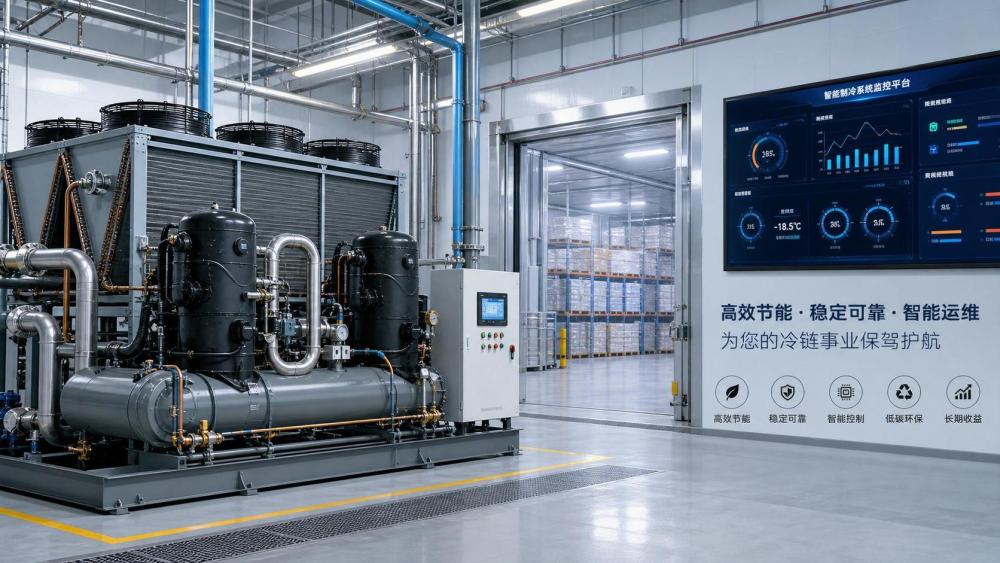
Industrial refrigeration decisions now sit at the intersection of energy, compliance, uptime, and long-term operating discipline.
That shift matters because the cheapest system on day one often becomes the most expensive asset over ten years.
In practical terms, ROI is no longer driven by equipment price alone.
Electricity volatility, refrigerant transition rules, load variation, heat rejection design, and service quality now shape capital returns more directly.
Across food processing, cold storage, pharmaceuticals, chemicals, logistics, and advanced manufacturing, that pattern keeps repeating.
A well-selected industrial refrigeration package protects production continuity, while a poorly matched system quietly erodes margins every month.
This is also why market intelligence has become part of technical evaluation.
Platforms such as GTC-Matrix track energy cost swings, refrigerant quota changes, and equipment evolution, helping investment discussions move beyond catalog comparisons.
The better question is not simply, “What does industrial refrigeration cost?”
It is, “Which cost factors will dominate returns after commissioning?”
Is equipment price still the main cost driver?
Usually, no. Equipment price is visible, but operating cost is where most industrial refrigeration budgets are won or lost.
For many facilities, energy consumption represents the largest lifecycle expense.
A system with lower first cost but poorer part-load efficiency may produce weaker ROI within the first few years.
This becomes more obvious in plants with seasonal demand, batch production, or variable ambient temperatures.
Another hidden issue is auxiliary power.
Pumps, condenser fans, defrost cycles, controls, and compressed air dependencies can materially change total industrial refrigeration costs.
More advanced controls may raise capital spending, yet they often improve suction stability, compressor staging, and fault response.
That tends to shorten the payback period when energy prices remain unstable.
A useful way to frame the decision is to compare visible and hidden costs side by side.
That table explains why industrial refrigeration procurement has become more analytical in 2026.
Which technical choices change industrial refrigeration costs the most?
Several technical decisions have an outsized effect on lifecycle economics, and most of them are set before startup.
Load profile matters more than headline capacity
A system designed around peak load alone may spend most of its life running inefficiently.
In real facilities, loads drift with production schedules, door openings, ambient conditions, and sanitation cycles.
That is why part-load efficiency often deserves more attention than peak performance figures.
Refrigerant pathway is now a financial issue
Industrial refrigeration costs increasingly depend on refrigerant strategy, not just refrigerant price.
A technically acceptable option today may create higher refill costs, retrofit exposure, or compliance pressure later.
More organizations now review GWP exposure, local safety codes, and expected service ecosystem before selection.
Heat exchanger design influences energy every day
Condensers and evaporators are not supporting actors.
Approach temperature, fouling behavior, airside design, and microchannel adoption all affect compressor workload.
Even a small improvement in heat transfer can change annual energy spend in a meaningful way.
Controls and monitoring are no longer optional extras
Without reliable controls, industrial refrigeration systems drift away from design intent.
Sensors, trending, alarms, and remote diagnostics help catch unstable suction, refrigerant loss, fouling, and sequencing problems early.
In most cases, that means better uptime and fewer emergency interventions.
How much do energy markets and refrigerant rules change the ROI picture?
Quite a lot. In 2026, external market forces are shaping internal project economics faster than many teams expected.
Electricity costs remain uneven across regions, and tariff structures can punish inefficient operation during peak periods.
That makes demand response capability and operating flexibility more valuable than before.
At the same time, environmentally preferred refrigerants are influenced by quota systems, regulatory updates, and supply chain timing.
When availability tightens, service cost and replacement planning become part of ROI, not just compliance paperwork.
This is where intelligence-led evaluation becomes useful.
GTC-Matrix regularly follows global energy shifts, refrigerant policy signals, oil-free compression trends, and heat exchange innovation.
That broader view helps decision teams understand whether a low bid today may carry policy-driven cost exposure tomorrow.
A stable industrial refrigeration investment is usually one that remains serviceable, efficient, and compliant under changing external conditions.
Where do projects most often lose value after installation?
The biggest value loss usually comes from mismatch, neglect, or weak implementation discipline rather than a single dramatic failure.
One common mistake is oversizing.
Oversized industrial refrigeration systems can short-cycle, run inefficiently at low load, and create unstable control behavior.
Another issue is treating maintenance as a reactive expense.
Deferred cleaning, poor oil management, sensor drift, and missed leak checks gradually increase energy use before anyone notices.
There is also an integration risk.
If the refrigeration system is not aligned with compressed air, ventilation, process timing, or heat recovery opportunities, efficiency potential stays trapped.
The following checklist is a practical way to spot avoidable ROI erosion early.
- Check whether design load assumptions match actual production cycles.
- Review part-load data, not only full-load efficiency values.
- Confirm refrigerant service availability over the expected asset life.
- Assess condenser and evaporator cleaning access before purchase.
- Plan spare parts, controls support, and remote monitoring from the start.
- Measure energy and uptime monthly against commissioning benchmarks.
In actual operation, disciplined follow-through often separates acceptable ROI from excellent ROI.
What is the smartest way to compare industrial refrigeration options now?
A strong comparison process combines technical fit, cost visibility, and future resilience.
Instead of asking for a single number, build a structured evaluation around operational evidence.
That means comparing projected energy use, maintenance intervals, refrigerant pathway risk, controls depth, and installation complexity together.
It also helps to distinguish between stable loads and volatile loads.
A simpler configuration may work well in predictable duty cycles.
More dynamic operations often benefit from variable capacity, better data visibility, and stronger system integration.
When evaluating proposals, these questions usually reveal the real differences:
That approach gives industrial refrigeration comparisons more depth and less guesswork.
So, what should be reviewed before approving a 2026 investment?
The most reliable decisions start with a simple principle: evaluate the system as a long-life operating platform, not a one-time purchase.
For industrial refrigeration, the best ROI usually comes from balanced design, realistic load assumptions, and future-ready refrigerant planning.
It also comes from disciplined visibility into maintenance, controls, and energy behavior after startup.
Before approval, it is worth mapping three things clearly: total installed cost, expected annual energy profile, and likely compliance exposure.
Then compare those findings against uptime needs and site-specific operating conditions.
In a market shaped by decarbonization, efficiency pressure, and tighter thermal performance expectations, that broader review reduces risk.
A practical next step is to create an internal scorecard covering load profile, refrigerant pathway, controls, maintenance readiness, and ten-year cost assumptions.
Using external intelligence sources such as GTC-Matrix can sharpen that scorecard with current signals on energy, policy, and technology direction.
That is often the difference between buying industrial refrigeration and investing in durable thermal performance.
Related News
- How to Compare Semiconductor Cooling Solutions by Heat Load and Uptime RiskAuthor :Cryogenic Systems Expert

- EU Label Deadline Hits China Chiller ExportsAuthor :Cryogenic Systems Expert

- How Smart Thermal Systems Improve Industrial Cooling EfficiencyAuthor :Cryogenic Systems Expert

- How to Choose Process Cooling Equipment for Stable Temperature ControlAuthor :Cryogenic Systems Expert

- EU Finalizes 2026 HFC Quota Cut for R-134a ChillersAuthor :Cryogenic Systems Expert

- EU Tightens HFC-134a Quotas for Industrial ChillersAuthor :Cryogenic Systems Expert

- REACH SVHC Update Pressures HFC-134a Chiller Supply ChainsAuthor :Cryogenic Systems Expert

- EU PFAS Coolant Ban Reshapes Chiller ExportsAuthor :Cryogenic Systems Expert

- EU REACH Restricts PFAS Cooling Media ImportsAuthor :Cryogenic Systems Expert

- EU Ecodesign Rule Takes Effect for Industrial ChillersAuthor :Cryogenic Systems Expert

- EU REACH Rule Takes Effect for PFAS in Industrial Cooling ExportsAuthor :Cryogenic Systems Expert

- Industrial Cooling for Plastic Processing: How to Size for Stable Cycle TimesAuthor :Cryogenic Systems Expert

- EU F-Gas Update Bars R404A/R507 in Commercial CoolingAuthor :Cryogenic Systems Expert

- DOE Raises Chiller Efficiency Standard From October 2026Author :Cryogenic Systems Expert

- India Mandates BIS Energy Certification for Industrial ChillersAuthor :Cryogenic Systems Expert

- Energy-Efficient Heat Exchange for Process Cooling: Cost vs PaybackAuthor :Cryogenic Systems Expert

- EPA R-134a Import Ban Takes Effect on July 13, 2026Author :Cryogenic Systems Expert

- India BIS Rule Takes Effect for Industrial ChillersAuthor :Cryogenic Systems Expert

- EPA Cuts R134a Import Quotas 20% From July 10Author :Cryogenic Systems Expert

- How to Compare Energy-Efficient Cooling Systems for Factory Expansion ProjectsAuthor :Cryogenic Systems Expert

- Chiller Price Index Rises 11.3% in Q2Author :Cryogenic Systems Expert

- Saudi SASO Tightens Chiller Import Compliance From July 10Author :Cryogenic Systems Expert

- Dubai Opens Fast-Track Chiller TendersAuthor :Cryogenic Systems Expert

- Japan Raises Chiller COP Floor to 6.2 From Sept. 1Author :Cryogenic Systems Expert
![]()
- Compact Thermal Management in Smart Devices: Common Failure RisksAuthor :Cryogenic Systems Expert

- Thermal Management for Batteries: Cooling Methods ComparedAuthor :Cryogenic Systems Expert

- How Compact Thermal Design Extends Smart Device UptimeAuthor :Cryogenic Systems Expert

- Shanghai-Rotterdam Reefer Rates Jump 37% in a WeekAuthor :Cryogenic Systems Expert

- Process Cooling Equipment Low Maintenance: What Cuts Downtime Over 5 Years?Author :Cryogenic Systems Expert

- Semiconductor Cooling Solutions: Which Design Works Best for High-Density Tools?Author :Cryogenic Systems Expert

- Semiconductor Thermal Management Systems: Preventing Yield Loss from Heat DriftAuthor :Cryogenic Systems Expert

- EPA Clears R-1234ze(E) for Industrial ChillersAuthor :Cryogenic Systems Expert
 for Industrial Chillers")
- DOE Raises Chiller IEER Floor to 12.8 From Oct. 2026Author :Cryogenic Systems Expert

- Singapore Refrigeration Show Adds Green Compliance HubAuthor :Cryogenic Systems Expert

- How Food Industry Temperature Control Systems Reduce Product LossAuthor :Cryogenic Systems Expert

- EU REACH Adds 12 SVHCs, Raising Chiller Compliance RiskAuthor :Cryogenic Systems Expert