US EPA Extends R-1234ze(E) Exemption for Industrial Chillers to End of 2027




On May 3, 2026, the U.S. Environmental Protection Agency (EPA) announced an extension of the exemption period for R-1234ze(E) in commercial industrial chillers — a regulatory adjustment directly affecting refrigerant transition timelines, manufacturing planning, and supply chain coordination across North American and global HVAC&R markets.
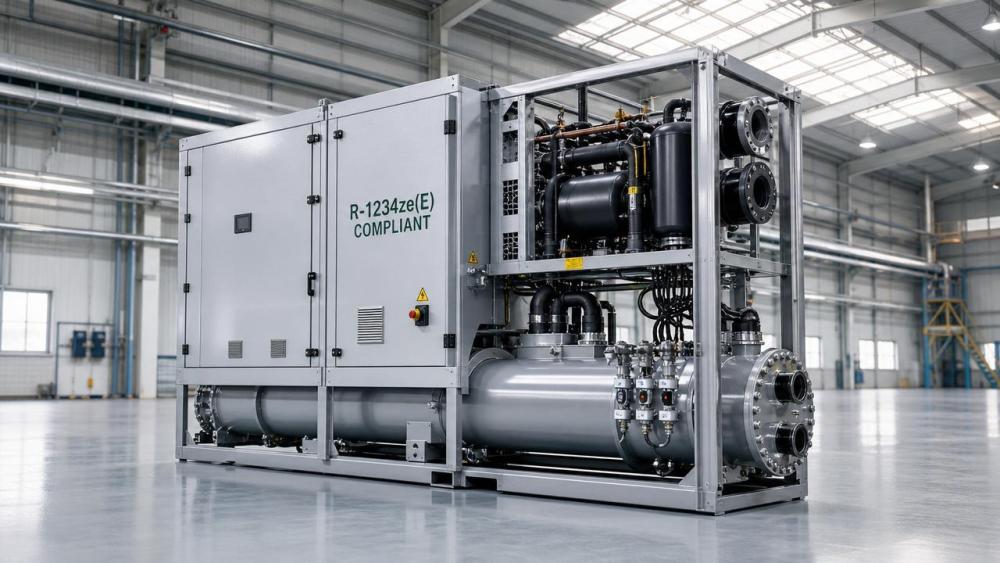
EPA’s Official Exemption Extension
The U.S. Environmental Protection Agency formally extended the use exemption for R-1234ze(E) in industrial chillers through December 31, 2027. This decision follows the originally scheduled phaseout of R-134a in Q3 2026 and provides manufacturers additional time to manage the technical and financial challenges associated with transitioning to ultra-low-GWP alternatives such as R-1233zd(E). Under the updated guidance, equipment producers may continue leveraging existing R-1234ze(E)-compatible platforms without immediate retooling or redesign.
Impact Across Supply Chain Roles
Export-oriented equipment manufacturers
Manufacturers exporting industrial chillers to the U.S. market benefit from extended compliance flexibility. The delay reduces pressure to accelerate GWP
Refrigerant procurement specialists
Procurement teams sourcing R-1234ze(E) face stabilized near-term demand but must monitor evolving EPA reporting requirements and potential restrictions on bulk supply volumes post-2027. Long-term contracts signed before mid-2026 may now require renegotiation clauses addressing future GWP
Chiller system integrators and OEMs
OEMs relying on R-1234ze(E)-based platform architectures gain breathing room to defer capital expenditures on new test benches, safety certifications, and material compatibility validation for next-generation refrigerants. Yet, engineering roadmaps must still allocate resources for parallel development of R-1233zd(E) or other GWP
After-sales and service providers
Service networks must maintain dual-refrigerant competency — supporting both legacy R-134a systems (through Q3 2026) and R-1234ze(E) units (through end-2027), while preparing technician training and recovery equipment upgrades for emerging low-GWP chemistries. Warranty claim handling and spare parts inventory planning will also reflect this phased transition.
Key Compliance & Operational Priorities for Firms
Update SNAP eligibility documentation and labeling
All chiller models using R-1234ze(E) must have current EPA SNAP listing status reflected in technical datasheets, nameplates, and customs declarations. Manufacturers should verify that exemption language in product manuals explicitly references the revised 2027 deadline.
Review and adjust refrigerant supply agreements
Contracts with refrigerant suppliers should incorporate milestone-based review triggers tied to EPA’s 2027 cutoff and anticipated 2028 GWP
Align technical specifications with upcoming tender requirements
Federal, state, and municipal HVAC procurement programs are increasingly embedding GWP thresholds into RFPs. Even with the exemption extension, bidders should proactively validate whether R-1234ze(E) remains acceptable under individual agency sustainability criteria — especially where local climate action plans exceed federal timelines.
Prepare for post-2027 certification readiness
While line retooling is deferred, firms must complete preliminary safety assessments, materials compatibility testing, and UL/ASHRAE standard alignment for R-1233zd(E) or equivalent alternatives by Q2 2027 to avoid bottlenecks during the final transition window.
Industry Perspective: A Strategic Pause, Not a Pivot
Analysis shows this extension reflects pragmatic regulatory pacing rather than a shift in long-term decarbonization goals. From an industry perspective, it acknowledges the real-world constraints of compressor metallurgy, lubricant stability, and field service infrastructure — factors that cannot be resolved solely through policy deadlines. What deserves closer attention is how this pause affects global harmonization efforts: while the U.S. grants additional time, the EU’s F-Gas Regulation and Japan’s JIS standards continue advancing toward stricter GWP ceilings, potentially widening regional compliance fragmentation. Observably, the 18-month reprieve offers critical time for cross-border supply chain recalibration — but does not reduce the ultimate technical or financial burden of full GWP
Strategic Implications for Market Participants
This extension serves as both a short-term relief mechanism and a signal of increasing regulatory granularity in refrigerant policy. It confirms that compliance pathways are becoming more differentiated by application segment, geography, and technology maturity — requiring firms to move beyond blanket ‘phaseout’ assumptions and instead adopt scenario-based compliance planning. For stakeholders, the core takeaway is not delay, but disciplined sequencing: using the extended timeline to strengthen documentation rigor, deepen supplier collaboration, and de-risk next-generation platform validation — all while maintaining visibility into tightening global benchmarks.
Source Attribution & Monitoring Guidance
This article was generated based solely on the provided title, event date (May 3, 2026), and summary description. Specific official source links were not provided in the input and should be verified continuously. Stakeholders are advised to monitor upcoming EPA Federal Register notices for detailed implementation guidance, clarify SNAP listing updates for specific chiller subcategories, track evolving procurement language in U.S. federal and municipal RFPs, and assess feedback from AHRI and ASHRAE technical committees regarding low-GWP system performance benchmarks.
Ready when you are. Send us a message to get started.
Related News
- How corrugation angle affects heat transfer in plate heat exchangersAuthor :Thermodynamics Analyst

- R22 Prices Retreat as China's Refrigerant Market Faces Tight Quotas and Soft DemandAuthor :Cryogenic Systems Expert

- How to select industrial equipment for automation with existing PLCsAuthor :

- Carrier Plans $600 Million Manufacturing and Engineering Center in Fort WorthAuthor :

- How electricity prices shape industrial compressed air price trendsAuthor :

- Chemours Faces Investor Lawsuit Over Opteon Refrigerant Sales ForecastsAuthor :Cryogenic Systems Expert

- Choosing air filtration systems for heavy dust in the Middle EastAuthor :

- LG Expands R290 Monobloc Heat Pump Range with New 12–16 kW ModelsAuthor :Cryogenic Systems Expert

- How to size a chiller for pharmaceutical cleanroom temperature controlAuthor :Cryogenic Systems Expert

- Kentucky Regulators Approve $191 Million Cooling Tower at Mitchell Coal PlantAuthor :Thermodynamics Analyst

- How much does a fully installed compressed air monitoring system cost?Author :

- What documentation supports CE marking for industrial equipment?Author :

- When do plate heat exchangers suit Middle East seawater cooling?Author :Thermodynamics Analyst

- EU Issues Updated Guidance on Industrial Refrigeration Efficiency and F-gas AlternativesAuthor :Cryogenic Systems Expert

- How does base pressure affect film purity in vacuum deposition?Author :Vacuum Process Fellow

- Do U.S. refrigerant regulations require replacing R-410A systems?Author :Cryogenic Systems Expert

- When does variable gas flow justify a custom screw compressor system?Author :Pneumatic Power Engineer

- How local support affects vacuum system costs in Southeast AsiaAuthor :

- How worldwide industry category guides help compare market opportunitiesAuthor :

- How to verify food-grade purity in compressed air systemsAuthor :Pneumatic Power Engineer

- When high-pressure waste heat recovery boilers make economic senseAuthor :Thermal Energy Strategist

- How to size compressed air equipment for pneumatic toolsAuthor :Pneumatic Power Engineer

- How to size vacuum process equipment for the required pump-down timeAuthor :Vacuum Process Fellow

- What determines the price of pure air compression systems?Author :Pneumatic Power Engineer

- How steam generation efficiency shapes thermal power system designAuthor :Thermal Energy Strategist

- What drives sustainable thermal systems cost over their operating life?Author :

- Which vacuum specification best protects semiconductor process yield?Author :Vacuum Process Fellow

- When do smart thermal systems with sensors reduce chiller energy use?Author :Cryogenic Systems Expert

- When does gasketed plate heat exchanger technology suit your process?Author :Thermodynamics Analyst

- How to size oil-free compressors for instrumentation air demandAuthor :Pneumatic Power Engineer

- How Class 0 oil-free compressors protect product quality in food productionAuthor :Pneumatic Power Engineer

- Which industrial solution comparison criteria prevent project delays?Author :

- Chiller Optimization Checklist for Rising Energy Use and Unstable Cooling OutputAuthor :Cryogenic Systems Expert

- How to Specify a High-Precision Temperature Chiller for Tight-Tolerance ProcessesAuthor :Cryogenic Systems Expert

- Designing Energy-Efficient Industrial Cooling for Variable Process LoadsAuthor :Cryogenic Systems Expert

- Low-GWP Cooling Solutions for Process Plants: Comparing Safety, Efficiency, and CostAuthor :Cryogenic Systems Expert