Songyang Compressor Achieves UL 60335-2-89 Explosion-Proof Certification for R290 Scroll Compressors




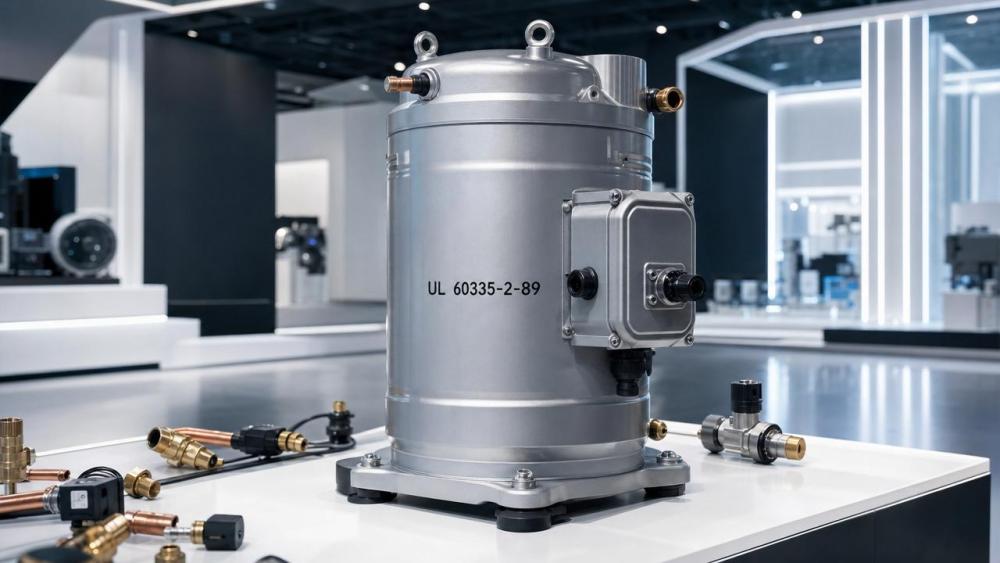
On April 8, 2026, during the China Refrigeration Exhibition, Songyang Compressor unveiled a series of R290 refrigerant scroll compressors — marking a pivotal regulatory milestone with its new-energy vehicle (NEV) model achieving UL 60335-2-89 explosion-proof certification. This development directly impacts global HVAC&R, automotive thermal management, and data center cooling supply chains by easing compliance barriers for export-oriented original equipment manufacturers (OEMs) targeting North America, the Middle East, and Australia/New Zealand.
R290 Compressor Certification and Exhibition Highlights
At the April 2026 China Refrigeration Exhibition, Songyang Compressor exhibited multiple R290-based scroll compressors designed for automotive air conditioning, heat pump systems, and data center cooling applications. Its NEV-specific R290 compressor successfully passed UL 60335-2-89 explosion-proof certification — making it among the first domestically produced, volume-ready models compliant with stringent market access requirements in North America, the Middle East, and Australia/New Zealand.
Supply Chain Impacts Across Key Roles
Direct Exporters
Exporters supplying compressors or integrated thermal systems to regulated markets now face tighter scrutiny on intrinsic safety documentation. With UL 60335-2-89 certification pre-validated for this model, exporters can reduce reliance on post-manufacturing third-party testing — shortening time-to-market and lowering conformity assessment costs.
Raw Material Procurement Firms
Suppliers of R290-compatible elastomers, seals, and electrical insulation materials must ensure material-level compatibility with explosion-proof operating conditions — particularly resistance to refrigerant permeation and thermal cycling under UL-specified fault scenarios.
Manufacturers of Integrated Systems
OEMs integrating these compressors into EV climate control units or heat pumps must align their system-level safety validation (e.g., enclosure integrity, ignition source mitigation, fault current handling) with UL 60335-2-89’s application-specific clauses — not just component-level approval.
Supply Chain Compliance Service Providers
Third-party labs and technical consultants specializing in North American or ANZ market access must update their test protocols and gap analyses to reflect the growing acceptance of R290 in high-risk applications — especially where UL 60335-2-89 serves as a de facto benchmark beyond household appliances.
Strategic Priorities for Manufacturers and Buyers
Verify Certification Scope and Application Boundaries
UL 60335-2-89 certification applies specifically to the NEV variant — not all R290 models on display. Buyers must confirm whether rated voltage, ambient temperature range, and fault-condition assumptions match their intended use case before procurement or integration.
Align Technical Specifications with UL-Validated Design Parameters
Design documents, tender specifications, and OEM technical bids must explicitly reference UL 60335-2-89 compliance — including maximum allowable charge size, mounting orientation limits, and required external protection devices — to avoid non-conformance during final audit.
Review Supplier Documentation Packages
Procurement teams should request full UL certification reports (not just certificates), evidence of production line consistency (e.g., factory inspection records), and declarations of conformity covering both mechanical and electrical safety aspects per UL 60335-2-89 Annexes.
Assess Lead Time Implications for Global Projects
While certification reduces downstream compliance effort, early engagement with Songyang is critical — especially for custom configurations — as UL 60335-2-89 validation requires dedicated test cycles; standard lead times may extend for variants requiring re-evaluation.
Industry Perspective: A Step Toward Broader R290 Acceptance
Analysis shows that UL 60335-2-89 certification for an NEV compressor signals more than product-level progress — it reflects a maturing risk-assessment framework for flammable refrigerants in mobile applications. From an industry perspective, this milestone lowers the perceived technical barrier for R290 adoption in transportation thermal systems, potentially accelerating harmonization efforts between UL, IEC, and regional standards bodies. What deserves closer attention is how quickly downstream OEMs incorporate such certified components into homologation pathways — especially given ongoing revisions to ISO 19453 and UN ECE R117 updates concerning refrigerant flammability in vehicles.
Broader Significance for Low-GWP Refrigerant Deployment
This certification represents a concrete enabler for scaling R290 use beyond stationary HVAC applications — validating engineering controls that mitigate ignition risks without compromising performance or efficiency. It does not eliminate regulatory heterogeneity across markets, nor does it supersede national type-approval requirements. Rather, it provides a recognized, internationally referenced safety benchmark that simplifies cross-border compliance architecture — particularly where UL standards inform local regulatory interpretation.
Source Attribution and Ongoing Monitoring
This article was generated exclusively from the provided information: title, event date (April 8, 2026), and event summary. Specific official source links were not provided in the input and should be verified continuously. Stakeholders are advised to monitor upcoming updates to UL 60335-2-89 implementation guidance, national deviations in explosion-proof enforcement (e.g., CSA C22.2 No. 60335-2-89 adoption in Canada), and evolving tender language in public-sector heat pump or EV infrastructure projects referencing R290 safety compliance.
Ready when you are. Send us a message to get started.
Related News
- How corrugation angle affects heat transfer in plate heat exchangersAuthor :Thermodynamics Analyst

- R22 Prices Retreat as China's Refrigerant Market Faces Tight Quotas and Soft DemandAuthor :Cryogenic Systems Expert

- How to select industrial equipment for automation with existing PLCsAuthor :

- Carrier Plans $600 Million Manufacturing and Engineering Center in Fort WorthAuthor :

- How electricity prices shape industrial compressed air price trendsAuthor :

- Chemours Faces Investor Lawsuit Over Opteon Refrigerant Sales ForecastsAuthor :Cryogenic Systems Expert

- Choosing air filtration systems for heavy dust in the Middle EastAuthor :

- LG Expands R290 Monobloc Heat Pump Range with New 12–16 kW ModelsAuthor :Cryogenic Systems Expert

- How to size a chiller for pharmaceutical cleanroom temperature controlAuthor :Cryogenic Systems Expert

- Kentucky Regulators Approve $191 Million Cooling Tower at Mitchell Coal PlantAuthor :Thermodynamics Analyst

- How much does a fully installed compressed air monitoring system cost?Author :

- What documentation supports CE marking for industrial equipment?Author :

- When do plate heat exchangers suit Middle East seawater cooling?Author :Thermodynamics Analyst

- EU Issues Updated Guidance on Industrial Refrigeration Efficiency and F-gas AlternativesAuthor :Cryogenic Systems Expert

- How does base pressure affect film purity in vacuum deposition?Author :Vacuum Process Fellow

- Do U.S. refrigerant regulations require replacing R-410A systems?Author :Cryogenic Systems Expert

- When does variable gas flow justify a custom screw compressor system?Author :Pneumatic Power Engineer

- How local support affects vacuum system costs in Southeast AsiaAuthor :

- How worldwide industry category guides help compare market opportunitiesAuthor :

- How to verify food-grade purity in compressed air systemsAuthor :Pneumatic Power Engineer

- When high-pressure waste heat recovery boilers make economic senseAuthor :Thermal Energy Strategist

- How to size compressed air equipment for pneumatic toolsAuthor :Pneumatic Power Engineer

- How to size vacuum process equipment for the required pump-down timeAuthor :Vacuum Process Fellow

- What determines the price of pure air compression systems?Author :Pneumatic Power Engineer

- How steam generation efficiency shapes thermal power system designAuthor :Thermal Energy Strategist

- What drives sustainable thermal systems cost over their operating life?Author :

- Which vacuum specification best protects semiconductor process yield?Author :Vacuum Process Fellow

- When do smart thermal systems with sensors reduce chiller energy use?Author :Cryogenic Systems Expert

- When does gasketed plate heat exchanger technology suit your process?Author :Thermodynamics Analyst

- How to size oil-free compressors for instrumentation air demandAuthor :Pneumatic Power Engineer

- How Class 0 oil-free compressors protect product quality in food productionAuthor :Pneumatic Power Engineer

- Which industrial solution comparison criteria prevent project delays?Author :

- Chiller Optimization Checklist for Rising Energy Use and Unstable Cooling OutputAuthor :Cryogenic Systems Expert

- How to Specify a High-Precision Temperature Chiller for Tight-Tolerance ProcessesAuthor :Cryogenic Systems Expert

- Designing Energy-Efficient Industrial Cooling for Variable Process LoadsAuthor :Cryogenic Systems Expert

- Low-GWP Cooling Solutions for Process Plants: Comparing Safety, Efficiency, and CostAuthor :Cryogenic Systems Expert