



When do plate heat exchangers suit Middle East seawater cooling?




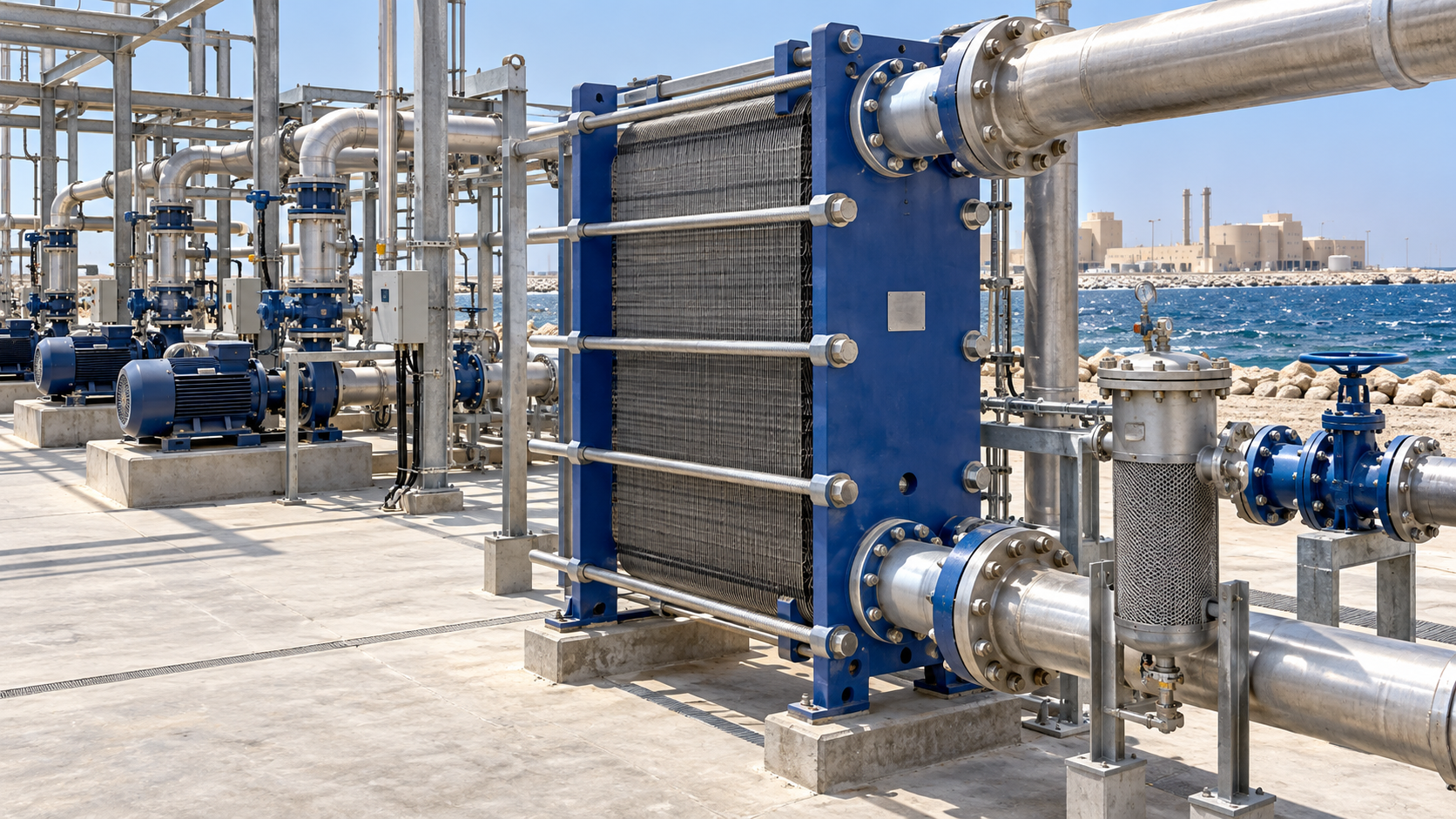
Plate heat exchangers suit Middle East seawater cooling when the required outlet temperature remains achievable during the hottest intake conditions, seawater channels can be kept clear, and the installation allows regular cleaning. A gasketed unit with suitably specified titanium plates is a strong candidate where space is limited and a close temperature approach has operational value. Its suitability weakens when debris control is unreliable, pumping head is scarce, or maintenance access exists only on the layout drawing.
For heat exchanger systems in Middle East coastal installations, selection should start with the complete seawater circuit. Plate material, intake treatment, channel geometry, pump performance, and cleaning arrangements determine whether an attractive thermal rating survives actual service.
Start with the hottest credible intake condition
A plate exchanger cannot cool a process stream below the temperature of the seawater entering it. As summer intake temperature rises, the available temperature difference shrinks. A unit rated against an annual average can therefore meet its nominal duty while failing at the condition that matters most.
The design basis should identify the highest credible seawater temperature at the actual intake, including any influence from shallow water, restricted circulation, or warm discharge recirculation. Arabian Gulf and Red Sea locations should not share an assumed seawater specification simply because both are in the Middle East. Local temperature, salinity, suspended solids, and biological activity require site-specific treatment.
Thermal evaluation needs the hot-side inlet temperature, required outlet temperature, flow, and fluid properties alongside the seawater conditions. A close approach between the cooled process outlet and seawater inlet generally requires more heat transfer area and careful flow arrangement. Increasing seawater flow has diminishing thermal returns while adding hydraulic demand.
Where the required process temperature is too close to the hottest available seawater temperature, compare the exchanger against the wider cooling arrangement. An intermediate freshwater loop adds another temperature approach; a refrigeration stage introduces power demand. Neither limitation disappears by selecting a larger plate pack.
Titanium plates address corrosion, with boundaries
Warm, oxygenated seawater creates a demanding chloride environment. Common stainless steel plate grades should not be accepted solely because they perform well in freshwater service. Thin plates, gasket contact regions, deposits, and stagnant pockets make localized corrosion particularly consequential: a small penetration can connect the two fluid circuits.
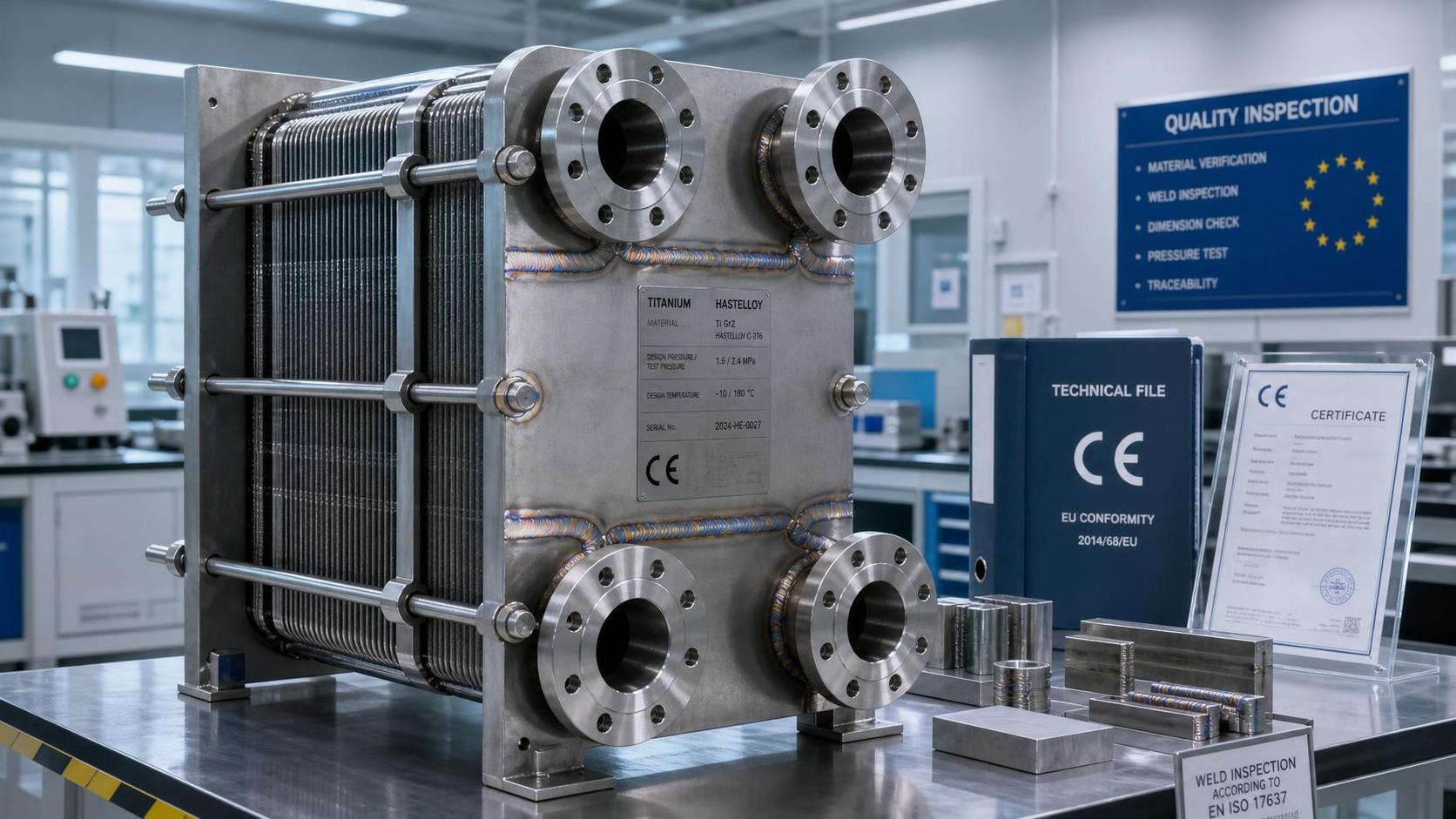
Titanium is frequently the preferred plate material for seawater because its passive surface provides strong resistance under many aerated seawater conditions. The specification still needs the actual alloy grade and confirmation against the full operating envelope. Temperature excursions, cleaning chemistry, unusual contamination, and abnormal process conditions belong in that review.
Material selection must also cover wetted connections, liners, instrument fittings, valves, and adjacent pipework. Titanium plates do not protect an unsuitable nozzle or a vulnerable connection elsewhere in the circuit. Dissimilar-metal interfaces deserve review, particularly where an unfavorable exposed area relationship could accelerate corrosion of the less noble component.
The other fluid matters equally. A plate acceptable for seawater service still requires compatibility assessment against the process medium. Where leakage could contaminate a product or damage equipment, the decision must include leak consequences and detection arrangements. Double-wall plates provide a leakage path for detection in suitable designs, but require their own thermal and hydraulic evaluation.
Debris control determines whether narrow channels are workable
Compact plate passages work well with controlled seawater quality. Shell fragments, weed, fibrous material, and sand alter that assessment. Large debris can obstruct channel entrances, while smaller particles collect in low-flow areas or lodge where the plate pattern creates restrictions. Uneven distribution then leaves part of the heat transfer surface underused.
Filtration must match the exchanger’s actual passage geometry and the intake’s debris profile. A screen opening selected only from a nominal channel gap is insufficient: flexible material can pass through a screen and accumulate downstream. Intake observations, seasonal events, and strainer operating records are more useful than a generic description of “filtered seawater.”
The strainer also consumes pressure and requires cleaning. Its dirty condition belongs in the hydraulic assessment, including the effect of automatic backwashing on available flow. A protective device that repeatedly starves the exchanger simply moves the operating problem upstream.
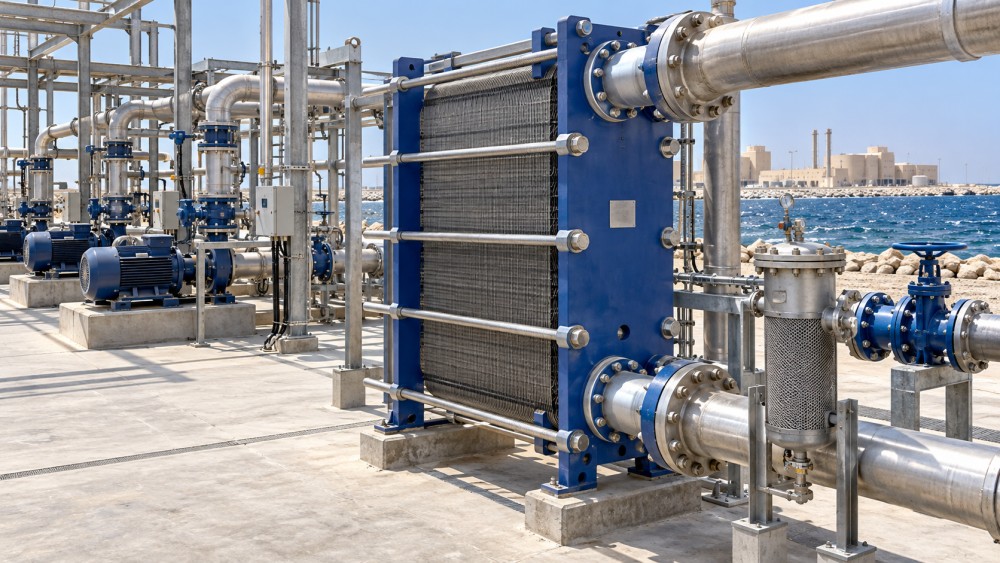
Wider-gap plates deserve consideration where particles remain after practical intake treatment. Their larger passages improve tolerance to some solids, but thermal performance and pressure drop must be recalculated. A change in channel geometry is a new selection, not an interchangeable substitute for the original plate pack.
Judge thermal performance and pumping demand together
Plate corrugations promote mixing and heat transfer, but they also resist flow. A compact selection can achieve its quoted duty at a seawater pressure drop that the existing pump cannot sustain. Conversely, adding parallel channels to reduce pressure drop can lower channel velocity enough to weaken heat transfer and encourage deposition.
The useful comparison is between complete operating points. Each candidate needs a thermal rating at the available seawater flow, a hydraulic rating at that same flow, and an assessment of performance as deposits develop. Comparing one design at a high pressure drop with another at a much lower allowance obscures the tradeoff.
Available head must account for intake losses, piping, valves, strainers, the exchanger, and discharge conditions. Static head depends on the circuit arrangement and should be established from the actual elevations and boundaries. Exchanger pressure drop alone does not define pump duty.
Flow variation also deserves attention. Reduced process load or pump turndown can leave some plate arrangements with weak channel flow. The rating should cover credible operating modes, including parallel-unit operation and isolation of one exchanger for maintenance. Adequate velocity at peak duty does not establish acceptable behavior throughout the operating range.
Cleaning access is part of the equipment selection
Gasketed plate exchangers have a practical advantage where opening the pack and inspecting individual surfaces is routine. That advantage disappears if pipework blocks the movable frame or the installation lacks space to separate and handle the plates. Maintenance clearance should be demonstrated on the equipment layout before the selection is fixed.
Cleaning strategy depends on the deposit. Backflushing can dislodge some loose material; it does not reliably remove adherent biological films or mineral scale. Cleaning in place requires chemistry compatible with the deposit, plates, gaskets, and connected components. Mechanical cleaning requires methods that avoid scratching plates or damaging sealing surfaces.
Biofouling control must be coordinated with the intake treatment regime. Oxidant concentration, dosing pattern, temperature, and exposure duration affect material compatibility. A statement that the system uses chlorination is insufficient to establish gasket suitability, especially if intermittent treatment produces higher local exposure.
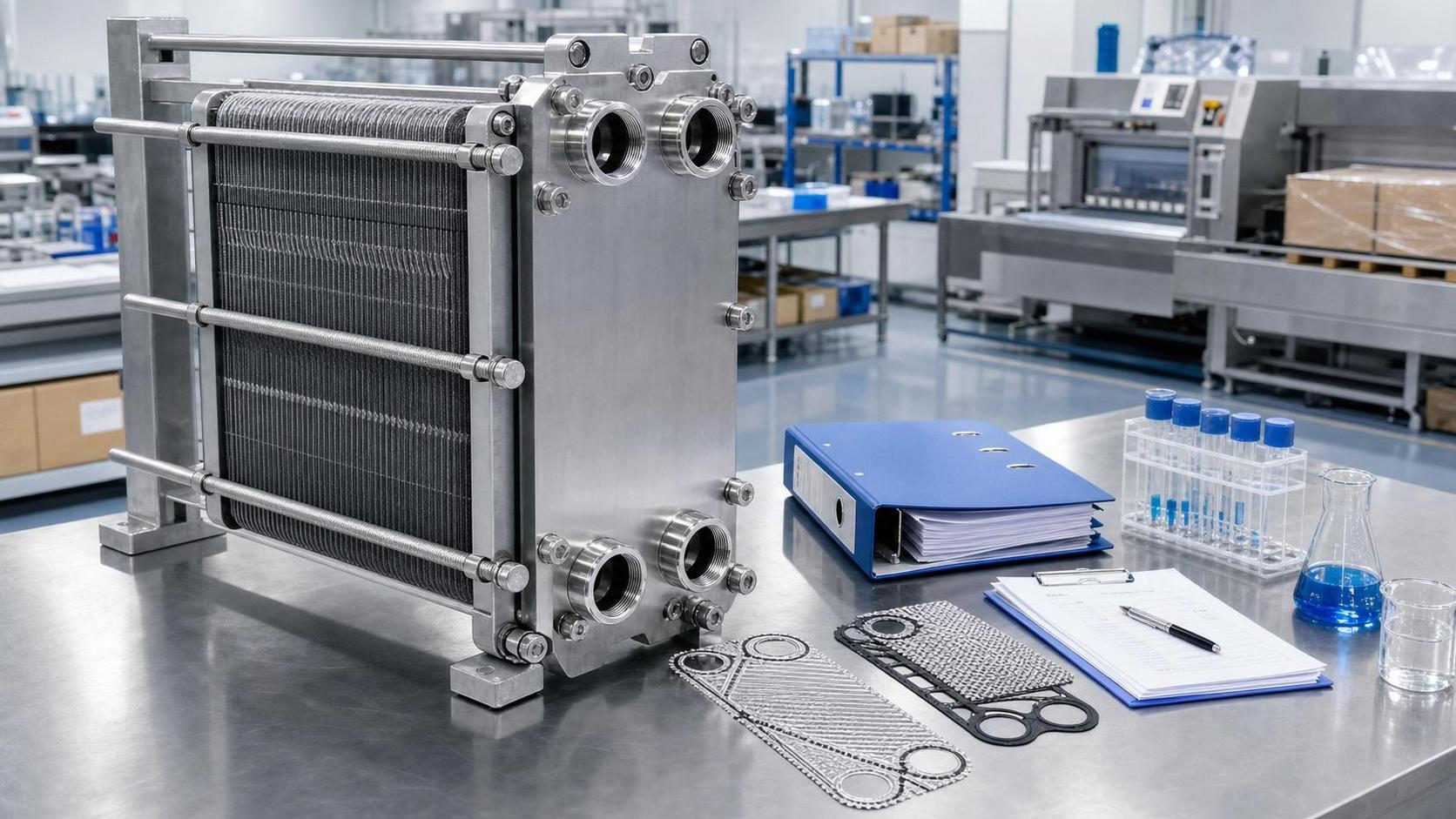
Gasket selection needs both fluid compositions, operating temperatures, cleaning agents, and shutdown conditions. EPDM and nitrile compounds have different strengths; neither is a universal seawater solution. Compound formulation matters alongside polymer family. Compatibility with lubricating oil on one side, for example, can change a choice that initially appeared suitable for seawater and water-based cleaning.
Repeated opening also brings practical costs: gasket replacement, plate inspection, correct tightening dimensions, and verification after reassembly. Where continuous cooling is required, isolation arrangements and standby capacity need to support the intended cleaning interval.
When another exchanger arrangement deserves preference
Plate exchangers lose their strongest advantage when the site cannot maintain the water quality and access their narrow passages require. The alternative should follow the limiting condition rather than a general preference for one construction.
A shell-and-tube exchanger still requires corrosion-resistant materials and fouling control. Its potential advantage is physical access and passage geometry, especially with seawater on an accessible tube side. Welded plate construction removes some gasket limitations but changes repair and cleaning options. Copper-brazed stainless plate units should not be treated as direct substitutes for titanium seawater designs.
Make the selection reviewable before purchase
A useful technical submission connects guaranteed performance to explicit conditions. It should state plate material and thickness, gasket compound, channel arrangement, design pressures and temperatures, allowable differential pressure, and seawater pressure drop at the rated flow. The thermal calculation needs to identify how fouling or service margin has been represented.
That margin deserves scrutiny. Adding plates changes the number of parallel channels and can reduce velocity. A larger surface area therefore does not automatically provide better resistance to deterioration in service. Clean and anticipated fouled performance should be evaluated with the resulting hydraulics, rather than inferred from an area allowance alone.
Lifecycle comparison should include pumping energy, strainer maintenance, cleaning frequency, replacement gaskets, standby provision, and the consequence of unavailable cooling. Precise costs require project data, but the cost drivers can be established before quotations are compared. A smaller frame has limited value if its operating assumptions require frequent outages.
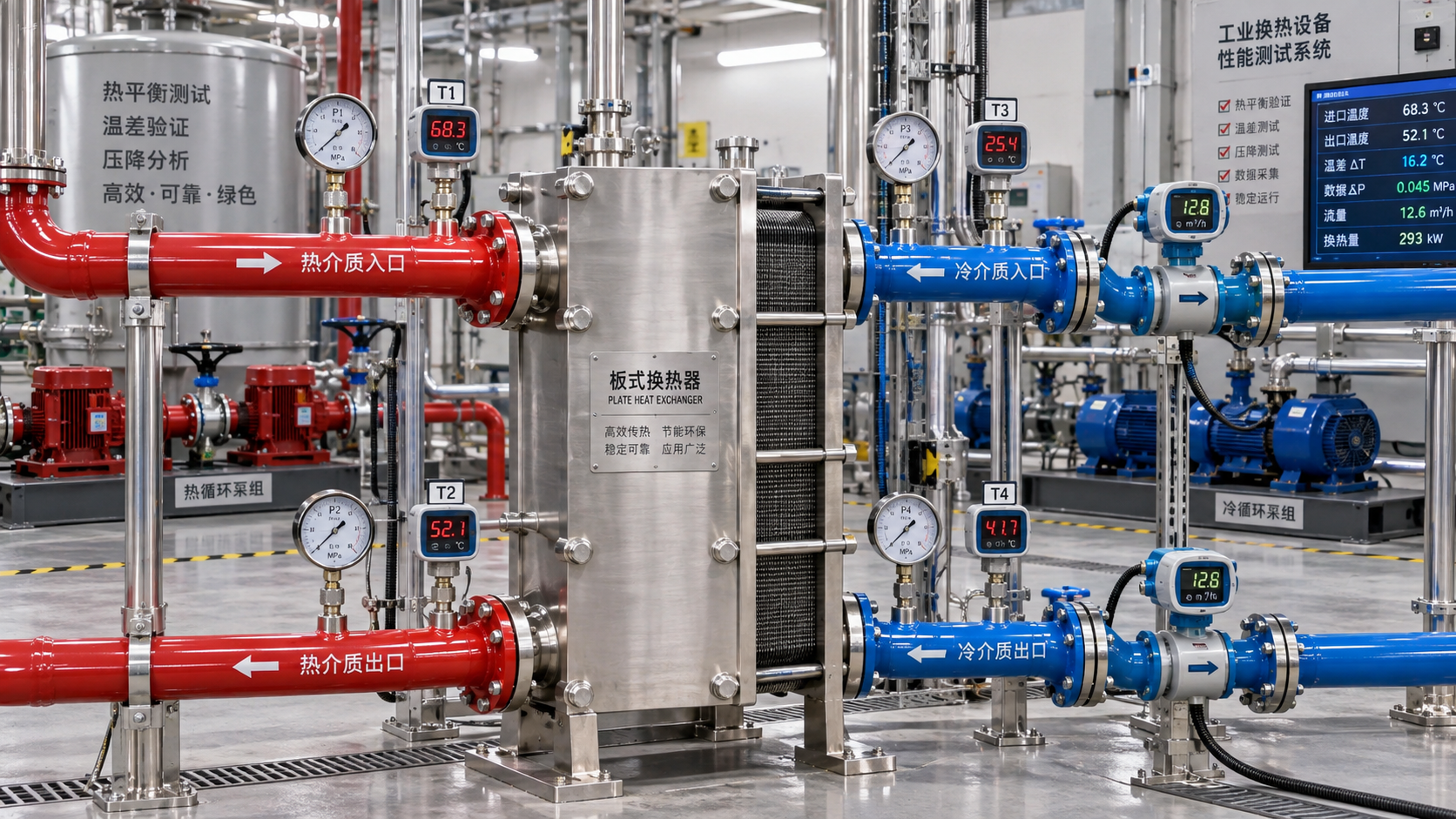
Baseline instrumentation makes the final selection verifiable after commissioning. Temperature and pressure measurements on both circuits, together with usable flow information, allow observed performance to be compared with the rating. Rising seawater differential pressure with falling duty suggests a different investigation from falling duty at stable pressure drop; neither observation identifies the deposit by itself. Establishing a clean baseline under recorded conditions makes later cleaning decisions more defensible.
Ready when you are. Send us a message to get started.
Related News
- When do plate heat exchangers suit Middle East seawater cooling?Author :Thermodynamics Analyst

- When does gasketed plate heat exchanger technology suit your process?Author :Thermodynamics Analyst

- When does heat recovery improve data center cooling efficiency?Author :Thermodynamics Analyst

- How Do I Verify Heat Transfer Calculations in a Supplier Quotation?Author :Thermodynamics Analyst

- How to evaluate a plate heat exchangers supplier before orderingAuthor :Thermodynamics Analyst

- EU Tightens Fatigue Checks for Plate Heat ExchangersAuthor :Thermodynamics Analyst

- EU PFAS Rule Adds New Export Filing for Cooling EquipmentAuthor :Thermodynamics Analyst

- EU EN 13445-4:2026 Adds Fatigue Report RequirementAuthor :Thermodynamics Analyst

- EU Updates EN 13445-4 for Plate ExchangersAuthor :Thermodynamics Analyst

- How to Compare Energy-Efficient Heat Exchange SolutionsAuthor :Thermodynamics Analyst

- Brazed Plate Exchanger Design: 7 Factors That Affect Heat TransferAuthor :Thermodynamics Analyst

- EU CBAM Pilot List Adds Plate ExchangersAuthor :Thermodynamics Analyst

- How Heat Exchange Systems Improve Temperature Control StabilityAuthor :Thermodynamics Analyst

- Japan to Require Efficiency Labels for Plate ExchangersAuthor :Thermodynamics Analyst

- EU REACH Adds PFAS Ban for Plate Heat ExchangersAuthor :Thermodynamics Analyst

- India Enforces BIS Rule for Plate Heat ExchangersAuthor :Thermodynamics Analyst

- DIN EN 13445-6:2026 Tightens Plate Exchanger CE RulesAuthor :Thermodynamics Analyst

- EU REACH Restricts PFAS Seals for Plate Heat ExchangersAuthor :Thermodynamics Analyst

- India Mandates BIS Certification for Imported Plate ExchangersAuthor :Thermodynamics Analyst

- Vietnam Requires QR Labels on Imported Plate Heat ExchangersAuthor :Thermodynamics Analyst

- EU EN 13445-4:2026 Tightens NDT Rules for Heat ExchangersAuthor :Thermodynamics Analyst

- EPA Clears R-1234ze(E) for Plate Exchanger SystemsAuthor :Thermodynamics Analyst
 for Plate Exchanger Systems")
- Heat Exchange Equipment Selection: Key Performance Checks Before You Compare ModelsAuthor :Thermodynamics Analyst

- ASHRAE 90.1-2026 Raises Plate Exchanger Efficiency ThresholdAuthor :Thermodynamics Analyst

- Heat Exchange Systems: How to Choose the Right SetupAuthor :Thermodynamics Analyst

- EPA SNAP 89 Takes Effect for Plate ExchangersAuthor :Thermodynamics Analyst

- How to Compare Heat Exchange Solutions for Lower Energy UseAuthor :Thermodynamics Analyst

- EPA SNAP 89 Expands Filing Rules for Plate Heat ExchangersAuthor :Thermodynamics Analyst

- EPA SNAP update adds filing rule for plate heat exchangersAuthor :Thermodynamics Analyst

- Industrial Heat Recovery: Where the Payback Is Fastest in 2026Author :Thermodynamics Analyst

- California EPR Deadline Nears for Cooling Equipment MakersAuthor :Thermodynamics Analyst

- Heat Exchanger Technology: Plate vs Shell and Tube for EfficiencyAuthor :Thermodynamics Analyst

- Industrial Heat Recovery Options for High-Temperature ProcessesAuthor :Thermodynamics Analyst

- Heat Transfer Problems in Process Lines: Causes and Practical FixesAuthor :Thermodynamics Analyst

- India Tightens Plate Exchanger Import Clearance RulesAuthor :Thermodynamics Analyst

- SABIC Methanol Force Majeure Extended to Q4 2026Author :Thermodynamics Analyst