



How Do I Verify Heat Transfer Calculations in a Supplier Quotation?




A supplier quotation may state a heat duty, an overall heat-transfer coefficient, and a reassuringly small temperature approach. That does not mean the equipment will meet duty once it is connected to a real process. The difficult part is rarely the basic equation. It is determining whether the supplier and the buyer are using the same operating basis: the same fluid composition, flow range, inlet temperatures, fouling condition, allowable pressure loss, and contingency for off-design operation.
So, how do I verify heat transfer calculations in a supplier quotation? Start by treating the quotation as a set of engineering assumptions rather than a finished answer. A credible thermal offer should allow an engineer to reconstruct the duty, follow the temperature profile, understand the resistance assumptions, and see the hydraulic trade-offs. If it does not, the quotation may still be commercially attractive, but it is not yet technically comparable.
Begin with the heat balance, not the quoted surface area
The first check is an energy balance on both sides of the exchanger. For a single-phase liquid or gas stream, the working relationship is generally:
Q = m × Cp × ΔT
Where Q is thermal duty, m is mass flow rate, Cp is specific heat capacity, and ΔT is the stream temperature change. You do not need the supplier’s proprietary selection software to test this. Using the stated flow rate, inlet and outlet temperatures, and a defensible Cp value, calculate the duty independently for the hot side and the cold side.
The two results should be reasonably close after allowing for rounding, heat loss where relevant, and uncertainty in fluid properties. A large mismatch is a warning sign. It may indicate that one stream is quoted in volumetric flow while another is interpreted as mass flow, that glycol concentration has been overlooked, or that the supplier has used a nominal rather than actual operating temperature.
Be particularly careful with water-glycol mixtures, thermal oils, humid air, refrigerants, and process fluids with changing composition. Their physical properties can differ materially from those of water. A quotation based on “water equivalent” duty may be acceptable for a preliminary budget exercise; it is not a sufficient basis for final equipment approval.
For condensing, evaporating, boiling, freezing, drying, or other phase-change duties, the simple Cp equation is incomplete. The calculation must include latent heat and, where applicable, sensible cooling or superheat. Ask the supplier to show enthalpy values or the process basis used. This is especially important in refrigeration packages, heat-pump systems, and solvent recovery duties, where a small change in pressure can alter saturation temperature and capacity.
Read the temperature program as if it were a process drawing
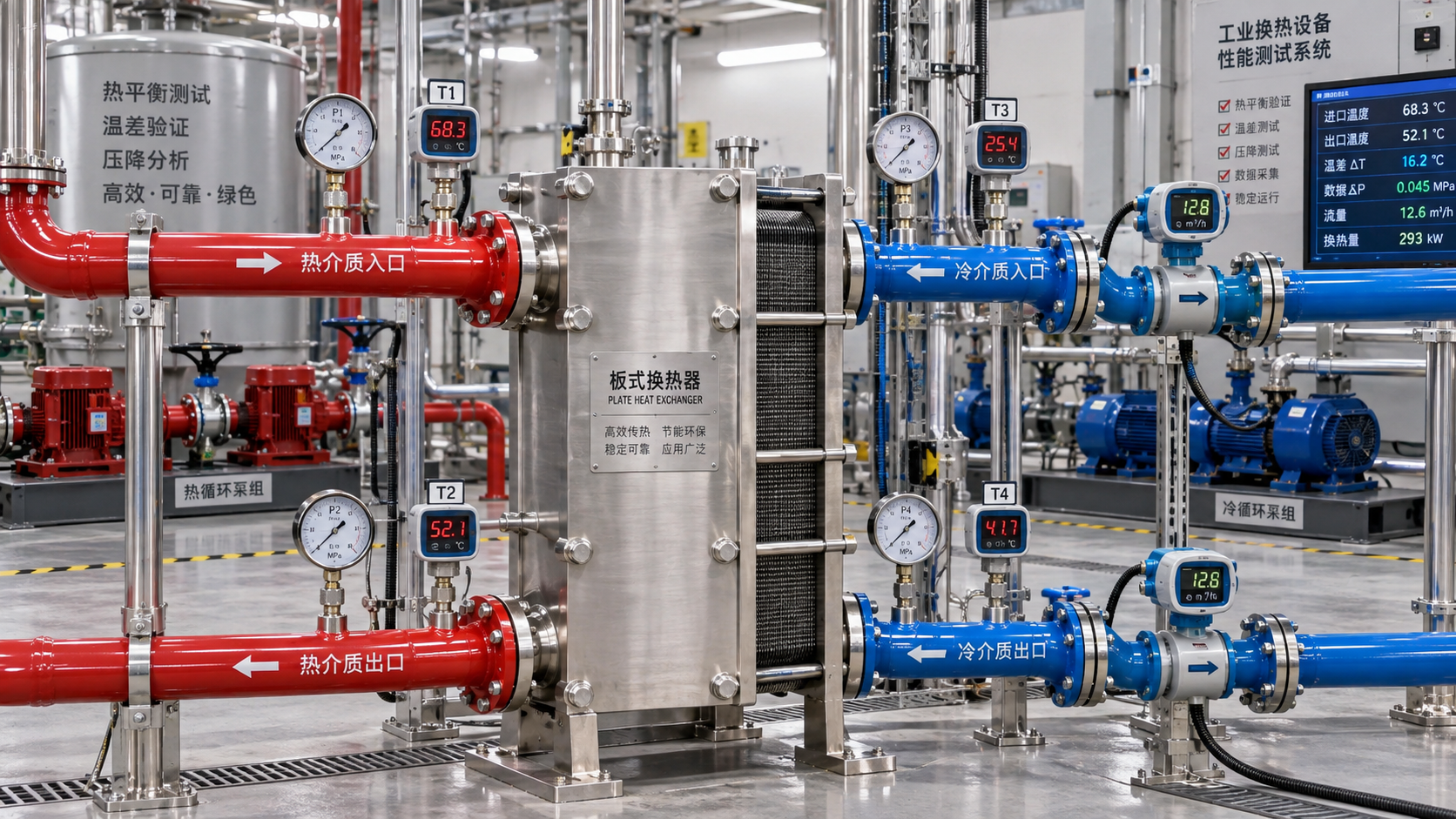
A thermal quotation should identify all four terminal temperatures: hot-side inlet and outlet, plus cold-side inlet and outlet. Put them into a simple temperature sketch before reviewing U-values or plate counts. This often exposes a problem faster than a detailed spreadsheet.
Check the terminal temperature differences. In counter-current service, the relevant driving force is normally the log mean temperature difference, or LMTD:
LMTD = (ΔT1 − ΔT2) / ln(ΔT1 / ΔT2)
The formula is familiar, but its application is where quotations become less transparent. For multipass shell-and-tube exchangers, crossflow coils, air coolers, or complex arrangements, an LMTD correction factor may be required. The supplier should state whether such a factor has been applied and what flow arrangement was assumed. A calculation based on pure counter-current flow can overstate performance if the actual configuration departs significantly from it.
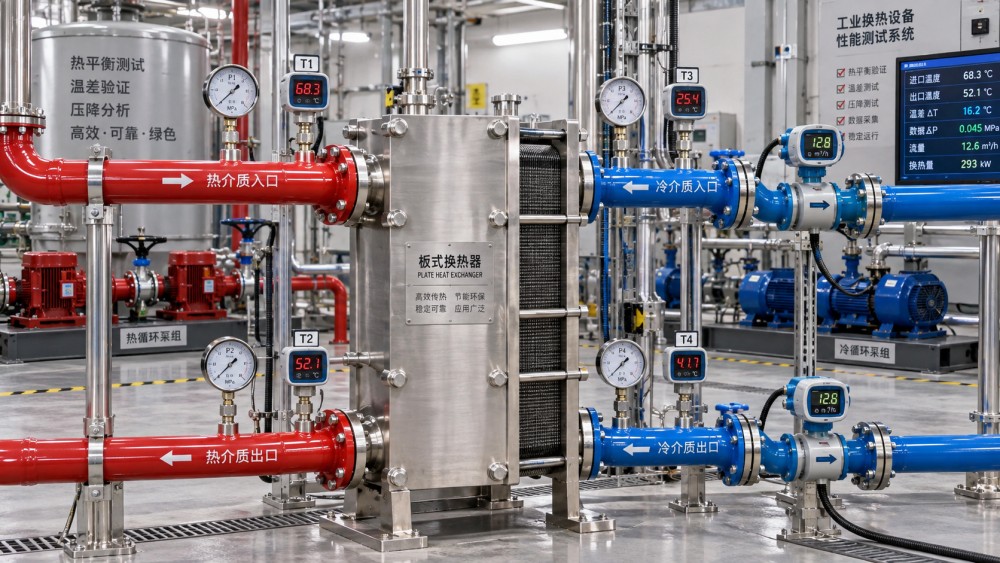
The smallest temperature difference, often called the approach or pinch, deserves extra scrutiny. A tight approach can be technically achievable, but it generally demands more surface area, cleaner conditions, lower flow maldistribution, or greater pumping power. When a supplier offers a much closer approach than competing vendors with no obvious consequence in exchanger size or pressure drop, ask what has changed in the design basis.
Also look for temperature cross. In some duties it is normal; in others it is not possible without a particular exchanger arrangement or phase-change condition. Do not reject a temperature cross automatically, but require the supplier to explain the thermal configuration rather than accepting a generic performance statement.
Test whether UA supports the claimed duty
Once the energy balance and temperature profile make sense, the core relationship is:
Q = U × A × F × LMTD
Here, U is the overall heat-transfer coefficient, A is effective heat-transfer area, and F is the correction factor if applicable. Rearranging the equation gives a practical review tool: calculate the required UA from the stated duty and temperature driving force, then compare it with the quotation’s U multiplied by area.
The resulting U-value should be plausible for the exchanger type and service. There is no universal “correct” number. Plate heat exchangers, shell-and-tube units, air-cooled coils, scraped-surface exchangers, and microchannel designs operate in very different ranges. Fluid viscosity, flow regime, wall material, plate corrugation, fin geometry, and fouling all influence the result. The useful question is not “Is this U-value high?” but “Can this U-value be sustained under our stated fluid and operating conditions?”
A supplier should be able to identify whether the quoted area is gross area, effective area, primary surface, or an area basis specific to the product design. Comparing surface area alone between vendors can be misleading. One vendor may quote total installed area while another reports an effective thermal area calculated differently. UA and guaranteed operating performance are more meaningful comparison points.
Fouling assumptions are where many “good” quotations become fragile
A clean exchanger selection can look excellent on paper and disappoint after several months of operation. Fouling resistance is not an accounting line added at the end of a calculation; it is part of the thermal design. Ask for the fouling factors applied to each side, their units, and whether the quoted duty is clean, fouled, or guaranteed at end-of-run conditions.
This matters in cooling-tower water circuits, untreated well water, washdown environments, food processes, viscous liquids, particulate-bearing streams, and services prone to scaling or biological growth. Even a carefully selected exchanger may need filtration, water treatment, bypass capability, cleaning access, or a planned cleaning interval. If those provisions are absent from the package boundary, the nominal heat-transfer calculation tells only part of the story.
There is a commercial trap here: adding a generous fouling allowance can protect capacity, but excessive allowance may force a larger exchanger with lower velocity, which can itself worsen deposition in some services. The right assumption depends on the fluid, cleanliness regime, velocity, and maintenance practice. It should be discussed with operations, not decided solely by procurement or a standard specification template.
Pressure drop is part of the thermal calculation
Heat transfer and pressure drop are linked. Increasing velocity often improves film coefficients and makes a compact exchanger possible, but it also increases pumping or fan energy and may create erosion, vibration, noise, or control instability. A quotation that promises strong thermal performance with an unusually low pressure drop deserves a closer look, particularly with viscous fluids or air-side cooling coils.
Verify the allowable pressure drop from the actual system, not a generic specification. On a chilled-water loop, the available pump head may already be largely consumed by control valves, strainers, pipework, and terminal units. On a compressor aftercooler or interstage cooler, pressure loss can affect compression power and downstream pressure. In vacuum processes, a seemingly modest pressure drop can have a disproportionate effect on process performance.
Request pressure-drop values at the guaranteed flow rate, preferably separately for each side. Then ask what happens at minimum, normal, and maximum operating flows. This is often more revealing than the nominal design point. A system that performs at 100% flow but loses temperature control at reduced flow may not suit batch production, seasonal cooling demand, or turndown in compressed-air equipment.
Make sure the quotation reflects the real operating envelope
Most disputes arise because the equipment was selected for one neat design condition while the plant operates across a messy range. Ambient temperature changes, production rates move, cooling-water temperatures drift, and fluids are not always as clean as the datasheet suggests. A robust review asks for performance at relevant off-design cases, not only the rated point.
For air-cooled equipment, verify the stated design ambient temperature, elevation if it is relevant, recirculation risk, and whether fan power is included in the package energy estimate. For water-cooled equipment, clarify seasonal water temperatures and flow control strategy. For a heat recovery application, confirm that the heat source and heat sink are available at the same time; a recoverable thermal duty is not automatically usable thermal duty.
In high-purity or tightly controlled sectors such as pharmaceuticals, semiconductor facilities, and certain food applications, the question may extend beyond capacity. Materials of construction, drainability, cleanability, leakage risk, temperature stability, and documentation can be just as decisive. A thermally efficient selection is not automatically the right process selection.
What to request before issuing a purchase order
A serious supplier should normally be able to provide a calculation sheet or thermal rating summary containing the essential basis. It does not need to reveal protected design software, but it should be reviewable. At minimum, request:
- Fluid names, composition or concentration, and physical-property basis.
- Flow rates, inlet/outlet temperatures, duty, and stated design margins.
- Heat-transfer area, U-value basis, LMTD or equivalent thermal method, and correction factor where used.
- Clean and fouled performance, including fouling resistance on each side.
- Pressure drop for each circuit at design flow and any stated operating range.
- Design and operating pressure/temperature limits, materials, and the exchanger arrangement.
- Guaranteed values, test conditions, exclusions, and the procedure for resolving a performance shortfall.
The wording of the guarantee matters. “Suitable for duty” is not the same as a guarantee of duty, outlet temperature, pressure drop, or energy consumption at defined conditions. If performance testing is practical, the acceptance conditions should be agreed before the order—not after commissioning questions begin.
Compare suppliers on assumptions, not just headline capacity
When several quotations appear to offer the same duty, create a side-by-side comparison of the actual assumptions. One vendor may have selected on clean water at a generous pressure-drop limit; another may have included glycol, fouling, and a constrained pump head. Their equipment prices may differ, but they are not quoting the same service.
This is where cross-disciplinary review helps. Process engineers should confirm the thermal basis. Mechanical teams should review pressure, material, maintainability, and installation constraints. Utilities specialists should examine pumping, fan, compressor, or refrigeration energy. Procurement can then compare commercial terms on a technically level basis rather than rewarding the most optimistic calculation.
At GTC-Matrix, thermal systems are best understood as connected energy systems rather than isolated equipment items. A heat exchanger selection can alter cooling demand, compressor loading, water consumption, and maintenance exposure elsewhere in the plant. Reviewing the calculation in that wider context is often where the real lifecycle decision becomes clear.
Do the simple checks yourself, request the missing assumptions, and do not be embarrassed to ask a supplier to rerun the selection. A quotation that remains transparent after those questions is usually a better foundation for reliable operation than one built around an impressive duty figure alone.
Related News
- How Do I Verify Heat Transfer Calculations in a Supplier Quotation?Author :Thermodynamics Analyst

- How to evaluate a plate heat exchangers supplier before orderingAuthor :Thermodynamics Analyst

- EU Tightens Fatigue Checks for Plate Heat ExchangersAuthor :Thermodynamics Analyst

- EU PFAS Rule Adds New Export Filing for Cooling EquipmentAuthor :Thermodynamics Analyst

- EU EN 13445-4:2026 Adds Fatigue Report RequirementAuthor :Thermodynamics Analyst

- EU Updates EN 13445-4 for Plate ExchangersAuthor :Thermodynamics Analyst

- How to Compare Energy-Efficient Heat Exchange SolutionsAuthor :Thermodynamics Analyst

- Brazed Plate Exchanger Design: 7 Factors That Affect Heat TransferAuthor :Thermodynamics Analyst

- EU CBAM Pilot List Adds Plate ExchangersAuthor :Thermodynamics Analyst

- How Heat Exchange Systems Improve Temperature Control StabilityAuthor :Thermodynamics Analyst

- Japan to Require Efficiency Labels for Plate ExchangersAuthor :Thermodynamics Analyst

- EU REACH Adds PFAS Ban for Plate Heat ExchangersAuthor :Thermodynamics Analyst

- India Enforces BIS Rule for Plate Heat ExchangersAuthor :Thermodynamics Analyst

- DIN EN 13445-6:2026 Tightens Plate Exchanger CE RulesAuthor :Thermodynamics Analyst

- EU REACH Restricts PFAS Seals for Plate Heat ExchangersAuthor :Thermodynamics Analyst

- India Mandates BIS Certification for Imported Plate ExchangersAuthor :Thermodynamics Analyst

- Vietnam Requires QR Labels on Imported Plate Heat ExchangersAuthor :Thermodynamics Analyst

- EU EN 13445-4:2026 Tightens NDT Rules for Heat ExchangersAuthor :Thermodynamics Analyst

- EPA Clears R-1234ze(E) for Plate Exchanger SystemsAuthor :Thermodynamics Analyst
 for Plate Exchanger Systems")
- Heat Exchange Equipment Selection: Key Performance Checks Before You Compare ModelsAuthor :Thermodynamics Analyst

- ASHRAE 90.1-2026 Raises Plate Exchanger Efficiency ThresholdAuthor :Thermodynamics Analyst

- Heat Exchange Systems: How to Choose the Right SetupAuthor :Thermodynamics Analyst

- EPA SNAP 89 Takes Effect for Plate ExchangersAuthor :Thermodynamics Analyst

- How to Compare Heat Exchange Solutions for Lower Energy UseAuthor :Thermodynamics Analyst

- EPA SNAP 89 Expands Filing Rules for Plate Heat ExchangersAuthor :Thermodynamics Analyst

- EPA SNAP update adds filing rule for plate heat exchangersAuthor :Thermodynamics Analyst

- Industrial Heat Recovery: Where the Payback Is Fastest in 2026Author :Thermodynamics Analyst

- California EPR Deadline Nears for Cooling Equipment MakersAuthor :Thermodynamics Analyst

- Heat Exchanger Technology: Plate vs Shell and Tube for EfficiencyAuthor :Thermodynamics Analyst

- Industrial Heat Recovery Options for High-Temperature ProcessesAuthor :Thermodynamics Analyst

- Heat Transfer Problems in Process Lines: Causes and Practical FixesAuthor :Thermodynamics Analyst

- India Tightens Plate Exchanger Import Clearance RulesAuthor :Thermodynamics Analyst

- SABIC Methanol Force Majeure Extended to Q4 2026Author :Thermodynamics Analyst

- How to Improve Heat Exchanger Efficiency Without Major RetrofitAuthor :Thermodynamics Analyst

- Plate Heat Exchange vs Shell & Tube: Which Fits Your Process Better?Author :Thermodynamics Analyst

- Heat Transfer Basics: What Affects Efficiency Most?Author :Thermodynamics Analyst
![]()