How corrugation angle affects heat transfer in plate heat exchangers




Corrugation angle changes both the heat-transfer coefficient and the hydraulic resistance of a chevron plate heat exchanger. When the angle is measured from the main flow direction, a larger angle generally produces stronger cross-channel mixing and higher heat transfer at the same channel flow rate—but also a greater pressure drop. The best thermal design is therefore not necessarily the plate with the highest angle.
Two qualifications matter immediately: manufacturers do not always define the angle from the same reference axis, and a higher local heat-transfer coefficient does not translate directly into an equivalent increase in exchanger duty. A meaningful comparison must connect plate geometry to the available pumping power, overall thermal resistance, and required operating conditions.
Confirm the angle convention before comparing plates
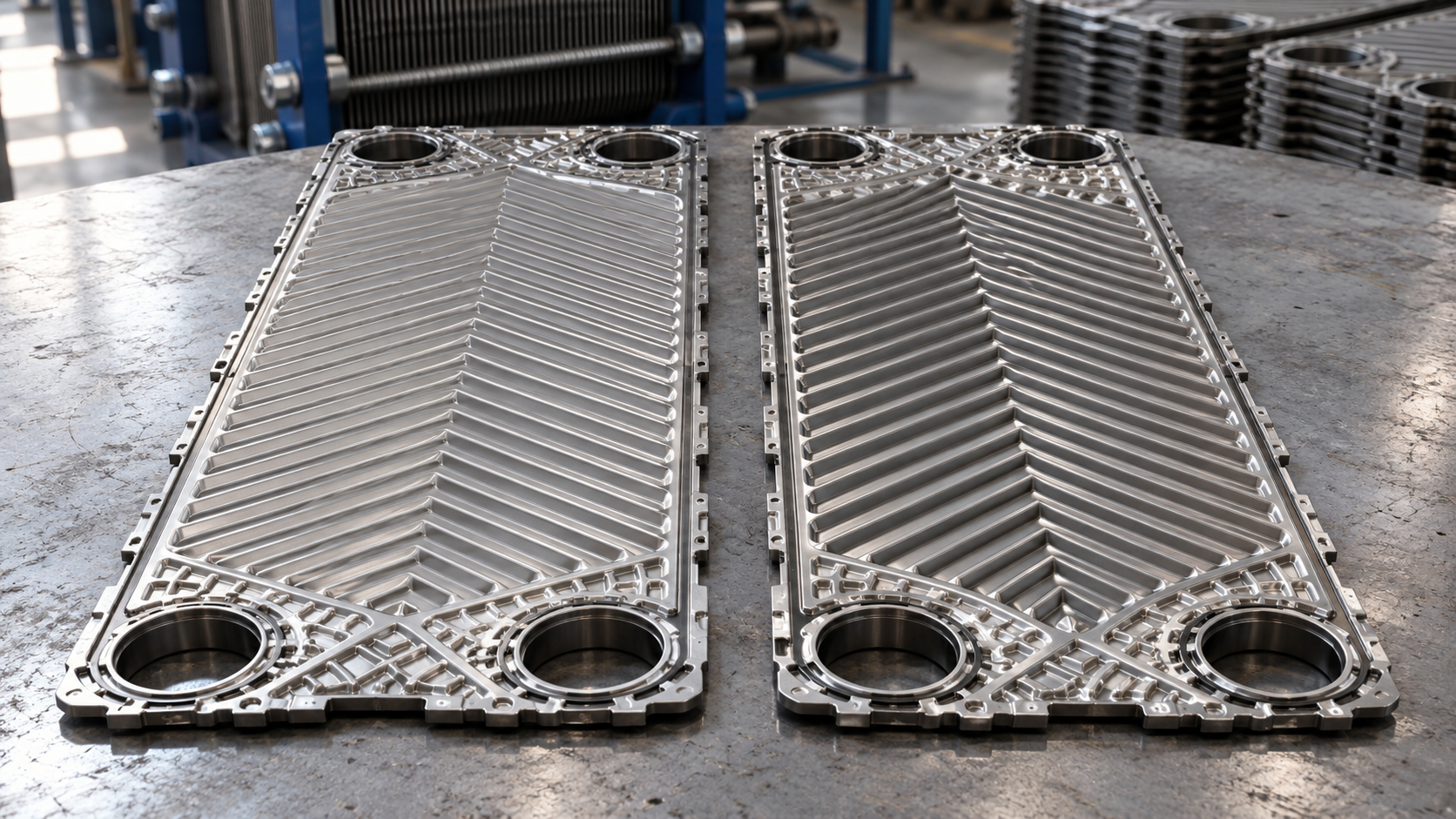
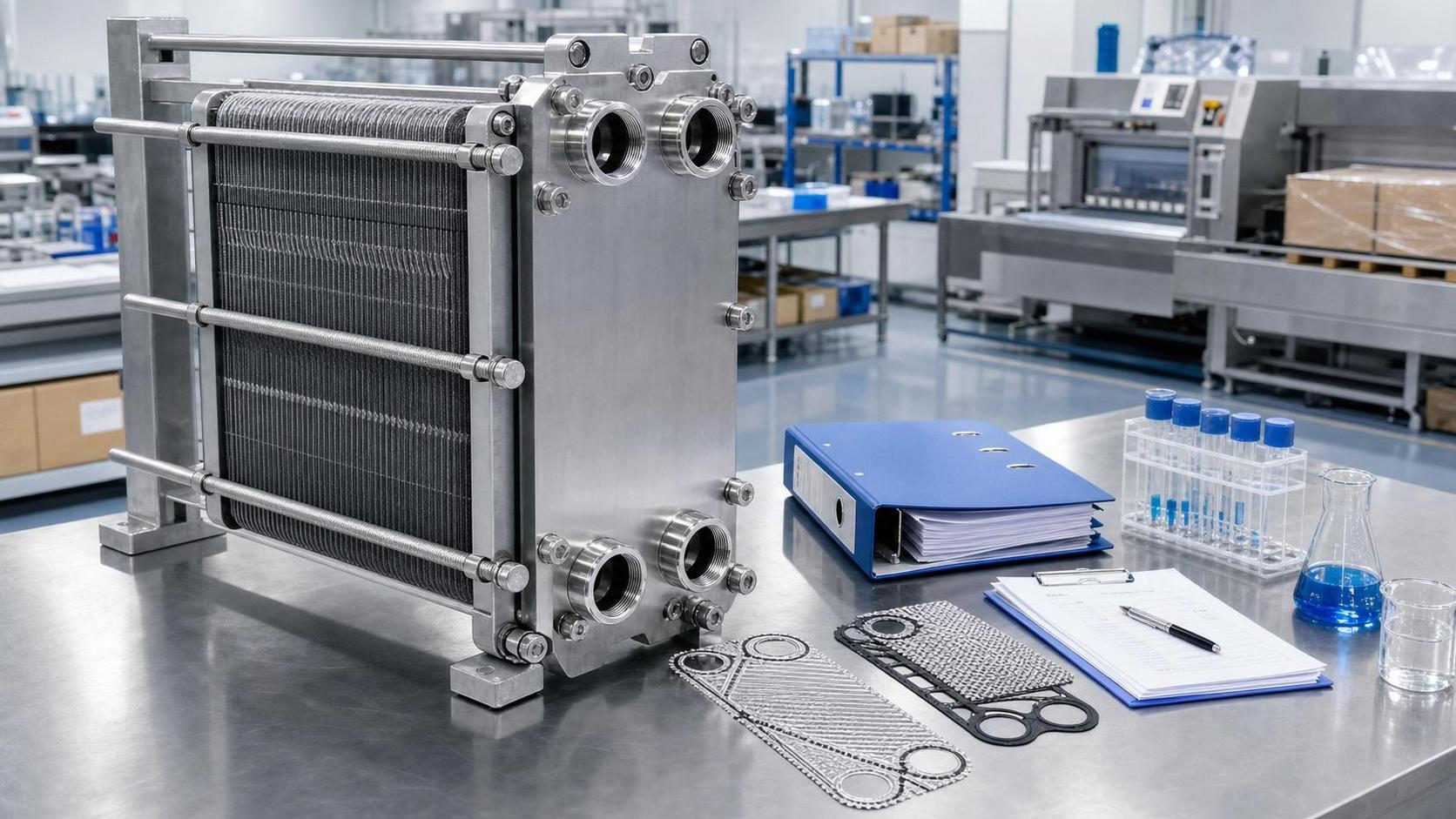
Chevron plates contain repeated inclined corrugations. Adjacent plates are arranged so their corrugations cross, creating a network of contact points and interconnected flow passages. The corrugation angle describes the orientation of those ridges, but its numerical value is meaningless without a reference direction.
An angle measured from the longitudinal flow direction is complementary to one measured from the transverse direction. A ridge described as 60° from the flow axis is also 30° from the transverse axis. Consequently, “high-angle” and “low-angle” descriptions can appear contradictory across technical papers and supplier documents even when they describe similar geometry.
All angle trends discussed here use the angle between the corrugation ridge and the main longitudinal flow direction. Under this convention, increasing the angle makes the corrugations more transverse to the bulk flow.
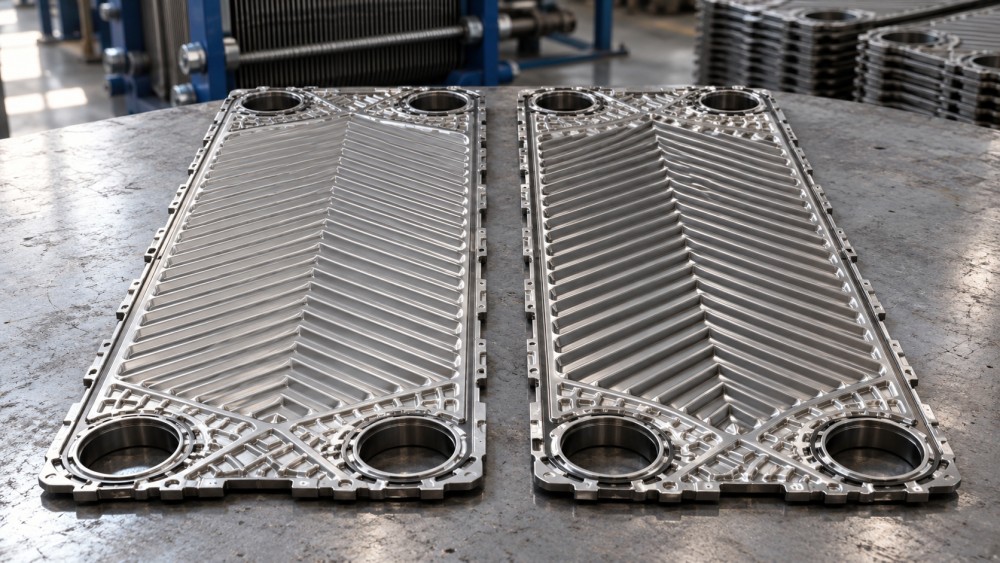
A geometry drawing should also identify corrugation pitch, pressing depth, mean channel gap, and the arrangement of the opposing plates. These dimensions affect hydraulic diameter, surface enlargement, and flow distribution. Comparing two nominal angles without controlling these variables does not isolate the effect of angle.
Why a larger angle increases heat transfer—and pressure loss
Heat transfer between a fluid and a plate depends partly on how effectively fluid near the wall exchanges energy with the channel core. In an undisturbed passage, the thermal boundary layer develops along the surface and limits this exchange. Chevron corrugations repeatedly redirect the flow, generate secondary motions, and disturb near-wall temperature gradients.
At a larger angle, the fluid encounters a more strongly obstructed longitudinal path. Interactions between the crossing corrugations promote mixing, flow separation, and reattachment. These mechanisms can increase convective heat transfer without requiring the same flow behavior found in a smooth circular tube.
The hydraulic penalty comes from the same mechanisms. Turning, separation, wall shear, and interaction with the corrugation network dissipate mechanical energy. A higher heat-transfer coefficient is therefore accompanied by greater channel resistance under otherwise comparable conditions.
This behavior is often represented through geometry-dependent correlations:
Nu = hDh/k = F(Re, Pr, angle, geometry)
Here, Nu is the Nusselt number, h the convective heat-transfer coefficient, Dh the hydraulic diameter, and k the fluid thermal conductivity. Reynolds number captures the relationship between inertia and viscosity, while Prandtl number describes momentum diffusion relative to thermal diffusion.
Pressure-drop calculations use a corresponding friction correlation. Its definition requires care: Darcy and Fanning friction factors differ by a factor of four. Published plate correlations may also use different hydraulic-diameter and velocity definitions. Combining a heat-transfer correlation from one source with a friction correlation from another can produce an internally inconsistent rating.
A smooth-pipe transition criterion should not be applied directly to a chevron channel. Corrugation-driven disturbances change the relationship between Reynolds number and flow behavior; the valid operating range belongs to the specific correlation and geometry.
A higher film coefficient may deliver only a modest increase in duty
The plate angle acts on the fluid-side heat-transfer coefficients, but exchanger performance depends on the complete resistance network. For a thin plate with coefficients and fouling resistances referred to a consistent area basis:
1/U = 1/hhot + Rf,hot + t/kplate + Rf,cold + 1/hcold
The overall coefficient U includes convection on both sides, plate conduction, and the specified fouling resistances. Improving one fluid-side coefficient has limited value when that side contributes little to the total resistance.
For example, consider a hypothetical resistance balance in which one fluid film accounts for 20% of the total thermal resistance. Increasing that film coefficient by 50%, while holding every other resistance constant, raises U by only about 7%. This is an arithmetic illustration, not a prediction for a particular plate design.
The same distinction applies to heat duty:
Q = UAΔTlmF
The temperature-driving force and any applicable arrangement correction factor also matter. At fixed inlet conditions and flow rates, outlet temperatures change as performance changes, so the logarithmic mean temperature difference cannot simply be held constant when predicting additional duty. A full thermal calculation must solve the energy balance and exchanger performance together.
This makes angle selection especially consequential when one fluid controls the thermal resistance. A viscous process stream may benefit from enhanced mixing, while increasing resistance on an already effective water side can yield little additional overall performance. The useful question is which side needs enhancement, not whether both sides can achieve a higher coefficient.
The comparison changes when the hydraulic constraint changes
A statement such as “the higher-angle plate transfers more heat” is incomplete unless the comparison basis is specified.
At fixed channel flow, a higher-angle plate can improve the coefficient while increasing pressure drop. At fixed available pressure drop, however, the same plate may permit less flow. The resulting decrease in Reynolds number can offset part of the geometric enhancement. Under a fixed-speed pump, the actual operating point follows the intersection of the pump and system curves rather than the exchanger rating alone.
Electrical pumping demand can be estimated as:
Pelectric ≈ Δp × V̇ / ηoverall
Here, V̇ is volumetric flow and ηoverall includes the relevant pump and drive efficiencies. Both exchanger circuits must be considered where their pumping requirements change.
For a complete selection, total pressure drop should include ports, distribution regions, channels, and pass connections. An improvement in channel friction does not necessarily produce an equally large reduction in total pressure loss if port velocities dominate.
Plate count and channel arrangement can reverse an apparent advantage
A higher-angle plate may appear attractive because its larger coefficient allows a smaller calculated area. But reducing plate count also reduces the number of parallel channels. At the same total flow rate, channel velocity then rises, adding a hydraulic penalty beyond the effect of angle alone.
The reverse occurs when adding plates to reduce pressure drop. More parallel channels lower velocity, which can reduce the fluid-side coefficient. The additional area and reduced coefficient must be calculated together. Area cannot be added or removed independently of channel hydraulics.
Pass arrangement introduces another coupling. More passes increase the flow path and change the number of parallel channels per pass. They can raise velocity and alter temperature matching, but they also increase pressure loss. A single-pass and multipass selection should not be compared as though corrugation angle were their only difference.
Some plate families provide different chevron configurations or combinations of plates to produce channels with different thermal and hydraulic characteristics. These can offer an intermediate selection between strongly and weakly resisting channels. Their performance requires correlations for the actual plate pairing; it should not be estimated by averaging two angle values or two coefficients.
Fluid properties and service conditions set the useful limits
Viscosity can change the angle decision across the operating range. A liquid that is moderately viscous at its normal outlet temperature may be much more viscous during startup. Stronger corrugation-induced mixing can improve heat transfer, but the startup pressure drop may become unacceptable. Temperature-dependent properties and any wall-viscosity correction required by the selected correlation should be included.
For non-Newtonian fluids, apparent viscosity depends on shear conditions. A Newtonian correlation populated with a single viscosity value is not automatically adequate. Geometry-specific validation becomes more important when the flow behavior differs from that used to develop the rating method.
Fouling does not follow a simple angle rule. Higher wall shear can discourage some deposits, but increased heat transfer also changes wall temperature and local concentration conditions. Crystallization, biological growth, particulate deposition, and chemical reaction fouling respond differently. Corrugation angle cannot substitute for checking channel clearance, fluid chemistry, filtration, and cleaning access.
Two-phase duties require a separate assessment. During evaporation or condensation, angle interacts with phase distribution, vapor quality, interfacial shear, and liquid-film behavior. Pressure loss can also change local saturation temperature. A geometry that performs well in liquid-to-liquid service cannot be assumed to provide the best boiling or condensation performance.
Flow distribution is another limit. Strong local heat transfer cannot compensate for channels receiving too little fluid. Port sizing and distribution-zone design therefore remain part of the evaluation, particularly when extrapolating between exchanger sizes.
What makes a corrugation-angle comparison technically defensible?
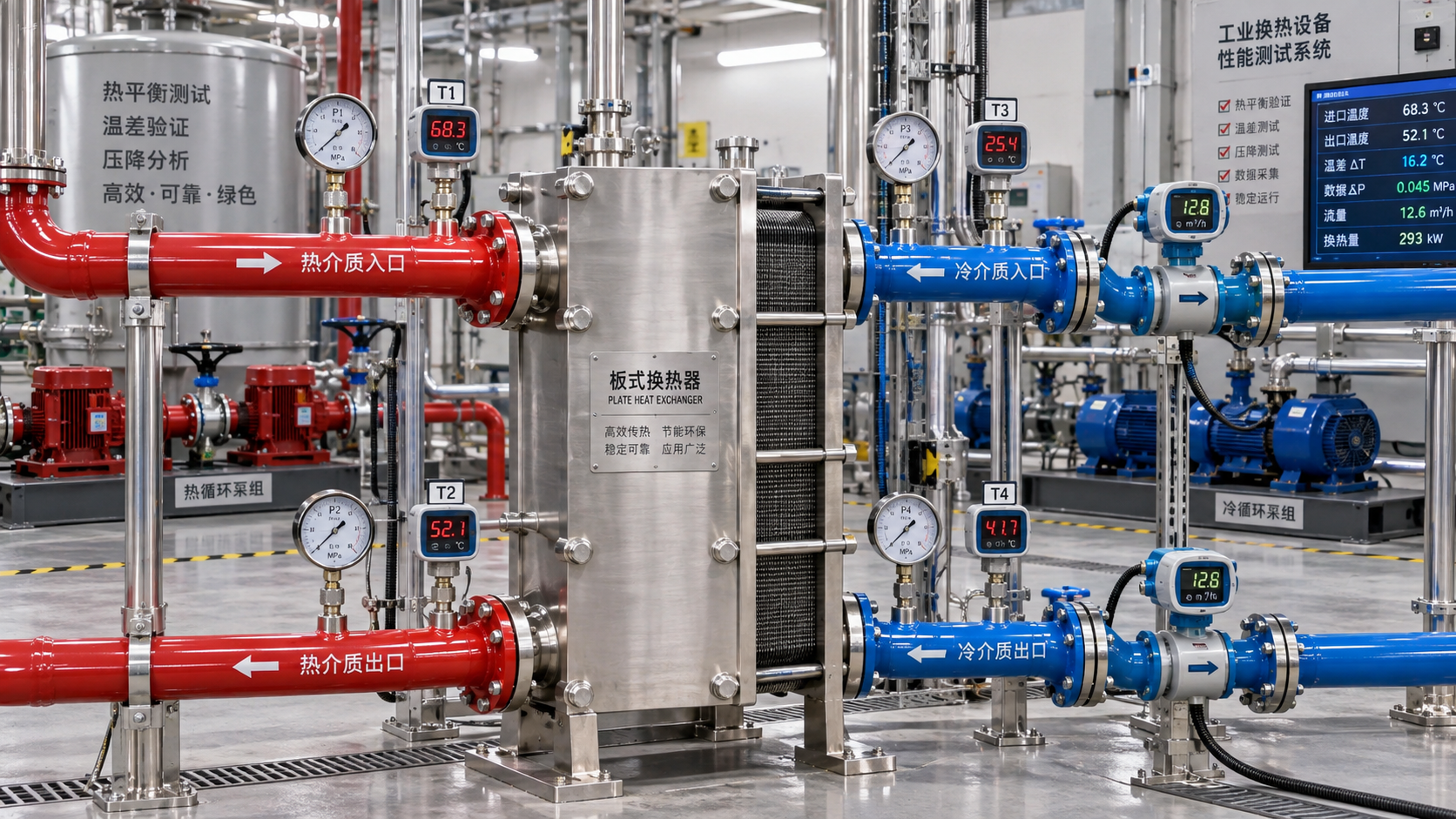
A useful rating comparison holds the required duty, fluid composition, inlet temperatures, flow rates, allowable pressure drops, and fouling basis constant. It then reports the resulting plate geometry, effective area, plate count, pass arrangement, outlet temperatures, and pressure loss on each side.
The supporting calculation should identify whether area means projected or developed surface area. Corrugations enlarge the actual surface, and an area-basis mismatch can make reported coefficients look different even when the underlying performance is comparable. Channel-gap, hydraulic-diameter, and friction-factor definitions also need to be consistent.
Design pressure compliance and thermal performance verification answer different questions. A mechanically compliant exchanger does not, by that fact alone, validate its heat-transfer correlation or guaranteed duty. Thermal acceptance conditions need an agreed fluid-property basis, measurement method, operating tolerances, and treatment of measurement uncertainty.
The strongest selection is the one that meets the thermal requirement within hydraulic limits across the relevant operating envelope—not the one with the largest angle or highest isolated coefficient. Corrugation angle is a powerful design variable, but its value is established only after the plate pack, fluid properties, and pumping system are evaluated together.
Ready when you are. Send us a message to get started.
Related News
- How corrugation angle affects heat transfer in plate heat exchangersAuthor :Thermodynamics Analyst

- When do plate heat exchangers suit Middle East seawater cooling?Author :Thermodynamics Analyst

- When does gasketed plate heat exchanger technology suit your process?Author :Thermodynamics Analyst

- When does heat recovery improve data center cooling efficiency?Author :Thermodynamics Analyst

- How Do I Verify Heat Transfer Calculations in a Supplier Quotation?Author :Thermodynamics Analyst

- How to evaluate a plate heat exchangers supplier before orderingAuthor :Thermodynamics Analyst

- EU Tightens Fatigue Checks for Plate Heat ExchangersAuthor :Thermodynamics Analyst

- EU PFAS Rule Adds New Export Filing for Cooling EquipmentAuthor :Thermodynamics Analyst

- EU EN 13445-4:2026 Adds Fatigue Report RequirementAuthor :Thermodynamics Analyst

- EU Updates EN 13445-4 for Plate ExchangersAuthor :Thermodynamics Analyst

- How to Compare Energy-Efficient Heat Exchange SolutionsAuthor :Thermodynamics Analyst

- Brazed Plate Exchanger Design: 7 Factors That Affect Heat TransferAuthor :Thermodynamics Analyst

- EU CBAM Pilot List Adds Plate ExchangersAuthor :Thermodynamics Analyst

- How Heat Exchange Systems Improve Temperature Control StabilityAuthor :Thermodynamics Analyst

- Japan to Require Efficiency Labels for Plate ExchangersAuthor :Thermodynamics Analyst

- EU REACH Adds PFAS Ban for Plate Heat ExchangersAuthor :Thermodynamics Analyst

- India Enforces BIS Rule for Plate Heat ExchangersAuthor :Thermodynamics Analyst

- DIN EN 13445-6:2026 Tightens Plate Exchanger CE RulesAuthor :Thermodynamics Analyst

- EU REACH Restricts PFAS Seals for Plate Heat ExchangersAuthor :Thermodynamics Analyst

- India Mandates BIS Certification for Imported Plate ExchangersAuthor :Thermodynamics Analyst

- Vietnam Requires QR Labels on Imported Plate Heat ExchangersAuthor :Thermodynamics Analyst

- EU EN 13445-4:2026 Tightens NDT Rules for Heat ExchangersAuthor :Thermodynamics Analyst

- EPA Clears R-1234ze(E) for Plate Exchanger SystemsAuthor :Thermodynamics Analyst
 for Plate Exchanger Systems")
- Heat Exchange Equipment Selection: Key Performance Checks Before You Compare ModelsAuthor :Thermodynamics Analyst

- ASHRAE 90.1-2026 Raises Plate Exchanger Efficiency ThresholdAuthor :Thermodynamics Analyst

- Heat Exchange Systems: How to Choose the Right SetupAuthor :Thermodynamics Analyst

- EPA SNAP 89 Takes Effect for Plate ExchangersAuthor :Thermodynamics Analyst

- How to Compare Heat Exchange Solutions for Lower Energy UseAuthor :Thermodynamics Analyst

- EPA SNAP 89 Expands Filing Rules for Plate Heat ExchangersAuthor :Thermodynamics Analyst

- EPA SNAP update adds filing rule for plate heat exchangersAuthor :Thermodynamics Analyst

- Industrial Heat Recovery: Where the Payback Is Fastest in 2026Author :Thermodynamics Analyst

- California EPR Deadline Nears for Cooling Equipment MakersAuthor :Thermodynamics Analyst

- Heat Exchanger Technology: Plate vs Shell and Tube for EfficiencyAuthor :Thermodynamics Analyst

- Industrial Heat Recovery Options for High-Temperature ProcessesAuthor :Thermodynamics Analyst

- Heat Transfer Problems in Process Lines: Causes and Practical FixesAuthor :Thermodynamics Analyst

- India Tightens Plate Exchanger Import Clearance RulesAuthor :Thermodynamics Analyst