Precision Temperature Control Systems: How to Evaluate Stability and Response Time




Precision temperature control systems are judged too often by one number: whether they can hit a target setpoint. In practice, that is only the starting point.
What matters in live production is how steadily the system holds temperature, how quickly it reacts to load changes, and how efficiently it performs under variable conditions.
That is why stability and response time have become central evaluation criteria across cooling, heat exchange, compressed air support systems, and tightly controlled thermal processes.
Across pharmaceuticals, semiconductors, food processing, advanced manufacturing, and laboratory environments, thermal deviation can quickly become a quality, yield, and energy issue.
From the perspective of GTC-Matrix, this shift reflects a broader industrial reality: thermal performance is no longer an isolated equipment question, but part of energy conversion efficiency and operational resilience.
Why the Market Is Paying Closer Attention
Temperature-sensitive operations are becoming more demanding, even in facilities that were once considered operationally tolerant.
Product recipes are narrower. Equipment cycles are faster. Energy costs are less predictable. Refrigerant policy and decarbonization goals are also influencing system design choices.
In that setting, precision temperature control systems are expected to do more than cool or heat a process loop.
They must protect process consistency, support throughput, and avoid waste caused by overshoot, slow recovery, or unstable control behavior.
This is especially visible where oil-free compression, microchannel heat exchangers, and hybrid thermal architectures are being adopted to improve efficiency.
Better components help, but control quality determines whether those efficiency gains are realized in day-to-day operation.
What Stability and Response Time Actually Mean
Stability refers to how closely a system maintains the required temperature around the setpoint during normal operation and disturbance events.
A stable unit does not wander, hunt, or drift when ambient conditions, flow rate, or process heat load change.
Response time describes how quickly the system reacts when the process demand shifts.
That includes startup pull-down, recovery after door openings or batch changes, and correction after sudden load spikes.
These two factors are linked, but they are not the same.
A system can be fast but unstable, reaching setpoint quickly and then oscillating. It can also be stable but slow, protecting quality while limiting throughput or extending downtime.
The best precision temperature control systems balance both characteristics against the real thermal profile of the process.
Common performance terms worth checking
- Setpoint accuracy: how close the measured temperature is to the target value.
- Temperature uniformity: how evenly temperature is maintained across the controlled zone or loop.
- Overshoot and undershoot: how far the system moves beyond the target during correction.
- Settling time: how long it takes to return and remain within the acceptable control band.
- Repeatability: whether the same thermal result is achieved over multiple cycles.
Where Evaluation Often Goes Wrong
Many comparisons rely on catalog values measured under narrow test conditions.
Those figures may be technically correct, yet still misleading when applied to actual projects.
For example, a quoted control accuracy of +/-0.1 degrees C says little unless the test medium, sensor location, ambient conditions, and load profile are clear.
A liquid loop can behave very differently from an air-based thermal chamber. A lightly loaded test is not equivalent to a multi-shift production cycle.
Another common issue is separating the temperature controller from the rest of the thermal system.
In reality, pumps, valves, compressors, heat exchangers, insulation, sensor quality, and control logic all influence system response.
Precision temperature control systems should therefore be assessed as complete operating packages, not as isolated control boxes.
A Practical Evaluation Framework
A useful review starts with the thermal behavior of the process itself.
Is the load steady or highly variable? Is thermal mass large or small? Is the consequence of drift a cosmetic issue, a quality failure, or a compliance risk?
Once those questions are defined, supplier claims become easier to test against operating reality.
Key criteria to compare
This approach is more useful than asking which model is simply “most precise.” Precision temperature control systems should be matched to the shape of the thermal duty.
How Different Applications Change the Decision
The same evaluation method does not carry equal weight across all sectors.
In semiconductor processes, small fluctuations can affect dimensional stability, deposition quality, or equipment uptime.
In pharmaceuticals, thermal control may connect directly to batch integrity, validation, and documentation requirements.
In food processing, fast response can be just as important as tight control because line interruptions and variable product loads are common.
In industrial cooling linked to compressors and heat exchangers, broader system efficiency becomes a major concern.
That is where the GTC-Matrix perspective is useful.
Temperature control does not sit apart from compressed air quality, refrigerant strategy, thermal recovery, or heat rejection design. These choices influence one another.
Questions that sharpen application fit
- Will thermal load change by batch, by shift, or by season?
- Is the critical temperature measured in the medium, at the product, or at the equipment surface?
- Does fast correction matter more than absolute tightness?
- Can energy efficiency at part load justify a higher initial investment?
- What level of data visibility is needed for audits, troubleshooting, or optimization?
Response Time Is Also an Energy Question
It is easy to treat response time as a productivity metric only.
In reality, poor response often leads to energy waste.
A slow system may overcompensate, run longer than needed, or force upstream equipment to operate under wider margins.
An unstable system may trigger repeated cycling, unnecessary compressor activity, or inefficient valve behavior.
That is why precision temperature control systems should be reviewed with plant utility behavior in mind, not only product quality targets.
When energy prices shift or refrigerant regulations tighten, systems with strong dynamic control usually become easier to justify financially.
What to Request Before Final Comparison
Before narrowing options, request performance evidence that reflects your operating profile rather than generic brochures.
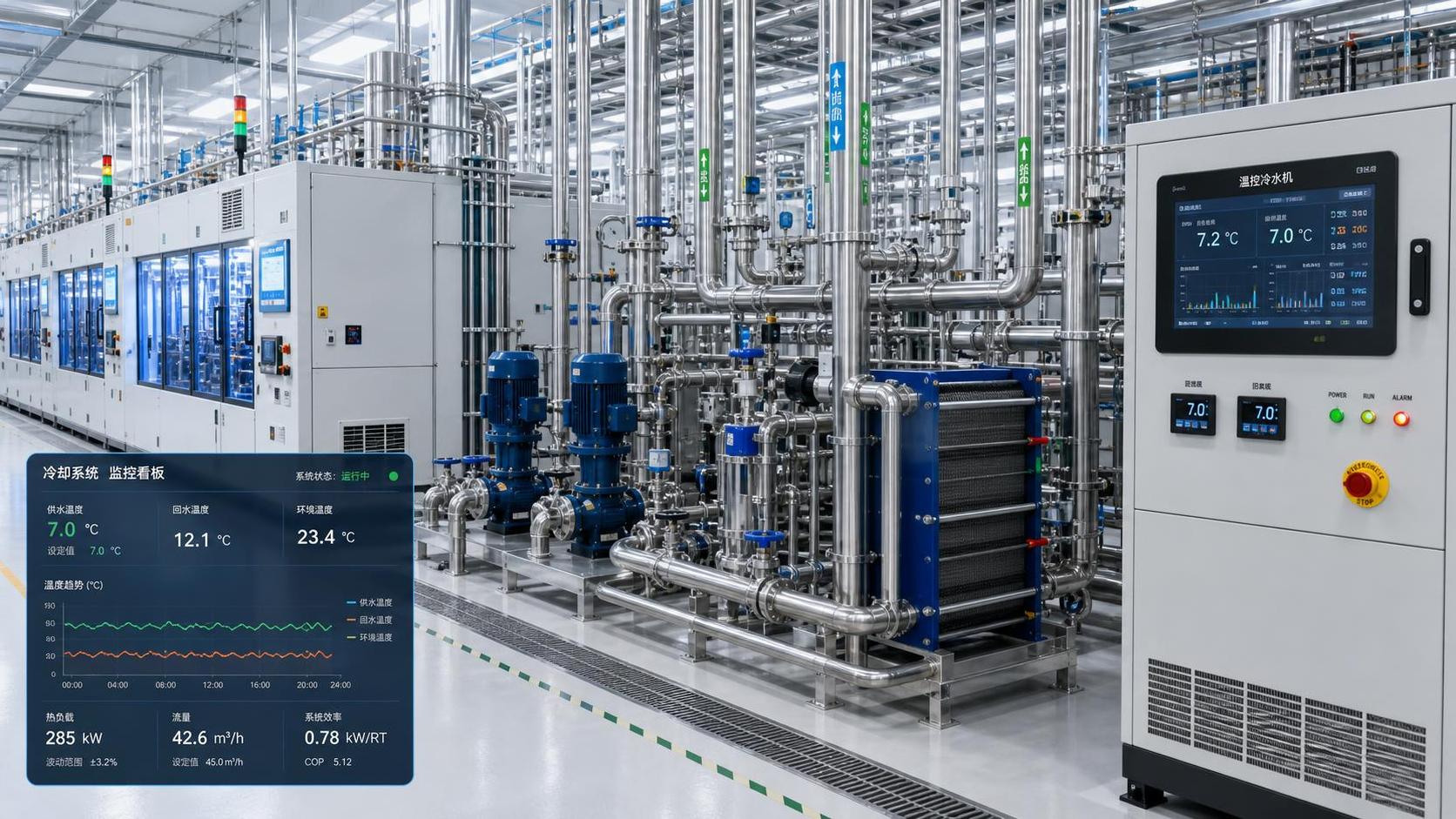
- Trend data showing temperature deviation during step-load tests.
- Part-load efficiency curves, not only nominal capacity points.
- Details on sensor placement and calibration intervals.
- Evidence of recovery time after disturbance scenarios.
- Control architecture information, including alarms, communications, and logging.
- References from applications with similar thermal mass and duty cycle.
This step often exposes whether two systems that appear similar on paper will perform very differently in service.
A Better Way to Move Forward
The strongest decisions usually start with a simple internal map: temperature tolerance, disturbance frequency, acceptable recovery time, energy limits, and monitoring needs.
From there, precision temperature control systems can be screened against measurable requirements instead of broad performance claims.
For organizations tracking thermal efficiency trends through platforms such as GTC-Matrix, that comparison can also be tied to wider questions of refrigerant policy, equipment modernization, and decarbonization strategy.
The next useful step is not to look for the most advanced system in abstract terms.
It is to define the operating disturbances that matter most, test suppliers against those conditions, and build the evaluation around stability, response time, and whole-system efficiency together.
Related News
- EPA Rule Takes Effect for R-410A Equipment ImportsAuthor :Cryogenic Systems Expert

- EN 378-1:2026 Tightens EU Export ChecksAuthor :Cryogenic Systems Expert

- How to Compare Semiconductor Cooling Solutions by Heat Load and Uptime RiskAuthor :Cryogenic Systems Expert

- EU Label Deadline Hits China Chiller ExportsAuthor :Cryogenic Systems Expert

- How Smart Thermal Systems Improve Industrial Cooling EfficiencyAuthor :Cryogenic Systems Expert

- How to Choose Process Cooling Equipment for Stable Temperature ControlAuthor :Cryogenic Systems Expert

- EU Finalizes 2026 HFC Quota Cut for R-134a ChillersAuthor :Cryogenic Systems Expert

- EU Tightens HFC-134a Quotas for Industrial ChillersAuthor :Cryogenic Systems Expert

- REACH SVHC Update Pressures HFC-134a Chiller Supply ChainsAuthor :Cryogenic Systems Expert

- EU PFAS Coolant Ban Reshapes Chiller ExportsAuthor :Cryogenic Systems Expert

- EU REACH Restricts PFAS Cooling Media ImportsAuthor :Cryogenic Systems Expert

- EU Ecodesign Rule Takes Effect for Industrial ChillersAuthor :Cryogenic Systems Expert

- EU REACH Rule Takes Effect for PFAS in Industrial Cooling ExportsAuthor :Cryogenic Systems Expert

- Industrial Cooling for Plastic Processing: How to Size for Stable Cycle TimesAuthor :Cryogenic Systems Expert

- EU F-Gas Update Bars R404A/R507 in Commercial CoolingAuthor :Cryogenic Systems Expert

- DOE Raises Chiller Efficiency Standard From October 2026Author :Cryogenic Systems Expert

- India Mandates BIS Energy Certification for Industrial ChillersAuthor :Cryogenic Systems Expert

- Energy-Efficient Heat Exchange for Process Cooling: Cost vs PaybackAuthor :Cryogenic Systems Expert

- EPA R-134a Import Ban Takes Effect on July 13, 2026Author :Cryogenic Systems Expert

- India BIS Rule Takes Effect for Industrial ChillersAuthor :Cryogenic Systems Expert

- EPA Cuts R134a Import Quotas 20% From July 10Author :Cryogenic Systems Expert

- How to Compare Energy-Efficient Cooling Systems for Factory Expansion ProjectsAuthor :Cryogenic Systems Expert

- Chiller Price Index Rises 11.3% in Q2Author :Cryogenic Systems Expert

- Saudi SASO Tightens Chiller Import Compliance From July 10Author :Cryogenic Systems Expert

- Dubai Opens Fast-Track Chiller TendersAuthor :Cryogenic Systems Expert

- Japan Raises Chiller COP Floor to 6.2 From Sept. 1Author :Cryogenic Systems Expert
![]()
- Compact Thermal Management in Smart Devices: Common Failure RisksAuthor :Cryogenic Systems Expert

- Thermal Management for Batteries: Cooling Methods ComparedAuthor :Cryogenic Systems Expert

- How Compact Thermal Design Extends Smart Device UptimeAuthor :Cryogenic Systems Expert

- Shanghai-Rotterdam Reefer Rates Jump 37% in a WeekAuthor :Cryogenic Systems Expert

- Process Cooling Equipment Low Maintenance: What Cuts Downtime Over 5 Years?Author :Cryogenic Systems Expert

- Semiconductor Cooling Solutions: Which Design Works Best for High-Density Tools?Author :Cryogenic Systems Expert

- Semiconductor Thermal Management Systems: Preventing Yield Loss from Heat DriftAuthor :Cryogenic Systems Expert

- EPA Clears R-1234ze(E) for Industrial ChillersAuthor :Cryogenic Systems Expert
 for Industrial Chillers")
- DOE Raises Chiller IEER Floor to 12.8 From Oct. 2026Author :Cryogenic Systems Expert

- Singapore Refrigeration Show Adds Green Compliance HubAuthor :Cryogenic Systems Expert