



How to Size a Blast Freezer for Industrial Refrigeration Capacity and Pull-Down Time




If you are sizing an industrial refrigeration equipment blast freezer, the key question is not simply “how much product can fit inside.” The real question is whether the system can remove heat fast enough to bring the product from its incoming temperature to the target core temperature within the required pull-down time, without wasting power or compromising product quality. That is where many evaluations go off track. A freezer can look large enough on paper and still be undersized in refrigeration capacity, airflow, evaporator selection, or loading pattern.
For technical selection work, it helps to treat blast freezing as a time-based heat removal problem. You are not buying cold storage. You are buying a process result: a defined mass of product, entering at a defined temperature, leaving at a defined temperature, within a defined cycle time.
Start with the process, not the room size
A common mistake is to begin with chamber volume or pallet count. That matters, but it is not the first number that should drive selection. In practice, blast freezer sizing starts with five process inputs:
- Product type
- Incoming product temperature
- Target final temperature
- Batch mass per cycle or throughput per hour
- Required pull-down time
Once those are clear, the refrigeration load becomes much easier to estimate. If they are unclear, every later discussion about compressor size, evaporator capacity, or fan arrangement becomes guesswork.
Take two examples. Freezing boxed bakery products from 5°C to -18°C is not the same task as freezing dense meat blocks from 20°C to -18°C. Even if the batch weight is identical, the freezing behavior, airflow resistance, latent heat removal profile, and acceptable freezing time are different. That means the same room dimensions can require very different equipment.
In other words: capacity is about thermal duty over time, not just enclosure size.
What “capacity” actually means in blast freezer selection
In this context, capacity usually gets mixed up across three different meanings:
- Storage capacity: how much product can physically fit in the chamber
- Refrigeration capacity: how much heat the system can remove, usually expressed in kW
- Process capacity: how much product can be frozen to spec within the required cycle time
For selection decisions, process capacity is the one that matters most. It combines the other two but adds the thing that actually affects operations: time.
A short direct answer is this: size the freezer by calculating total heat load per batch or per hour, then match that load to a realistic refrigeration capacity at actual operating conditions, with enough margin for airflow losses, door openings, product variability, and frost buildup.
How to estimate the thermal load without oversimplifying it
The product load is the center of the calculation. In broad terms, you need to remove:
- Sensible heat above freezing point
- Latent heat during phase change
- Sensible heat below freezing point
Then add the non-product loads:
- Heat gain through walls, floor, and ceiling
- Infiltration from door openings
- Fan motor heat
- Lighting and internal equipment loads
- Defrost-related impact, where relevant
- Packaging and rack mass that also needs cooling
Many first-pass estimates focus only on the product itself. That often leads to undersizing, especially in operations with frequent loading cycles, manual handling, or warm packaging materials entering with the product.
If the freezer is used in repeated batch operation, it is also worth checking whether the room returns fully to set condition between loads. In some plants, the second and third batches of the shift perform worse than the first because the system never fully recovers. A selection that works for one isolated batch may fail under actual production rhythm.
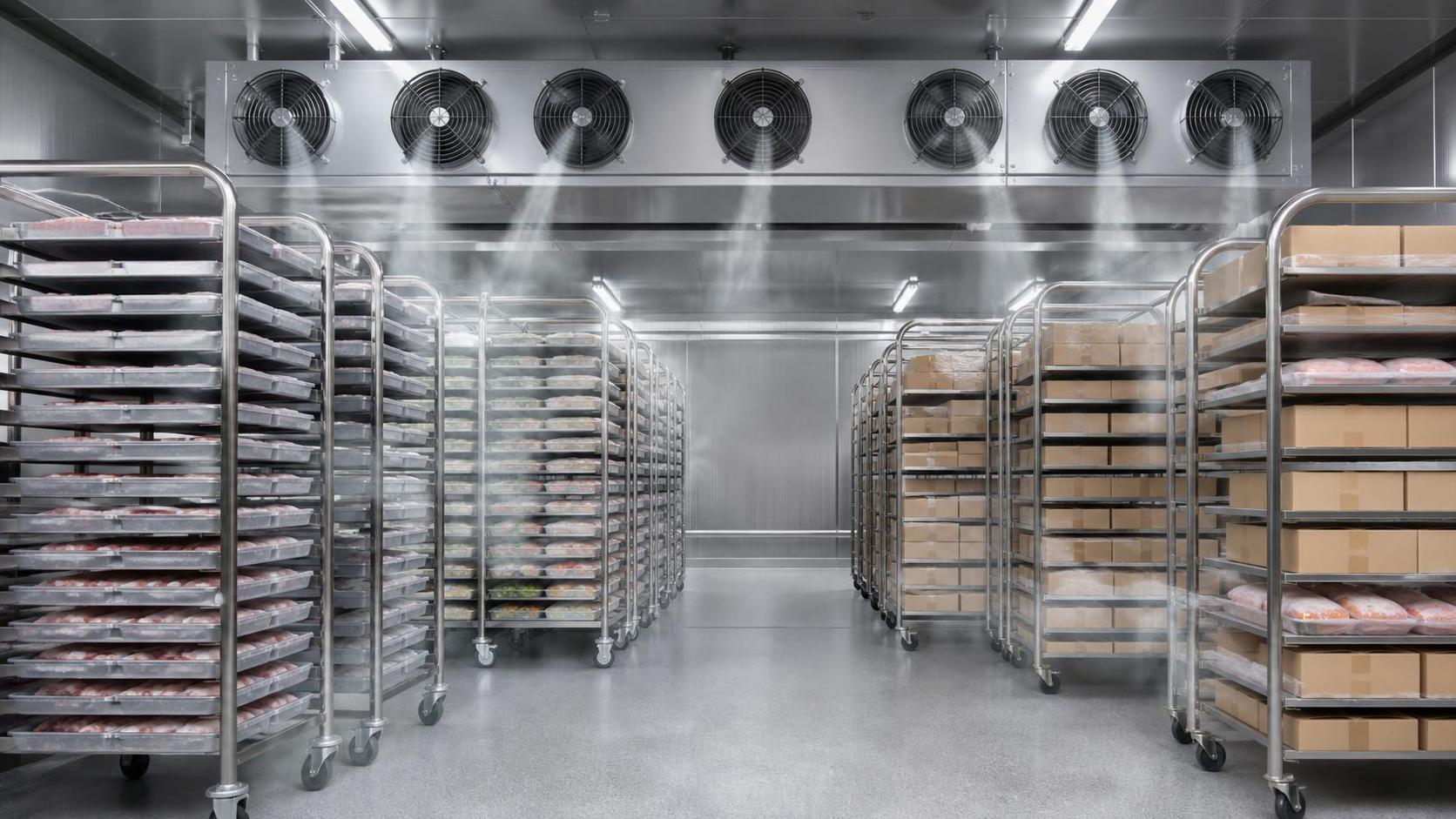
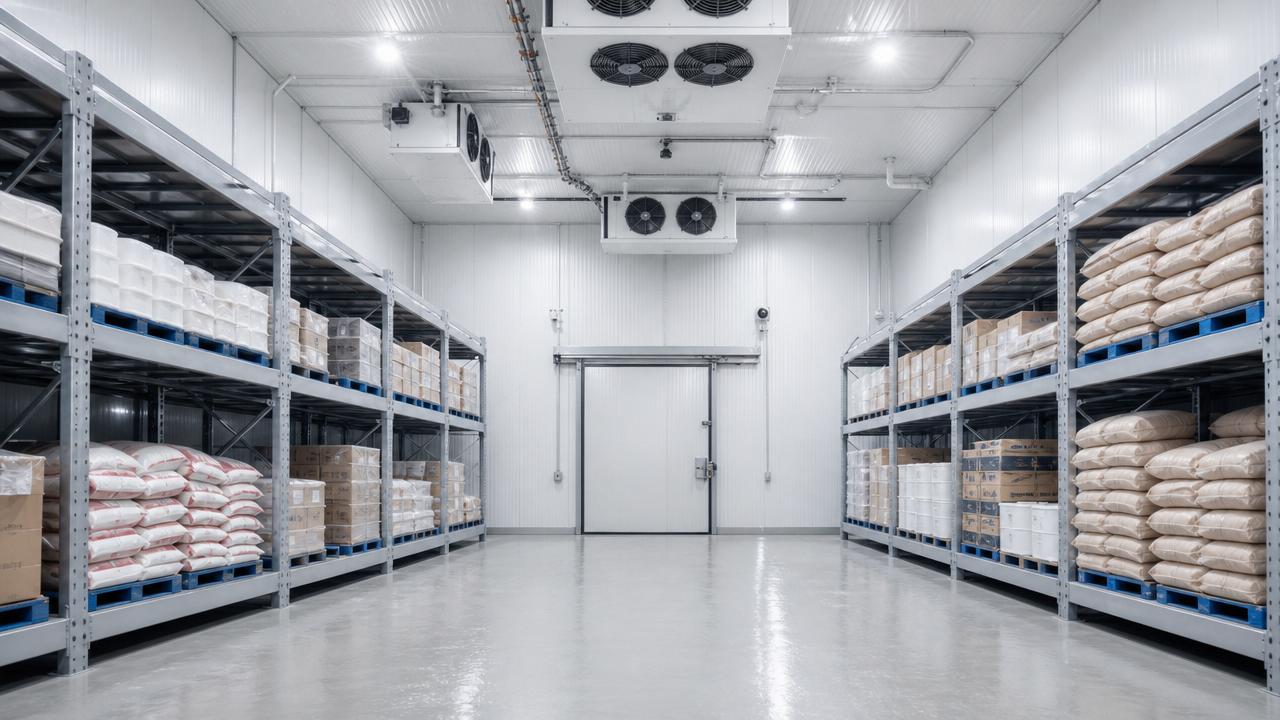
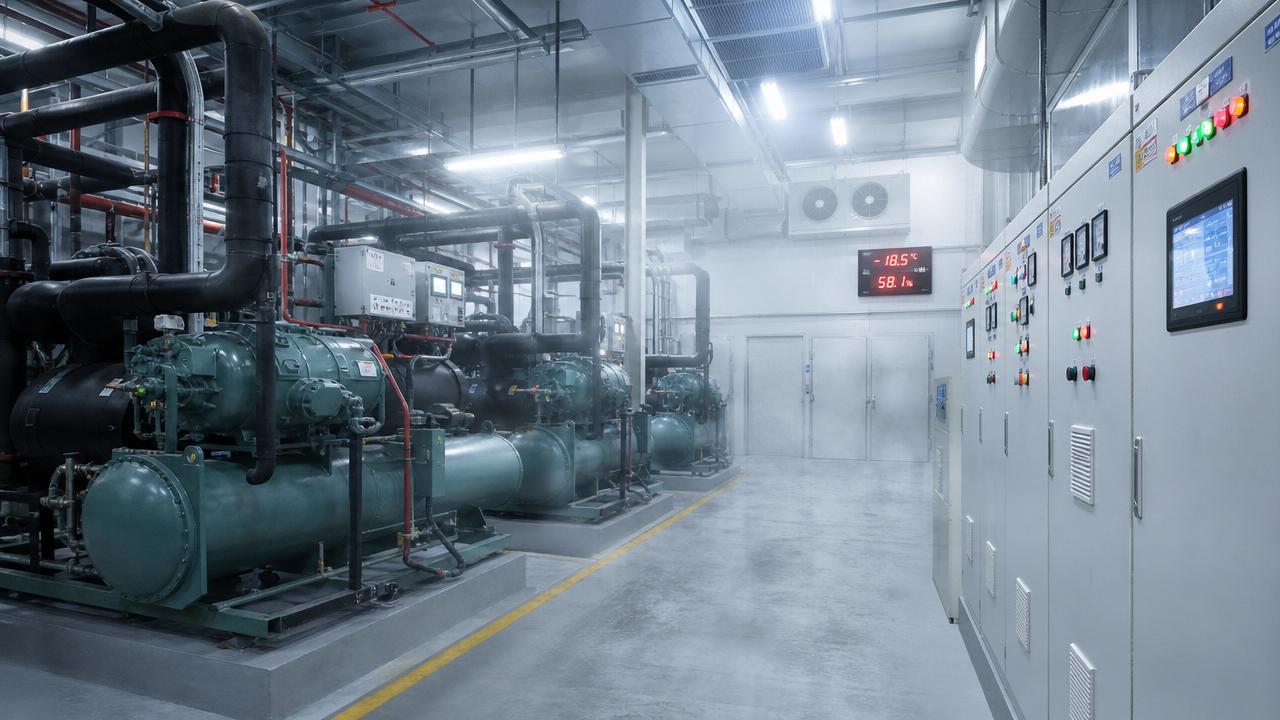
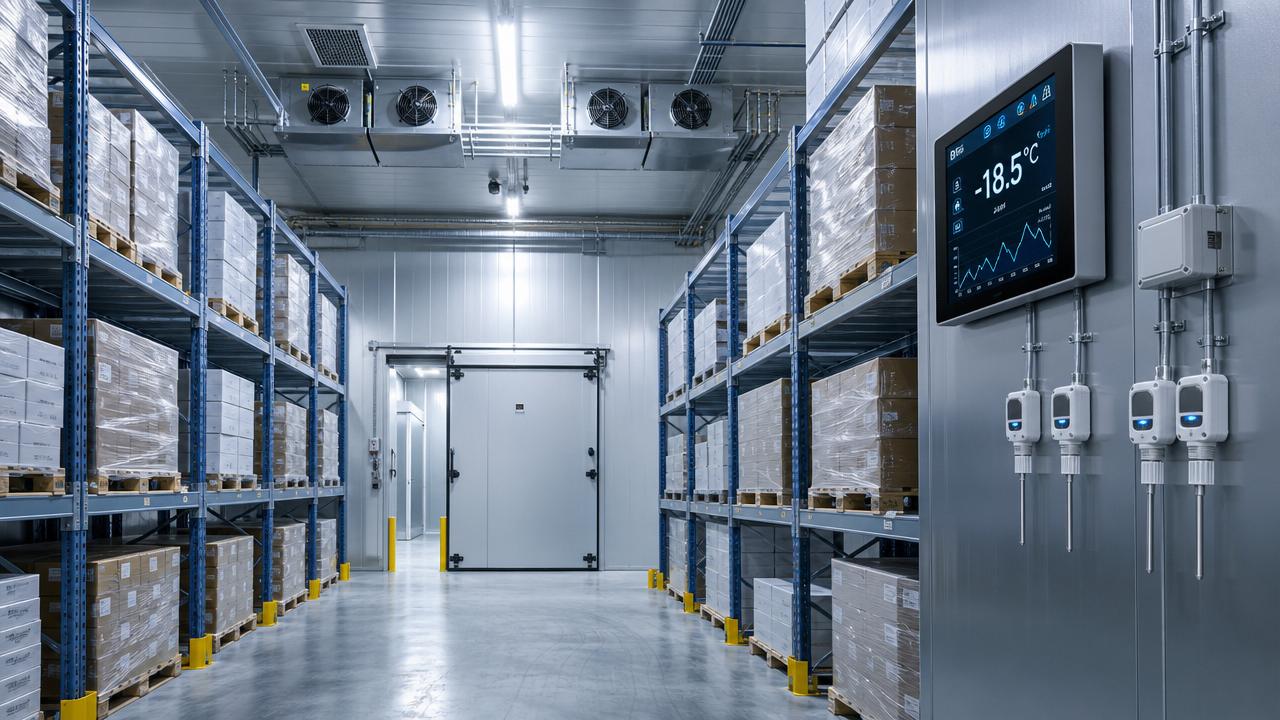
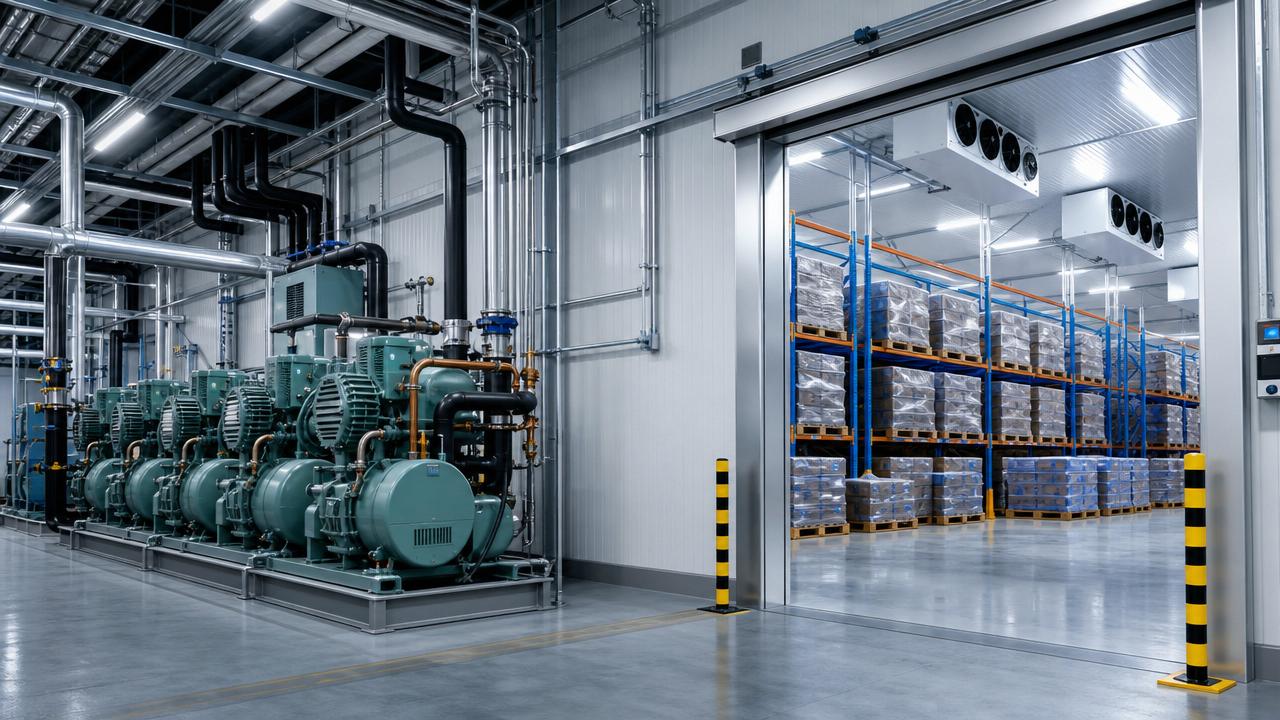
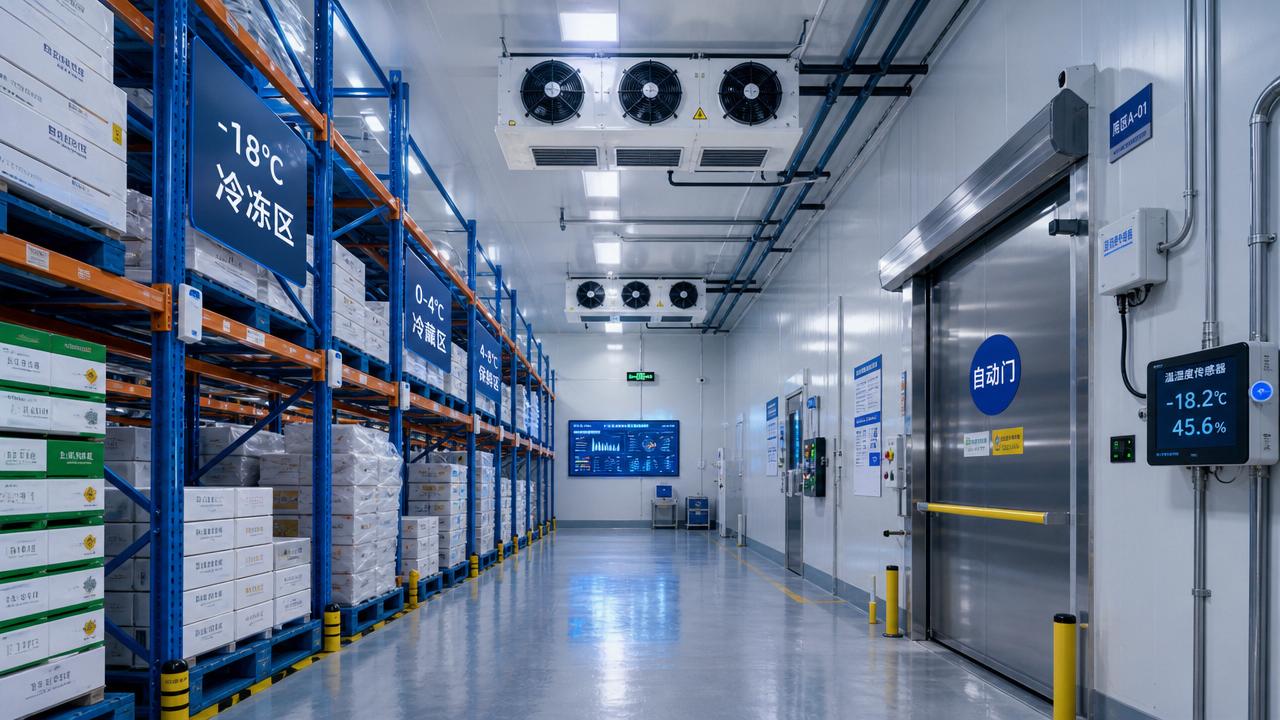
[图片占位符1:技术人员查看托盘式速冻间的产品装载和气流路径示意,alt="industrial refrigeration equipment blast freezer airflow and load sizing layout"]
Pull-down time changes everything
Two systems may eventually reach the same product temperature, but if one takes twice as long, it is not equivalent. Pull-down time drives both production output and product quality. In food applications, longer freezing times can increase ice crystal damage, drip loss after thawing, texture degradation, and process bottlenecks. In some industrial or pharmaceutical applications, delayed temperature reduction can affect downstream handling windows or compliance requirements.
This is why technical assessors should ask a blunt question early: What is the maximum acceptable pull-down time at full design load?
If the answer is vague, the project is not ready for final equipment selection.
It also helps to separate “room air temperature” from “product core temperature.” Suppliers sometimes quote aggressive chamber temperature performance, but the production requirement is usually about the product core. A freezer that reaches a low air temperature quickly may still underperform if airflow distribution is uneven or product stacking is too dense.
Airflow is not a side issue
Blast freezing depends on heat transfer at the product surface. Refrigeration capacity alone does not guarantee fast freezing. If airflow is poorly distributed, if cartons block the air path, or if pallets are packed too tightly, the evaporator may have enough nominal capacity while the product still freezes slowly.
This is one of the more expensive mistakes in specification reviews: choosing a freezer on compressor numbers alone.
When comparing options, check:
- Required air velocity across the product
- Uniformity of airflow from front to back and top to bottom
- Acceptable stacking pattern and carton spacing
- Pressure drop across loaded product
- Whether the design suits trays, trolleys, racks, or pallets
A blast freezer designed for tray-loaded loose product may perform badly with dense palletized cartons. The opposite can also happen. This is not a small mismatch; it can change the freezing time enough to affect line balancing and daily throughput.
Be careful with nominal refrigeration ratings
Another selection trap is using published refrigeration capacity without checking the rating condition. Compressor and evaporator capacities depend on suction temperature, condensing temperature, refrigerant choice, superheat, defrost strategy, and ambient conditions. A nominal kW figure taken from a brochure may not represent your real operating point.
That matters even more when the plant operates in hot climates, with variable condenser performance, or under seasonal load swings. If a supplier quotes capacity, ask for the basis:
- Evaporating temperature
- Condensing temperature
- Refrigerant used
- Fan operation assumptions
- Frost condition or clean coil condition
- Whether the value is net usable capacity or gross capacity
Technical evaluation gets stronger when every quoted number is tied to a condition set. Without that, you are comparing marketing values, not operating performance.
What experienced assessors usually check before approving a freezer size
In real projects, experienced reviewers tend to look beyond the thermal math and ask how the freezer will actually be used. That is where practical sizing often succeeds or fails.
They usually confirm whether the incoming product temperature is stable or highly variable. They look at batch loading discipline, because the best-designed chamber will still struggle if operators overload it or block air channels. They check whether the process is truly batch-based or behaves more like semi-continuous operation. They ask how often doors open during a cycle. And they verify whether there is a future throughput increase planned within the next few years.
This last point matters. Oversizing can be wasteful, but sizing with no headroom at all can lock the site into immediate limits. A modest design margin is reasonable when there is a clear expansion case. A large speculative margin, on the other hand, often means higher capital cost, poorer part-load efficiency, and more control complexity than the process really needs.
Where mis-sizing usually comes from
Most bad selections do not come from a single huge error. They come from several small assumptions stacking up:
- Using average product weight instead of peak batch weight
- Ignoring packaging heat load
- Assuming perfect airflow through a tightly packed load
- Accepting nominal equipment ratings without condition checks
- Confusing storage temperature with freezing duty
- Using room temperature as proof of product core performance
One more point deserves attention: blast freezers are not always the right answer. If the process requires very high throughput with stable product geometry, a tunnel or spiral system may be more appropriate. If the real need is holding already frozen product, a blast freezer may be unnecessary overkill. Good selection work sometimes ends with “this is the wrong equipment category,” and that is a useful conclusion.
A practical way to compare supplier proposals
When reviewing bids for an industrial refrigeration equipment blast freezer, compare them against a single process sheet. Keep every supplier tied to the same assumptions:
- Product description and unit dimensions
- Mass per batch or hourly throughput
- Entry and exit temperatures
- Required core temperature
- Maximum pull-down time
- Loading arrangement
- Ambient design condition
- Door-opening pattern
Then ask each supplier to state the refrigeration basis clearly and explain how airflow is managed through the actual product arrangement. This often reveals whether a proposal is genuinely engineered or simply adapted from a standard cold room package.
For teams that track refrigeration technology, energy cost shifts, and equipment evolution across sectors, intelligence platforms such as GTC-Matrix can be useful as a background reference when comparing system approaches, refrigerant direction, and broader industrial cooling trends. That kind of context does not replace project-specific load calculation, but it can help frame vendor claims more critically.
Before you finalize the size
Ask for evidence of performance at conditions close to yours. That may be a tested reference case, a detailed thermal calculation, or a clearly stated design model. If the process is sensitive, request confirmation of product core pull-down rather than room air temperature alone.
Also check what happens off design: partial load, frost buildup, high ambient days, and real operator behavior. Freezers do not live in ideal conditions, and neither should your sizing logic.
The best selection is usually the one that matches the actual freezing task with the least ambiguity. A properly sized industrial refrigeration equipment blast freezer should give you repeatable pull-down time, acceptable operating cost, and enough process resilience to handle day-to-day variation without hiding behind oversized hardware.
FAQ
Is chamber volume enough to size a blast freezer?
No. Chamber volume only tells you how much can fit. It does not tell you whether the system can remove heat fast enough to meet the required freezing time.
Should I size for average load or peak load?
If the freezer must reliably meet production targets, size against the realistic peak operating case, then check part-load behavior as a separate issue.
Why do two freezers with similar kW ratings perform differently?
Because rating conditions, airflow design, evaporator selection, loading pattern, and frost behavior can all change real pull-down performance.
Is lower room temperature always better?
Not necessarily. Very low air temperature does not guarantee faster or more uniform product freezing if airflow and product presentation are poor.
When should I consider something other than a blast freezer?
If throughput is very high and product format is consistent, continuous systems such as tunnel or spiral freezers may be a better fit. If the product is already frozen, a cold storage room may be enough.
Image Placeholder List
- Position suggestion: After the section on thermal load and before the discussion of pull-down time
Image content: A technical illustration or plant photo showing loaded racks or pallets, airflow direction, and freezing zone layout inside a blast freezer
Alt text: industrial refrigeration equipment blast freezer airflow and load sizing layout
Internal Link Anchor Text Suggestions
- Blast freezer vs cold storage room: suggested link to a comparison page
- How to calculate industrial refrigeration load: suggested link to a technical guide
- Evaporator selection for low-temperature rooms: suggested link to a component selection article
- Industrial refrigerant trends and compliance factors: suggested link to an industry insights page
- Tunnel freezer and spiral freezer selection basics: suggested link to an equipment comparison page
External Authority Source Directions
- Industry association technical guidance on refrigeration load calculation and frozen food processing
- Government or regulatory agency pages on refrigerant rules, efficiency standards, and environmental compliance
- Official manufacturer engineering manuals for compressors, evaporators, and low-temperature system design
Related News
- How to Size a Blast Freezer for Industrial Refrigeration Capacity and Pull-Down TimeAuthor :Cryogenic Systems Expert

- MPA Opens Fast-Track Cold Chain Inspections in SingaporeAuthor :Cryogenic Systems Expert

- GCC Cold Storage Imports Face GCC-CLIMAT 2026 RuleAuthor :Cryogenic Systems Expert

- Industrial Refrigeration Equipment Evaporator Selection: Capacity, Frost, and Energy TradeoffsAuthor :Cryogenic Systems Expert

- Industrial Refrigeration Equipment: Cost Factors to CompareAuthor :Cryogenic Systems Expert

- Manzhouli Rail Hub Sets Weekly Reefer RecordAuthor :Cryogenic Systems Expert

- Manzhouli Rail Cold-Chain Volume Hits Weekly HighAuthor :Cryogenic Systems Expert

- High-Precision Temperature Control for Stable Cold StorageAuthor :Cryogenic Systems Expert
![]()
- High-Precision Temperature Control in Cold StorageAuthor :Cryogenic Systems Expert

- Japan's METI Mandates AI Energy Models for Cold StorageAuthor :Cryogenic Systems Expert
![]()
- Fruit Attraction Madrid 2026 Booths 91% Booked; Smart Cold Storage Now EU Entry GateAuthor :Cryogenic Systems Expert

- Fruit Attraction Madrid: 90% Booths Booked; Smart Cold Storage Now EU Entry GateAuthor :Cryogenic Systems Expert
![]()
- How Global Energy Costs Are Changing Cold Storage PlanningAuthor :Cryogenic Systems Expert

- High-Precision Temperature Control in Cold StorageAuthor :Cryogenic Systems Expert

- Hema's Discount Brand 'Chao He Suan NB' Expands to Southeast AsiaAuthor :Cryogenic Systems Expert

- State Council Approves Urban Renewal '15th Five-Year' Plan, Boosting Cold Storage Retrofit DemandAuthor :Cryogenic Systems Expert

- Colombia Upholds Anti-Dumping Duties on Chinese Acrylic SheetsAuthor :Cryogenic Systems Expert

- PSA Launches Express Lane for Industrial Thermal EquipmentAuthor :Cryogenic Systems Expert

- Smart Thermal Systems for Cold Storage: Control Gains That Cut Energy WasteAuthor :Cryogenic Systems Expert

- PSA Launches Express Lane for Temperature-Critical CargoAuthor :Cryogenic Systems Expert

- Pure Power Sources: What Matters Most for Cold Storage ReliabilityAuthor :Cryogenic Systems Expert

- Brazil Grants Unilateral Visa-Free Access to Chinese CitizensAuthor :Cryogenic Systems Expert

- India BIS Proposes Mandatory Low-GWP Verification for R449A in Cold StorageAuthor :Cryogenic Systems Expert

- US BIS Adds 3 Cold Storage Controller Makers to Entity ListAuthor :Cryogenic Systems Expert

- High-Precision Temperature Control in Cold Storage OperationsAuthor :Cryogenic Systems Expert

- India BIS Proposes Mandatory Low-GWP Verification for R449A in Cold StorageAuthor :Cryogenic Systems Expert

- US BIS Adds 3 Chinese Cold Storage Controller Makers to Entity ListAuthor :Cryogenic Systems Expert

- China Expands HCFCs Phase-Out Verification for Cold Storage ExportsAuthor :Cryogenic Systems Expert

- Smart Thermal Systems for Cold Storage: What Delivers PaybackAuthor :Cryogenic Systems Expert

- China Expands HCFCs Phase-Out Checks to 127 Chiller PlantsAuthor :Cryogenic Systems Expert

- Shanghai Port Reefer FEU Rates Surge Past $12,800 Amid Red Sea DiversionAuthor :Cryogenic Systems Expert

- Red Sea Crisis Pushes Shanghai-Rotterdam Reefer Freight to $12,520/FEUAuthor :Cryogenic Systems Expert
![]()
- What Intellectualization Means for Smarter Cold Storage OperationsAuthor :Cryogenic Systems Expert