Industrial Thermal Systems: Common Failure Risks in Continuous Operation




Why Continuous Operation Changes the Risk Profile
Continuous production rarely fails because of one dramatic event. More often, industrial thermal systems drift out of balance long before alarms become urgent.
A slight fouling layer, unstable suction pressure, or poor condensate removal can quietly raise energy use and shorten equipment life.
That is why failure analysis in industrial thermal systems cannot stop at nameplate data. Real risk depends on duty cycle, ambient conditions, load variation, and maintenance discipline.
In practice, the same cooling loop behaves differently in a food line, a semiconductor utility room, or a mixed-process plant with aging compressed air assets.
GTC-Matrix often frames this as the link between the thermal center and the power heart: heat exchange, cooling, compression, and vacuum performance deteriorate together, not separately.
For that reason, early diagnostics matter less as a repair tactic and more as an operational decision tool.
Different Operating Environments Create Different Failure Paths
Not every continuous-duty site stresses industrial thermal systems in the same way. The failure point usually reflects what the process cannot tolerate.
Where product quality depends on narrow temperature windows, sensor drift and control instability become larger threats than visible mechanical wear.
Where uptime is everything, rotating components, lubrication quality, and cooling water cleanliness often dominate the risk picture.
In high-purity utilities, contamination risk changes the maintenance logic. Oil carryover, moisture intrusion, and leak-back can become more expensive than motor failure.
When heat load fluctuates throughout the shift
Facilities with variable batch schedules often push industrial thermal systems through repeated starts, partial loads, and sudden demand peaks.
This is where controls, valves, and exchanger response time deserve closer attention. Equipment may appear correctly sized but still cycle inefficiently.
A common misread is to blame the compressor first. Sometimes the deeper issue is unstable process demand or delayed heat rejection.
When operation is stable but contamination slowly builds
In cleaner, steady-state operations, failure tends to arrive quietly. Approach temperature widens, pressure drop rises, and motors work harder without obvious process upset.
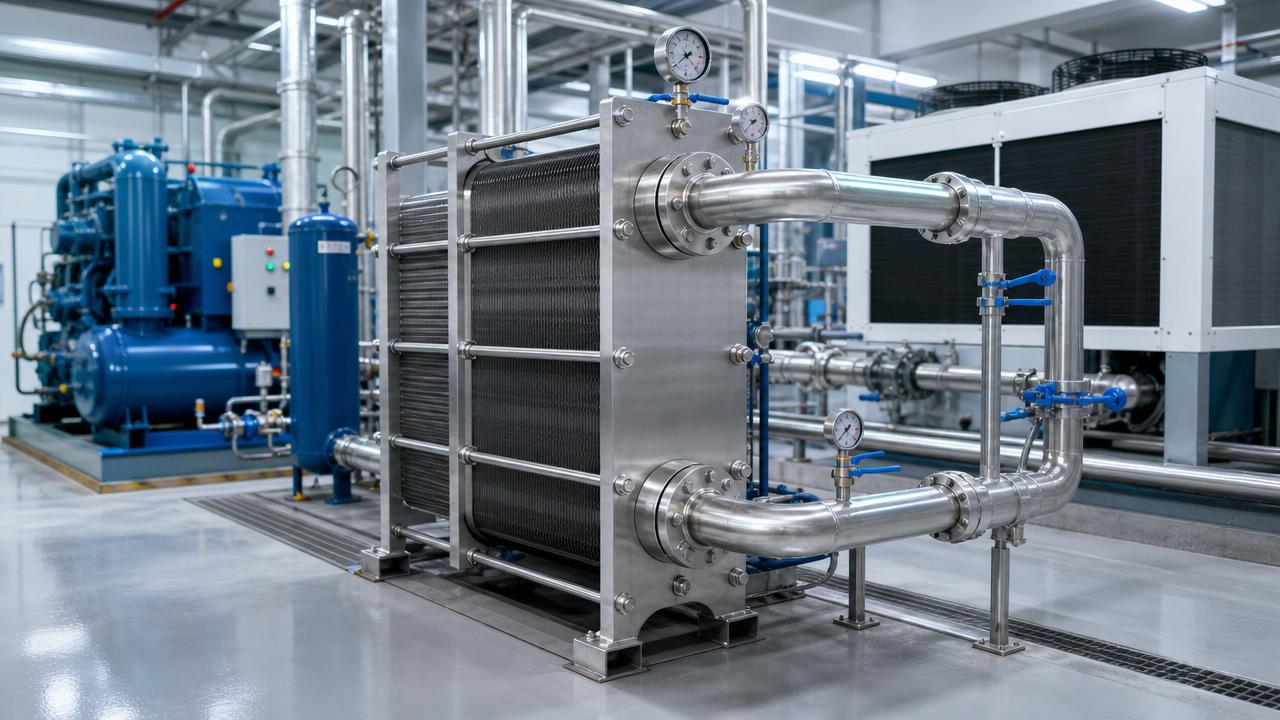
These conditions often affect industrial thermal systems in cooling towers, condensers, oil coolers, and microchannel heat exchangers differently.
The judgment point is not only whether fouling exists, but where it forms first and how quickly it changes system efficiency.
The Failure Risks That Show Up Most Often on Real Sites
Across sectors, several patterns repeat. They look familiar, but their consequences vary sharply by process sensitivity and maintenance response time.
- Heat exchanger fouling that increases approach temperature and forces compressors, pumps, or fans into longer duty cycles.
- Cooling water instability that causes scaling, corrosion, biological growth, or uneven thermal transfer across exchanger surfaces.
- Compressed air leakage and pressure loss that hide behind normal production noise while increasing run hours and discharge temperature.
- Lubrication degradation in bearings, gearboxes, and screw elements, often accelerated by heat soak or poor shutdown habits.
- Control drift from sensors, actuators, and valves that makes industrial thermal systems look oversized, undersized, or mechanically unstable.
- Refrigerant-side issues such as undercharge, non-condensables, or incorrect superheat that reduce heat rejection without immediate trip events.
The operational challenge is that these problems seldom stay isolated. Poor cooling raises compression temperature, which then accelerates wear and energy loss elsewhere.
In High-Precision Processes, Small Thermal Errors Become Large Business Risks
Pharmaceutical, electronics, and advanced food environments usually judge industrial thermal systems by consistency rather than sheer output.
A unit may still run, yet repeated temperature oscillation can disturb product stability, vacuum quality, drying behavior, or clean utility performance.
In these settings, the most useful warning signs are often indirect: longer pull-down time, tighter valve hunting, drifting dew point, or unexplained utility overlap.
More robust diagnostics usually combine thermal trend data with air quality, moisture control, and process timing records.
This is where intelligence-led monitoring matters. GTC-Matrix tracks how oil-free compression, cleaner refrigerants, and advanced exchanger designs change failure expectations over time.
In Heavy-Duty Utility Networks, Mechanical Stress Tells the Story Earlier
Metals, chemicals, general manufacturing, and large utility plants often accept wider thermal variation, but they punish mechanical weakness quickly.
Here, industrial thermal systems fail more visibly through vibration, elevated oil temperature, unstable bearing condition, and persistent high discharge pressure.
The key judgment is whether the stress comes from true overload or from hidden system resistance.
A fan upgrade, for example, does little if the condenser is already scaled. A larger compressor may worsen efficiency if downstream leakage remains unresolved.
In actual operation, the smarter path is usually sequence review first, component replacement second.
The Same Symptoms Do Not Mean the Same Root Cause
One reason industrial thermal systems are misdiagnosed is that common symptoms overlap. Higher power draw can signal fouling, undercharge, airflow issues, or control mismatch.
That is why comparing application conditions is more useful than comparing isolated alarms.
This comparison is often more actionable than a generic fault list because it connects symptoms to operating context.
What Gets Missed Before Reliability Programs Are Updated
Several mistakes repeat across industrial thermal systems, especially when sites expand capacity without updating thermal strategy.
- Treating similar process lines as identical, even though ambient heat, contamination, or duty rhythm differs.
- Tracking only equipment alarms, not the slower changes in exchanger performance and energy conversion efficiency.
- Choosing maintenance intervals from calendar habits rather than water quality, load profile, and actual run condition.
- Focusing on replacement cost while ignoring implementation downtime, cleaning effort, or compatibility with newer refrigerant rules.
- Assuming one subsystem can be optimized alone, even though compression, cooling, and heat rejection interact continuously.
In many cases, these are not technical blind spots but decision blind spots. The data exists, yet it is not stitched into a usable diagnosis.
How to Match Diagnostics and Maintenance to the Actual Site
A workable plan for industrial thermal systems starts by separating conditions that are permanent from those that only appear during peak load, seasonal change, or product changeover.
After that, the most effective actions are usually straightforward.
- Map heat sources, cooling paths, compressed air demand, and vacuum dependence on one operating timeline.
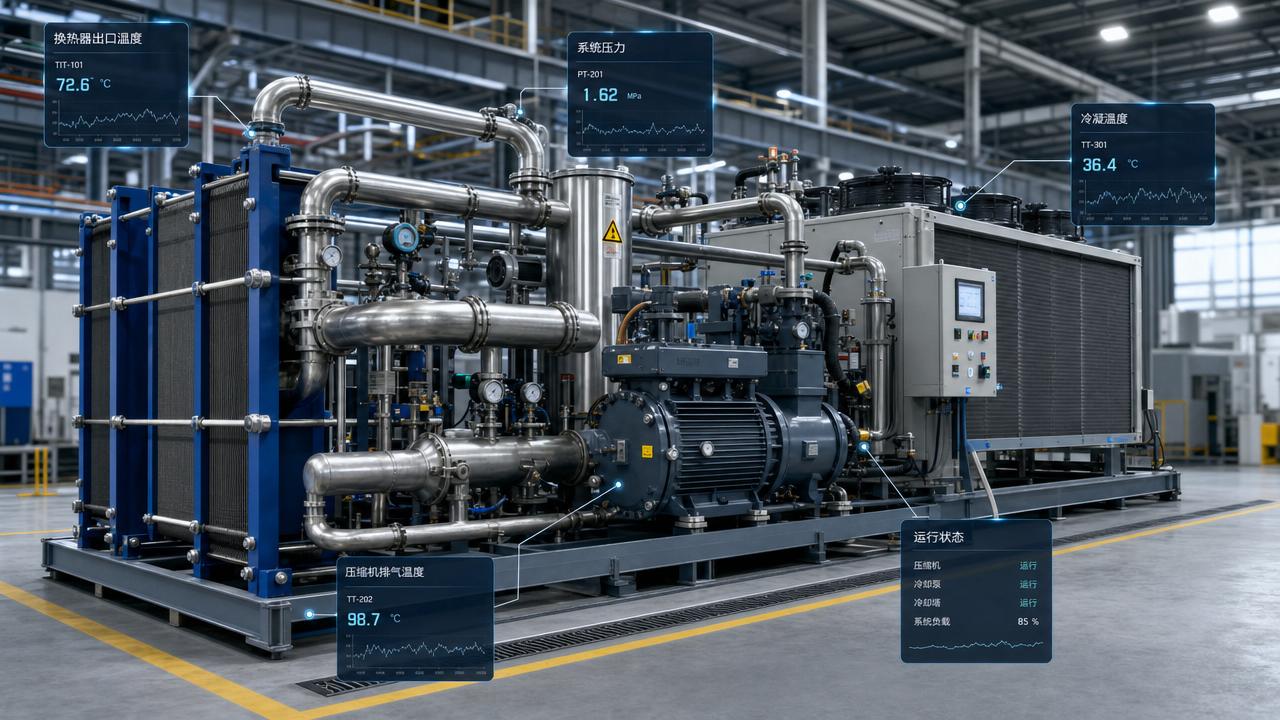
- Set trend thresholds for approach temperature, discharge temperature, pressure drop, dew point, and specific energy consumption.
- Review exchanger cleaning intervals against water chemistry, particulate exposure, and measured thermal degradation.
- Verify controls after production changes, not only after mechanical repair.
- Compare long-term operating cost against retrofit difficulty before selecting oil-free, low-NOx, or microchannel upgrades.
The most resilient industrial thermal systems are not simply overbuilt. They are matched to real operating behavior and reviewed with current technical intelligence.
A practical next step is to organize failure records by scenario, then compare them with energy trends, purity requirements, and maintenance burden.
That approach makes it easier to define where diagnostics should deepen, where retrofit risk is justified, and where routine upkeep already protects uptime well enough.
Ready when you are. Send us a message to get started.
Related News
- Carrier Plans $600 Million Manufacturing and Engineering Center in Fort WorthAuthor :

- Semiconductor Thermal Management: Low Vibration Design PrioritiesAuthor :

- Thermal Interface Materials: What Drives Real Thermal OptimizationAuthor :
![]()
- Global Energy Costs in Europe: What Changed in 2026Author :

- Smart Device Thermal Management: Common Failures and FixesAuthor :

- Thermal Efficiency Optimization: 5 Signs Your System Is Losing HeatAuthor :

- How Precision Temperature Control Systems Improve Process StabilityAuthor :

- How Intellectualization Improves Process Visibility in Modern PlantsAuthor :

- Global Energy Costs in 2026: What Rising Prices Mean for Plant PlanningAuthor :

- Carbon Neutrality Roadmaps: Common Gaps in Industrial PlanningAuthor :

- Heat Transfer Basics: What Affects Efficiency in Industrial EquipmentAuthor :

- Industrial Thermal Systems: Common Failure Risks in Continuous OperationAuthor :

- Global Energy Costs: 2026 Risk Signals to WatchAuthor :

- Pneumatic Power Systems: Common Sizing Mistakes to AvoidAuthor :

- How Thermal Power Systems Cut Downtime in 2026Author :

- Clean Energy Technology Trends Reshaping Industry in 2026Author :

- Pneumatic Power Systems: Key Checks Before Equipment SelectionAuthor :

- Compression Technology Mistakes That Raise Maintenance RiskAuthor :

- Clean Energy Technology Risks to Watch in 2026 ProjectsAuthor :

- Smart Thermal Systems: 5 Signals Your Controls Are Wasting HeatAuthor :

- How to Size Pneumatic Power Systems for Stable OutputAuthor :

- Pneumatic Power Systems: Key Safety Risks in Daily OperationAuthor :

- Clean Energy Technology Shifts Reshaping Industrial InvestmentAuthor :

- Intellectualization in Industry: What Delivers Measurable Value?Author :

- Thermal Management Mistakes That Shorten Equipment LifeAuthor :

- Clean Energy Technology Options That Fit Real Manufacturing UpgradesAuthor :

- Energy-Saving Technologies Worth Tracking in 2026Author :