Industrial Cooling Systems: Common Sizing Mistakes to Avoid




Sizing errors in industrial cooling systems rarely fail loudly at first. They appear as rising power bills, unstable temperatures, short cycling, delayed commissioning, and avoidable maintenance. In a market shaped by tighter energy targets, refrigerant transitions, and stricter uptime expectations, correct sizing has become a strategic engineering decision. Avoiding common mistakes helps protect thermal performance, control lifecycle cost, and improve long-term system reliability across diverse industrial environments.
Why sizing industrial cooling systems now demands closer attention
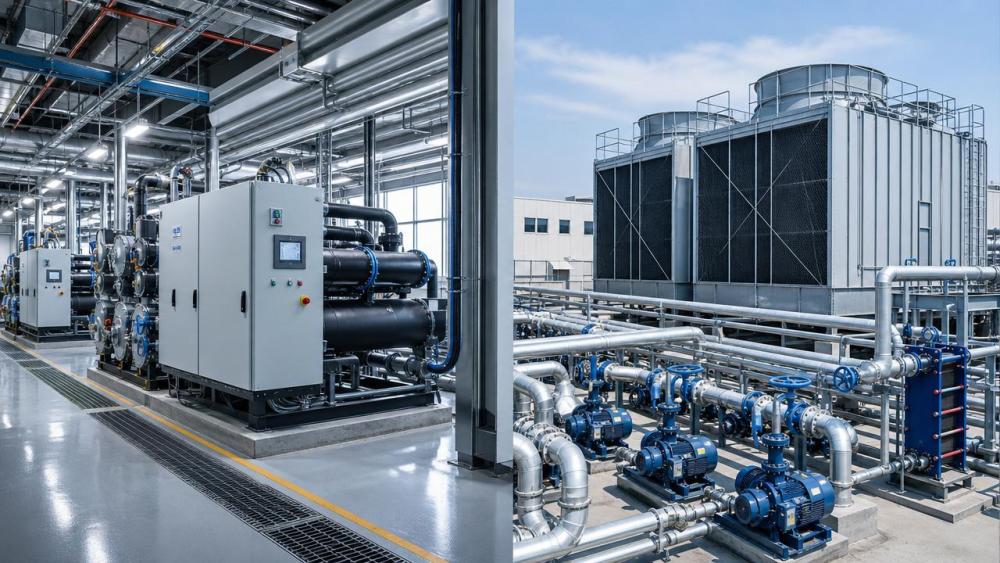
The operating context for industrial cooling systems is changing quickly. Facilities are adding automation, increasing heat density, and expecting tighter process stability. At the same time, energy pricing remains volatile.
This means traditional rule-of-thumb sizing is becoming less reliable. A system sized only for nominal conditions may underperform during peak loads, future expansion, or seasonal swings.
Another trend is the wider use of modular plants and hybrid cooling architectures. Chillers, cooling towers, dry coolers, pumps, and controls must now operate as an integrated thermal network.
When one sizing assumption is wrong, the impact spreads. Pump energy rises, compressor loading shifts, approach temperatures widen, and process quality can drift outside tolerance.
The most frequent sizing mistakes continue to repeat across projects
Many industrial cooling systems are not mis-sized because of one large error. They are mis-sized because several small assumptions stack together during design and procurement.
1. Using nameplate heat loads instead of real operating loads
Installed equipment capacity is not the same as actual heat rejection. Duty cycles, diversity factors, standby patterns, and process sequencing all affect true thermal demand.
Oversizing from nameplate totals raises capital cost and often reduces part-load efficiency. Undersizing creates temperature instability during simultaneous peak events.
2. Ignoring ambient design extremes
Industrial cooling systems perform differently across climates. Wet-bulb temperature, dry-bulb peaks, altitude, and seasonal humidity shifts must be included in sizing decisions.
A system sized for average weather may fail during heat waves. That risk is growing as climate variability increases in many industrial regions.
3. Misjudging process temperature tolerance
Not every process needs the same temperature precision. Some applications tolerate wider ranges, while others demand narrow control bands and rapid response.
If tolerance is misunderstood, industrial cooling systems may be oversized for precision that the process never uses, or under-designed for critical thermal stability.
4. Overlooking part-load behavior
Most plants do not operate at full load continuously. Chillers and pumps spend much of the year in part-load conditions, where efficiency curves matter more than peak ratings.
Sizing industrial cooling systems only around maximum demand often creates poor turndown, unstable cycling, and excess electricity consumption.
5. Failing to include distribution losses
Pipe length, insulation quality, elevation changes, valve pressure drops, and heat gain through distribution all influence required cooling capacity and pump head.
A correctly sized chiller connected to an incorrectly sized network still produces a poorly performing system. Thermal and hydraulic sizing must be checked together.
6. Treating future expansion as unlimited safety margin
Future capacity matters, but excessive spare sizing can be expensive. It may also reduce current efficiency if equipment remains lightly loaded for long periods.
A better approach is staged capacity planning. Modular industrial cooling systems often support growth more effectively than one oversized central unit.
The drivers behind these mistakes are becoming more visible
Several industry shifts explain why sizing errors persist, even in technically advanced projects. The table below summarizes the main drivers.
These drivers show why industrial cooling systems should be assessed as dynamic assets, not static equipment packages. Thermal loads, controls, and operating strategy must be aligned.
The impact extends beyond utility cost into reliability and project execution
Poorly sized industrial cooling systems affect more than monthly energy consumption. They influence commissioning speed, process consistency, maintenance frequency, and equipment lifespan.
When capacity is too low, production interruptions and alarm events become more likely. When capacity is too high, compressors cycle inefficiently and controls struggle to stabilize temperatures.
- Thermal drift can lower product quality in temperature-sensitive applications.
- Frequent starts and stops can shorten compressor and pump life.
- Oversized systems can lock facilities into avoidable operating expense.
- Undersized systems can delay project acceptance and force late redesign.
In broader industrial settings, cooling also interacts with compressed air rooms, vacuum skids, power electronics, and heat recovery loops. A sizing error in one area may destabilize others.
What deserves closer attention before selecting industrial cooling systems
A stronger sizing process begins with better questions. The goal is not simply adding margin. The goal is building reliable industrial cooling systems around verified operating reality.
- Confirm actual heat loads by process step, duty cycle, and simultaneous operation.
- Use realistic ambient design points, including site extremes and seasonal patterns.
- Check both thermal capacity and hydraulic performance across the full network.
- Model part-load efficiency instead of relying only on full-load ratings.
- Define process temperature tolerance with measurable control limits.
- Plan expansion through modularity, headers, or reserved tie-in points.
- Review control logic early, especially sequencing, staging, and sensor placement.
For industrial cooling systems connected to mission-critical processes, scenario testing is valuable. Peak load days, partial shutdowns, fouling conditions, and utility interruptions should be considered.
A practical framework can reduce sizing risk and improve long-term decisions
The following framework helps turn thermal sizing into a repeatable decision process rather than a one-time estimate.
This framework supports better specification quality, fewer revisions, and more resilient industrial cooling systems. It also aligns with broader decarbonization and efficiency goals.
The strongest next step is a data-based review before design assumptions harden
Industrial cooling systems should be sized from measured conditions, operating scenarios, and future flexibility plans. That approach is more valuable today than simply adding conservative reserve capacity.
A focused review of load data, ambient assumptions, piping losses, and part-load behavior can reveal hidden risks early. It can also improve equipment selection and reduce total ownership cost.
For organizations tracking thermal infrastructure, GTC-Matrix provides strategic intelligence on cooling, compression, vacuum, and heat exchange technologies. Better insight supports better sizing, stronger efficiency outcomes, and more confident project decisions.
Ready when you are. Send us a message to get started.
Related News
- Kentucky Regulators Approve $191 Million Cooling Tower at Mitchell Coal PlantAuthor :Thermodynamics Analyst

- Cooling Tower Market Trends Reshaping Replacement Plans and Capital BudgetsAuthor :Thermodynamics Analyst

- Field-Erected Cooling Tower Market: Why Utility Projects Favor Custom DesignsAuthor :Thermodynamics Analyst

- Evaporative Cooling Tower Market Outlook: Demand Drivers, Risks, and Growth AreasAuthor :Thermodynamics Analyst

- When does an industrial cooling radiator outperform a cooling tower?Author :Thermodynamics Analyst

- EU Cooling Tower Standard EN 13771:2026 Takes EffectAuthor :Thermodynamics Analyst

- EU REACH SVHC Update Triggers Cooling Tower DisclosureAuthor :Thermodynamics Analyst

- SASO Adds Bio-Durability Test for Cooling Tower FillAuthor :Thermodynamics Analyst

- EU REACH Update Bars Phthalates in Cooling Tower PVC FillAuthor :Thermodynamics Analyst

- EU Tightens CE Rules for Cooling Tower Steel PartsAuthor :Thermodynamics Analyst

- Shanghai-Rotterdam Cooling Tower Space TightensAuthor :Thermodynamics Analyst

- Hamburg Port Strike Delays Cooling Tower Parts ClearanceAuthor :Thermodynamics Analyst

- ASHRAE 188-2026 Makes Cooling Tower Microbial Control MandatoryAuthor :Thermodynamics Analyst

- India Enforces BIS IS 17842:2026 for Cooling TowersAuthor :Thermodynamics Analyst

- EU REACH Restricts Zinc Inhibitors in Cooling TowersAuthor :Thermodynamics Analyst

- TUV Rheinland Switches Cooling Tower Labels to IEC 61800-9-2Author :Thermodynamics Analyst

- EU REACH Rule Takes Effect for Cooling Tower CoatingsAuthor :Thermodynamics Analyst

- Vietnam to Require IoT Modules in Imported Cooling TowersAuthor :Thermodynamics Analyst

- How to Compare Industrial Cooling Equipment Dry Coolers for Year-Round EfficiencyAuthor :Thermodynamics Analyst

- SASO Tightens Cooling Tower Import Rules for 2027Author :Thermodynamics Analyst

- REACH SVHC Update Limits Copper Corrosion InhibitorsAuthor :Thermodynamics Analyst

- SASO Starts Cooling Tower Data Rule for CoCAuthor :Thermodynamics Analyst

- Saudi SASO Portal Adds Corrosion Data RuleAuthor :Thermodynamics Analyst

- SASO Adds Corrosion Report Rule for Cooling TowersAuthor :Thermodynamics Analyst

- RDHx Prices Rise as AI Demand Lifts Premium ModelsAuthor :Thermodynamics Analyst

- EU EN 13859-2:2026 Mandates Extreme Humidity Heat-Loss TestsAuthor :Thermodynamics Analyst

- VDE Tightens Cooling Tower Test ScopeAuthor :Thermodynamics Analyst

- SASO Tightens Cooling Tower Test Proof for SaberAuthor :Thermodynamics Analyst

- Saudi SABER Cooling Tower Rule Takes Effect EarlyAuthor :Thermodynamics Analyst

- EU Carbon Labels to Cover Cooling Tower ExportsAuthor :Thermodynamics Analyst

- Saudi SABER Cooling Tower Rule Takes Effect EarlyAuthor :Thermodynamics Analyst

- EU Carbon Label Rule Hits Cooling Tower ExportsAuthor :Thermodynamics Analyst

- Saudi SABER Cooling Tower Rule Adds EN 13859-2 TestAuthor :Thermodynamics Analyst

- Saudi SABER Tightens Cooling Tower Energy Report RulesAuthor :Thermodynamics Analyst

- Saudi SASO Tightens Cooling Tower Efficiency FilingAuthor :Thermodynamics Analyst

- Saudi SABER Tightens Cooling Tower Energy Report ChecksAuthor :Thermodynamics Analyst