India Extends CVD on Malaysian Solar Glass to 10.14%




On June 2, 2026, India moved from a temporary trade-risk concern to a confirmed long-term rule setting by extending the countervailing duty on Malaysian patterned tempered glass used for photovoltaic modules for another five years, with rates set at 9.71% to 10.14%. Because this glass is also used in heat-exchange structural components for Cooling Towers and photovoltaic combined heat and power systems, the measure deserves attention not only from direct glass traders but also from Chinese exporters, module integrators, procurement teams, and supply-chain service providers involved in supplying supporting glass substrates and integrated modules into India.
What has been formally confirmed
The confirmed event is that the Department of Revenue under India’s Ministry of Finance formally issued a new rule on June 2, 2026. Under that rule, the validity period of the countervailing duty applied to Malaysian-origin patterned tempered glass for use in photovoltaic modules has been extended by five years.
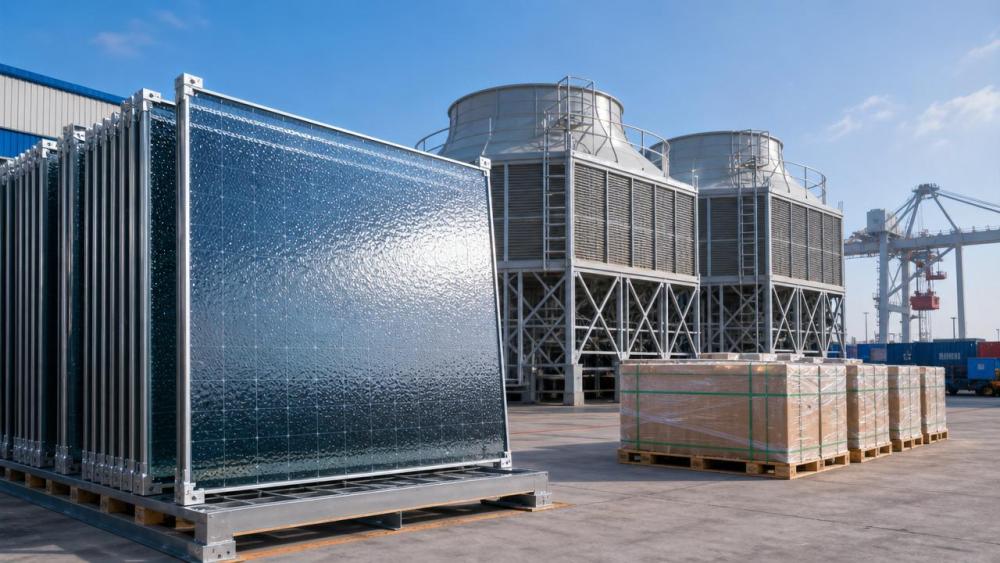
The applicable duty range has been set at 9.71% to 10.14%. The product concerned is described as patterned tempered glass used for photovoltaic modules. The supplied information also indicates that this product is widely used in heat-exchange structural parts for industrial Cooling Towers and photovoltaic combined heat and power systems.
The confirmed business relevance is that this rule change directly affects the compliance route and cost structure for Chinese exporters supplying supporting glass substrate materials and integrated modules to India.
Where the pressure may appear across the supply chain
Trade flows tied to Malaysian-origin glass
From an industry perspective, companies directly trading in the covered glass may face the most immediate impact because the rule is not a general market signal but a product-and-origin-specific trade measure with a five-year extension. The practical pressure point is likely to be in import planning, landed-cost calculation, quotation validity, and contract review where Malaysian-origin supply is involved.
What deserves closer attention is whether internal trade documentation, product descriptions, and origin-related records are sufficiently consistent with the covered product scope. Even where the commercial focus is on system delivery rather than standalone glass sales, the duty extension may still affect transaction structuring and total delivered cost.
Chinese exporters supplying substrates and integrated modules
For Chinese exporters, the supplied information already indicates a direct effect on compliance pathways and cost structure when supplying into India. Analysis shows that the issue is not limited to customs cost alone. It may also influence how exporters classify the supply model, prepare supporting documents, align technical submissions, and communicate origin-sensitive pricing with Indian customers.
Businesses involved in bundled supply, supporting materials, or integrated module delivery should pay closer attention to whether project quotations, bid responses, commercial invoices, packing lists, and technical documents are aligned in their product descriptions and supply-chain disclosure logic. This is particularly relevant where the supplied product may be linked to the covered glass category through module configuration or supporting component delivery.
Procurement teams for cooling and energy-linked systems
Procurement functions in projects involving Cooling Towers or photovoltaic combined heat and power applications may also be affected because the glass concerned is used in heat-exchange structural components in these systems. The impact may appear in supplier selection, price comparison, sourcing route review, and delivery scheduling rather than only in formal trade compliance teams.
Observably, buyers may need to re-check whether existing sourcing assumptions still hold if Malaysian-origin material is part of the supply chain. In practice, this can influence procurement timing, vendor qualification review, and the balance between cost, supply continuity, and documentation certainty.
Supply-chain and compliance service providers
Logistics coordinators, customs support teams, testing-related service providers, and document management functions may face a higher burden in origin review and shipment file completeness. The reason is straightforward: once a duty measure is extended for a multi-year period, counterparties usually become more sensitive to traceability, supporting records, and consistency between technical and commercial files.
At this stage, the supplied information does not provide detailed execution rules, so it would be premature to describe any single documentation outcome as settled. Even so, service providers should expect greater scrutiny around origin-linked paperwork and product scope identification.
Practical points companies should review now
Re-check origin exposure in current and upcoming orders
Analysis shows that companies should first identify whether any active or planned supply into India involves Malaysian-origin patterned tempered glass within the covered use context. This review matters for both direct shipments and integrated deliveries where the glass may be embedded in a larger product package.
Align technical files with trade documents
What deserves closer attention is the consistency between technical descriptions and commercial paperwork. Product names, application descriptions, and component references in quotations, bid files, contracts, invoices, and supporting technical documents should be reviewed together. Where product use relates to photovoltaic modules, Cooling Towers, or photovoltaic combined heat and power structures, inconsistency in descriptions may create avoidable compliance friction.
Watch for further execution language and market-side interpretation
The confirmed fact is the five-year extension and the duty range. The supplied information does not include detailed operational guidance, downstream tender language, or customs application examples. It is therefore more appropriate to treat the current development as a landed rule change with execution details still worth monitoring. Companies should continue watching for official wording, practical interpretation in trade processing, and any adjustments in customer-side procurement requirements.
Reassess cost and delivery assumptions before committing new bids
For exporters and project suppliers, a prudent step is to revisit cost models and delivery commitments where the covered product may affect the bill of materials or sourcing path. This does not mean every order will face the same outcome, but it does mean pricing, lead-time promises, and supplier commitments should be checked against the new five-year duty horizon rather than older assumptions.
Why this reads as a firm execution signal
Observably, this development is better understood as an already effective rule extension rather than a vague policy discussion. The reason is that the supplied information describes a formally issued new rule and a defined duty range, which gives the market a clearer basis for compliance and pricing review.
At the same time, analysis also suggests that the full commercial effect is not yet something that can be stated in one uniform way for every company. The operational impact will likely depend on sourcing structure, product configuration, contract model, and how Indian-side procurement and compliance processes reflect the measure in practice. That is why continued attention to tender documents, certification wording, and transaction-level documentation remains important.
How the market should interpret the change for now
The immediate significance of this event lies in the conversion of trade-policy uncertainty into a multi-year compliance parameter for a specific product and origin combination. For the industry, the message is less about headline tariff movement alone and more about the need to reassess sourcing logic, documentation discipline, and pricing structure where Malaysian-origin photovoltaic glass is involved.
It is more appropriate to understand this as a confirmed regulatory and trade-execution change with direct implications for supply-chain planning, while the precise market response still requires observation. A measured reading is therefore warranted: the rule has landed, but its transaction-level effects will continue to unfold through procurement practice, compliance review, and customer-side implementation.
Basis of this article and what still needs verification
This article is generated based on the user-provided news title, event date, and event summary. The factual foundation used here includes the June 2, 2026 timing, the formal issuance by the Department of Revenue under India’s Ministry of Finance, the five-year extension, the 9.71% to 10.14% duty range, the product scope involving patterned tempered glass for photovoltaic modules, its use in Cooling Towers and photovoltaic combined heat and power heat-exchange structures, and the stated relevance to Chinese exporters’ compliance routes and cost structures.
For this type of event, source categories that are usually relevant include official notices, releases from regulatory authorities, customs or trade-administration information, industry association materials, standard-setting documents, and reporting by authoritative media. However, a specific official source link was not provided in the input, so that point still requires ongoing verification.
Further observation is still needed on any detailed implementation wording, certification or compliance interpretation, tender-document changes, market feedback, and how enterprises adjust execution in actual trade and delivery scenarios.
Ready when you are. Send us a message to get started.
Related News
- Kentucky Regulators Approve $191 Million Cooling Tower at Mitchell Coal PlantAuthor :Thermodynamics Analyst

- Cooling Tower Market Trends Reshaping Replacement Plans and Capital BudgetsAuthor :Thermodynamics Analyst

- Field-Erected Cooling Tower Market: Why Utility Projects Favor Custom DesignsAuthor :Thermodynamics Analyst

- Evaporative Cooling Tower Market Outlook: Demand Drivers, Risks, and Growth AreasAuthor :Thermodynamics Analyst

- When does an industrial cooling radiator outperform a cooling tower?Author :Thermodynamics Analyst

- EU Cooling Tower Standard EN 13771:2026 Takes EffectAuthor :Thermodynamics Analyst

- EU REACH SVHC Update Triggers Cooling Tower DisclosureAuthor :Thermodynamics Analyst

- SASO Adds Bio-Durability Test for Cooling Tower FillAuthor :Thermodynamics Analyst

- EU REACH Update Bars Phthalates in Cooling Tower PVC FillAuthor :Thermodynamics Analyst

- EU Tightens CE Rules for Cooling Tower Steel PartsAuthor :Thermodynamics Analyst

- Shanghai-Rotterdam Cooling Tower Space TightensAuthor :Thermodynamics Analyst

- Hamburg Port Strike Delays Cooling Tower Parts ClearanceAuthor :Thermodynamics Analyst

- ASHRAE 188-2026 Makes Cooling Tower Microbial Control MandatoryAuthor :Thermodynamics Analyst

- India Enforces BIS IS 17842:2026 for Cooling TowersAuthor :Thermodynamics Analyst

- EU REACH Restricts Zinc Inhibitors in Cooling TowersAuthor :Thermodynamics Analyst

- TUV Rheinland Switches Cooling Tower Labels to IEC 61800-9-2Author :Thermodynamics Analyst

- EU REACH Rule Takes Effect for Cooling Tower CoatingsAuthor :Thermodynamics Analyst

- Vietnam to Require IoT Modules in Imported Cooling TowersAuthor :Thermodynamics Analyst

- How to Compare Industrial Cooling Equipment Dry Coolers for Year-Round EfficiencyAuthor :Thermodynamics Analyst

- SASO Tightens Cooling Tower Import Rules for 2027Author :Thermodynamics Analyst

- REACH SVHC Update Limits Copper Corrosion InhibitorsAuthor :Thermodynamics Analyst

- SASO Starts Cooling Tower Data Rule for CoCAuthor :Thermodynamics Analyst

- Saudi SASO Portal Adds Corrosion Data RuleAuthor :Thermodynamics Analyst

- SASO Adds Corrosion Report Rule for Cooling TowersAuthor :Thermodynamics Analyst

- RDHx Prices Rise as AI Demand Lifts Premium ModelsAuthor :Thermodynamics Analyst

- EU EN 13859-2:2026 Mandates Extreme Humidity Heat-Loss TestsAuthor :Thermodynamics Analyst

- VDE Tightens Cooling Tower Test ScopeAuthor :Thermodynamics Analyst

- SASO Tightens Cooling Tower Test Proof for SaberAuthor :Thermodynamics Analyst

- Saudi SABER Cooling Tower Rule Takes Effect EarlyAuthor :Thermodynamics Analyst

- EU Carbon Labels to Cover Cooling Tower ExportsAuthor :Thermodynamics Analyst

- Saudi SABER Cooling Tower Rule Takes Effect EarlyAuthor :Thermodynamics Analyst

- EU Carbon Label Rule Hits Cooling Tower ExportsAuthor :Thermodynamics Analyst

- Saudi SABER Cooling Tower Rule Adds EN 13859-2 TestAuthor :Thermodynamics Analyst

- Saudi SABER Tightens Cooling Tower Energy Report RulesAuthor :Thermodynamics Analyst

- Saudi SASO Tightens Cooling Tower Efficiency FilingAuthor :Thermodynamics Analyst

- Saudi SABER Tightens Cooling Tower Energy Report ChecksAuthor :Thermodynamics Analyst