Which Maintenance Issues Reduce Air Compressor Efficiency?




Air compressor efficiency falls when the machine must work harder to deliver the same usable air volume and pressure. The most damaging maintenance issues are often ordinary ones: restricted inlet filtration, leaks, poor lubrication, heat rejection problems, moisture accumulation, incorrect belt condition, and controls that no longer match actual demand. These faults rarely appear alone. A dirty filter can increase operating temperature; higher temperature can degrade lubricant; degraded lubricant can raise internal friction and shorten component life.
The first warning is often a change in the relationship between power, pressure, and production output. If discharge pressure appears normal but air tools slow down, cycle times drift, or the compressor runs longer than expected, the restriction may be downstream rather than inside the compressor. If pressure rises quickly and the unit unloads frequently, the issue may be storage, control settings, or a partially closed valve. Maintenance work should begin by separating these patterns instead of replacing parts based on a single gauge reading.
Restricted Intake Air Raises the Compression Work
An air compressor cannot produce air efficiently when its inlet path is obstructed. Intake filters collect airborne dust, fibers, oil mist, and moisture. Their condition is especially important in facilities with powder handling, woodworking, packaging debris, welding fumes, or nearby vehicle traffic. A filter that looks only lightly soiled can still be restrictive if fine particles have loaded the media.
Restriction lowers inlet pressure at the compressor element. Because less air enters each compression cycle, the machine delivers less free air while the drive system continues consuming significant power. A common mistake is to react by raising the pressure setpoint. That may hide a production symptom, but it increases compression work and does not restore lost inlet capacity.
Inspect the complete intake path, not just the filter element. A collapsed flexible duct, damaged weather hood, blocked silencer, loose inner element, or poorly sealed filter housing can create different failures. A leak before the filter allows unfiltered air into the compressor; a restriction after the filter limits capacity even when the filter is clean. Replace filter elements according to their condition indicator, operating environment, and service history. Blowing out a disposable filter with compressed air can damage the media and leave embedded contaminants behind.
Air Leaks Waste Capacity After It Has Been Compressed
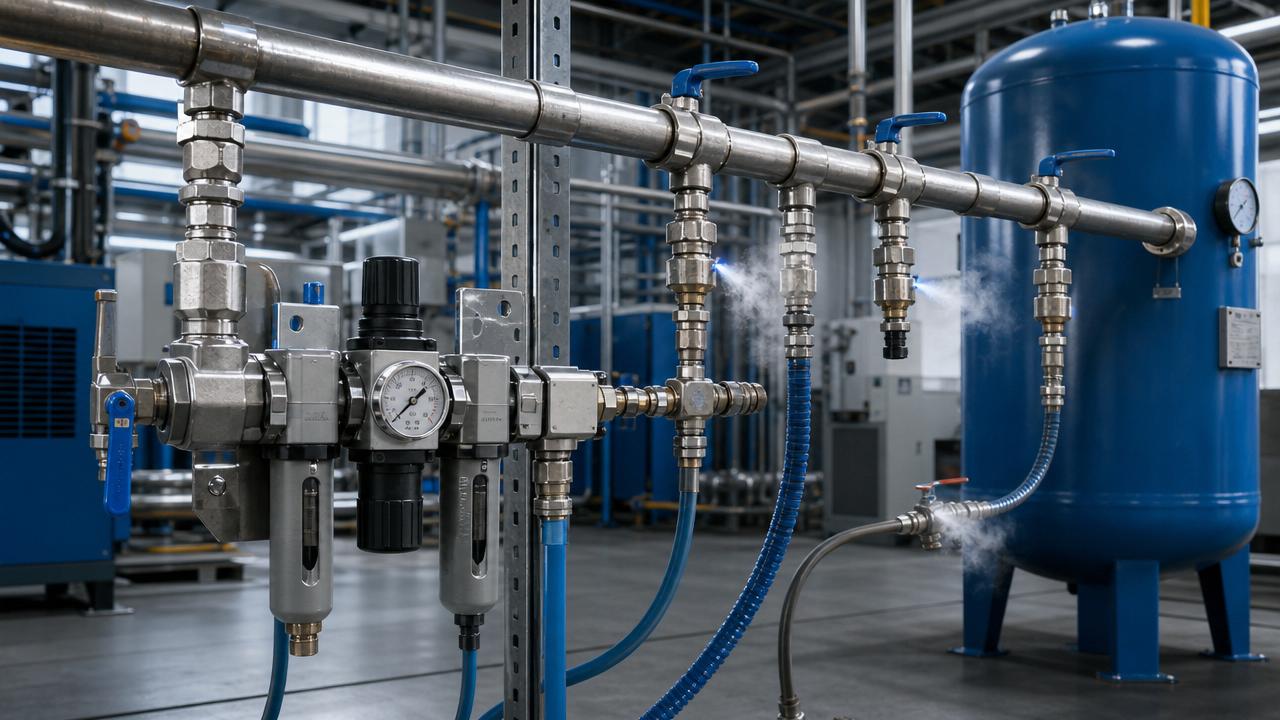
Leaks are among the most persistent reasons for excessive compressor run time. They occur at couplings, quick-connect fittings, hoses, threaded joints, condensate drains, regulators, valve stems, and failed flexible connections. A leak does not always produce an obvious sound, particularly in a noisy production area or when the escaping air is at a small, steady rate.
Leak severity depends on pressure, duration, and system behavior. A small leak at a branch that remains pressurized around the clock can consume more compressed air than a larger leak used only during a short shift. Leaks near the compressor and leaks at a point of use also have different consequences: the former directly raise base demand, while the latter may combine with undersized piping or poor regulation to cause local pressure loss.
Testing should occur when legitimate compressed-air use is controlled or clearly identified. Listening alone is unreliable. Ultrasonic inspection, pressure-decay testing, and logged compressor load/unload behavior provide stronger evidence. Repairing leaks without verifying the result can create false confidence, because another leakage path may keep the compressor operating in the same pattern.
- A hose that leaks only when bent or moved may pass a stationary inspection but fail during normal equipment motion.
- Automatic drains deserve attention because a drain stuck open can create continuous demand that is easily mistaken for normal base load.
- Fittings repeatedly repaired with sealing compound may indicate vibration, poor thread engagement, or incompatible connection geometry rather than a simple sealing failure.
Lubrication Problems Create Heat, Drag, and Contamination
Oil-injected compressors depend on lubricant for sealing, cooling, and reducing contact friction. Using the wrong lubricant, extending drain intervals beyond the actual service conditions, or mixing incompatible products can reduce these functions. High ambient temperature, dusty air, frequent short cycles, and elevated discharge temperature can age lubricant faster than a calendar interval suggests.
Lubricant breakdown may show up as varnish, deposits, rising temperature, unusual odor, sluggish valves, or a gradual increase in differential pressure across oil-related filters and separators. These symptoms should not automatically be blamed on the oil itself. A restricted cooler, poor ventilation, or incorrect thermostat behavior can overheat otherwise suitable lubricant. Likewise, excessive oil carryover may point to a separator problem, excessive oil level, damaged scavenge line, or unstable operating pressure.
Oil level must be judged using the manufacturer’s specified shutdown and temperature condition. Overfilling can increase carryover and separator loading. Underfilling reduces cooling and lubrication reserve. The sight glass is useful only when interpreted in the correct operating state; checking it immediately after stopping a hot unit can lead to an incorrect refill decision.
Cooling Deficiencies Cause More Than High Temperature Alarms
Compressed air leaves the compression stage hot. The compressor’s cooling system must remove that heat from the lubricant, air stream, and drive components. When an aftercooler, oil cooler, radiator, fan, or ventilation path is fouled, the machine may remain below its alarm limit while still consuming more energy and stressing internal components.
Cooler fouling often has two sides. External surfaces collect dust, lint, oily film, or debris that reduces airflow. Internal passages can accumulate scale, corrosion products, or process-water deposits where water-cooled equipment is used. Cleaning only the visible fin surface may not correct an internal flow restriction. Conversely, aggressive cleaning methods can bend fins, strip protective coatings, or force contaminants deeper into the core.
Room conditions matter. Recirculating hot discharge air into the compressor inlet raises inlet temperature and reduces air density. A ventilation fan that spins but moves little air, a blocked louver, or an enclosure with poor exhaust routing can cause this condition. The temperature difference between intake air, cooling air, and discharge air is often more informative than a single ambient reading.
Temperature symptoms also need careful interpretation. High discharge temperature combined with normal cooling airflow can indicate an internal compression problem, incorrect lubricant viscosity, failed thermostatic control, or a discharge restriction. High room temperature and high cooler outlet temperature more strongly suggest inadequate heat rejection. Treating every overheating event as a cooler-cleaning task can miss the root cause.
Neglected Condensate Drainage Adds Pressure Loss and Air Quality Trouble
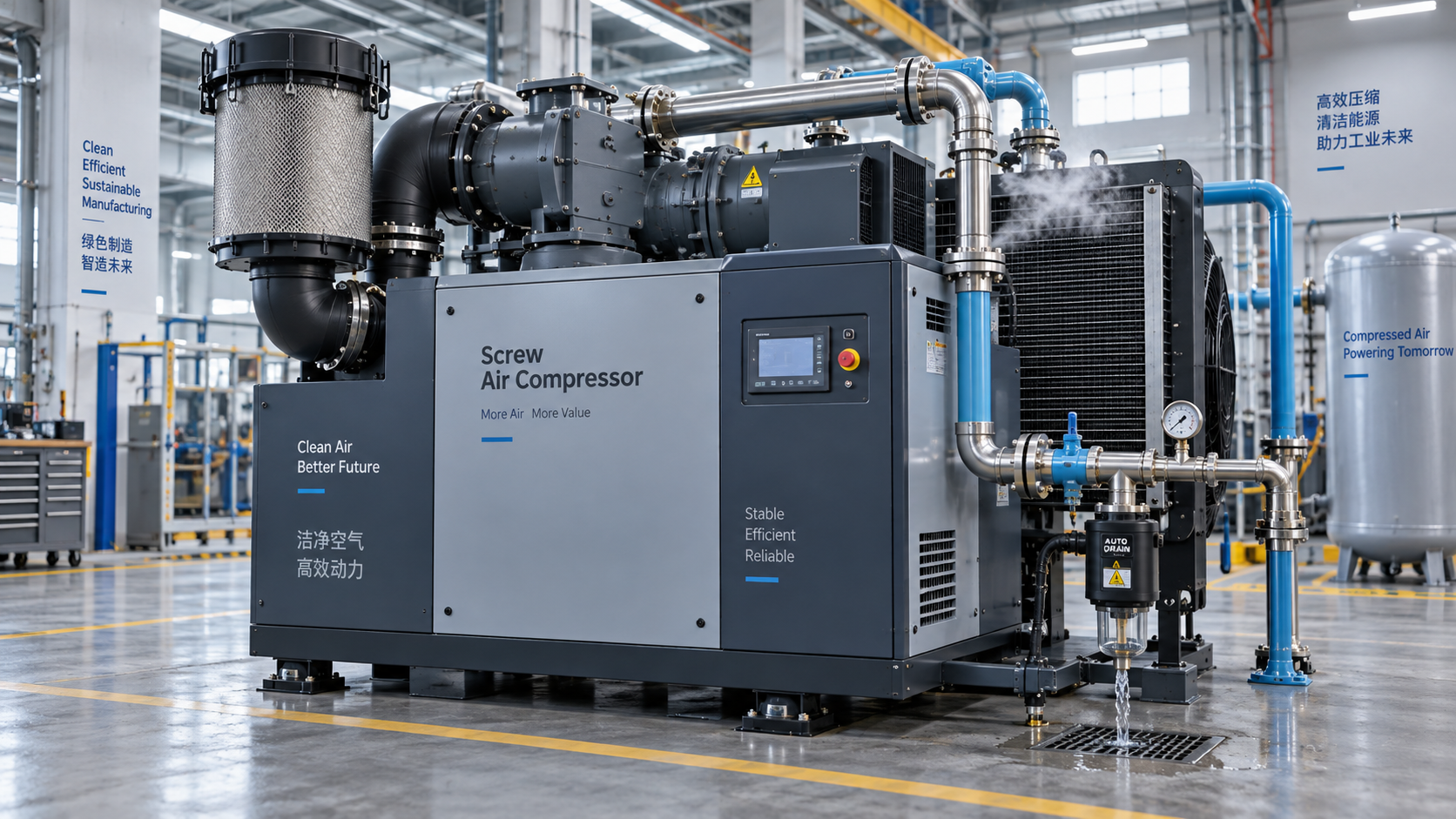
Atmospheric air contains water vapor. Compression concentrates that moisture, and cooling after compression turns much of it into liquid condensate. If drains, separators, and dryer components are neglected, water collects in receivers and distribution piping. The immediate result may be corrosion, but the efficiency effect is also important: corroded pipe interiors, contaminated filters, malfunctioning drains, and water-filled low points increase resistance and destabilize pressure delivery.
Manual drains are frequently left closed too long or left cracked open after draining. Either condition wastes energy or harms the air system. Automatic drains require functional testing because contamination can prevent full closure or block the discharge path. A drain that cycles audibly is not necessarily working correctly; it may release mostly compressed air while leaving accumulated water behind.
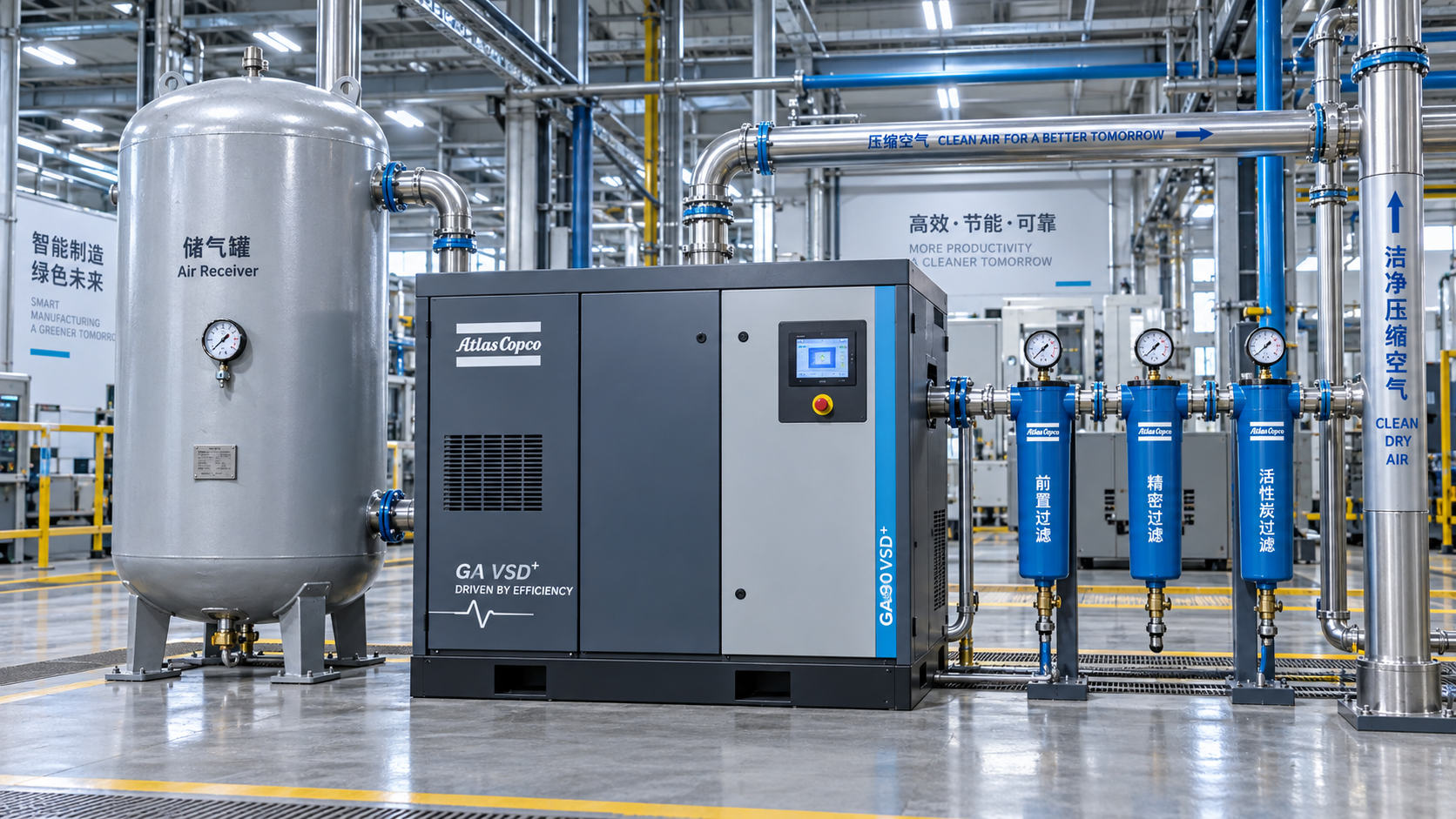
Dryer performance should be reviewed alongside drainage. A pressure drop across a dryer or coalescing filter raises the compressor discharge pressure needed to achieve the required point-of-use pressure. Replacing a filter solely because it has reached a scheduled interval can be appropriate in critical service, yet differential pressure and contamination history are still needed to identify unusual loading. Repeatedly high pressure drop may originate upstream from oil carryover, poor condensate separation, or deteriorating pipework.
Pressure Drop Is Often Misdiagnosed as Insufficient Compressor Capacity
When a distant production point lacks pressure, increasing compressor set pressure is a tempting response. It is often expensive and incomplete. Pressure can be lost through undersized piping, long hose runs, partially closed isolation valves, clogged filters, restrictive regulators, damaged quick couplings, and poorly arranged branch connections. The compressor may be healthy while the distribution system wastes the pressure it creates.
Compare pressure at the compressor discharge, after treatment equipment, at the main header, and at the affected point during real air demand. Static readings are not enough. A system may look balanced at rest and lose substantial pressure only when a high-flow device cycles. This comparison distinguishes a distribution bottleneck from a compressor delivery problem.
Drive Components and Mechanical Condition Need Direct Inspection
Belt-driven compressors lose efficiency when belts are worn, glazed, misaligned, or improperly tensioned. A belt that is too loose slips under load and generates heat. Excessive tension increases bearing load. Alignment errors can produce similar symptoms, including noise and premature belt wear, so tension adjustment alone may not solve the issue.
Direct-drive machines have fewer external drive adjustments, but coupling condition, bearing health, motor ventilation, and vibration remain relevant. Increased vibration is not only a reliability concern. It can loosen connections, affect drive transmission, damage piping supports, and produce recurring leaks. Trend data is more useful than a single vibration observation because mounting changes, foundation condition, and nearby equipment can influence the reading.
Internal wear should be considered after simpler restrictions and controls have been ruled out. Worn compressor elements, leaking valves in reciprocating units, failed minimum-pressure valves, and damaged seals can reduce delivery or increase operating temperature. These faults require service methods appropriate to the machine design. Opening a compressor without confirming the external causes first adds downtime and may introduce contamination during reassembly.
Controls Can Turn a Maintained Machine Into an Inefficient System
Control maintenance includes verifying pressure switches, transducers, load/unload valves, inlet valves, variable-speed settings, and sequencing between multiple compressors. A drifting pressure sensor can cause the compressor to maintain a higher pressure than the process needs. An inlet valve that does not fully close may create unnecessary loaded operation. A load/unload machine operating with insufficient storage can cycle rapidly, wasting energy and increasing thermal stress.
Variable-speed control is not automatically efficient in every duty pattern. It performs best when air demand changes within the useful operating range of the compressor. If demand is largely steady, a poorly configured speed-controlled unit may operate away from its efficient region while a fixed-speed unit remains loaded more consistently. Control settings should follow measured demand profiles, required pressure at the point of use, and the interaction of all compressors connected to the header.
After maintenance, record operating pressure, temperature, run hours, load state, differential pressure across treatment equipment, and observed leak behavior under comparable production conditions. This creates a baseline for detecting gradual losses before they become a capacity problem. Efficiency is preserved through the relationship between these readings, not through any one maintenance task performed in isolation.
Related News
- Which Maintenance Issues Reduce Air Compressor Efficiency?Author :Pneumatic Power Engineer

- How Much Energy Can Variable-Speed Screw Compressors Save?Author :Pneumatic Power Engineer

- China Expands Cross-Border RMB and FX Cash Pooling NationwideAuthor :Pneumatic Power Engineer

- How to Size Air Compressor Systems for Pneumatics by Flow and Pressure DemandAuthor :Pneumatic Power Engineer

- How Energy Recovery Systems for Compressors Cut Power CostsAuthor :Pneumatic Power Engineer

- How to Evaluate Screw Compressors in Industrial Refrigeration EquipmentAuthor :Pneumatic Power Engineer

- India Makes BIS Certification Mandatory for Screw CompressorsAuthor :Pneumatic Power Engineer

- China Tightens Export Filing for Screw CompressorsAuthor :Pneumatic Power Engineer

- SABIC Sets IoT Interface Rule for Screw CompressorsAuthor :Pneumatic Power Engineer

- Industrial Heat Recovery Systems for Compressors: When Do Energy Savings Pay Back?Author :Pneumatic Power Engineer

- EU Tightens REACH Limit for Screw Compressor LubricantsAuthor :Pneumatic Power Engineer

- EU Opens China Screw Compressor Review With Carbon RuleAuthor :Pneumatic Power Engineer

- DOE Mandates AHRI 1000-2026 for Screw CompressorsAuthor :Pneumatic Power Engineer

- VDMA Filing Signals EU Risk for Chinese Oil Screw CompressorsAuthor :Pneumatic Power Engineer
![]()
- Screw vs Piston Air Compressors for Stable Plant OutputAuthor :Pneumatic Power Engineer

- Saudi SASO Tightens Refrigerant Limits in IEC 60335-2-40:2026Author :Pneumatic Power Engineer

- IIR Warns of 18-Week Lead Times for Screw CompressorsAuthor :Pneumatic Power Engineer

- Welded Compressed Air Manifold Selection Guide for Pressure Stability and LeaksAuthor :Pneumatic Power Engineer

- India BIS Rule Adds IS 16830 Requirement for Imported Screw CompressorsAuthor :Pneumatic Power Engineer

- What to Check Before Choosing a Compressed Air FactoryAuthor :Pneumatic Power Engineer

- China Tightens Export Checks on Screw CompressorsAuthor :Pneumatic Power Engineer

- Screw Compressor Lead Times Reach 22 WeeksAuthor :Pneumatic Power Engineer

- Vietnam Requires QR Labels on Imported Screw CompressorsAuthor :Pneumatic Power Engineer

- Compressed Air Technologies Filtration: How to Reduce Pressure Drop and Energy LossAuthor :Pneumatic Power Engineer

- STSPIN830 Lead Time Tops 32 Weeks in Screw CompressorsAuthor :Pneumatic Power Engineer

- IGBT Shortage Extends Screw Compressor Lead TimesAuthor :Pneumatic Power Engineer

- Compressed Air Systems: 7 Hidden Costs That Raise Total Operating ExpenseAuthor :Pneumatic Power Engineer

- Compressed Air Efficiency: 7 Hidden Losses That Raise Operating CostsAuthor :Pneumatic Power Engineer

- How to Compare Screw vs Oil-Free Air Compression SystemsAuthor :Pneumatic Power Engineer

- Compressed Air Leaks: What They Really Cost in Daily OperationsAuthor :Pneumatic Power Engineer

- DOE Moves Up R449A Chiller Deadline to March 2027Author :Pneumatic Power Engineer

- How Compression Technology Cuts Energy Use in Modern PlantsAuthor :Pneumatic Power Engineer

- EU Adds GB 18613-2025 to Import Energy ChecksAuthor :Pneumatic Power Engineer

- EU CE Rule Adds SRA for R290 Compressor ImportsAuthor :Pneumatic Power Engineer

- Compressed Air Leaks: Hidden Costs and Practical Ways to Reduce LossesAuthor :Pneumatic Power Engineer

- Kunming Sourcing Festival Adds Thermal & Compression HubAuthor :Pneumatic Power Engineer