How Should Energy Management Systems Handle Compressor Load Changes?




An energy management system should treat compressor load changes as a control problem, not simply a signal to start or stop equipment. The goal is to match compressed-air or process-gas supply to real demand while holding pressure, flow, air quality, and production continuity within acceptable limits. That usually requires four connected capabilities: accurate demand measurement, sensible compressor sequencing, stable variable-speed control where appropriate, and trend-based maintenance decisions.
A system that reacts only after pressure drops will often waste energy through excess pressure, unloaded running, frequent cycling, or several compressors operating inefficiently at partial load. A system that reacts too aggressively can create a different problem: unstable pressure, motor stress, poor dryer performance, and avoidable production interruptions. Good control balances response speed with operating stability.
Start with the load pattern, not the compressor nameplate
Before changing control logic, the energy management system needs to understand what is actually changing. Compressor demand is rarely one smooth curve. It may include a stable base load, shift-based changes, short bursts from packaging or pneumatic tools, intermittent high-demand processes, leakage, and pressure losses caused by filters or undersized piping.
This distinction matters because each type of variation calls for a different response. A predictable production shift can be handled with scheduling and planned sequencing. A rapid, irregular demand spike may require receiver storage, a trim compressor, or a revised pressure-control strategy. Continuous nighttime demand may reveal leakage or unattended equipment rather than genuine production demand.
The minimum useful data set normally includes:
- System pressure at the compressor discharge and at critical end-use points.
- Compressed-air flow or another reliable proxy for demand.
- Compressor status, power draw, loaded/unloaded state, speed, and fault condition.
- Operating pressure setpoints and pressure-band limits.
- Production schedule or process-state data when it explains demand changes.
- Dryer, filter, cooling, and condensate-management status where air quality is production-critical.
Measuring only compressor power is not enough. A rise in power may reflect useful flow, a leak, a clogged filter, elevated pressure, or an inefficient sequencing decision. The energy management system should relate power to delivered air and operating conditions, rather than treating electrical consumption alone as the performance indicator.
Separate base load, trim load, and transient demand
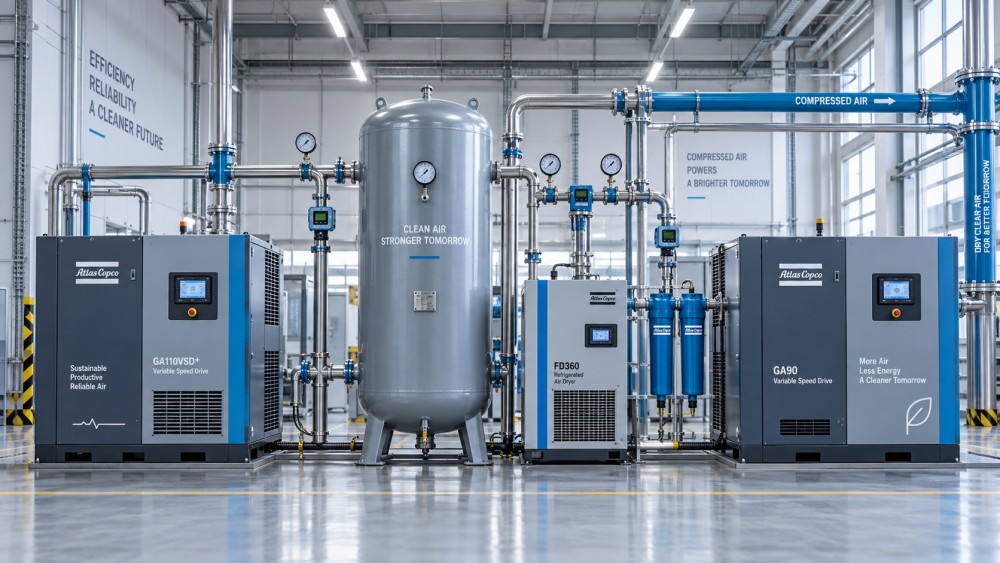
Most multi-compressor systems perform best when the energy management system assigns different jobs to different machines. Instead of allowing every compressor to chase the same pressure signal, establish a stable operating hierarchy.
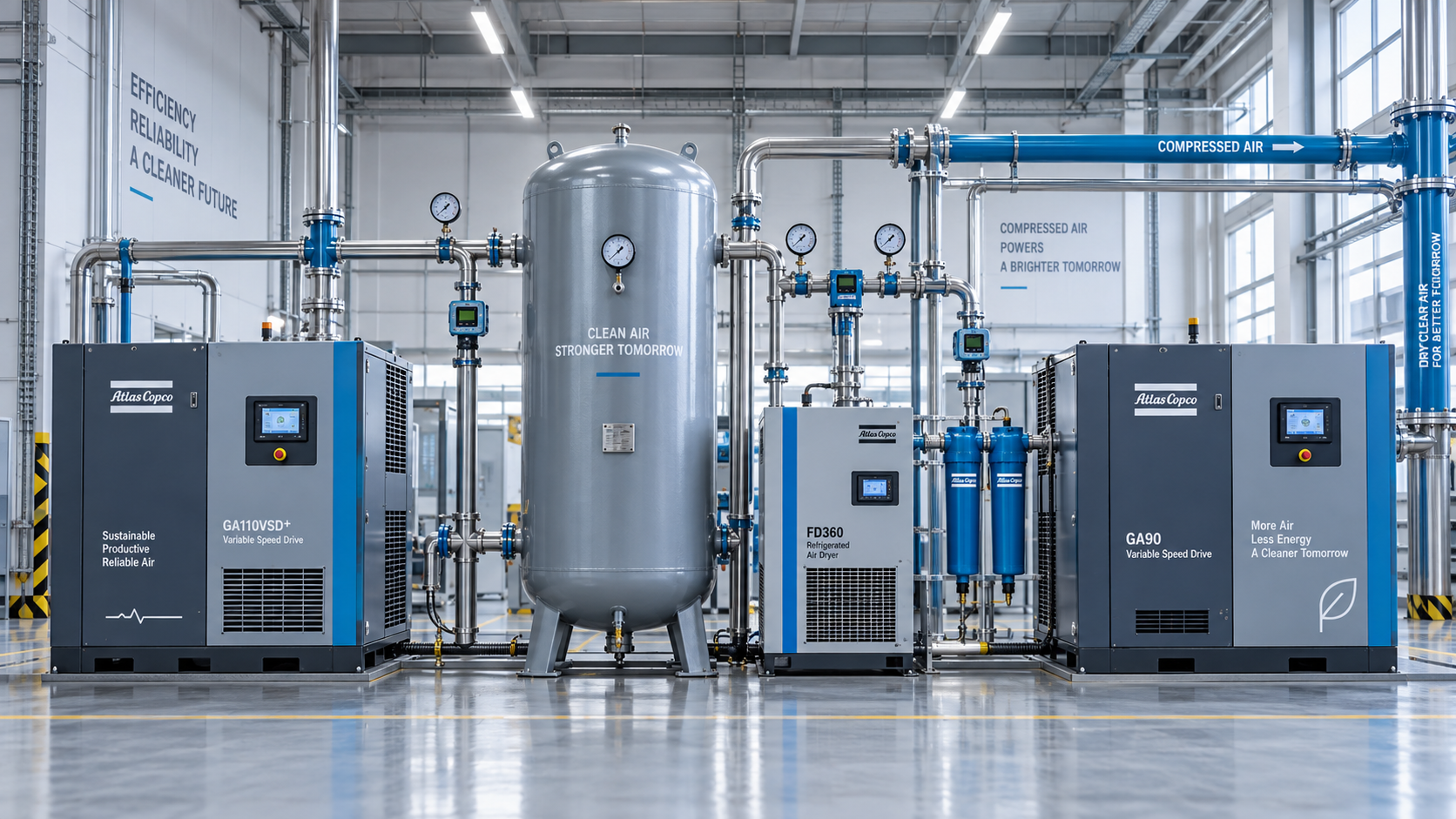
A base-load machine carries the stable portion of demand. A trim machine follows the remaining variation. In many installations, a variable-speed drive compressor is useful as the trim unit because it can adjust output without repeated load/unload transitions. That does not mean it should automatically become the lead machine in every situation. At very low speeds or outside its intended range, its efficiency and cooling behavior may no longer be favorable. The controller should use manufacturer operating limits and site data, rather than assuming that variable speed always means lowest energy use.
Where several fixed-speed compressors are installed, sequencing is equally important. The controller should select the combination that meets demand with the fewest inefficient unloaded hours and sufficient reserve for operational risk. A smaller unit may be the right choice for overnight demand even when a larger unit is more efficient at full load. The best sequence is therefore conditional, not permanent.
Use pressure as a boundary, not the sole control target
Pressure is essential, but a narrow pressure target can produce unstable behavior. If the energy management system starts and stops compressors based on a single pressure value, ordinary demand fluctuations can trigger rapid cycling. If it responds too slowly, the far end of the network may fall below the pressure required by a critical process.
A better approach uses a defined pressure band, measured at locations that reflect production reality. The compressor room may show adequate pressure while distant equipment experiences a drop caused by undersized distribution lines, excessive filter differential pressure, or local peak demand. Raising the whole system pressure to solve a local restriction usually increases energy use and can conceal the actual fault.
For this reason, pressure control should be paired with pressure-drop monitoring. If the controller repeatedly sees a large difference between compressor discharge pressure and the critical point of use, investigate the network before increasing setpoints. Filters, dryers, isolation valves, hose assemblies, and poorly sized piping can all create artificial demand for higher pressure.
Build control logic around response time
Compressor systems contain physical delays. Air receivers buffer supply. Pipe volume delays pressure changes. Compressor starts take time. Variable-speed drives have ramp limits. Some processes can tolerate a short pressure variation; others cannot. An energy management system needs logic that respects those delays.
Useful logic commonly includes start delays, minimum run times, minimum stop times, staged loading, and a deadband around pressure targets. These are not administrative settings. They prevent the controller from reacting to a brief disturbance as if it were a sustained change in demand.
Consider a production line that creates short air pulses. If the controller starts a standby compressor every time pressure falls for a few seconds, the site may accumulate unnecessary starts and run extra capacity long after the pulse ends. If the controller waits too long, the line may see pressure instability. The practical solution may involve a local receiver near the pulsing load, a different lead/lag delay, or a dedicated trim strategy. Control settings alone cannot compensate for inadequate storage or poor distribution design.
Do not let compressors “fight” each other
Multiple compressors can waste substantial energy when each machine uses its own pressure controller without coordination. One unit may load as another unloads; two variable-speed machines may both operate in less efficient regions; or a backup unit may stay active because its local setpoint overlaps the lead compressor’s range.
The energy management system should provide one supervisory sequence. Individual compressor controls still protect the machine, but the central logic decides which unit is base, which unit trims demand, when another machine is required, and when it can be removed. Lead rotation should also be intentional. Rotating equipment can distribute operating hours, but it should not override a clearly more efficient configuration during a stable production period unless maintenance or reliability needs justify it.
Include demand-side signals when they are available
The best compressor control does not rely exclusively on pressure after demand has already occurred. When the energy management system can receive production schedule, machine-state, batch, or line-start information, it can prepare capacity before predictable load changes arrive.
For example, a controlled start sequence can bring the appropriate compressor online before a large process begins, rather than waiting for pressure to decline. Similarly, planned shutdown logic can reduce capacity after a line stops, provided the system verifies that no other critical consumer remains active. This is especially useful in facilities with batch production, shift changes, or multiple independent process areas.
Demand-side integration must be used carefully. A production signal tells the system what may happen; pressure and flow confirm what is happening. Treating schedule data as an unquestioned command can leave the system under-supplied when actual process behavior differs from plan.
Use predictive analytics for maintenance and planning, not as a substitute for control
Historical data can reveal changes that real-time control alone cannot explain. A growing difference between expected and actual power at a similar load may point to air leaks, poor inlet conditions, deteriorating valves, cooler fouling, abnormal lubricant behavior, or an inappropriate operating sequence. A rising pressure drop across filtration may show why operators keep increasing pressure setpoints.
Predictive functions are most useful when they identify a specific operating question: Why is weekend demand higher than before? Why does one compressor spend more time unloaded? Why does the system need a second machine earlier in the shift? The answer may be a maintenance issue, a production change, or a distribution constraint. The energy management system should make these patterns visible and assignable, rather than merely generating alarms.
For industrial cooling, vacuum processes, and compressed-air applications, GTC-Matrix follows the same underlying principle: thermodynamic equipment performs best when operating decisions account for both equipment behavior and process demand. Monitoring energy trends alongside pressure, flow, and thermal conditions gives operators a clearer basis for selecting control upgrades and maintenance priorities.
A practical implementation sequence
- Map the system. List compressors, controls, receiver locations, dryers, major end uses, pressure sensors, and known process constraints.
- Collect representative operating data. Include normal production, low-demand periods, shift transitions, and known peak events. A single daytime snapshot rarely represents the system.
- Identify the load shape. Separate stable demand, predictable changes, short peaks, unexplained baseload, and local pressure problems.
- Define the operating hierarchy. Decide which machine provides base load, which trims variation, what capacity remains in reserve, and when the sequence changes.
- Set protective timing and pressure boundaries. Configure delays and minimum run/stop periods around actual system response, not arbitrary defaults.
- Test one operating scenario at a time. Observe pressure stability, loaded/unloaded time, starts, power behavior, and production response before making further changes.
- Review exceptions. Repeated overrides, persistent high pressure, frequent standby starts, and unexplained off-shift consumption indicate that the system design or settings need attention.
Where energy management projects often go wrong
The most common error is trying to solve every load change by increasing compressor capacity. In many cases, the issue is control coordination, inadequate storage near a fluctuating load, leakage, or pressure loss in the distribution system. Adding another compressor without resolving those causes can simply create another machine that runs unloaded.
Another error is optimizing for average demand while ignoring extremes. Average flow may suggest that one compressor is sufficient, but a brief process peak can still cause pressure collapse. Conversely, sizing and sequencing everything around the highest peak can leave the site inefficient for most operating hours. The energy management system needs both a normal operating strategy and a controlled response for exceptional demand.
Finally, avoid treating compressor optimization as separate from air quality and reliability. Reducing pressure or shutting down capacity may save energy, but not when it compromises drying, contaminates a sensitive process, or leaves no practical response to a machine fault. The right control strategy preserves the operating conditions the process actually requires, then removes waste around those requirements.
Start by confirming where demand changes originate, how quickly they occur, and which operating constraint is non-negotiable. Once those answers are clear, compressor load changes become manageable: stable demand is carried efficiently, variable demand is trimmed intelligently, short peaks are buffered instead of overbuilt, and abnormal consumption becomes visible before it turns into routine energy waste.
Related News
- How Should Energy Management Systems Handle Compressor Load Changes?Author :Pneumatic Power Engineer

- Which Maintenance Issues Reduce Air Compressor Efficiency?Author :Pneumatic Power Engineer

- How Much Energy Can Variable-Speed Screw Compressors Save?Author :Pneumatic Power Engineer

- China Expands Cross-Border RMB and FX Cash Pooling NationwideAuthor :Pneumatic Power Engineer

- How to Size Air Compressor Systems for Pneumatics by Flow and Pressure DemandAuthor :Pneumatic Power Engineer

- How Energy Recovery Systems for Compressors Cut Power CostsAuthor :Pneumatic Power Engineer

- How to Evaluate Screw Compressors in Industrial Refrigeration EquipmentAuthor :Pneumatic Power Engineer

- India Makes BIS Certification Mandatory for Screw CompressorsAuthor :Pneumatic Power Engineer

- China Tightens Export Filing for Screw CompressorsAuthor :Pneumatic Power Engineer

- SABIC Sets IoT Interface Rule for Screw CompressorsAuthor :Pneumatic Power Engineer

- Industrial Heat Recovery Systems for Compressors: When Do Energy Savings Pay Back?Author :Pneumatic Power Engineer

- EU Tightens REACH Limit for Screw Compressor LubricantsAuthor :Pneumatic Power Engineer

- EU Opens China Screw Compressor Review With Carbon RuleAuthor :Pneumatic Power Engineer

- DOE Mandates AHRI 1000-2026 for Screw CompressorsAuthor :Pneumatic Power Engineer

- VDMA Filing Signals EU Risk for Chinese Oil Screw CompressorsAuthor :Pneumatic Power Engineer
![]()
- Screw vs Piston Air Compressors for Stable Plant OutputAuthor :Pneumatic Power Engineer

- Saudi SASO Tightens Refrigerant Limits in IEC 60335-2-40:2026Author :Pneumatic Power Engineer

- IIR Warns of 18-Week Lead Times for Screw CompressorsAuthor :Pneumatic Power Engineer

- Welded Compressed Air Manifold Selection Guide for Pressure Stability and LeaksAuthor :Pneumatic Power Engineer

- India BIS Rule Adds IS 16830 Requirement for Imported Screw CompressorsAuthor :Pneumatic Power Engineer

- What to Check Before Choosing a Compressed Air FactoryAuthor :Pneumatic Power Engineer

- China Tightens Export Checks on Screw CompressorsAuthor :Pneumatic Power Engineer

- Screw Compressor Lead Times Reach 22 WeeksAuthor :Pneumatic Power Engineer

- Vietnam Requires QR Labels on Imported Screw CompressorsAuthor :Pneumatic Power Engineer

- Compressed Air Technologies Filtration: How to Reduce Pressure Drop and Energy LossAuthor :Pneumatic Power Engineer

- STSPIN830 Lead Time Tops 32 Weeks in Screw CompressorsAuthor :Pneumatic Power Engineer

- IGBT Shortage Extends Screw Compressor Lead TimesAuthor :Pneumatic Power Engineer

- Compressed Air Systems: 7 Hidden Costs That Raise Total Operating ExpenseAuthor :Pneumatic Power Engineer

- Compressed Air Efficiency: 7 Hidden Losses That Raise Operating CostsAuthor :Pneumatic Power Engineer

- How to Compare Screw vs Oil-Free Air Compression SystemsAuthor :Pneumatic Power Engineer

- Compressed Air Leaks: What They Really Cost in Daily OperationsAuthor :Pneumatic Power Engineer

- DOE Moves Up R449A Chiller Deadline to March 2027Author :Pneumatic Power Engineer

- How Compression Technology Cuts Energy Use in Modern PlantsAuthor :Pneumatic Power Engineer

- EU Adds GB 18613-2025 to Import Energy ChecksAuthor :Pneumatic Power Engineer

- EU CE Rule Adds SRA for R290 Compressor ImportsAuthor :Pneumatic Power Engineer

- Compressed Air Leaks: Hidden Costs and Practical Ways to Reduce LossesAuthor :Pneumatic Power Engineer