Industrial Heat Recovery Systems for Compressors: When Do Energy Savings Pay Back?




Industrial Heat Recovery Systems for Compressors: When Do Energy Savings Pay Back?
For finance-led investment decisions, industrial heat recovery systems for compressors are not simple efficiency upgrades.
They are capital projects that must prove cash impact, risk control, and operational relevance.
That distinction matters more now.
Electricity prices remain volatile, fuel costs are uneven, and many plants still discharge usable heat every hour.
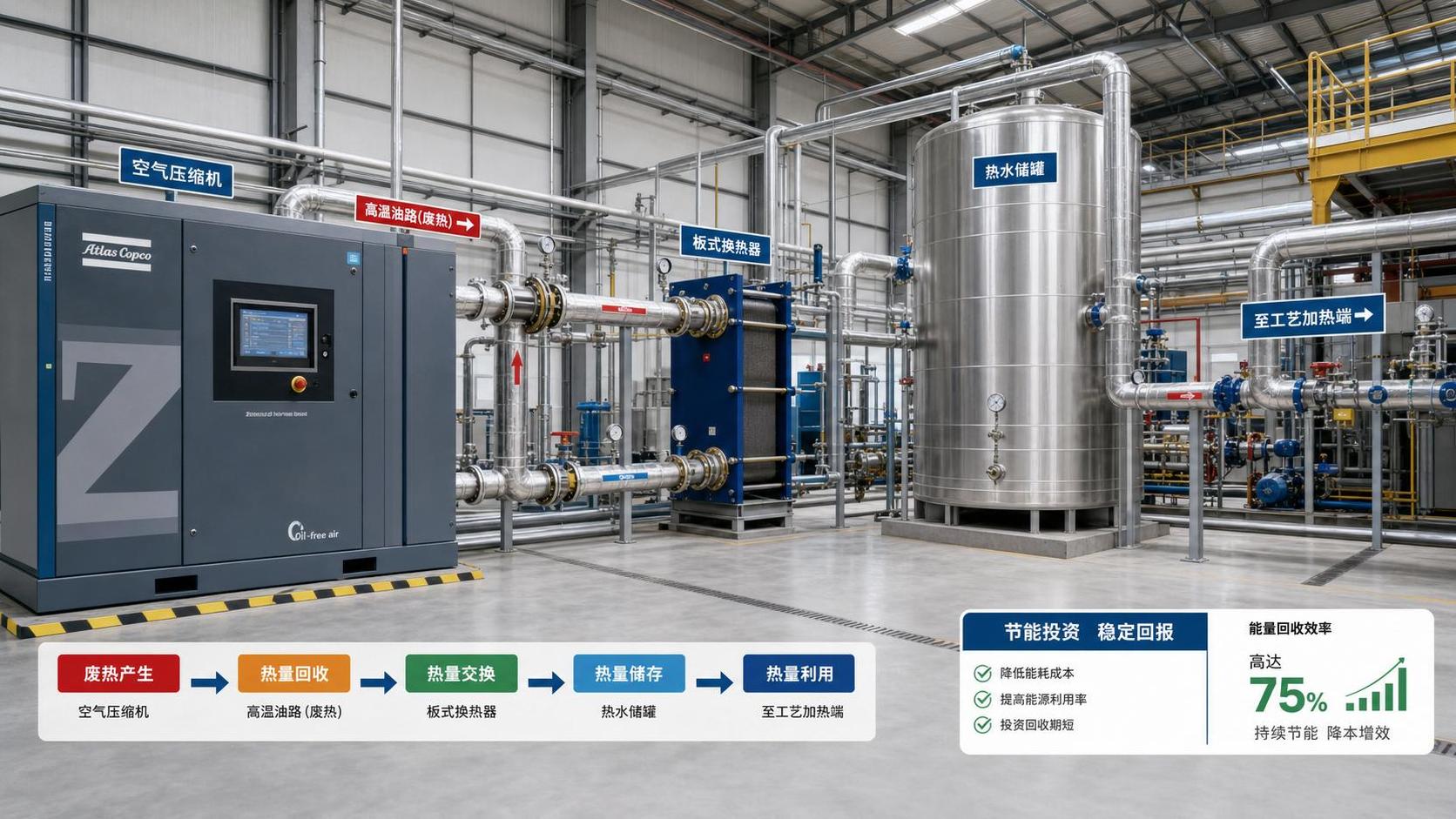
In practical terms, industrial heat recovery systems for compressors can convert waste heat into hot water, space heating, or process support.
The value is real, but only under the right operating conditions.
The central question is not whether heat can be recovered.
It is whether the recovered heat offsets enough purchased energy, often enough, to justify the investment.
Why Compressor Heat Recovery Is Financially Attractive
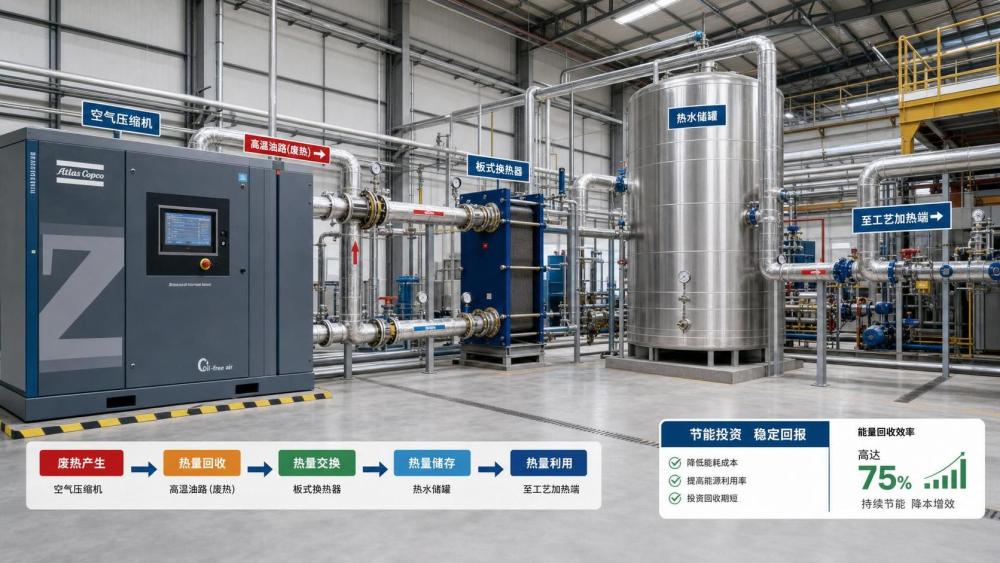
Most compressed air systems waste a large share of input energy as heat.
That heat usually leaves through oil coolers, aftercoolers, or ventilation air.
Industrial heat recovery systems for compressors capture part of that loss and redirect it to useful demand.
When the recovered heat replaces electric heating, gas boilers, or purchased steam support, savings become visible quickly.
This is why compressor heat recovery often looks stronger than general efficiency projects.
It does not depend only on reducing consumption.
It also creates a second-use energy stream from an asset already running.
What Finance Teams Should Notice First
- Recovered heat displaces a measurable utility cost.
- Savings can often be estimated from operating hours and heat demand overlap.
- The project usually improves energy intensity without changing core production.
- Carbon and compliance benefits may add value, but cost reduction should lead the case.
When Do Industrial Heat Recovery Systems for Compressors Pay Back?
Payback depends on a simple business reality.
You need enough recoverable heat, enough useful demand, and enough yearly runtime.
If one of those is weak, the return stretches.
If all three are strong, industrial heat recovery systems for compressors can pay back surprisingly fast.
In many industrial settings, the strongest cases appear in facilities with stable compressed air loads and constant low-grade heat demand.
Food processing, pharmaceuticals, chemicals, packaging, and multi-shift manufacturing often fit this pattern.
The Main Drivers of ROI
- Annual compressor operating hours.
- Fraction of input energy recoverable in usable form.
- Temperature level required by the receiving process.
- Cost of displaced energy, especially gas, electricity, or boiler fuel.
- Installation complexity, piping distance, and controls integration.
- Seasonal mismatch between heat generation and heat demand.
From a capital review perspective, runtime and thermal demand overlap deserve the most attention.
A system that runs 8,000 hours with steady heat use is fundamentally different from one running 2,500 hours with intermittent demand.
The Fastest-Payback Scenarios
In actual procurement reviews, a few situations stand out.
These are the cases where industrial heat recovery systems for compressors often justify serious budget attention.
- Plants needing year-round hot water for cleaning, washing, or sanitation.
- Facilities replacing electric resistance heating with recovered thermal energy.
- Sites with high gas costs or constrained boiler capacity.
- Operations with oil-injected compressors already running under stable base load.
- Campuses or factories where compressor rooms sit close to thermal loads.
The more continuous the demand, the easier the business case becomes.
The more expensive the displaced energy source, the faster the payback usually appears.
That is why low-temperature process heating often outperforms seasonal space heating in ROI terms.
Where the Business Case Weakens
Not every site should proceed.
Some projects look attractive on paper but underperform after commissioning.
This usually happens when the thermal sink is assumed rather than verified.
Common Reasons for Delayed Payback
- Compressed air demand swings sharply across shifts or seasons.
- Required process temperatures exceed what the recovery loop can deliver economically.
- Heat demand exists only in winter, leaving low annual utilization.
- Pipe routing, storage, or control upgrades add hidden cost.
- Maintenance teams are not aligned on monitoring and performance verification.
A weak utilization profile can erase otherwise strong efficiency numbers.
That is why a heat recovery project should be judged as a site integration decision, not only as a compressor accessory purchase.
A Practical Evaluation Framework for Procurement
A disciplined review process reduces optimism bias.
It also helps compare vendors using the same financial logic.
Five Questions That Matter
- How many annual hours does the compressor operate at meaningful load?
- What verified heat demand exists at the same time those hours occur?
- What energy source will the recovered heat displace, and at what unit cost?
- What total installed cost includes piping, controls, storage, and downtime risk?
- How will actual savings be measured after startup?
These questions sound basic, but they often separate viable projects from attractive presentations.
In procurement terms, they force the discussion toward evidence, not generic sustainability claims.
Simple Payback Benchmarks to Use Carefully
Simple payback is not the whole story, but it remains a useful screening tool.
For industrial heat recovery systems for compressors, broad ranges are often more honest than one precise promise.
These ranges should not replace engineering validation.
Still, they help set approval expectations early.
They also help internal teams decide whether a full feasibility study is worth funding.
Risk Control Before Approval
The strongest proposals usually include a risk map, not just a savings estimate.
That matters because industrial heat recovery systems for compressors sit between utilities, production, and maintenance.
A gap in any one area can reduce realized returns.
- Request baseline data for compressor load profiles and thermal demand curves.
- Ask vendors to separate equipment cost from integration cost.
- Require assumptions for recovery rate, outlet temperature, and annual utilization.
- Define post-installation measurement points before purchase approval.
- Check whether incentives, carbon reporting, or utility programs improve economics.
This approach keeps the project grounded in controllable variables and makes supplier comparisons much cleaner.
A Smarter Way to Judge the Opportunity
Industrial heat recovery systems for compressors pay back when waste heat becomes dependable avoided cost.
That usually means long operating hours, nearby thermal demand, and a clear replacement for purchased energy.
Where those conditions are present, the economics can be compelling.
Where they are missing, the project should be challenged early.
For organizations tracking energy cost exposure and manufacturing competitiveness, this is the right lens.
The decision is not about recovering heat because it is available.
It is about recovering heat because it performs like disciplined capital.
That is where efficient thermal strategy begins, and where better procurement decisions usually follow.
Ready when you are. Send us a message to get started.
Related News
- How to compare compressor flow ratings using free air deliveryAuthor :Pneumatic Power Engineer

- When does variable gas flow justify a custom screw compressor system?Author :Pneumatic Power Engineer

- How to size compressed air equipment for pneumatic toolsAuthor :Pneumatic Power Engineer

- How Should Energy Management Systems Handle Compressor Load Changes?Author :Pneumatic Power Engineer

- Which Maintenance Issues Reduce Air Compressor Efficiency?Author :Pneumatic Power Engineer

- How Much Energy Can Variable-Speed Screw Compressors Save?Author :Pneumatic Power Engineer

- Industrial Compressor Selection: Matching Flow, Pressure, and Duty CycleAuthor :Pneumatic Power Engineer

- China Expands Cross-Border RMB and FX Cash Pooling NationwideAuthor :Pneumatic Power Engineer

- How to Size Air Compressor Systems for Pneumatics by Flow and Pressure DemandAuthor :Pneumatic Power Engineer

- How Energy Recovery Systems for Compressors Cut Power CostsAuthor :Pneumatic Power Engineer

- How to Evaluate Screw Compressors in Industrial Refrigeration EquipmentAuthor :Pneumatic Power Engineer

- India Makes BIS Certification Mandatory for Screw CompressorsAuthor :Pneumatic Power Engineer

- China Tightens Export Filing for Screw CompressorsAuthor :Pneumatic Power Engineer

- SABIC Sets IoT Interface Rule for Screw CompressorsAuthor :Pneumatic Power Engineer

- Industrial Heat Recovery Systems for Compressors: When Do Energy Savings Pay Back?Author :Pneumatic Power Engineer

- EU Tightens REACH Limit for Screw Compressor LubricantsAuthor :Pneumatic Power Engineer

- EU Opens China Screw Compressor Review With Carbon RuleAuthor :Pneumatic Power Engineer

- DOE Mandates AHRI 1000-2026 for Screw CompressorsAuthor :Pneumatic Power Engineer

- VDMA Filing Signals EU Risk for Chinese Oil Screw CompressorsAuthor :Pneumatic Power Engineer
![]()
- Screw vs Piston Air Compressors for Stable Plant OutputAuthor :Pneumatic Power Engineer

- Saudi SASO Tightens Refrigerant Limits in IEC 60335-2-40:2026Author :Pneumatic Power Engineer

- IIR Warns of 18-Week Lead Times for Screw CompressorsAuthor :Pneumatic Power Engineer

- Welded Compressed Air Manifold Selection Guide for Pressure Stability and LeaksAuthor :Pneumatic Power Engineer

- India BIS Rule Adds IS 16830 Requirement for Imported Screw CompressorsAuthor :Pneumatic Power Engineer

- What to Check Before Choosing a Compressed Air FactoryAuthor :Pneumatic Power Engineer

- China Tightens Export Checks on Screw CompressorsAuthor :Pneumatic Power Engineer

- Screw Compressor Lead Times Reach 22 WeeksAuthor :Pneumatic Power Engineer

- Vietnam Requires QR Labels on Imported Screw CompressorsAuthor :Pneumatic Power Engineer

- Compressed Air Technologies Filtration: How to Reduce Pressure Drop and Energy LossAuthor :Pneumatic Power Engineer

- STSPIN830 Lead Time Tops 32 Weeks in Screw CompressorsAuthor :Pneumatic Power Engineer

- IGBT Shortage Extends Screw Compressor Lead TimesAuthor :Pneumatic Power Engineer

- Compressed Air Systems: 7 Hidden Costs That Raise Total Operating ExpenseAuthor :Pneumatic Power Engineer

- Compressed Air Efficiency: 7 Hidden Losses That Raise Operating CostsAuthor :Pneumatic Power Engineer

- How to Compare Screw vs Oil-Free Air Compression SystemsAuthor :Pneumatic Power Engineer

- Compressed Air Leaks: What They Really Cost in Daily OperationsAuthor :Pneumatic Power Engineer

- DOE Moves Up R449A Chiller Deadline to March 2027Author :Pneumatic Power Engineer