


How to tell when compressed air filter elements need replacing




Knowing when to replace compressed air filter elements means looking beyond the service-date sticker. A filter can become an expensive restriction before its scheduled change, while another can pass contamination downstream without showing a significant rise in differential pressure. For after-sales maintenance teams, the challenge is deciding which signal matters—and whether the element is actually the cause.
The most reliable approach combines three checks: pressure loss under comparable operating conditions, evidence of downstream air quality, and the manufacturer’s service limits. Together, these help distinguish normal changes from clogging, exhausted adsorption capacity, or element damage.
The practical answer: replace on condition, but respect the service limit
Replace an element when it reaches the manufacturer’s specified differential-pressure limit, reaches its time-based service interval, or can no longer deliver the required filtration performance. Investigate suspected damage or contamination breakthrough promptly rather than waiting for the next planned shutdown.
Those rules need context. Different filter technologies fail differently, so a single replacement trigger will not cover every housing in a compressed air treatment train.
Confirm the exact element function before making a decision. A particulate filter is not an oil-vapor removal device, and a coalescing element does not remove water vapor. Replacing the wrong component may leave the complaint unchanged.
Read differential pressure as a trend, not an isolated number
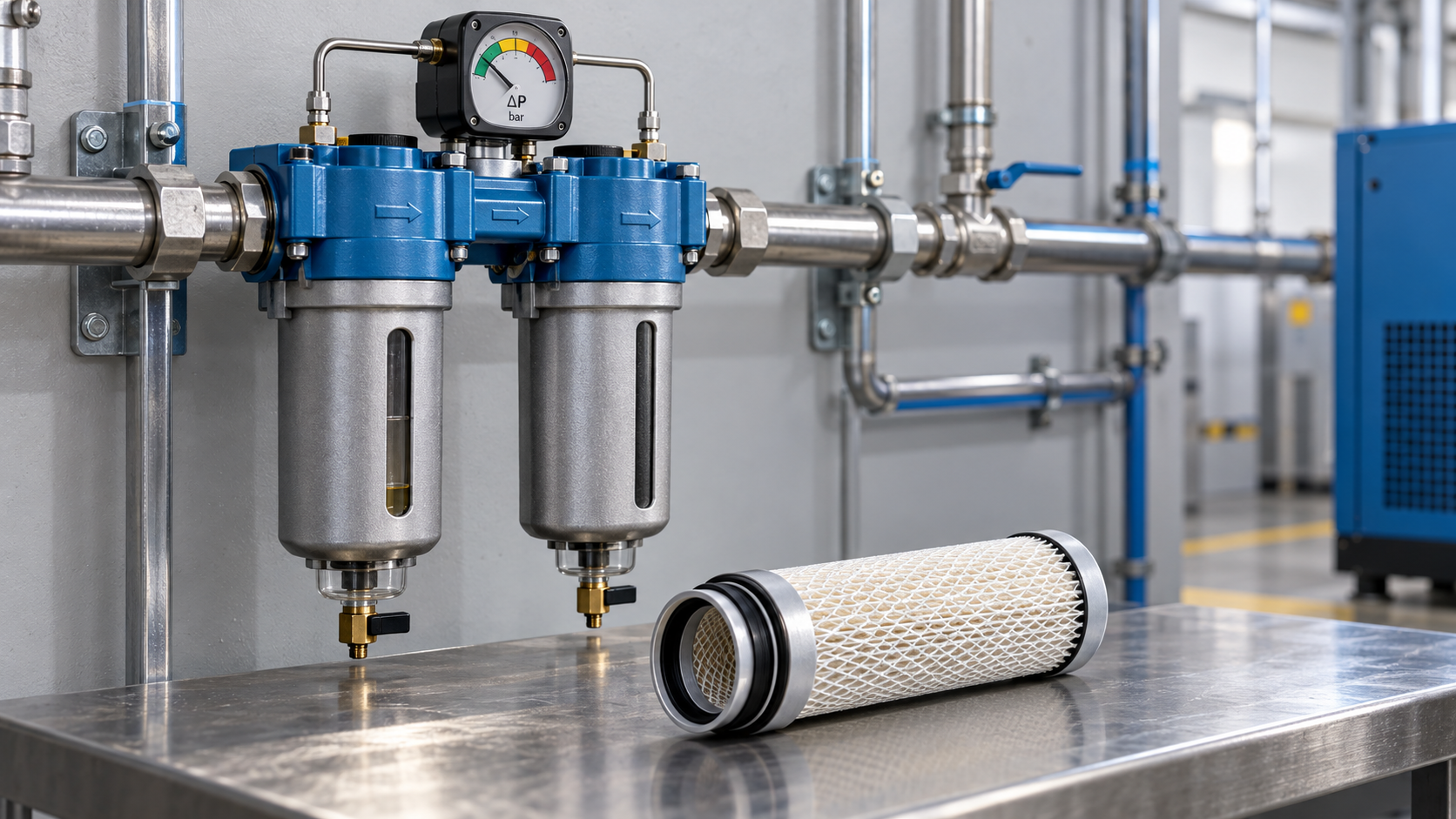
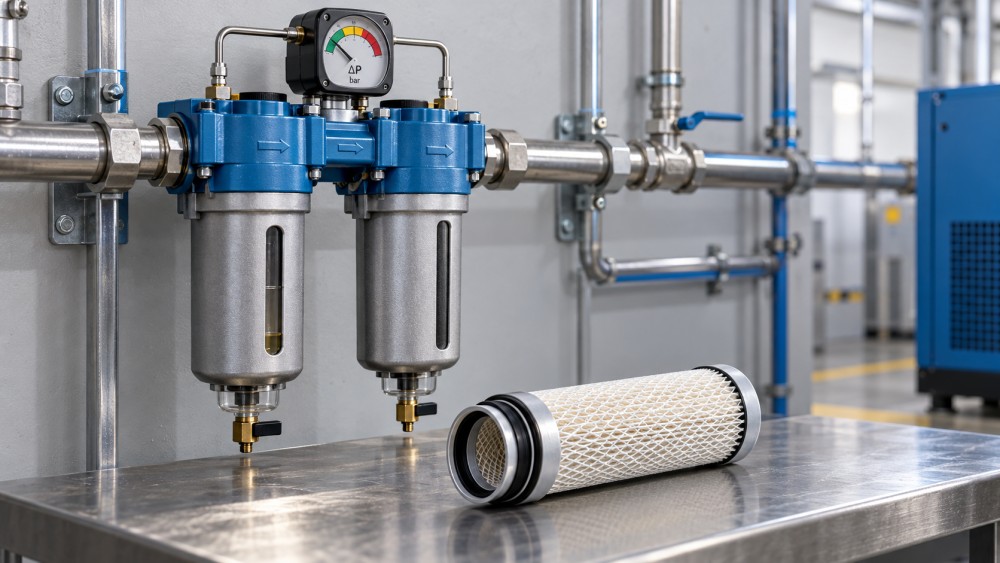
Differential pressure is the pressure difference between the filter inlet and outlet. As captured material restricts flow through an element, this difference generally increases. That makes it a useful maintenance indicator—but only when the readings are comparable.
A filter carrying peak production flow will normally show more pressure drop than it does during a quiet shift. Operating pressure, temperature, and the wet condition of a coalescing element also influence the reading. Comparing an idle-system value with a full-load value can make a healthy element look clogged.
Build a usable baseline
After installing a new element, record its differential pressure at a representative, stable load. For coalescing filters, follow the manufacturer’s guidance on stabilization; a dry initial reading may differ from normal wetted operation.
- Record inlet pressure, operating flow where available, and the production condition.
- Note the element grade, installation date, and drain condition.
- Repeat readings under similar conditions rather than relying on occasional walk-by observations.
- Check indicator operation if readings remain implausibly fixed or conflict with system behavior.
Use the replacement threshold specified for the particular element and housing. A colored gauge band is helpful only if the indicator is appropriate for that assembly. There is no universal differential-pressure limit suitable for every compressed air filter.
A steady rise under comparable conditions points toward loading. A sudden rise deserves a broader check: a failed drain, liquid surge, increased demand, or upstream contamination event may be involved. A sudden drop can also be suspicious if it coincides with worsening air quality; damaged media or a failed seal may reduce resistance while allowing bypass.
Why a low reading can be misleading
A lightly loaded filter may show low differential pressure simply because little air is passing through it. More importantly, pressure loss does not measure removal efficiency. Torn media, incorrect installation, or a displaced seal can allow contamination through without creating a high reading.
For activated carbon elements, this distinction is especially important. Oil-vapor adsorption capacity can run out while the flow path remains relatively unrestricted. A reassuring pressure gauge is not proof that vapor removal is still effective.
When contamination appears downstream, trace the source before replacing parts
Oil at a pneumatic tool, liquid at a valve island, or particles in a process line can trigger an urgent service call. Replacement may be necessary, but identifying what has reached the point of use is the first useful step.
For example, water downstream of a coalescing filter does not automatically mean the element has failed. Water vapor may have passed through normally and then condensed as the pipe cooled. That points toward dryer performance, pressure dew point, or distribution conditions rather than filtration alone.
Use the contamination type to direct the investigation:
- Liquid water: Check separator and filter drains, dryer operation, and locations where the piping cools.
- Oil aerosol: Examine compressor carryover, coalescing filter condition, drain operation, seals, and actual flow through the housing.
- Oil vapor or recurring odor: Review activated carbon service life, inlet temperature, and upstream treatment. Odor alone is not a reliable compliance test.
- Solid particles: Check element integrity and sealing, but also consider downstream pipe corrosion, maintenance debris, or deteriorating hoses.
Where air quality affects product quality, use appropriate sampling and measurement rather than appearance alone. ISO 8573-1 provides a framework for specifying particle, water, and oil purity classes; relevant measurement methods are covered elsewhere in the ISO 8573 series. Testing should match the contaminant and sampling location that matter to the process.
If an air-quality failure threatens a critical application, follow the site’s isolation and quality-response procedures. Replacing a suspect element does not by itself prove that contaminated downstream piping or equipment is ready for service.
Check the drain before blaming the coalescing element
A coalescing filter collects liquid droplets and directs the liquid toward a drainage area. If the drain blocks or fails closed, liquid can accumulate and be carried downstream. The resulting complaint may sound exactly like element failure.
Inspect automatic drains for blocked passages, electrical or control faults, and incorrect isolation-valve positions. Check drain discharge arrangements for backpressure or routing problems. A drain stuck open creates a different problem: continuous compressed air loss.
Correcting the drain fault may restore operation, but it does not guarantee the element remains serviceable. Review whether the element experienced prolonged flooding, excessive loading, or conditions outside its rating. Replace it if required by its condition or the manufacturer’s instructions.
Why calendar-based replacement still matters
Maintenance teams reasonably hesitate to discard an element that appears clean and shows modest pressure loss. However, visible dirt and differential pressure do not capture every deterioration mechanism. Media, binders, seals, and drainage layers may change with time and exposure.
Follow the specified service interval even when the pressure indicator has not reached its limit. Do not assume all filter grades share the same interval, and check whether the manufacturer specifies calendar time, operating hours, or whichever occurs first.
Conditions that may require earlier attention include:
- Heavy dust loading or unusually contaminated intake air.
- Elevated operating temperatures or increased compressor oil carryover.
- Frequent liquid surges, drain failures, or dryer upsets.
- Demand exceeding the filter’s rated capacity at actual operating conditions.
- Maintenance events that introduce dirt or disturb old pipe deposits.
Activated carbon service life is particularly sensitive to inlet oil-vapor concentration, temperature, humidity, and operating exposure. Use the manufacturer’s sizing and service guidance, supported by suitable monitoring where the application requires it.
A field check that leads to a defensible replacement decision
When time is limited, a consistent inspection sequence prevents unnecessary parts changes without overlooking real failures.
- Confirm the assembly. Identify the housing, element grade, flow direction, rated conditions, and installed part number. Check for open bypasses or recent system changes.
- Capture operating evidence. Record inlet and outlet pressure during representative demand, the indicator reading, and the reported air-quality symptom.
- Review service history. Look for overdue intervals, repeated short element life, compressor faults, dryer alarms, and drain problems.
- Check supporting equipment. Verify drainage and upstream treatment before attributing the problem solely to the element.
- Decide and document. Replace when a specified limit is reached, integrity is compromised, or the element no longer meets its required duty. Record the reason, not just the replacement date.
If the evidence remains uncertain, do not extend service solely because the gauge looks normal. Consult the equipment documentation and use targeted air-quality testing or manufacturer support, especially for critical process air.
Replace safely—and verify that the repair worked
A filter bowl is a pressure-containing component. Before opening it, follow the site’s lockout and isolation procedure, prevent automatic repressurization, and fully depressurize the housing using the specified method. Verify zero pressure; do not loosen the bowl as a way to vent it.
Use an approved replacement element with the correct grade, dimensions, seals, and operating compatibility. Similar appearance does not establish equivalent performance. Inspect the housing and sealing surfaces, replace seals as instructed, and follow the specified assembly procedure.
Do not wash or blow out disposable coalescing elements unless the manufacturer explicitly permits it. Apparent cleanliness does not demonstrate restored filtration efficiency, and compressed-air cleaning can damage the media.
After reassembly, repressurize gradually as instructed, check for leaks, confirm drain operation, and record the new differential pressure under representative conditions. Where contamination prompted the work, verify downstream air quality rather than closing the job on pressure readings alone.
Use repeat failures to improve the system, not just the schedule
If new compressed air filter elements repeatedly clog early, investigate the loading source. An undersized housing, excessive compressor carryover, poor bulk-liquid separation, or contaminated distribution piping can turn routine replacement into a recurring expense.
Pressure loss also has an energy consequence: raising compressor discharge pressure to overcome a restrictive filter can increase power demand. The actual penalty depends on compressor controls, operating profile, and system conditions, so base economic decisions on measured data rather than a universal saving claim.
The best replacement decision protects both air quality and operating efficiency. Track comparable pressure readings, respect service-life limits, and investigate contamination in context. That gives maintenance teams something more useful than a calendar reminder: a clear reason to replace the element—and evidence that the intervention solved the problem.
Ready when you are. Send us a message to get started.
Related News
- How to tell when compressed air filter elements need replacingAuthor :Pneumatic Power Engineer

- How to compare compressor flow ratings using free air deliveryAuthor :Pneumatic Power Engineer

- When does variable gas flow justify a custom screw compressor system?Author :Pneumatic Power Engineer

- How to size compressed air equipment for pneumatic toolsAuthor :Pneumatic Power Engineer

- How Should Energy Management Systems Handle Compressor Load Changes?Author :Pneumatic Power Engineer

- Which Maintenance Issues Reduce Air Compressor Efficiency?Author :Pneumatic Power Engineer

- How Much Energy Can Variable-Speed Screw Compressors Save?Author :Pneumatic Power Engineer

- Industrial Compressor Selection: Matching Flow, Pressure, and Duty CycleAuthor :Pneumatic Power Engineer

- China Expands Cross-Border RMB and FX Cash Pooling NationwideAuthor :Pneumatic Power Engineer

- How to Size Air Compressor Systems for Pneumatics by Flow and Pressure DemandAuthor :Pneumatic Power Engineer

- How Energy Recovery Systems for Compressors Cut Power CostsAuthor :Pneumatic Power Engineer

- How to Evaluate Screw Compressors in Industrial Refrigeration EquipmentAuthor :Pneumatic Power Engineer

- India Makes BIS Certification Mandatory for Screw CompressorsAuthor :Pneumatic Power Engineer

- China Tightens Export Filing for Screw CompressorsAuthor :Pneumatic Power Engineer

- SABIC Sets IoT Interface Rule for Screw CompressorsAuthor :Pneumatic Power Engineer

- Industrial Heat Recovery Systems for Compressors: When Do Energy Savings Pay Back?Author :Pneumatic Power Engineer

- EU Tightens REACH Limit for Screw Compressor LubricantsAuthor :Pneumatic Power Engineer

- EU Opens China Screw Compressor Review With Carbon RuleAuthor :Pneumatic Power Engineer

- DOE Mandates AHRI 1000-2026 for Screw CompressorsAuthor :Pneumatic Power Engineer

- VDMA Filing Signals EU Risk for Chinese Oil Screw CompressorsAuthor :Pneumatic Power Engineer
![]()
- Screw vs Piston Air Compressors for Stable Plant OutputAuthor :Pneumatic Power Engineer

- Saudi SASO Tightens Refrigerant Limits in IEC 60335-2-40:2026Author :Pneumatic Power Engineer

- IIR Warns of 18-Week Lead Times for Screw CompressorsAuthor :Pneumatic Power Engineer

- Welded Compressed Air Manifold Selection Guide for Pressure Stability and LeaksAuthor :Pneumatic Power Engineer

- India BIS Rule Adds IS 16830 Requirement for Imported Screw CompressorsAuthor :Pneumatic Power Engineer

- What to Check Before Choosing a Compressed Air FactoryAuthor :Pneumatic Power Engineer

- China Tightens Export Checks on Screw CompressorsAuthor :Pneumatic Power Engineer

- Screw Compressor Lead Times Reach 22 WeeksAuthor :Pneumatic Power Engineer

- Vietnam Requires QR Labels on Imported Screw CompressorsAuthor :Pneumatic Power Engineer

- Compressed Air Technologies Filtration: How to Reduce Pressure Drop and Energy LossAuthor :Pneumatic Power Engineer

- STSPIN830 Lead Time Tops 32 Weeks in Screw CompressorsAuthor :Pneumatic Power Engineer

- IGBT Shortage Extends Screw Compressor Lead TimesAuthor :Pneumatic Power Engineer

- Compressed Air Systems: 7 Hidden Costs That Raise Total Operating ExpenseAuthor :Pneumatic Power Engineer

- Compressed Air Efficiency: 7 Hidden Losses That Raise Operating CostsAuthor :Pneumatic Power Engineer

- How to Compare Screw vs Oil-Free Air Compression SystemsAuthor :Pneumatic Power Engineer

- Compressed Air Leaks: What They Really Cost in Daily OperationsAuthor :Pneumatic Power Engineer