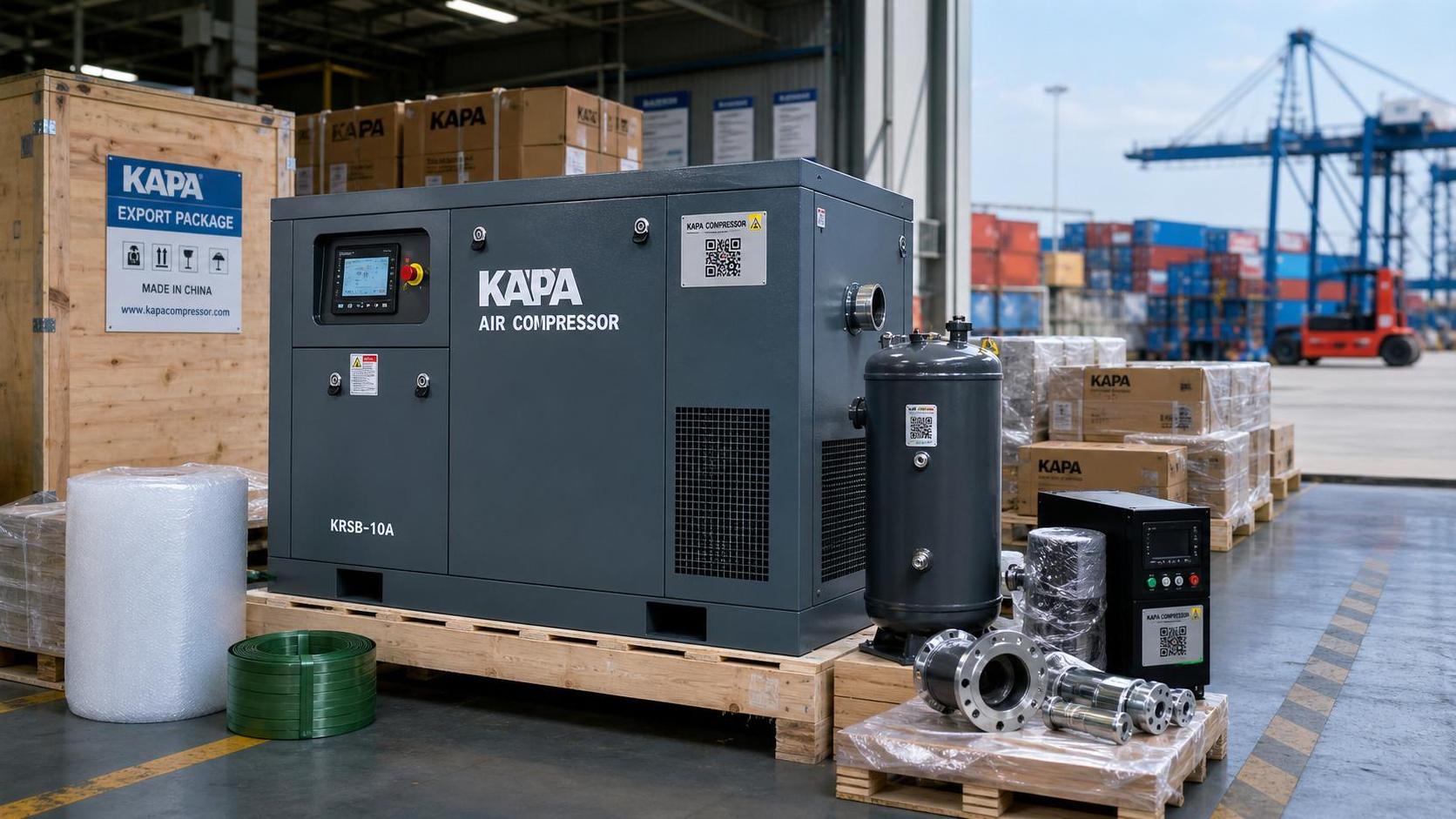
China Tightens Export Checks on Screw Compressors




On July 1, 2026, China’s General Administration of Customs launched a targeted compliance review for industrial screw compressors exported to the EU, Southeast Asia, and the Middle East. The move deserves close attention from manufacturers, exporters, supply chain teams, and overseas buyers because the checks focus on document accuracy and physical consistency in three practical areas: nameplate energy-efficiency information, declared versus actual refrigerant charge, and the completeness of safety labels for A2L refrigerants such as R-290 and R-1234yf.
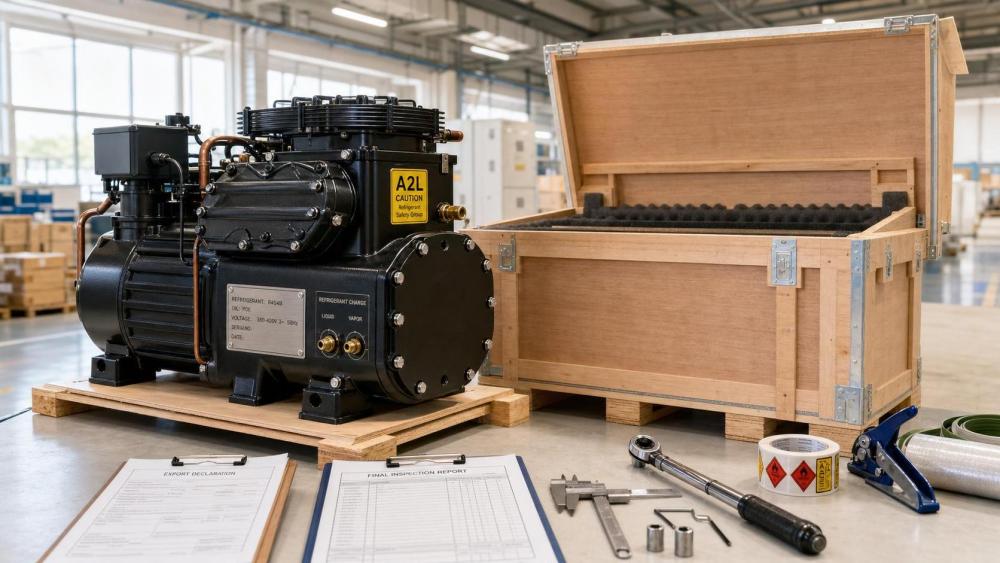
What the new export review covers
According to the information provided, the General Administration of Customs issued a notice on July 1, 2026, titled the Notice on Strengthening Export Energy Efficiency and Environmental Compliance Supervision for Industrial Screw Compressors (Shu Jian Fa [2026] No. 78). From that date, screw compressors exported to the EU, Southeast Asia, and the Middle East are subject to 100% document review and a 5% on-site unpacking inspection.
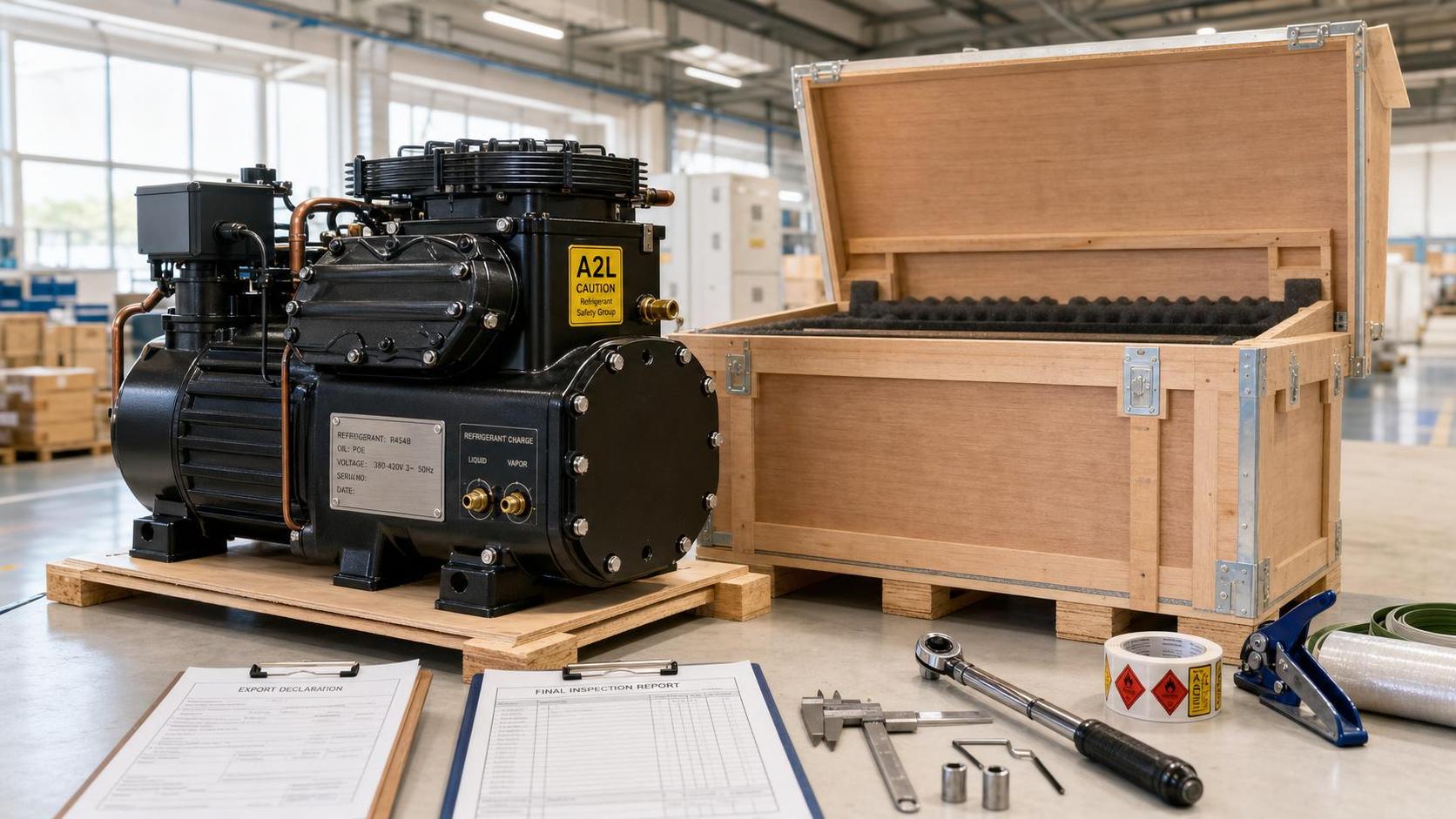
The stated inspection focus includes verification of the energy-efficiency grade shown on the nameplate, the deviation between the actual refrigerant charge and the declared value, with an allowed error of no more than plus or minus 3%, and the completeness of safety labels for A2L refrigerants including R-290 and R-1234yf. The information provided also states that companies found in violation will face a three-month suspension of export qualifications.
Where the immediate pressure is likely to appear
Export operations will face tighter document scrutiny
From an industry perspective, direct exporters are the first group likely to feel the operational impact. The reason is straightforward: the measure combines full document review with physical spot checks, which means shipment files, product declarations, and on-product markings need to align more closely than before. What deserves closer attention is whether internal export documentation matches the actual shipped unit on a model-by-model basis.
Manufacturing teams may need closer control over final-unit consistency
Analysis shows that manufacturing and final inspection functions may be affected where product labeling, refrigerant charging, and shipment preparation intersect. The practical issue is not only whether a unit meets internal production standards, but whether the shipped product can withstand customs verification against the declared refrigerant charge and the nameplate information. For plants handling A2L refrigerants, label completeness becomes a visible checkpoint rather than a background compliance item.
Supply chain and delivery planning may need more buffer
Observably, supply chain service providers, logistics coordinators, and customer-facing delivery teams should pay attention to timing risk. Even without assuming broader disruption, a regime built around 100% document review and selective unpacking inspection can affect shipment preparation, exception handling, and communication with overseas customers. The most relevant business link here is delivery coordination, especially for exports headed to the three named regional markets.
Overseas buyers and procurement teams may look more closely at compliance evidence
Buyers, import partners, and procurement departments may also be affected because export qualification suspension for non-compliant suppliers creates a direct continuity risk. Analysis shows that customer concern is likely to center on whether suppliers can maintain stable delivery and provide consistent product information, particularly for units involving refrigerant-related declarations and safety labeling.
What companies should watch in the near term
Keep declared data and physical product details aligned
What deserves closer attention is the match between export declarations, product nameplates, and the actual refrigerant charge in the shipped unit. The current requirement makes discrepancies a frontline issue rather than a paperwork issue alone, especially with the stated tolerance limit of plus or minus 3%.
Review A2L refrigerant labeling as a shipment-level checkpoint
For exporters handling R-290, R-1234yf, or other A2L refrigerants referenced in the provided information, label completeness should be treated as part of shipment release control. This is a practical area where customs verification can connect visible product labeling with declared compliance information.
Prepare for inspection-related delivery conversations
Analysis shows that customer communication may become more important for orders heading to the EU, Southeast Asia, and the Middle East. Companies may need clearer internal procedures for handling document queries, unpacking inspections, and delivery schedule updates if a shipment is selected for on-site checking.
Track whether enforcement language is followed by further clarification
Observably, the current notice sets clear inspection targets and penalties, but businesses should continue watching for any later official clarification on implementation details. The difference between the policy signal and daily execution will matter in areas such as document formatting, inspection practice, and exception handling.
How this signal is best understood right now
Analysis shows that this development is best read as a near-term compliance tightening with longer-term signaling value. The immediate fact is a more rigorous export review for a defined product category and destination set. The broader signal, based only on the information provided, is that customs attention is concentrating on the truthfulness and consistency of energy-efficiency and refrigerant-related declarations rather than on shipment volume or market promotion.
It is more appropriate to understand this as an enforcement signal that can affect execution quality across the export chain, rather than as a concluded shift in market demand or a confirmed structural change in the industry. Continued observation is still necessary because the provided information does not establish how frequently violations will be found or whether implementation details will later be refined.
Why the industry should treat this as an execution issue
From an industry perspective, the significance of this notice lies in its specificity. It does not describe general compliance expectations in abstract terms; it names the product scope, target export regions, inspection ratio, key verification items, tolerance threshold, and penalty. That makes it more useful as an operational reference than as a broad policy headline. At this stage, the most rational reading is that affected companies should view it as a concrete compliance checkpoint with immediate shipping implications and a broader need for continued monitoring.
Basis of this article and points for continued verification
This article is based on the user-provided news title, event date, and event summary. In coverage of this type, commonly relevant source categories may include official notices, company disclosures, industry association updates, authoritative media reports, and standards-related documents. The specific official source link was not provided in the input, so it still requires ongoing verification. Continued attention should focus on whether further official explanations, implementation details, or follow-up notices are released regarding inspection practice and compliance requirements.
Ready when you are. Send us a message to get started.
Related News
- When does variable gas flow justify a custom screw compressor system?Author :Pneumatic Power Engineer

- How to size compressed air equipment for pneumatic toolsAuthor :Pneumatic Power Engineer

- How Should Energy Management Systems Handle Compressor Load Changes?Author :Pneumatic Power Engineer

- Which Maintenance Issues Reduce Air Compressor Efficiency?Author :Pneumatic Power Engineer

- How Much Energy Can Variable-Speed Screw Compressors Save?Author :Pneumatic Power Engineer

- Industrial Compressor Selection: Matching Flow, Pressure, and Duty CycleAuthor :Pneumatic Power Engineer

- China Expands Cross-Border RMB and FX Cash Pooling NationwideAuthor :Pneumatic Power Engineer

- How to Size Air Compressor Systems for Pneumatics by Flow and Pressure DemandAuthor :Pneumatic Power Engineer

- How Energy Recovery Systems for Compressors Cut Power CostsAuthor :Pneumatic Power Engineer

- How to Evaluate Screw Compressors in Industrial Refrigeration EquipmentAuthor :Pneumatic Power Engineer

- India Makes BIS Certification Mandatory for Screw CompressorsAuthor :Pneumatic Power Engineer

- China Tightens Export Filing for Screw CompressorsAuthor :Pneumatic Power Engineer

- SABIC Sets IoT Interface Rule for Screw CompressorsAuthor :Pneumatic Power Engineer

- Industrial Heat Recovery Systems for Compressors: When Do Energy Savings Pay Back?Author :Pneumatic Power Engineer

- EU Tightens REACH Limit for Screw Compressor LubricantsAuthor :Pneumatic Power Engineer

- EU Opens China Screw Compressor Review With Carbon RuleAuthor :Pneumatic Power Engineer

- DOE Mandates AHRI 1000-2026 for Screw CompressorsAuthor :Pneumatic Power Engineer

- VDMA Filing Signals EU Risk for Chinese Oil Screw CompressorsAuthor :Pneumatic Power Engineer
![]()
- Screw vs Piston Air Compressors for Stable Plant OutputAuthor :Pneumatic Power Engineer

- Saudi SASO Tightens Refrigerant Limits in IEC 60335-2-40:2026Author :Pneumatic Power Engineer

- IIR Warns of 18-Week Lead Times for Screw CompressorsAuthor :Pneumatic Power Engineer

- Welded Compressed Air Manifold Selection Guide for Pressure Stability and LeaksAuthor :Pneumatic Power Engineer

- India BIS Rule Adds IS 16830 Requirement for Imported Screw CompressorsAuthor :Pneumatic Power Engineer

- What to Check Before Choosing a Compressed Air FactoryAuthor :Pneumatic Power Engineer

- China Tightens Export Checks on Screw CompressorsAuthor :Pneumatic Power Engineer

- Screw Compressor Lead Times Reach 22 WeeksAuthor :Pneumatic Power Engineer

- Vietnam Requires QR Labels on Imported Screw CompressorsAuthor :Pneumatic Power Engineer

- Compressed Air Technologies Filtration: How to Reduce Pressure Drop and Energy LossAuthor :Pneumatic Power Engineer

- STSPIN830 Lead Time Tops 32 Weeks in Screw CompressorsAuthor :Pneumatic Power Engineer

- IGBT Shortage Extends Screw Compressor Lead TimesAuthor :Pneumatic Power Engineer

- Compressed Air Systems: 7 Hidden Costs That Raise Total Operating ExpenseAuthor :Pneumatic Power Engineer

- Compressed Air Efficiency: 7 Hidden Losses That Raise Operating CostsAuthor :Pneumatic Power Engineer

- How to Compare Screw vs Oil-Free Air Compression SystemsAuthor :Pneumatic Power Engineer

- Compressed Air Leaks: What They Really Cost in Daily OperationsAuthor :Pneumatic Power Engineer

- DOE Moves Up R449A Chiller Deadline to March 2027Author :Pneumatic Power Engineer

- How Compression Technology Cuts Energy Use in Modern PlantsAuthor :Pneumatic Power Engineer