US 3-Year Treasury Yield Rise Pressures Compressor Export Quotes




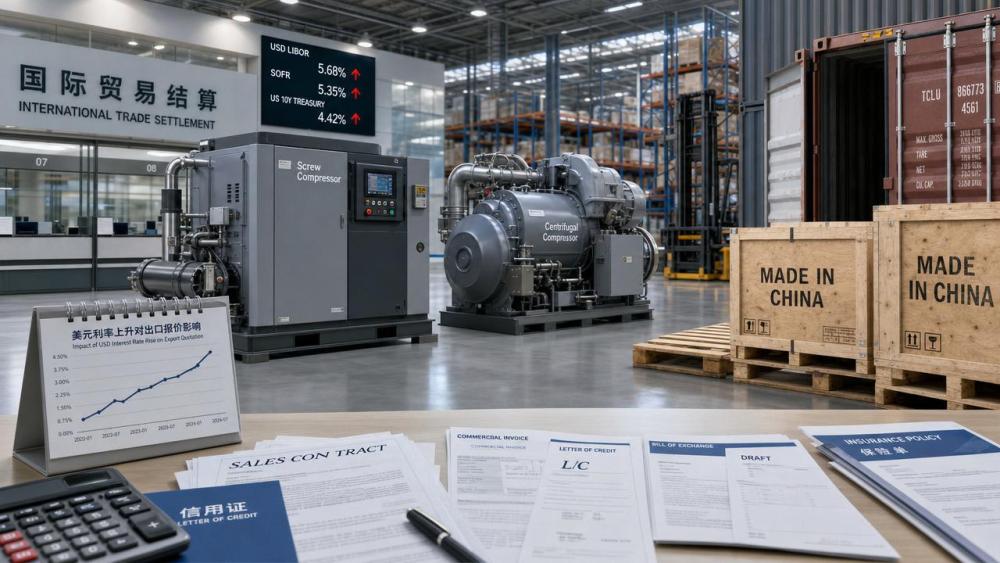
On June 9, 2026, the US Treasury completed a $58 billion auction of three-year notes, with the awarded yield reaching 4.192%, up 29.5 basis points from April and marking the highest level since 2024. For China-based exporters of screw compressors, centrifugal compressors, and oil-free systems, the development is worth close attention because expectations of higher US rates for longer, together with a stronger US dollar and pressure on the RMB fixing, may raise forward settlement costs and letter of credit issuance expenses, while forcing a review of exchange-rate buffer assumptions in quotes for some Europe- and US-bound orders.
A rate move that has immediate trade relevance
Confirmed information shows that the US Treasury held a $58 billion auction of three-year government notes on June 9, 2026. The awarded yield came in at 4.192%, which was 29.5 basis points higher than in April and the highest reading since 2024.
The information provided also indicates that the market broadly expects the Federal Reserve to keep interest rates higher for longer. At the same time, the US dollar index has strengthened and the RMB central parity has come under pressure.
Within this context, the direct concern identified for the industrial compressor segment is that Chinese exporters of screw compressors, centrifugal compressors, and oil-free systems may face higher costs for forward foreign-exchange settlement and for opening letters of credit. Some export quotations for European and American orders may therefore need to reassess their exchange-rate buffer mechanisms.
Where pressure may show up across export operations
Quoted orders with longer validity windows
From an industry perspective, exporters handling longer quotation cycles may feel the impact first. If exchange-rate assumptions change while financing and settlement costs rise, the pressure is likely to appear in quote preparation, margin protection, and negotiations over validity periods for Europe- and US-bound orders.
Finance and trade documentation workflows
Observably, teams responsible for settlement and trade finance may need to pay closer attention to forward settlement arrangements and letter of credit-related costs. The issue is not only the headline yield move itself, but how that move feeds into day-to-day export execution, especially where payment terms depend on bank documentation and timing.
Manufacturers balancing production and pricing
For manufacturers exporting screw compressors, centrifugal compressors, and oil-free systems, the main pressure point may be the connection between factory pricing and external financial costs. If order quotations were built on earlier exchange-rate buffers, the latest market move could require a reassessment of how much room remains between production cost assumptions and final export pricing.
Overseas buyers and channel partners
Buyers and distributors in Europe and the United States may also be affected indirectly. If exporters revise buffer mechanisms or payment-related assumptions, discussions may shift toward quote validity, payment structure, and the extent to which currency-related risk is absorbed by the seller or shared with the customer.
What exporters should watch now
Recheck exchange-rate buffers in active quotations
Analysis shows that the most immediate task is to review whether existing quotations for Europe- and US-bound orders still reflect current exchange-rate risk assumptions. This is especially relevant where quotes were issued before the June 9 auction outcome and where validity periods extend across changing currency conditions.
Track the cost path of settlement and L/C arrangements
What deserves closer attention is the practical effect on forward settlement costs and letter of credit issuance expenses. Companies should distinguish between a macro market signal and the actual cost changes appearing in bank-related trade execution, because the business impact will materialize through those operational channels.
Review product lines with export exposure
For screw compressors, centrifugal compressors, and oil-free systems, exporters may need to identify which product categories and destination orders are most sensitive to pricing adjustments. The purpose is not to assume uniform pressure across all business, but to pinpoint where foreign-exchange and financing factors are most likely to affect quoting discipline.
Prepare customer communication around quote terms
Observably, communication with overseas customers may become more important where quote revisions are under consideration. Terms tied to payment method, documentation, and quote validity may require clearer explanation if sellers decide to revisit currency buffers in ongoing negotiations.
Why this looks more like a signal than a final outcome
Analysis shows that this development is better understood as a market signal with direct implications for export pricing mechanics, rather than as a confirmed shift in end-market demand for industrial compressors. The information provided points to cost and settlement pressure, not to a verified change in order volumes or customer procurement plans.
It is also more appropriate to understand this as a development that requires continued observation. The auction result, the expectation of higher US rates for longer, the stronger dollar, and pressure on the RMB fixing together form a pricing and settlement backdrop. However, the extent to which that backdrop translates into broader changes for exporters still depends on how financial costs and quoting practices evolve in actual transactions.
How the sector may frame this development
At this stage, the industry significance lies in the connection between macro financing conditions and the practical structure of export quotations. For compressor exporters, the immediate issue is not simply the rise in the three-year Treasury yield, but whether currency and trade-finance costs now require a reset in quote assumptions for some Europe- and US-facing business.
A neutral reading is that the development should currently be treated as a short-term pricing and risk-management signal with potential to extend further if the same conditions persist. It does not by itself confirm a broader market turning point, but it does justify closer review of settlement, payment, and quotation arrangements.
Basis of this article and points for further verification
This article is based on the user-provided news title, event date, and event summary. The facts cited here rely on the provided information that the US Treasury completed a $58 billion auction of three-year notes on June 9, 2026, with an awarded yield of 4.192%, up 29.5 basis points from April and the highest since 2024, alongside the stated market expectation of higher US rates for longer and the identified implications for Chinese compressor exporters.
For this type of development, commonly relevant source categories may include official government announcements, company disclosures, industry association updates, authoritative media coverage, and trade-finance or standards-related documents. A specific official source link was not provided in the input, so further verification is still required. Follow-up attention should remain on official statements, market-rate developments, and whether export pricing and settlement practices in the compressor segment show sustained adjustment.
Ready when you are. Send us a message to get started.
Related News
- When does variable gas flow justify a custom screw compressor system?Author :Pneumatic Power Engineer

- How to size compressed air equipment for pneumatic toolsAuthor :Pneumatic Power Engineer

- How Should Energy Management Systems Handle Compressor Load Changes?Author :Pneumatic Power Engineer

- Which Maintenance Issues Reduce Air Compressor Efficiency?Author :Pneumatic Power Engineer

- How Much Energy Can Variable-Speed Screw Compressors Save?Author :Pneumatic Power Engineer

- Industrial Compressor Selection: Matching Flow, Pressure, and Duty CycleAuthor :Pneumatic Power Engineer

- China Expands Cross-Border RMB and FX Cash Pooling NationwideAuthor :Pneumatic Power Engineer

- How to Size Air Compressor Systems for Pneumatics by Flow and Pressure DemandAuthor :Pneumatic Power Engineer

- How Energy Recovery Systems for Compressors Cut Power CostsAuthor :Pneumatic Power Engineer

- How to Evaluate Screw Compressors in Industrial Refrigeration EquipmentAuthor :Pneumatic Power Engineer

- India Makes BIS Certification Mandatory for Screw CompressorsAuthor :Pneumatic Power Engineer

- China Tightens Export Filing for Screw CompressorsAuthor :Pneumatic Power Engineer

- SABIC Sets IoT Interface Rule for Screw CompressorsAuthor :Pneumatic Power Engineer

- Industrial Heat Recovery Systems for Compressors: When Do Energy Savings Pay Back?Author :Pneumatic Power Engineer

- EU Tightens REACH Limit for Screw Compressor LubricantsAuthor :Pneumatic Power Engineer

- EU Opens China Screw Compressor Review With Carbon RuleAuthor :Pneumatic Power Engineer

- DOE Mandates AHRI 1000-2026 for Screw CompressorsAuthor :Pneumatic Power Engineer

- VDMA Filing Signals EU Risk for Chinese Oil Screw CompressorsAuthor :Pneumatic Power Engineer
![]()
- Screw vs Piston Air Compressors for Stable Plant OutputAuthor :Pneumatic Power Engineer

- Saudi SASO Tightens Refrigerant Limits in IEC 60335-2-40:2026Author :Pneumatic Power Engineer

- IIR Warns of 18-Week Lead Times for Screw CompressorsAuthor :Pneumatic Power Engineer

- Welded Compressed Air Manifold Selection Guide for Pressure Stability and LeaksAuthor :Pneumatic Power Engineer

- India BIS Rule Adds IS 16830 Requirement for Imported Screw CompressorsAuthor :Pneumatic Power Engineer

- What to Check Before Choosing a Compressed Air FactoryAuthor :Pneumatic Power Engineer

- China Tightens Export Checks on Screw CompressorsAuthor :Pneumatic Power Engineer

- Screw Compressor Lead Times Reach 22 WeeksAuthor :Pneumatic Power Engineer

- Vietnam Requires QR Labels on Imported Screw CompressorsAuthor :Pneumatic Power Engineer

- Compressed Air Technologies Filtration: How to Reduce Pressure Drop and Energy LossAuthor :Pneumatic Power Engineer

- STSPIN830 Lead Time Tops 32 Weeks in Screw CompressorsAuthor :Pneumatic Power Engineer

- IGBT Shortage Extends Screw Compressor Lead TimesAuthor :Pneumatic Power Engineer

- Compressed Air Systems: 7 Hidden Costs That Raise Total Operating ExpenseAuthor :Pneumatic Power Engineer

- Compressed Air Efficiency: 7 Hidden Losses That Raise Operating CostsAuthor :Pneumatic Power Engineer

- How to Compare Screw vs Oil-Free Air Compression SystemsAuthor :Pneumatic Power Engineer

- Compressed Air Leaks: What They Really Cost in Daily OperationsAuthor :Pneumatic Power Engineer

- DOE Moves Up R449A Chiller Deadline to March 2027Author :Pneumatic Power Engineer

- How Compression Technology Cuts Energy Use in Modern PlantsAuthor :Pneumatic Power Engineer